“With law shall our land be built up, but with lawlessness laid waste.”
— Njal advises on the importance of legal order in Iceland.

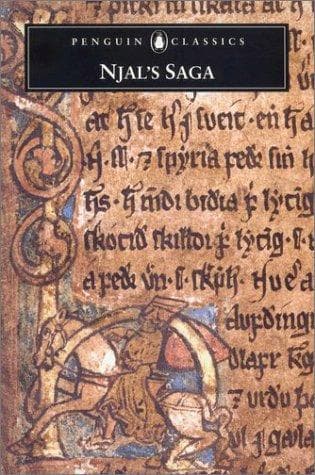
Anonymous (1997)
Genre
Fantasy / Historical Fiction
Reading Time
1260 min
Key Themes
See below
Sign in to track this book
Njal's Saga shows the tragic story of ancient Iceland, a land of blood feuds where every insult demanded revenge and even the wisest advice could not stop fate.
The saga starts by introducing Unn, whose husband Hrut divorces her because he cannot have sex with her. Queen Gunnhild cursed him. Unn asks her uncle, Mord Fiddle, for legal advice. He helps her get back her dowry through a clever lawsuit. The story then moves to Gunnar Hlidarendi, a noble and skilled warrior known for his strength and good looks. He travels, gaining fame and wealth. When he returns, he marries Hallgerd Long-Legs, a beautiful but proud and vengeful woman. She has a history of bad marriages and violence. Their marriage immediately has problems, especially because of Hallgerd's feud with Gunnar's mother, Rannveig, and her violent slave, Otkel.
Hallgerd’s difficult nature quickly causes conflict with Bergthora, the wife of Gunnar's close friend and wise advisor, Njal Thorgeirsson. A small argument about social standing turns into a series of revenge killings between their households. Hallgerd causes the killing of Njal’s slave, Kol, and Bergthora retaliates by having Hallgerd’s slave, Atli, killed. This cycle of revenge continues, with each wife urging her men to commit more violence. Gunnar and Njal try to make peace and pay compensation, but the women’s hatred means each payment is followed by another death, making the blood feud worse and hinting at bigger problems.
Gunnar’s fame and skill also make others jealous and angry, especially Gizur the White and Otkel's sons. Gunnar had killed Otkel's sons in self-defense after they ambushed him. Legal disputes over these killings result in Gunnar being outlawed for three years. As he gets ready to leave Iceland, he looks back at his farm, Hlidarendi, and says he cannot leave such a beautiful place. He ignores his sentence and stays home with Hallgerd. This act breaks the law, making him open to attack by his enemies. Njal warns him about what will happen, but Gunnar’s pride and love for his home are stronger than his obedience to the law.
Gunnar’s enemies, led by Gizur the White and Mord Valgardsson, gather many men and surround Hlidarendi. Gunnar, with his brother Kolskegg and a few loyal men, defends his home bravely, killing many attackers. During the fight, Gunnar’s bowstring breaks. He asks Hallgerd for two locks of her hair to make a new bowstring. As revenge for a past slap, she refuses. She says, 'I will remind you of the slap you gave me, and I do not care if you defend yourself longer or shorter.' This betrayal leaves Gunnar without defense. His attackers eventually overpower and kill him. This is a tragic end for the saga's greatest warrior, caused by his wife's revenge.
After Gunnar's death, Njal and his sons, especially Skarphedin and Grim, are deeply affected. They follow the law by seeking payment and justice for Gunnar, but the revenge cycle is not over. Mord Valgardsson, who planned Gunnar's death, continues to cause problems. Njal’s sons, particularly Skarphedin, are quick to anger and violence. They get into new feuds, killing men who had helped kill Gunnar. This series of revenge killings further involves Njal's sons in the blood feuds of the time, bringing them closer to their own tragic end, despite Njal's wisdom and attempts to find peaceful solutions.
Kari Solmundarson, a skilled warrior and sailor, enters the story. He becomes a close friend and later marries Helga, Njal’s daughter. Kari is an honorable, brave, and loyal man. His presence strengthens Njal’s household. He proves to be a valuable ally to Njal’s sons, joining their feuds and offering advice. His role becomes more important as the story goes on, especially after the tragic events that happen to Njal and his family. Kari represents hope and a force for justice in the saga's later parts, driven by his close connection to Njal's family.
The anger towards Njal's family grows, mainly because of Flosi Thordarson. Njal's sons killed his kinsman, Thrain Sigfusson. Flosi gathers many men, including some from the East Fjords, and rides to Bergthorshvoll, Njal's farm. They set fire to the house. Njal, his wife Bergthora, and their sons (Skarphedin, Grim, and Helgi) are trapped inside. Njal is offered a chance to leave but refuses, saying he will not leave his wife and sons. He, Bergthora, and their youngest son Thord, along with Kari's young son Thord, lie down in their bed, cover themselves with ox-hides, and burn to death. Skarphedin, Grim, and Helgi also die in the flames, fighting hard until the end.
Kari Solmundarson, Njal’s son-in-law, escapes the burning house. He breaks through a smoke-hole and runs for freedom, even though Flosi's men chase him. Kari sees his family and his own young son die. He is filled with sadness and a strong desire for revenge. He promises to avenge the burning of Njal and his family, becoming the only survivor and the main person to bring justice in the saga's final acts. His escape changes the story's focus to getting justice for the terrible crime at Bergthorshvoll.
The burning of Njal's house becomes the main legal case at the Althing, Iceland's assembly. Kari, with Thorgeir Skorthabaki, brings the case against Flosi and the burners. The legal process is complex and difficult, involving detailed arguments, witness statements, and the specific rules of Icelandic law. The tension at the Althing leads to open fighting. Both sides gather many men and fight on the assembly grounds. Many men are killed, and violence often stops the legal process. This shows the deep disagreements and how hard it was to enforce justice in a society prone to blood feuds.
Despite the violence, a compromise is reached at the Althing. Flosi Thordarson and the other main burners are declared outlaws. This means they must leave Iceland for a set time or be killed. Flosi and his men go to various countries, including Norway, the Orkneys, and Rome. However, Kari Solmundarson is not satisfied with this legal solution; he wants direct revenge. He relentlessly hunts the burners across Europe, killing them one by one, often in dramatic and brutal fights. This shows his strong commitment to avenging Njal's family.
After years of hunting and many killings, Kari Solmundarson and Flosi Thordarson eventually meet again. Flosi, having finished his outlawry and gone on a pilgrimage to Rome, returns to Iceland a changed man, wanting peace. Wise and respected people, especially Hildigunn, Flosi's wife and Njal's niece, and Thorgeir Skorthabaki, help Kari and Flosi make peace. Kari marries Flosi's niece, Helga, which further strengthens the peace. This final agreement, made through law, marriage, and a shared desire to end the bloodshed, finishes the long and violent saga, bringing order back to the Icelandic community.
The Protagonist/Supporting
From a revered legal expert and peacemaker, he becomes a tragic martyr whose death fuels the saga's final acts of vengeance and reconciliation.
The Protagonist
From a celebrated warrior whose fame spreads across lands, he falls due to his entanglement in feuds and his wife's betrayal, dying a tragic hero.
The Antagonist
Her character remains consistently proud and vengeful, driving much of the early conflict and ultimately contributing to Gunnar's downfall.
The Supporting
From a proud woman engaging in petty feuds, she demonstrates ultimate loyalty and courage by choosing to die with her family.
The Supporting
A formidable and grim warrior, his life is defined by loyalty and violence, culminating in a heroic, defiant death.
The Supporting/Protagonist
From a loyal son-in-law, he transforms into a relentless avenger, finally becoming an instrument of reconciliation and peace.
The Antagonist
Driven by vengeance to commit a terrible act, he becomes an outlaw, then seeks penance and ultimately reconciliation, transforming into a man of peace.
The Antagonist
Consistently a troublemaker and instigator, he remains a source of malice and discord throughout the narrative.
The Supporting
Consistently a figure of wisdom and legal authority, he guides the community towards justice and eventually peace.
The cycle of revenge drives 'Njal's Saga.' From the small fights between Hallgerd and Bergthora that lead to killings, to Gunnar's revenge killings, and finally Kari's hunt for the burners, the saga shows how one act of violence always leads to another. Njal's attempts to use law to stop this cycle often fail, as personal honor and the demand for 'blood for blood' repeatedly override legal agreements. The burning of Njal's house is the ultimate act of revenge. This then starts Kari's long quest for payback, showing how destructive and endless blood feuds were in Icelandic society.
“''With laws shall our land be built up and settled, and with lawlessness wasted and spoiled.'”
The saga often looks at the conflict between the Althing's legal system and the widespread personal revenge. Njal, a master of law, often offers legal solutions and compromises. But characters like Hallgerd, Skarphedin, and Flosi, with their quick tempers and pride, often reject or ignore these. Gunnar's refusal to leave Iceland after being outlawed, which leads to his death, is a clear example of breaking the law. The Althing itself often turns violent. This shows how fragile legal order was. In the end, peace happens only when law and personal agreement come together, as seen in the final deal between Kari and Flosi. This suggests that law alone cannot control human emotions.
“''They will pay with their lives, and that is a just sentence for such a deed.'”
A strong sense of fate runs through the saga. Njal, with his ability to see the future, often predicts tragic events, like Gunnar's death and the burning of his own house. Despite these warnings, characters often seem unable to change their destiny. Gunnar's inability to leave Iceland, even when outlawed, is shown as an unavoidable pull of fate. The repeated dreams and omens, like the bloody axe, further show that some events are meant to happen. This idea highlights the Norse belief in a destiny that characters, even with wisdom and strength, cannot fully escape. This makes their struggles more moving.
“''Never will I leave my home, for I think it so fair.'”
Honor (sómi) and reputation (orðstír) are very important in 'Njal's Saga.' Characters constantly try to keep their honor, often using violence when they feel it has been disrespected. Hallgerd's pride, Bergthora's strong loyalty, and Flosi's need to avenge his kinsman are all driven by a strong sense of honor. The fear of being seen as weak or cowardly (níðingur) often pushes people to take revenge, even when they know it is a bad idea. Gunnar's heroic stand against impossible odds and Kari's relentless hunt for the burners are also acts to protect and restore honor for themselves and their dead relatives.
“''It is ill to be called a coward, and worse to be one.'”
Women in 'Njal's Saga' are powerful, often destructive, forces. Hallgerd Long-Legs and Bergthora Skarphedinsdottir, through their strong pride and actions, directly cause many of the early feuds and revenge killings. Hallgerd's refusal to give Gunnar her hair is a key act that seals his fate. While they do not fight directly, their words and manipulation often drive men to violence. This shows their important influence in a society run by men. However, women also help make peace, as seen with Hildigunn's role in getting Kari and Flosi to agree. This shows their complex and varied impact on events.
“''I will remind you of the slap you gave me, and I care not whether you defend yourself longer or shorter.'”
Foreshadowing future events and emphasizing the role of fate.
Throughout the saga, prophetic dreams and omens serve to foreshadow major events and underscore the theme of fate. Njal, in particular, possesses a gift for foresight, often interpreting dreams and making predictions that invariably come true. Examples include his warnings to Gunnar about the consequences of marrying Hallgerd and his clear foreknowledge of the burning of his own house. Other characters also experience significant dreams, such as Gunnar's dream of a bloody axe. These devices build suspense and reinforce the idea that many events are predetermined, adding a layer of tragic inevitability to the narrative.
Using legal proceedings as a framework for conflict and resolution.
The Icelandic legal system, particularly the Althing, provides a significant structural element for the saga. Many conflicts are framed as legal disputes, with characters bringing lawsuits, seeking compensation, and arguing cases. The saga details the intricacies of these legal battles, demonstrating Njal's mastery of the law. While these lawsuits often devolve into violence, they also provide opportunities for resolution and reconciliation. The grand lawsuit concerning the burning of Njal's house is a central narrative arc, showcasing the interplay between legal process and the realities of a blood feud society.
A escalating series of reciprocal killings driving much of the plot.
The 'retaliatory killing cycle' is a fundamental plot device that drives much of the saga's action, particularly in its early and middle sections. It begins with the petty feuds instigated by Hallgerd and Bergthora, where the killing of one thrall or kinsman demands the death of another in return. This 'eye for an eye' mentality ensures that conflicts escalate rather than diminish. This device vividly illustrates the destructive nature of the blood feud, demonstrating how seemingly minor grievances can spiral into widespread violence and tragedy, ultimately leading to the deaths of major characters like Gunnar and Njal's family.
A crucial object symbolizing loyalty, betrayal, and a hero's downfall.
The bowstring is a potent symbol in the saga, particularly during Gunnar's final stand. When his bowstring breaks, his request to Hallgerd for two locks of her hair to make a new one becomes a test of her loyalty. Her refusal, born of petty revenge, directly leads to Gunnar's inability to defend himself and his subsequent death. The bowstring thus symbolizes not only Gunnar's martial prowess but also the devastating impact of Hallgerd's betrayal and the fragility of even the greatest warrior when faced with internal strife and a lack of support from his closest kin.
“With law shall our land be built up, but with lawlessness laid waste.”
— Njal advises on the importance of legal order in Iceland.
“I would have you be called Gunnar of Hlidarendi, and have a byname of your own.”
— Njal gives Gunnar advice on establishing his reputation.
“A man's renown is the better for being slow in coming, if it lasts the longer when it comes.”
— Njal reflects on the value of enduring fame.
“I am not afraid of death, but I am afraid of what comes after.”
— Gunnar speaks before his final stand at Hlidarendi.
“There is no man without his faults.”
— A general observation on human nature in the saga.
“Better to die with honor than live with shame.”
— A recurring theme in characters' decisions throughout the saga.
“The hand that gives is the hand that gets.”
— Reflects the importance of generosity and reciprocity in Norse society.
“He who warns is not to blame.”
— Njal often gives warnings that go unheeded, emphasizing responsibility.
“It is ill to quarrel with a man who has many friends.”
— Advice on the dangers of feuds and social alliances.
“The tongue is the slayer of the head.”
— Highlights the consequences of reckless speech in the saga's conflicts.
“A man's fate is what he makes it.”
— Implies agency amidst the saga's themes of destiny.
“Fire is a good servant but a bad master.”
— Metaphorical reference to the burning of Njal's farm, a key event.
“No one is a total fool if he knows when to hold his tongue.”
— Wisdom on discretion and silence in tense situations.
“The best horse is the one that carries you home.”
— Practical advice valuing utility over prestige.
Ready to see how well you understood this book? Take our interactive quiz with 10 questions.

Anonymous may refer to:Anonymity, the state of an individual's identity, or personally identifiable information, being publicly unknown Anonymous work, a work of art or literature that has an unnamed or unknown creator or author Anonymity, a property of a voting rule, saying that it does not discriminate apriori between voters







