“I'm not a hero. I'm a villain.”
— Nimona declares her identity to Ballister Blackheart early in the story.

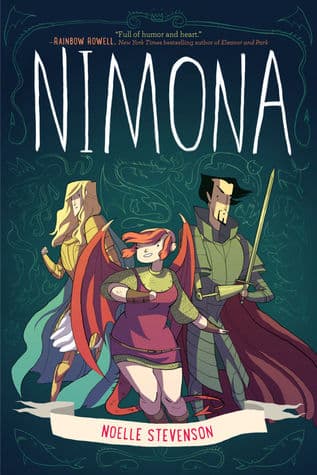
Noelle Stevenson (2015)
Genre
Fantasy / Young Adult
Reading Time
120 min
Key Themes
See below
Sign in to track this book
A mischievous shapeshifter teams up with a disgraced supervillain to expose the kingdom's heroes, only to discover her own powers are more dangerous and mysterious than anyone imagined.
The story begins with Nimona, a shapeshifter, arriving at Lord Blackheart's lair and declaring herself his new sidekick. Blackheart, a disgraced villain with a prosthetic arm, prefers a more calculated approach to villainy. Nimona shows her powers by transforming into a shark and then a dragon. Despite Blackheart's concerns about her chaotic nature, he accepts her, seeing her abilities as useful to expose the corrupt Institution of Law Enforcement and Heroics, especially his former friend and rival, Sir Ambrosius Goldenloin.
Nimona's first mission with Blackheart is to steal a dragon from the Institution. Blackheart plans a careful infiltration, but Nimona, in her typical way, crashes through a wall as a monstrous beast, causing panic. She corners the dragon but befriends it instead of stealing it, to Blackheart's frustration. The mission fails, but Nimona's destructive display makes Blackheart seem like a strong villain, though one with an unpredictable associate. Goldenloin and the Institution are confused by the chaos, unable to figure out Blackheart's goals.
Blackheart and Nimona investigate the Institution, suspecting corruption. They find a hidden lab and discover that the Institution, led by the Director, is experimenting with a dangerous substance, seemingly for a weapon. This confirms Blackheart's suspicions about the Institution's nature, changing their mission from simple villainy to exposing a threat. Nimona becomes interested in the glowing, volatile substance and the Institution's activities.
The Director of the Institution, who seems kind, secretly manipulates Goldenloin. She gives him false information about Blackheart and portrays Nimona as a monster. Goldenloin is torn between his loyalty to the Institution and his friendship with Blackheart. He questions the Director's aggressive tactics and the purpose of the experiments. Blackheart tries to tell Goldenloin about the Institution's corruption, but Goldenloin's pride and the Director's influence make him disbelieve his former friend.
As the conflict grows, Nimona's shapeshifting becomes more erratic when she is distressed or injured. She sometimes turns into a more primal, monstrous form, frightening Blackheart and suggesting an older origin. Nimona shares parts of a traumatic past, mentioning experiments and feeling like a monster. Blackheart worries about her and her power, realizing she is more than a sidekick; she is a being with immense, destructive capabilities and a mysterious history.
The Institution's experimental weapon, powered by the volatile substance, activates and goes out of control, endangering Goldenloin and the city. Blackheart and Nimona, despite their villainous appearance, intervene. Nimona, showing great power, confronts the weapon while Blackheart tries to disable it. They save Goldenloin, who sees the weapon's destructive potential and Blackheart's concern for safety. This creates a temporary alliance between Blackheart and Goldenloin, as they realize the Director is the real threat.
After the weapon's activation, Blackheart, Goldenloin, and Nimona confront the Director. The Director is a brilliant but ruthless scientist who, years ago, experimented on Nimona. She created her shapeshifting abilities or tried to control them. The Director sees Nimona as her property and a tool. She also reveals she caused the incident that cost Blackheart his arm and knighthood, framing him to further her agenda. This revelation destroys Goldenloin's remaining loyalty to the Institution.
With the Director's true nature revealed and her weapon threatening the city, Nimona makes a decision. Using her full, monstrous power, she confronts the Director, becoming a colossal, destructive force. In a final battle, Nimona sacrifices herself, consuming the Director and the weapon in an explosion, preventing further destruction. The city is saved, but Nimona vanishes, leaving Blackheart and Goldenloin unsure of her fate.
After this, Blackheart and Goldenloin reconcile. They understand each other and the extent of the Institution's corruption. Blackheart works to rebuild and do good, no longer playing a villain. He mourns Nimona, but one day, he receives a small note with a drawing of a shark, suggesting Nimona might be alive. This message gives Blackheart hope that his sidekick may return, perhaps having found peace or control over her abilities.
The Protagonist
Nimona evolves from a chaotic, attention-seeking sidekick to a self-sacrificing hero who embraces her true nature to protect those she cares about.
The Protagonist
Blackheart transitions from a morally grey villain seeking revenge to a compassionate hero who prioritizes the well-being of others, especially Nimona.
The Supporting
Goldenloin's arc involves a gradual awakening to the corruption around him, leading him to question his allegiances and ultimately side with Blackheart and Nimona.
The Antagonist
The Director's arc is one of escalating villainy, culminating in her exposure and ultimate demise, validating Blackheart's long-held suspicions.
The Supporting
The Dragon's arc is brief but significant, moving from captive to a temporary ally, symbolizing the potential for unexpected bonds.
The Mentioned
Dr. Blitzmeyer's arc is not explicitly shown, but her past involvement with Blackheart provides context for his scientific background.
Nimona's journey involves her struggle with her identity as a shapeshifter. She often feels like a 'monster' because of her past and uncontrollable powers. Blackheart helps her accept herself, showing her that her abilities are not a curse. This theme also appears through Blackheart's identity as a 'villain' who is more heroic than the supposed heroes. The story questions societal labels and encourages characters to define themselves, not by what others think.
“"I'm not a girl. I'm a monster."”
The book changes traditional hero/villain ideas by showing the 'heroic' Institution of Law Enforcement and Heroics as a corrupt organization. The Director, who seems to represent justice, is the real antagonist. She conducts unethical experiments and spreads propaganda. Blackheart, the 'villain,' wants justice and to expose the Institution's lies. This theme criticizes unchecked power and the danger of blindly trusting authority. It suggests true heroism is moral action, regardless of public image.
“"There's a monster in this city, Goldenloin. And it's not me."”
Nimona, an outcast with a traumatic past, finds belonging and family with Lord Blackheart. Despite initial awkwardness, Blackheart becomes a protective, fatherly figure who accepts Nimona, monstrous forms and all. Their bond is built on trust and understanding, giving Nimona the stability she needs. This theme shows that family is not always blood, but shared experiences, loyalty, and love. It provides a safe place for outsiders.
“"You're not a monster, Nimona. You're just... you."”
The graphic novel blurs the lines between good and evil. Blackheart, called a villain, follows a strict moral code and seeks to expose injustice. Goldenloin, a hero, initially participates in the Institution's corruption. Nimona, with her destructive powers, struggles with her capacity for both chaos and compassion. The story argues that 'good' and 'evil' are not fixed qualities but are defined by actions and intentions. It asks readers to look beyond labels and judge characters by their moral choices.
“"Sometimes the good guys are the bad guys."”
Nimona's primary power and a symbol of her identity
Nimona's ability to shapeshift into any creature serves as a central plot device. It is both her greatest asset, allowing her to cause chaos and aid Blackheart, and a source of her internal conflict, as she struggles to control it and fears her 'monstrous' forms. The erratic nature of her transformations often propels the plot forward by creating unforeseen challenges and revealing more about her mysterious origins and emotional state. It also visually represents her struggle with identity and belonging.
Blackheart's physical scar and a symbol of his past trauma
Lord Blackheart's prosthetic arm is a constant visual reminder of his past and the incident that cost him his knighthood and damaged his friendship with Goldenloin. It symbolizes the injustice he suffered at the hands of the Institution and fuels his desire for revenge and truth. The arm is not just a physical limitation but a psychological burden, representing his loss and the unfair branding as a villain. Its presence underscores the deep-seated conflict between him and the Institution.
The corrupt authority figure and source of conflict
The Institution acts as the primary antagonist in the story, despite its heroic facade. It is a plot device that represents oppressive authority, corruption, and the manipulation of public perception. Its experiments and secrets drive much of Blackheart and Nimona's actions, and its eventual exposure and downfall form the climax of the narrative. The Institution's existence creates the central conflict, forcing characters to question what it means to be a hero or villain in a world where truth is obscured.
Unveiling character motivations and the world's history
The narrative strategically uses flashbacks and gradual reveals of character backstories, particularly for Blackheart and Nimona. These insights into their pasts—Blackheart's disfigurement, his friendship with Goldenloin, and Nimona's experimentation—serve to explain their motivations, deepen their characterization, and provide crucial context for the ongoing conflict. These reveals often occur at pivotal moments, shifting reader perception and building empathy for the characters, while also exposing the true villainy of the Director.
“I'm not a hero. I'm a villain.”
— Nimona declares her identity to Ballister Blackheart early in the story.
“The Institution isn't good. It's just powerful.”
— Ballister Blackheart explains the corrupt nature of the ruling organization.
“You can't just go around killing people!”
— Ballister argues with Nimona about her violent methods.
“I'm a shark. I'm a monster. I'm a villain. That's what I do.”
— Nimona embraces her shapeshifting nature and role defiantly.
“Sometimes the bad guys are the only ones who see what's really going on.”
— Ballister reflects on his outsider perspective against the Institution.
“You don't have to be what they say you are.”
— Nimona challenges Ballister's self-imposed limitations.
“I'm not a sidekick. I'm a force of nature.”
— Nimona asserts her independence and power to Ballister.
“The world isn't black and white. It's a lot of gray.”
— Ballister explains moral complexity to Nimona during a conflict.
“I don't want to be a monster anymore.”
— Nimona expresses vulnerability about her identity and past.
“Heroes are just villains who won.”
— A cynical observation about history and power dynamics.
“You can't save everyone. Sometimes you just have to save yourself.”
— A moment of pragmatic advice amid chaos and conflict.
“I'm not afraid of you. I'm afraid for you.”
— Ballister expresses concern for Nimona's destructive tendencies.
“Change is the only constant. Might as well make it work for you.”
— Nimona uses her shapeshifting as a metaphor for adaptability.
Ready to see how well you understood this book? Take our interactive quiz with 10 questions.
Biography coming soon.







