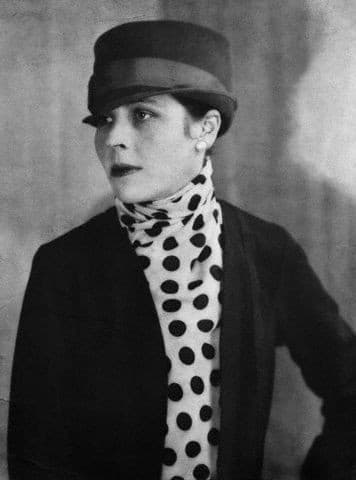
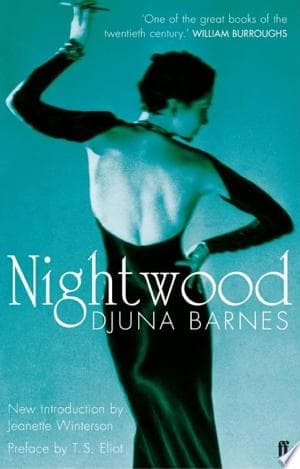
Djuna Barnes was an American artist, illustrator, journalist, and writer who is perhaps best known for her novel Nightwood (1936), a cult classic of lesbian fiction and an important work of modernist literature.

Djuna Barnes (2014)
Genre
Literary Fiction
Reading Time
12 Minutes
Key Themes
See below
Sign in to track this book
In the opium-scented shadows of 1920s Paris, a desperate woman's obsessive love for a shapeshifting, wealthy heir unravels a world of forbidden desires and tragic self-destruction.
The novel introduces Baron Felix Volkbein, a man who wants an aristocratic background despite his uncertain Jewish heritage. He invents a noble past, driven by a longing for grandeur he never knew. Felix's search for legitimacy leads him to Vienna, where he meets and marries Hedvig, a woman of genuine but faded aristocracy. Their marriage, however, is not one of passion but of convenience and shared sadness. Hedvig, with her own quiet despair, puts up with Felix's quirks and his strong wish for an heir. This desire for an aristocratic child becomes the central focus of Felix's life, as he believes it will solidify his invented identity and give him the roots he wants in a changing world.
Felix's dream of an heir comes true with the birth of his son, Guido. The child shows signs of developmental issues, further complicating Felix's pursuit of a perfect lineage. Guido's strange, almost animal-like nature becomes a source of both fascination and sadness for Felix. Meanwhile, the story shifts to Nora Flood, a wealthy American living in Paris. Nora is a very independent woman with a strong connection to suffering. She runs a salon, a meeting place for the city's lost souls and thinkers. There, Nora meets Robin Vote, a beautiful, mysterious, and restless woman who sleeps through days and wanders at night. Robin's wild spirit immediately captivates Nora, drawing her into an intense and ultimately destructive love affair.
Nora Flood falls in love with Robin Vote, offering her a home and a stable, if unusual, life. Nora's love is very intense and she desperately wants to understand and possess Robin. She sees Robin as a wild creature, a beautiful spirit she wants to protect. However, Robin cannot be contained. She constantly wanders, drawn by an instinctual pull towards the night, new faces, and brief encounters. She often disappears for days or weeks, leaving Nora in despair. Nora's attempts to hold onto Robin only highlight their fundamental incompatibility: Nora's need for faithfulness and permanence against Robin's urge for freedom and temporary connection.
Troubled by Robin's frequent disappearances and her own heartbreak, Nora seeks advice from Dr. Matthew O'Connor. Dr. O'Connor is a central figure in the Parisian underworld, an Irish-American doctor who, despite having no medical license, offers unique, often darkly humorous advice to the city's outcasts. He is known for his elaborate, often drunken speeches, his cross-dressing, and his deep, if cynical, understanding of human nature and suffering. Nora confides in him, pouring out her soul and her pain over Robin. O'Connor, with his empathy and sharp wit, becomes Nora's confessor, offering her a distorted view of her own despair and a unique perspective on love, betrayal, and identity in their nocturnal world.
Much of the novel's philosophical ideas come from Dr. Matthew O'Connor's long speeches. These rambling, often poetic talks are given late at night, usually to Nora, and cover many topics. O'Connor discusses identity, the roles people play, the pain of existence, and the appeal of the night. He speaks of the 'night people,' those who live outside normal society, and their deep, often sad, understanding of life's truths. His words mix self-pity, insight, and a biting cynicism, reflecting his own marginalized life and his deep, if unconventional, compassion for the suffering he sees. These speeches are a philosophical core, helping to interpret the characters' struggles.
Robin's wandering nature leads her into an affair with Jenny Petherbridge, a wealthy, manipulative, and insecure woman. Jenny wants to collect people and experiences, and she sees Robin as another prize. This new relationship devastates Nora, who is left to deal with the painful reality of Robin's infidelity and her own inability to keep the woman she loves. Jenny, in her possessiveness, tries to completely absorb Robin, similar to Nora's earlier desires but with more selfish control. The affair shows Robin's inability to commit to any one person or place, and the destructive cycle of longing and abandonment that defines her relationships.
Driven by desperation and hope, Nora confronts Jenny Petherbridge, trying to understand and perhaps reclaim Robin. This confrontation is full of tension and emotional pain. Nora appeals to Jenny, trying to explain the depth of her love for Robin and their unique bond. However, Jenny, with her own possessiveness and lack of true empathy, is unmoved. The encounter leaves Nora feeling more isolated and defeated, realizing her efforts are useless. It confirms Robin's complete emotional detachment and her inability to be swayed by either woman's pleas. Nora's attempt to intervene only solidifies her position as the abandoned lover, deepening her despair.
As years pass, Robin Vote continues her pattern of restless wandering and temporary relationships. She moves from lover to lover, country to country, never settling, always seeking something undefined. Her beauty remains, but her spirit becomes more fragmented and lost. She is a creature of instinct, driven by an internal need for movement and newness that she cannot explain or control. The story emphasizes her almost animalistic nature, her inability to form lasting bonds, and her deep sense of alienation from normal human society. Her journey becomes a metaphor for a deeper existential homelessness, a ceaseless search for belonging she can never find.
The story briefly returns to Felix Volkbein, now an old man, his earlier aristocratic hopes mostly unfulfilled. He thinks about his life, his marriage to Hedvig, and the strange, silent existence of his son, Guido. Guido, who never truly fit into society, remains a figure of quiet tragedy, embodying the failure of Felix's attempts to create a noble lineage. Felix's thoughts are tinged with sad resignation, a recognition that his earlier ambitions were futile. His story contrasts with the more passionate and volatile relationships of the other characters, showing a different kind of human longing and its eventual, quiet disappointment.
Nora Flood continues to live in the shadow of her love for Robin. Despite the years and Robin's many infidelities, Nora's devotion remains strong, though now marked by a deep, lasting grief. She lives alone, haunted by memories of Robin and unable to move on. Her love becomes a kind of spiritual wound, a constant source of pain and longing. Nora's character shows the profound suffering that can come with unrequited or lost love, her life a demonstration of the destructive power of an obsessive attachment to an elusive ideal. Her solitude is not chosen but imposed by the lasting mark Robin has left on her soul.
In the novel's final scene, Nora tracks Robin down to a dilapidated chapel in the countryside. She finds Robin in an almost wild state, interacting with a stray dog. Robin, without pretense or social conditioning, has regressed to a primal, animalistic existence. She mimics the dog's movements, growls, and ultimately, engages in a strange, almost sexual wrestling match with the animal. This disturbing scene symbolizes Robin's complete abandonment of human society and her surrender to instinct. Nora witnesses this transformation, realizing the futility of her love and her inability to ever reclaim the 'human' Robin. The scene is a stark depiction of ultimate alienation and the dissolution of identity.
The Protagonist
Nora begins as a woman seeking stability and connection, but her unrequited love for Robin ultimately leads her to a state of profound, enduring grief and solitude, losing herself in her longing.
The Antagonist/Central Figure
Robin remains largely static in her inherent restlessness, but her journey culminates in a symbolic regression to an almost animalistic state, shedding her human identity.
The Supporting
O'Connor's character is largely static, serving as a philosophical anchor and a voice of the novel's themes, his wisdom and despair remaining constant.
The Supporting
Felix's initial drive for aristocratic legitimacy gradually gives way to a resigned acceptance of his unfulfilled ambitions and the tragic fate of his son.
The Supporting
Jenny remains a static character, her manipulative and insecure nature driving her actions without significant personal growth or change.
The Minor
Hedvig remains a largely static character, symbolizing a quiet, enduring despair and the fading of old European aristocracy.
The Minor
Guido's arc is one of quiet, tragic stasis, existing as a symbol rather than an active participant, never truly developing beyond his initial presentation.
The novel explores the destructive and consuming nature of love, especially unrequited or impossible love. Nora's obsession with Robin, despite Robin's inability to return her feelings, shows love as a source of suffering, longing, and loss of identity. Love is not a comforting bond but a tormenting force that can trap individuals in pain and despair, showing its capacity to both elevate and destroy the self.
“We are but skin about a heart, that must forever beat against the world.”
Characters in 'Nightwood' constantly struggle with their identities, often creating elaborate fronts or clinging to invented pasts. Felix Volkbein's obsession with an aristocratic lineage, and Dr. O'Connor's cross-dressing, are clear examples. The novel suggests that identity is fluid, performed, and often a desperate attempt to create meaning or belonging in a world that offers little. The characters' struggles reveal how fragile the self is and how individuals try to define themselves against a backdrop of societal alienation.
“A man is a little thing while he is a man, but when he is a mask he is a great thing.”
'Nightwood' is full of exiles, misfits, and 'night people' who live on the edges of conventional society. They are artists, wanderers, and individuals who do not conform to societal norms, especially in their sexuality. This theme explores what it is like to be an outsider, the deep loneliness that comes with it, and the unique bonds formed within these marginalized groups. The night itself becomes a metaphor for this in-between space, where traditional rules and daylight identities disappear.
“We are all of us, in this world, more or less, 'night people.'”
A tension exists between the primitive, instinctual self and the demands of civilized society. Robin Vote embodies this most clearly; her wild, animalistic nature constantly clashes with Nora's attempts to domesticate her love. The novel suggests that beneath civilization lies a primal self, driven by instinct and beyond reason or social conditioning. The final scene with Robin and the dog powerfully illustrates this regression, questioning what it means to be human.
“She was an animal without an animal's peace.”
The past, both personal and historical, affects the characters. Felix's obsession with an invented aristocratic past, and Nora's endless replaying of her memories of Robin, show how individuals are haunted and shaped by what has been. Memory is not a passive recall but an active, often painful, force that dictates present suffering and prevents moving forward. The novel suggests that for some, the past is an inescapable prison, constantly intruding upon and defining their current reality.
“The past is a dead man's nose, that still bleeds upon the living.”
Narrative style reflecting characters' inner thoughts and emotions.
The novel frequently employs stream of consciousness, particularly in the lengthy, philosophical monologues of Dr. Matthew O'Connor and the introspective passages concerning Nora's despair. This device allows the reader direct access to the characters' complex, often fragmented thoughts, feelings, and philosophical musings, creating a rich, psychological landscape. It blurs the line between dialogue and internal rumination, immersing the reader in the characters' subjective experiences and the novel's dense, poetic language, often at the expense of linear plot progression.
Use of objects, settings, and characters to represent abstract ideas.
Symbolism is pervasive in 'Nightwood.' The 'night' itself symbolizes the subconscious, the realm of instinct, and the marginalized existence of the characters. Robin Vote is a symbol of untamed nature, primal instinct, and the elusive quality of desire. The circus, frequently mentioned, symbolizes the grotesque, the performative nature of identity, and the spectacle of human suffering. Even Felix's fabricated baronage symbolizes the futility of artificial constructs. These symbols enrich the novel's thematic depth, allowing it to explore complex ideas about identity, love, and alienation through evocative imagery.
Non-linear storytelling that jumps between characters and timeframes.
The narrative of 'Nightwood' is not strictly linear or chronological. It often jumps between different characters' perspectives (Felix, Nora, O'Connor), and moves fluidly between past and present events, sometimes with little explicit transition. This disjointed structure mirrors the fragmented inner lives of the characters and the chaotic, dreamlike atmosphere of the Parisian underworld. It requires the reader to piece together the story, emphasizing the subjective and often elusive nature of truth and memory, and contributing to the novel's modernist aesthetic.
Elements of the grotesque, decay, and the uncanny creating a dark mood.
Barnes infuses 'Nightwood' with a distinct Gothic sensibility. Descriptions of decaying mansions, the nocturnal settings, characters with exaggerated or unsettling features (like Guido), and a pervasive sense of doom and melancholia contribute to a dark, oppressive atmosphere. The grotesque is often used to highlight the characters' internal suffering or their alienation from society. This device enhances the novel's exploration of psychological torment and the darker aspects of human nature, giving it a timeless, almost mythic quality beyond its specific 1920s Paris setting.
Ready to see how well you understood this book? Take our interactive quiz with 10 questions.
Djuna Barnes was an American artist, illustrator, journalist, and writer who is perhaps best known for her novel Nightwood (1936), a cult classic of lesbian fiction and an important work of modernist literature.







