“She was an invention of the age, a wonder. She was a goddess on the flying trapeze.”
— Describing Fevvers' public persona and aerial artistry.

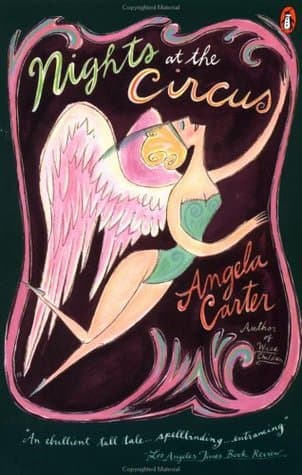
Angela Carter (1984)
Genre
Fantasy / Historical Fiction
Reading Time
300 min
Key Themes
See below
Sign in to track this book
In a dazzling fin-de-siècle world of freaks and marvels, an American journalist chases the truth behind Sophie Fevvers, a winged aerialiste who may be a genuine swan-woman or the ultimate circus illusion, as their love story unfolds across the stages and frozen landscapes of Europe.
American journalist Jack Walser arrives at the London dressing room of Sophie Fevvers, the famous aerialiste, known for her magnificent wings. He is there to interview her for a sensational scoop, determined to uncover whether her wings are real or an elaborate hoax. Fevvers, a flamboyant character, recounts a fantastical version of her origins, claiming she was hatched from an egg and raised in a brothel run by the formidable Lizzie. Walser, initially skeptical, finds himself increasingly captivated by Fevvers's charisma and her incredible, often contradictory, tales. He struggles to discern fact from fiction, as Fevvers's narrative intertwines the mundane with the miraculous, constantly challenging his journalistic objectivity.
Fevvers details her childhood in Mrs. Schreck's 'Museum of Womanhood,' a high-class brothel and exhibition space that catered to gentlemen with unusual tastes. Raised by Lizzie, a former prostitute and current manager, Fevvers was initially an exhibit herself, a 'winged human' displayed behind glass. She describes an unconventional upbringing surrounded by various women, each with their own stories and skills. It was here that she developed her theatrical flair and learned to navigate a world that simultaneously exploited and celebrated her uniqueness. This period shaped her resilient and self-possessed character, teaching her to control her own narrative and use her perceived abnormalities to her advantage.
Having failed to get a definitive answer about Fevvers's wings, and increasingly smitten, Jack Walser decides to join Colonel Kearney's circus as a clown, hoping to get closer to Fevvers and uncover the truth. The entire troupe embarks on a long, arduous train journey from London to St. Petersburg. Walser, under the tutelage of Buffo the clown, struggles to adapt to circus life and the eccentricities of his fellow performers. The train itself becomes a microcosm of the circus world, filled with a diverse cast of characters: strongmen, trapeze artists, animal trainers, and the philosophical Princess of Abyssinia. This journey marks Walser's complete immersion into the fantastical realm of the circus, leaving his conventional journalistic life behind.
The circus arrives in St. Petersburg, where their performances captivate the Russian aristocracy. Fevvers, as the star attraction, becomes the object of obsession for the Grand Duke, a figure of immense power and depravity. He invites Fevvers and other circus members to his palace, a place of lavish excess and dangerous games. Fevvers, accompanied by Lizzie, navigates the Grand Duke's predatory advances with cunning and wit, protecting herself and her companions. Walser, still struggling with his clown role, observes the dangerous allure of the aristocracy and the resilience of the performers in the face of exploitation, further deepening his understanding of Fevvers's strength and vulnerability.
As the circus travels deeper into Siberia, the train mysteriously derails, stranding the entire troupe in the vast, frozen wilderness. This event marks a significant shift in the narrative, moving from the urban spectacle to a primal, mystical setting. The performers are forced to contend with the brutal elements, dwindling supplies, and the psychological strain of isolation. The accident also brings to the forefront the underlying tensions and relationships within the circus family. Walser, still clumsy as a clown, finds himself increasingly reliant on the practical skills and resilience of his fellow performers, as the boundaries between reality and the fantastical continue to blur in the desolate landscape.
Following the train derailment, a group of female performers, led by Lizzie and including Fevvers, separates from the main troupe. They stumble upon a hidden, ancient commune populated entirely by women, deep within the Siberian forest. This commune, a matriarchal society, offers a stark contrast to the patriarchal world they've known, providing a temporary sanctuary and a different perspective on female power and autonomy. The women of the commune practice their own rituals and live in harmony with nature, representing an alternative vision of womanhood. Fevvers and Lizzie find a sense of belonging and understanding among these women, solidifying their bond and their belief in female strength and independence.
During the chaos of the derailment and the subsequent struggle for survival, Jack Walser suffers a head injury that results in amnesia. Stripped of his identity as a journalist and his preconceived notions, he wanders the Siberian landscape. He is eventually taken in by a group of shamans, who guide him through a series of rituals and a spiritual transformation. Walser, no longer bound by his past, begins to experience the world through a more intuitive and mystical lens, shedding his Western rationalism. This journey mirrors his earlier immersion into the circus, but on a deeper, more existential level, preparing him for a new understanding of Fevvers and her magical reality.
Amidst the Siberian chaos, the circus's tigers escape their cages, adding another layer of danger to the stranded troupe. Simultaneously, the 'human beast' – a performer who embodies primal savagery – becomes increasingly prominent. This character, who has a complex relationship with the tigers, blurs the lines between human and animal, performance and reality. The escaped tigers symbolize the untamed forces of nature and the dangerous elements of the circus itself. Their presence highlights the fragility of civilization and the power of the wild, mirroring the internal struggles and animalistic urges within the human characters, particularly Walser's own transformation.
As Walser, now a transformed figure with a more primal understanding of the world, wanders through the Siberian snow, Fevvers, guided by her unique abilities and the wisdom of the women's commune, sets out to find him. Using her powerful wings, she soars above the desolate landscape, eventually locating the amnesiac Walser. Her flight is a powerful display of her true nature, a culmination of the questions Walser had sought to answer. Their reunion is not merely a physical one but a meeting of two transformed individuals. Walser, having shed his skepticism, is now ready to accept Fevvers for who she is, wings and all, marking a profound shift in their relationship and his perception of reality.
The surviving members of Colonel Kearney's circus, battered but not broken, begin to regroup after the Siberian ordeal. The traditional structure of the circus has been shattered, but a new, more empowered dynamic emerges, particularly among the women. Fevvers and Lizzie, now more confident in their own strength and agency, lead the way. The novel concludes with a sense of hopeful anticipation for a new era, one where women like Fevvers can truly fly, free from the constraints of patriarchal expectations and societal definitions. The circus, in its dissolution, becomes a metaphor for the dismantling of old orders and the birth of a more liberated future.
The Protagonist
Fevvers begins as a celebrated but questioned figure, asserting her identity through performance, and ends as a truly liberated woman, fully embracing her power and leading the way for a new age.
The Protagonist
Walser transforms from a skeptical, rational journalist into an amnesiac, shaman-trained individual who embraces the fantastical, eventually becoming a devoted partner to Fevvers.
The Supporting
Lizzie remains a steadfast guardian throughout, her loyalty and practicality enduring and strengthening through the trials of the journey.
The Supporting
Colonel Kearney attempts to maintain control over his circus, but ultimately loses his grip as the world around him, and the women within it, begin to challenge his authority.
The Supporting
Buffo's character descends further into madness and despair as the circus faces increasing hardship, ultimately succumbing to his inner demons.
The Supporting
Mignon evolves from a passive victim to a more resilient individual, finding agency and sisterhood among the female performers.
The Supporting
The Princess of Abyssinia remains a steadfast source of wisdom and strength, her connection to the wild deepening as the circus confronts nature's challenges.
The Antagonist
The Grand Duke attempts to assert his power over Fevvers but is ultimately thwarted by her resilience and wit.
The novel explores the fluidity of identity, challenging fixed notions of self. Fevvers's ambiguous origins—is she swan or woman, real or fake?—are central to this theme. Walser's journey of self-discovery, from skeptical journalist to amnesiac shaman-in-training, exemplifies radical transformation. The circus itself is a place where performers adopt new personas, blurring the lines between their true selves and their acts. This theme is most evident in Walser's Siberian experience, where he sheds his old identity and embraces a new, more intuitive way of being, mirroring Fevvers's own embrace of her unique nature.
“''Is she fact or is she fiction?''”
Angela Carter subverts traditional patriarchal narratives by centering powerful, unconventional female characters. Fevvers, with her magnificent wings, is a symbol of female liberation and defiance against societal expectations. Lizzie represents shrewd female wisdom and unwavering loyalty, while the women's commune in Siberia offers a vision of matriarchal autonomy. The novel critiques the male gaze and the commodification of women, portraying female solidarity as a source of strength and resistance. The ending, with Fevvers truly taking flight and the women embarking on a new journey, signifies a triumphant assertion of female agency.
“''Every woman a bird!''”
The circus thrives on illusion, and the novel constantly blurs the lines between what is real and what is staged. Fevvers's wings are the ultimate mystery, forcing characters and readers alike to question their perceptions of reality. Walser's initial journalistic quest is to uncover the 'truth,' but he gradually learns that truth itself can be multifaceted and subjective. The fantastical elements, from talking tigers to shamanic rituals, challenge a purely rational worldview, suggesting that magic and myth hold their own form of truth, especially in the context of human experience and belief. This is especially poignant when Walser, after his amnesia, no longer seeks to 'expose' Fevvers, but simply to accept her reality.
“''She was a grand illusion, and it was his business to penetrate her, to find the truth behind the paint and feathers.''”
The entire novel is a celebration and deconstruction of performance. The circus is a world where identities are performed, stories are enacted, and reality is shaped by the spectacle. Fevvers is a master performer, using her acts to control her narrative and captivate her audience. Walser, by joining the circus as a clown, becomes a performer himself, experiencing the transformative power of embodying a role. The novel suggests that performance is not just about entertainment, but about creating meaning, challenging perceptions, and even shaping one's own destiny. The performers, despite their hardships, find their authentic selves within their acts.
“''The circus is the only true theatre, the theatre of life itself.''”
The story begins and ends with Jack Walser's journalistic inquiry into Fevvers.
The novel employs a frame narrative, starting with Jack Walser's interview of Fevvers in London and culminating in their reunion. This structure allows the fantastical tales of Fevvers's past to be embedded within Walser's more grounded, if increasingly surreal, present. It also establishes Walser's initial skepticism as a point of entry for the reader, guiding them through the unfolding wonders and challenges to their own perceptions of reality. The frame ultimately closes with a transformed Walser, reflecting the profound impact of Fevvers and the circus on his worldview.
The blending of realistic settings and characters with fantastical elements.
Magical realism is a pervasive device, seamlessly integrating the miraculous into the mundane. Fevvers's wings, her alleged birth from an egg, and the talking tigers exist alongside detailed descriptions of turn-of-the-century London and Siberian landscapes. This blending creates a world where the extraordinary is accepted, or at least grappled with, as part of everyday life. It challenges the reader's rational expectations, inviting them to suspend disbelief and engage with the story on a deeper, more symbolic level, where the 'impossible' holds profound truths about human experience and the power of imagination.
The circus's physical journey across Europe and Siberia parallels the characters' internal transformations.
The literal journey of Colonel Kearney's circus from London to St. Petersburg and into the Siberian wilderness serves as a powerful metaphor for the characters' internal, spiritual journeys. As the physical landscape changes from urban spectacle to desolate wild, the characters undergo profound transformations. Walser's journey is the most explicit, leading to amnesia and a shamanic awakening. This device emphasizes that true change often requires stepping outside of one's comfort zone and confronting the unknown, both externally and within oneself, allowing for new perspectives and self-discovery.
Hints and predictions of future events, particularly regarding Fevvers's destiny and a new age for women.
The novel uses subtle and overt foreshadowing, often through Fevvers's own pronouncements and the mystical elements of the story. Fevvers frequently speaks of her destiny to 'fly' and herald a new age, setting up expectations for her ultimate liberation. The Princess of Abyssinia and the Siberian shamans also offer prophetic insights. This device builds suspense and imbues the narrative with a sense of inevitability regarding Fevvers's triumph and the broader theme of female empowerment. It suggests a preordained trajectory for the characters and the world they inhabit, hinting at a future where the miraculous becomes manifest.
“She was an invention of the age, a wonder. She was a goddess on the flying trapeze.”
— Describing Fevvers' public persona and aerial artistry.
“To be the object of desire is to be a slave, and the highest freedom is to be the one who desires.”
— Whispered wisdom concerning power dynamics in relationships.
“We are all of us, in a sense, made of stories.”
— Exploring the nature of self and narrative construction.
“She was a bird; she was a woman; she was a bird-woman.”
— Emphasizing the unique, hybrid nature of Fevvers.
“What a perilous thing it is to be a woman, to be a show.”
— Reflecting on the vulnerability and spectacle of female existence.
“The greatest trick the devil ever pulled was convincing the world he didn't exist. The greatest trick the circus ever pulled was convincing the world it did.”
— A commentary on the illusion and reality of the circus world.
“Every metamorphosis is a kind of death.”
— Pondering the cost and consequence of change.
“She was an artificial pearl, but nevertheless a pearl.”
— Describing Fevvers' constructed identity and inherent value.
“Reality is a convention, and the only reality is what you perceive.”
— A philosophical statement on subjective experience.
“The world is a stage, and we are merely players.”
— A classic theatrical metaphor applied to life's grand spectacle.
“He knew, with a sudden, chilling certainty, that he had fallen in love with a myth.”
— Walser's realization about his feelings for Fevvers.
“The true nature of things is not always what it seems.”
— A recurring theme of deception and hidden truths.
“Nothing is real unless it is dreamed.”
— Emphasizing the power of imagination and fantasy.
“To be a freak is to be an exception, to be unique.”
— A re-evaluation of the term 'freak' within the circus context.
Ready to see how well you understood this book? Take our interactive quiz with 10 questions.

Angela Olive Pearce, who published under the name Angela Carter, was an English novelist, short story writer, poet, and journalist, known for her feminist, magical realism, and picaresque works. She is best known for her book The Bloody Chamber, which was published in 1979. In 2008, The Times ranked Carter tenth in their list of "The 50 greatest British writers since 1945". In 2012, Nights at the Circus was selected as the best ever winner of the James Tait Black Memorial Prize.







