“Mister, I'm just a carny, like you.”
— Stanton Carlisle's initial self-assessment when joining the carnival.

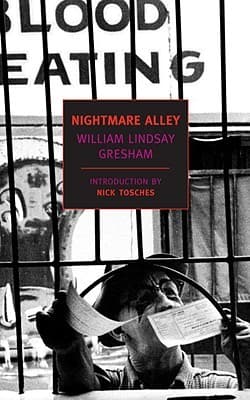
William Lindsay Gresham (1946)
Genre
Literary Fiction / Mystery
Reading Time
275 min
Key Themes
See below
Sign in to track this book
A ruthless charlatan rises from carnival squalor to high-society spiritualism, his self-delusion ensuring his inevitable, horrifying return to the abyss he tried to escape.
The novel begins at a carnival, showing the 'geek show' where a dehumanized, alcoholic man bites the heads off live chickens for the crowd. Stan Carlisle, a young, ambitious roustabout, watches this horrifying sight with disgust and fascination. He sees the geek, an old man named Jim, as the lowest form of humanity and vows never to reach such a state. This early scene establishes Stan's strong ambition and his fear of failure, setting up his relentless pursuit of success and his eventual tragic end.
Stan soon becomes involved with Zeena Krumbein, the carnival's mentalist and fortune-teller, and her alcoholic husband, Pete. Zeena, an experienced performer, understands human psychology and cold reading. Stan, eager to learn, begins an affair with Zeena, who then teaches him the complex codes and tricks of the mentalist act. Pete, despite his alcoholism, created their act's intricate system of verbal cues. Stan watches Pete's decline with pity and disdain, recognizing the power of the knowledge he is gaining.
Pete Krumbein's alcoholism worsens, making him less reliable. One night, Stan accidentally gives Pete wood alcohol instead of regular liquor, intending to sober him up for a performance. Pete dies a terrible, painful death. Though Stan's involvement is accidental, he feels guilty but quickly tells himself it was an unfortunate accident. Pete's death, while sad, gives Stan a big opportunity. With Pete gone, Stan can take over the mentalist act with Zeena, marking his first significant step toward a more important role.
After Pete's death, Stan continues to improve his mentalist skills with Zeena, but his ambition pushes him beyond the carnival. He falls for Molly Cahill, a young, innocent carnival girl who performs an electric chair act. Stan sees Molly as his way out of the carnival's crude life and a symbol of a 'cleaner' future. He seduces her and convinces her to leave the carnival with him, promising a better life as his assistant in a new, more refined mentalist act. They leave the carnival, believing they are meant for greater things.
Stan and Molly move to the city, where Stan, now called 'The Great Stanton,' refines his mentalist act. They perform in nightclubs and theaters for wealthier, more sophisticated audiences than the carnival crowds. Stan's charm, combined with Molly's innocent appeal and their well-practiced code, makes them a hit. Stan enjoys the attention and financial success, believing he has truly moved past his carnival beginnings. He pretends to be a genuine psychic, even though he knows it is all an elaborate trick.
During one performance, Stan meets Dr. Lilith Ritter, a beautiful and clever psychologist known for exposing spiritualists. Lilith attends his show to reveal him as a fraud. However, Stan, using his sharp observation and psychological skills, manages to impress her. Instead of exposing him, Lilith becomes interested in Stan's methods and intelligence. Recognizing his potential, she proposes a partnership, offering to give him inside information on her wealthy clients, allowing him to turn his act from simple mentalism into full spiritualism.
With Lilith Ritter's help, Stan moves from being a stage mentalist to a 'spiritualist,' preying on the weaknesses of the wealthy. Lilith gives him detailed psychological profiles and personal secrets of her patients, allowing Stan to convincingly 'speak' with their deceased loved ones. He acts like a gifted medium, exploiting his clients' grief and gullibility. Molly, increasingly uneasy with the deception, expresses her moral concerns, but Stan, blinded by ambition and money, ignores her, convinced he is unstoppable.
Stan targets Ezra Grindle, a powerful, grief-stricken industrialist haunted by his former lover Helen's death. Lilith warns Stan that Grindle is a dangerous person to manipulate, but Stan, overconfident, ignores her. He plans an elaborate scheme to convince Grindle that he can bring Helen's spirit. The deception involves Molly dressed as Helen. However, the plan fails when Grindle, overcome with emotion, tries to hug the 'spirit,' accidentally hurting Molly and revealing part of the trick. This incident marks the beginning of Stan's downfall, as his carefully built world starts to collapse.
After the disastrous event with Grindle, Stan's relationship with Lilith worsens. Lilith, seeing Stan's recklessness and realizing he is no longer useful, decides to protect herself. She systematically gathers proof of his fraudulent acts, including recordings of their conversations where he admits his deceptions. In a shocking betrayal, Lilith exposes Stan to the authorities and the public, revealing him as a fraud. Stan's reputation is ruined, his spiritualist career ends, and he faces legal trouble and public shame, losing everything he had built.
After the exposure, Molly, heartbroken and disgusted by Stan's actions and the lies he made her part of, finally leaves him. She can no longer tolerate his deceit or his self-destructive path. Abandoned and disgraced, Stan falls into a deep depression, turning to alcohol for comfort. He loses his money, his home, and any respectability. He wanders from city to city, taking odd jobs, his once-sharp mind dulled by drink, his ambition replaced by despair and self-pity.
Stan's alcoholism completely consumes him. He becomes a homeless person, sleeping in cheap hotels and on park benches, begging for money to fuel his addiction. His appearance deteriorates, his clothes become ragged, and his once-charming manner is replaced by an empty stare. He is haunted by his past failures and the memory of his former glory, but he lacks the will or means to escape his self-made prison. He is utterly alone, a shadow of his former ambitious self, his fall mirroring the 'geek' he once vowed never to become.
In his deepest despair, Stan finds a traveling carnival, the very place he thought he had escaped. Destitute and desperate for work, he asks the carnival owner for a job. The owner, seeing Stan's broken state, offers him work. However, the job is not as a roustabout or performer, but as the new 'geek' for the freak show. The owner explains that the previous geek has died and they need a replacement. Stan, completely broken and with no other choices, faces the ultimate irony and the horrifying fulfillment of his deepest fear – to become the very thing he once despised and swore to avoid.
Faced with the offer to become the geek, Stan initially resists, his last bit of pride fighting against the inevitable. He pleads, trying to explain his past as 'The Great Stanton,' but his pleas are ignored. The carnival owner sees only a broken, alcoholic man suitable for the most degrading role. With no other choice, no money, and no hope, Stan gives in. He takes the first drink offered to him in his new 'uniform,' the cheap liquor sealing his fate. The novel ends with Stan Carlisle, the once-ambitious mentalist, transformed into the 'geek' he had so strongly sworn he would never become, his journey from success to ultimate degradation complete.
The Protagonist
Stan's arc is a classic rise and fall, from ambitious carny to celebrated spiritualist, ultimately succumbing to alcoholism and becoming the very 'geek' he once disdained.
The Supporting
Molly's arc involves a loss of innocence and growing disillusionment, culminating in her courageous decision to leave Stan and his destructive path.
The Supporting
Zeena remains largely static, a representation of the carnival's enduring wisdom and cynicism, observing Stan's rise and fall with a knowing detachment.
The Supporting
Pete's arc is one of decline, from a brilliant but alcoholic performer to his accidental death, serving as a catalyst for Stan's rise.
The Antagonist
Lilith's arc sees her transitioning from an observer to an accomplice, then to Stan's ultimate betrayer, cementing her role as a formidable and self-serving antagonist.
The Supporting
Grindle's arc is primarily static, serving as a catalyst for Stan's downfall, his grief remaining largely unresolved despite Stan's attempts at manipulation.
The Mentioned
The Geek's 'arc' is circular, starting as a degraded figure and returning at the end to be replaced by Stan, symbolizing the cyclical nature of human suffering and addiction.
The novel explores how characters, despite believing they control their lives, are often shaped by their desires, flaws, and outside events. Stan Carlisle, driven by ambition, thinks he can defy fate and rise above his beginnings. However, his choices, especially his embrace of deceit and his inability to resist power, lead him to the very degradation he promised to avoid. The carnival itself shows this theme, with illusions presented as real, and the audience willingly suspending disbelief, much like Stan's wealthy clients. Even Lilith Ritter, who appears to control Stan, is ultimately driven by her own self-preservation, showing that no one is truly immune.
“There was no way in hell, he vowed, that anything like that would ever happen to him.”
Deception is central to 'Nightmare Alley,' appearing in many forms. Stan Carlisle is a master of deceiving others, first as a mentalist and then as a spiritualist, exploiting people's grief and trust. However, the deeper theme is self-deception. Stan constantly justifies his immoral actions, convincing himself his lies are harmless or necessary for his progress. He believes he is too clever to be caught, too strong to fall to the weaknesses he sees in others (like Pete's alcoholism). This self-deception blinds him to his true actions and prevents him from seeing his own vulnerability, leading to his downfall. Lilith Ritter also engages in self-deception, believing her manipulations are justified.
“He knew it was all a fake, but he made himself believe it wasn't, because it was easier that way.”
Stan Carlisle's ambition initially seems like a positive force, helping him escape poverty. However, the novel shows how uncontrolled ambition, without morality or empathy, can become destructive. Stan's desire for wealth, fame, and acceptance makes him abandon his moral compass, exploit innocent people, and betray those who care about him. Each step toward success requires more deception and moral compromise, turning him into a callous, isolated person. His ambition, instead of elevating him, brings him to the lowest possible point, showing the tragic results of prioritizing money over decency.
“You can't get rich honest, Stan. Not really rich.”
Addiction, especially alcoholism, is a constant theme that acts as both a literal and symbolic force of degradation. The novel begins with the horrifying image of the 'geek,' an alcoholic reduced to an animal state, serving as a warning to Stan. Pete Krumbein's tragic death from wood alcohol highlights alcohol's destructive power. As Stan's life falls apart, he too succumbs to alcoholism, mirroring the fate he desperately tried to avoid. Alcohol becomes a crutch, a way to escape his failures and guilt, but it ultimately strips him of his dignity, sanity, and humanity, completing his transformation into the 'geek.' The theme suggests that addiction is a powerful, inescapable force that can reduce even the most ambitious to despair.
“It was the only way out, he thought, the only way to stop remembering.”
The novel blurs the lines between what is real and what is perceived, showing how easily people can believe illusions. The carnival is a world of tricks, where the audience pays to be deceived. Stan's mentalist and spiritualist acts thrive on people's desire to believe in something beyond the ordinary, especially when facing grief or uncertainty. The story questions belief itself: are people truly convinced, or do they simply want to be convinced? The novel suggests that reality is often subjective and can be manipulated by those who understand human psychology, highlighting how fragile truth is in a world eager for comforting lies.
“People want to believe, Stan. They need to believe.”
Early events and character observations hint at Stan's ultimate fate.
The novel uses extensive foreshadowing, most notably through the character of the 'geek.' Stan's initial horrified reaction to the geek and his solemn vow never to become like him serves as a chilling premonition of his eventual downfall. Pete Krumbein's death from alcoholism also foreshadows Stan's own descent into addiction. These early events create a sense of dramatic irony, as the reader is aware of the tragic trajectory Stan's life is likely to take, even as he rises in apparent success. The consistent return to the theme of degradation keeps the reader anticipating the inevitable.
The contrast between what is expected and what actually happens, particularly regarding Stan's ambitions.
Situational irony is central to Stan Carlisle's story. He begins by vowing never to become the 'geek,' yet through his relentless pursuit of success and subsequent moral decay, he ultimately becomes that very figure. Dramatic irony is present as the reader often understands the hollowness of Stan's achievements and the precariousness of his position, even when Stan himself is blinded by his ambition and self-deception. For example, the reader knows Lilith Ritter is dangerous and untrustworthy, while Stan, in his overconfidence, believes he can control her. This irony heightens the tragic nature of Stan's journey.
The 'geek' symbolizes ultimate human degradation, addiction, and the loss of self.
The 'geek' is the most powerful symbol in the novel. He represents the absolute rock bottom of human existence, stripped of dignity, sanity, and self-respect due to alcoholism and exploitation. For Stan, the geek initially symbolizes everything he fears and wishes to avoid. As the story progresses, the geek becomes a direct mirror of Stan's own eventual fate, symbolizing the cyclical nature of addiction and the complete loss of identity. His transformation into the geek at the novel's end signifies the tragic fulfillment of Stan's deepest fears and the ultimate degradation of his once-ambitious spirit.
The story begins and ends in a carnival setting, highlighting Stan's cyclical journey.
The carnival serves as a crucial framing device for the narrative. The story opens in a carnival, introducing Stan and his initial ambitions, and closes with Stan returning to a carnival, completing his tragic transformation into the 'geek.' This circular structure emphasizes the idea that despite Stan's attempts to escape his origins and rise in society, he ultimately returns to the very place and state he tried to flee. The carnival itself, with its illusions and grotesque realities, reflects the deceptive nature of Stan's life and the inherent theatricality of his deceptions, both onstage and off.
“Mister, I'm just a carny, like you.”
— Stanton Carlisle's initial self-assessment when joining the carnival.
“Nobody believes anything until they have to.”
— Zeena's cynical observation about human nature and belief.
“People are funny about their dead.”
— Zeena explaining why people pay to talk to deceased loved ones.
“The geek is the lowest form of human degradation.”
— Description of the carnival's most abject attraction.
“He knew he was good. He knew he was the best. But he also knew that he was a fake.”
— Stanton Carlisle's internal conflict as his mentalist act grows.
“There's no God but what we make ourselves.”
— Stanton's increasingly nihilistic worldview.
“The world was a big carnival, and he was the star attraction.”
— Stanton's inflated ego during the height of his success.
“He could feel the cold hand of fear on his heart.”
— Stanton's growing paranoia and anxiety as his lies unravel.
“You can't fool all the people all the time, but you can fool enough of them to make a living.”
— A pragmatic view on the sustainability of deception.
“He was a man who had lost his way in a maze of his own making.”
— Stanton's ultimate downfall, trapped by his own schemes.
“The carnival never died. It just moved on.”
— A reflection on the enduring nature of the carnival and its illusions.
“He wanted to believe, but he knew too much.”
— Stanton's internal struggle with the spiritualism he fakes.
“The mind is a tricky thing, ain't it?”
— Molly's simple observation about the power of suggestion and self-deception.
“He was a man without a soul, and he knew it.”
— Stanton's final, bleak realization about his moral emptiness.
Ready to see how well you understood this book? Take our interactive quiz with 10 questions.

Biography coming soon.







