“Sarny, what be a word?”
— Nightjohn asks Sarny about words, introducing the central theme of literacy.

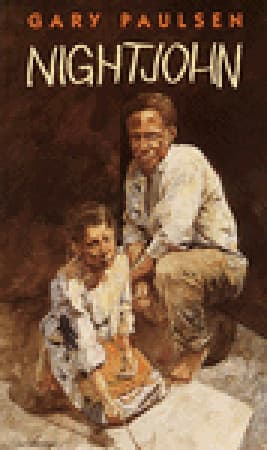
Gary Paulsen (1993)
Genre
Children's / Historical Fiction / Young Adult
Reading Time
90 min
Key Themes
See below
Sign in to track this book
On a 19th-century Southern plantation, a slave risks severe injury to secretly teach a young girl to read, starting a dangerous spread of forbidden knowledge and hope.
Twelve-year-old Sarny, an enslaved girl on the Waller plantation in the pre-Civil War South, tells the story. She cares for the babies in the slave quarters. One day, a new slave named Nightjohn arrives. He has severe scars from whippings and a rope around his neck, showing he was a runaway. Despite his appearance, Sarny notices a quiet dignity about him. The other slaves, especially Delie, are careful around him, fearing he will cause trouble. Sarny, however, is drawn to him and watches him closely, sensing he is different from the other field hands.
One night, after work, Nightjohn approaches Sarny. He offers to teach her a letter for a chew of tobacco. Sarny, curious and wanting to learn, agrees. Nightjohn leads her to a secluded spot and scratches the letter 'A' into the dirt with his finger. He explains that knowing letters is forbidden and punishable by having toes or fingers removed, or worse. Despite the danger, Sarny is fascinated and quickly memorizes the shape and sound of 'A', feeling a strong connection to the symbol.
Nightjohn continues to teach Sarny letters in secret, always at night. He teaches her 'B', 'C', and 'D'. One night, as Nightjohn teaches Sarny the letter 'D' behind the slave cabins, Master Waller, the cruel owner, finds them. Waller is angry at this defiance, as he believes educated slaves are dangerous. He immediately grabs Nightjohn and drags him away, preparing to make an example of him. The other slaves watch in fear, knowing the severe punishment for such an offense.
Master Waller punishes Nightjohn by cutting off two of his toes with a chisel, a terrible act meant to stop any other slave from trying to learn or teach. Nightjohn's screams echo through the night, a reminder of the consequences of literacy. After the mutilation, Nightjohn is left in the slave quarters, bleeding and in pain. Before he is taken away to be sold to another plantation, Nightjohn subtly shows Sarny the letters 'E', 'F', 'G', 'H', 'I', 'J' carved into the soles of his feet, a final act of rebellion and a promise to continue the fight for knowledge.
Inspired by Nightjohn's bravery, Sarny begins to teach the other young slaves, including the babies she cares for, the letters she has learned. She uses sticks to draw in the dirt and whispers the sounds, sharing the forbidden knowledge. However, Clell, a trusted house slave, finds out and tells Master Waller. Waller is angry again and confronts Sarny. As punishment, Waller whips Sarny with a leather strap, a brutal and long beating meant to break her spirit and stop the spread of literacy among his slaves. The whipping leaves Sarny scarred and traumatized.
Months after Nightjohn left, and after Sarny's whipping, Nightjohn reappears on the Waller plantation. His return is a shock and a mystery, as he had been sold far away. He is again covered in scars, but his spirit is strong. Nightjohn says he intentionally got himself sold back to the Waller plantation, or at least to a nearby one, to continue teaching slaves to read. He tells Sarny he needs her help, seeing her as a key part of his network. He asks her to join him in his dangerous quest to spread literacy among the enslaved people, saying that knowledge is their only true path to freedom.
Nightjohn and Sarny begin their work, setting up an underground network of literacy. They move from plantation to plantation, often at night, teaching small groups of slaves in secret places. Nightjohn teaches the basics, while Sarny helps with the younger children and reinforces the lessons. They use various methods, like scratching letters on bark or using the stars for shapes. This dangerous work requires extreme caution and trust, as discovery would mean severe punishment or death for all involved. They understand that each letter learned helps empower their people.
As years pass, the network grows beyond Nightjohn and Sarny. Those they teach then teach others, creating a chain of forbidden knowledge. Sarny, now older, becomes a leader in this movement, carrying Nightjohn's torch. They develop coded messages and safe routes to communicate and share lessons, always staying ahead of slave patrols and watchful masters. Learning to read becomes a quiet, powerful form of resistance, giving hope and dignity to those who had been denied it. The story ends with Sarny continuing this work, knowing that every letter learned chips away at the chains of slavery.
The Protagonist
Sarny transforms from an innocent, curious girl into a brave, dedicated leader in the fight for literacy among enslaved people.
The Supporting/Mentor
Nightjohn is presented as already having undergone significant transformation; his arc is one of sustained, selfless sacrifice and leadership in the fight for literacy.
The Antagonist
Waller remains a static character, embodying the unchanging cruelty and fear of slave owners.
The Supporting
Mammy's arc is one of quiet endurance and a struggle between protection and the emerging hope of literacy.
The Supporting
Delie remains a static character, representing the pervasive fear that kept many enslaved people from outright defiance.
The Supporting
Clell's character is static, serving as a plot device to reveal Sarny's secret and trigger her punishment.
The Mentioned
Alice is a minor character, her presence primarily serving to demonstrate Sarny's dedication to teaching.
The Mentioned
The 'Baby' has no character arc but symbolizes the future generation of enslaved people.
The main idea of 'Nightjohn' is how reading changes lives. For enslaved people, reading and writing are not just skills but tools of freedom, hope, and resistance. Master Waller's opposition to slave literacy shows this power, as he fears that an educated slave is a rebellious slave. Nightjohn's brave return to slavery to teach, and Sarny's strong desire to learn, show that knowledge is the best weapon against oppression, offering a path to self-awareness and a connection to a world beyond the plantation. Each letter learned is a step towards freedom, even if only intellectual freedom at first.
“To know things, for us to know things, is bad for them. We get to wanting and when we get to wanting it's bad for them. They thinks we want what they got . . . . That's why they don't want us reading.”
The book explores different ways people resisted slavery. Nightjohn's act of returning to teach, despite great personal risk and having escaped before, is a strong act of rebellion. Sarny's efforts to learn and then teach other children, even after being whipped, show a quiet but fierce defiance. These acts are not open armed rebellions but a more hidden, intellectual uprising. By seeking and sharing knowledge, the enslaved characters challenge the foundation of their subjugation, showing their humanity and ability to act despite brutal oppression.
“I didn't know what letters was, not what they meant, but I thought it might be something I wanted to know. To learn.”
Sacrifice and courage are important parts of the story. Nightjohn shows this by sacrificing his freedom and enduring mutilation to bring literacy to others. Sarny, a young girl, shows great courage by risking severe punishment to learn and then to teach. Learning or teaching to read under slavery was an act of great bravery, often met with brutal consequences. The characters' willingness to suffer for the good of their community and for knowledge shows the extraordinary courage needed to resist such an inhumane system.
“He knew what they would do to him, he knew it for sure, but he came back anyway. Just to teach us.”
The novel clearly shows how slavery takes away human dignity, through whippings, mutilations, and the denial of basic human rights, including education. Master Waller sees his slaves as property, not people, and their bodies suffer terrible violence. Despite this, the characters, especially Sarny and Nightjohn, show great strength. Their pursuit of knowledge and their determination to help each other defy attempts to strip them of their humanity, showing the lasting strength of the human spirit even under the most oppressive conditions.
“They took away his toes, but they couldn't take away the letters he carried in his head.”
Provides an intimate and immediate perspective of slavery through a child's eyes.
The story is told from Sarny's perspective, allowing readers to experience the horrors of slavery and the longing for knowledge directly through her innocent yet increasingly aware eyes. This narrative choice makes the events more personal and impactful, fostering empathy. Sarny's simple, direct language gives authenticity to her experiences and highlights the profound impact of Nightjohn's lessons on her young mind, making the pursuit of literacy a deeply personal and relatable struggle.
Letters symbolize freedom, knowledge, and an assertion of humanity.
Letters and the act of reading are powerful symbols throughout the book. They represent not just the ability to decipher words but also freedom, dignity, and a connection to a wider world beyond the plantation. For the enslaved, literacy is the ultimate forbidden fruit, a key to understanding their subjugation and envisioning a different future. The physical act of Nightjohn scratching letters in the dirt or carving them into his feet emphasizes their tangible power and the risks taken for this invaluable knowledge.
Physical scars symbolize the brutality of slavery and the cost of resistance.
Nightjohn's numerous scars, both from his previous escape attempts and the mutilation of his toes, serve as a stark physical manifestation of the brutality of slavery and the severe consequences of defying the system. However, they also symbolize his resilience and unwavering commitment to his cause. His scars tell a story of suffering, but also of survival and an unbroken spirit, making him a living testament to the fight for freedom and knowledge. They are a constant reminder of the high stakes involved.
Highlights the stark differences between oppression and the yearning for freedom.
Paulsen frequently uses contrast to emphasize the harsh realities of slavery against the powerful human spirit. The brutal, uneducated Master Waller is contrasted with the wise, literate Nightjohn. The physical confinement of the plantation is contrasted with the intellectual freedom offered by reading. The fear of the older slaves like Delie is contrasted with Sarny's youthful curiosity and courage. This device effectively underscores the central conflicts and the extraordinary nature of the characters' defiance.
“Sarny, what be a word?”
— Nightjohn asks Sarny about words, introducing the central theme of literacy.
“A word be a sound with a picture, a picture that make you think.”
— Sarny's initial understanding of what a word is, taught by Nightjohn.
“It was not a thing to be done lightly, learning to read. It was a thing that could get you killed.”
— The narrator's reflection on the extreme danger associated with slaves learning to read.
“I ain't sayin' it's right, but it's what we got. And we gotta live with what we got.”
— Mammy's pragmatic advice to Sarny about their harsh reality under slavery.
“He said a word could make you free.”
— Sarny recalling Nightjohn's powerful belief about the liberating power of literacy.
“Every time he come, it was like a little light come in with him.”
— Sarny describing the positive impact of Nightjohn's secret visits.
“He didn't just teach us words; he taught us that we was people.”
— Sarny's profound realization about Nightjohn's broader lesson of human dignity.
“They could take your body, but they couldn't take your mind.”
— A central message Nightjohn conveys about mental freedom despite physical bondage.
“He was a man who brought light into darkness, and he paid for it with his body.”
— Sarny's somber reflection on Nightjohn's sacrifice for teaching literacy.
“The letters was like little birds flying across the page, and I had to catch them.”
— Sarny's vivid description of the challenge and wonder of learning to read.
“A secret shared is a secret weakened.”
— Mammy's warning to Sarny about the danger of revealing the secret of literacy.
“He had the knowing in his eyes, the kind of knowing that made him dangerous to the masters.”
— Sarny's observation about Nightjohn's intelligence and its threat to the slave system.
“The words was still there, in my mind, and nobody could take them away.”
— Sarny's realization that once learned, knowledge is an internal, unassailable possession.
“And the words, they started to sing to me, a song of things I never knew before.”
— Sarny's developing appreciation for the beauty and power of written language.
Ready to see how well you understood this book? Take our interactive quiz with 10 questions.

Biography coming soon.

Dan Gemeinhart
4.5

Kate O'Hearn
4.4

Jeanne Birdsall
4.4

Jen Wang
4.4

Wendelin Van Draanen
4.3

John Marsden
4.3

Chris Van Allsburg
4.3

Jennifer A. Nielsen
4.2