“The stories are a part of you now, whether you like it or not.”
— Alex's realization about his connection to the stories he's told.

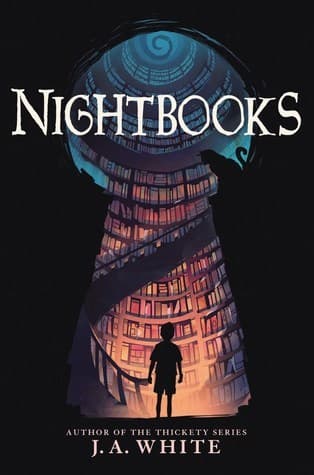
J.A. White (2018)
Genre
Fantasy / Children's / Young Adult
Reading Time
320 min
Key Themes
See below
Sign in to track this book
Imprisoned by a witch, a young boy must spin a new, terrifying tale each night to survive, desperately writing his own escape before his stories—and his life—run out.
Ten-year-old Alex Mosher feels like an outcast because he loves scary stories. He decides to burn his treasured 'nightbooks'—notebooks filled with his original tales. As he approaches the incinerator in his apartment building's basement, he hears a strange noise and smells pumpkin pie. Following the scent, he finds an unlocked apartment door, enters, and is immediately trapped inside by a powerful, glamorous witch named Natacha. She reveals her magical apartment is a prison and demands he tell her a new scary story every night, threatening to turn him into a statue if he fails to entertain her. Alex quickly realizes his life depends on his storytelling.
Alex meets Yasmin, a slightly older girl who has been Natacha's prisoner for an unknown time. Yasmin is cynical and practical, quickly explaining the rules of their confinement and the witch's unpredictable nature. She also shows Alex the magical library within the apartment, filled with countless books, including a special section containing all of Natacha's previous victims' 'nightbooks'—journals like Alex's. Alex is terrified to see his own nightbooks already on the shelf, confirming the witch's power and the grim fate of those who fail her. He also meets Natacha's familiar, a fluffy, seemingly harmless cat named Lenore, who appears to be more than just a pet.
On his first night, Alex tells Natacha 'The Boy Who Couldn't Stop Writing,' a tale about a boy who writes himself out of existence. Natacha is captivated but warns him his stories must be original and truly scary. Yasmin, meanwhile, explains more about Natacha's magic, particularly the enchanted garden that grows inside the apartment. This garden is filled with strange, dangerous plants and creatures, including 'Nightmare Flowers' that emit sleep-inducing pollen. She warns Alex never to touch anything in the garden and to be wary of Lenore, who seems to have a deeper connection to Natacha. Yasmin also mentions the 'secret room' Natacha often visits.
Desperate to find a way out, Alex and Yasmin begin searching for the 'secret room' Yasmin mentioned. They discover a hidden door behind a tapestry. Inside, they find a small, dusty chamber filled with old artifacts, including a locked diary. Yasmin, resourceful and clever, manages to pick the lock. The diary belongs to a previous victim named Clara, and its entries reveal unsettling details about Natacha's past, her powers, and the true nature of the magical apartment. The diary hints at a weakness or a way to defeat the witch, sparking a flicker of hope in the children.
Reading Clara's diary, Alex and Yasmin learn that Natacha's magic is tied to the apartment and that she needs to consume children's fear and stories to maintain her power and youth. Clara's entries suggest that Natacha is not invincible and that a specific potion, made from certain magical ingredients found within the apartment, could weaken or even defeat her. The diary also warns them about Lenore, revealing the cat is more than just a familiar and has a sinister role in Natacha's schemes. Alex and Yasmin realize they must gather the ingredients for this potion, which are scattered throughout the dangerous apartment and garden.
Alex and Yasmin begin a perilous quest to gather the ingredients for Clara's potion. These include a 'whisper-root' from the garden, 'spider silk' from the attic, and a 'tear of a forgotten thing.' They navigate the enchanted garden, avoiding the Nightmare Flowers and other dangerous plants. During their search, Lenore, Natacha's cat, appears often, watching their actions with an unnerving intelligence. The children begin to suspect Lenore is not just a pet but an active participant in Natacha's magic, possibly even a spy. Yasmin's practical skills and Alex's quick thinking help them overcome several obstacles, but their time is running out.
As Alex tells his stories each night, he subtly weaves in elements from Clara's diary, hoping to gain insight or provoke a reaction from Natacha. During one story, he describes a witch who was once a lonely girl, and Natacha, surprisingly, shows a flicker of emotion. Later, through a harrowing encounter and further clues from Clara's diary, Alex realizes that Lenore is not merely a cat but a transformed child, one of Natacha's earliest victims, now bound to her as a familiar. This revelation deepens the horror of their situation and solidifies their resolve to escape.
With all the ingredients finally gathered, Alex and Yasmin work together to brew Clara's potion in secret. The process is full of tension and near-discovery by Natacha. Once the potion is ready, they decide on a plan to give it to the witch. Their opportunity arises during Alex's nightly storytelling session. As Alex tells his most terrifying story yet, creating a powerful distraction, Yasmin attempts to slip the potion into Natacha's drink. However, Natacha, ever observant, senses their treachery, and a direct confrontation erupts, revealing the full extent of her power and her desperation.
During the confrontation, Natacha's magic begins to falter slightly, weakened by the potion and the children's combined efforts. Alex, remembering Clara's diary and Natacha's earlier emotional reaction, realizes the witch's greatest fear is being forgotten and unloved. He begins to tell a new, spontaneous story, not of horror, but of a lonely girl who was never loved and whose magic stemmed from her isolation. This story, woven with empathy and understanding, preys on Natacha's deepest insecurities, causing her glamour to break and revealing her true, withered, and ancient form. Her power is directly linked to the fear and stories she consumes.
As Natacha's true form is revealed and her magic wanes, the apartment itself begins to crumble. The magical enchantments holding them captive weaken. Alex and Yasmin seize the opportunity, escaping through the collapsing walls of the apartment. Natacha, stripped of her power and glamour, is left behind as the apartment fully collapses around her, effectively defeating her. Outside, they find themselves back in the real world, but forever changed by their ordeal. Alex's nightbooks, now imbued with real-world experience, hold new meaning, and his friendship with Yasmin is solidified.
After their harrowing escape, Alex and Yasmin find themselves disoriented but safe. Authorities take them in, and they are eventually reunited with their families, who are relieved but bewildered by their stories. The children, however, share a unique bond forged in shared trauma and triumph. Alex, no longer ashamed of his love for scary stories, finds a new purpose in his writing, understanding its power to both terrify and connect. Yasmin, too, finds a new sense of agency and confidence. Their experience has transformed them, turning fear into resilience and imagination into a tool for survival. They know they will always be connected by their night in the witch's apartment.
The Protagonist
Alex transforms from a shy, self-conscious boy who wants to hide his stories into a confident storyteller who uses his unique talent to save himself and his friend.
The Antagonist
Natacha's power is ultimately stripped away as her deepest insecurities are exposed, revealing her true, withered form and leading to her downfall.
The Supporting
Yasmin learns to trust and collaborate, allowing her hardened exterior to soften and finding hope through partnership.
The Supporting/Mentioned
Lenore's true identity is revealed, highlighting the tragic consequences of Natacha's magic and providing a deeper motivation for Alex and Yasmin.
The Mentioned
Though deceased, Clara's legacy provides the path to Natacha's defeat, making her a posthumous mentor figure.
The main theme is the transformative and life-saving power of stories. Alex's survival depends on his ability to craft compelling narratives for Natacha. His stories are not just entertainment; they are a form of magic, a weapon, and a way to connect. Through storytelling, Alex processes his fears, understands his captor, and finds the key to her defeat. The book itself shows how powerful stories are within the plot. For example, Alex's final, empathetic story about Natacha's loneliness breaks her glamour, showing how understanding can be more potent than fear.
“Stories are wild creatures, Alex. When you let them loose, who knows what havoc they might wreak?”
Fear is a strong force in the novel, both as a tool for Natacha and as an emotion Alex and Yasmin must conquer. Natacha literally feeds on fear, making it a tangible threat. Alex, initially driven by fear for his life, learns to channel that fear into his stories, turning it into a creative force. Yasmin, hardened by her experiences, also learns to confront her fear directly. Their journey through the treacherous apartment and garden, filled with Nightmare Flowers and other dangers, represents their internal struggle to overcome terror and find courage.
“Sometimes the only way out of a scary story is to write your own ending.”
Alex's imagination, initially a source of isolation, becomes his ultimate salvation. The book supports creativity as a vital human trait, able to build worlds, solve problems, and endure hardship. Alex's ability to invent new, terrifying stories each night shows the boundless nature of the human mind. The magical apartment itself is a manifestation of a powerful imagination, though a twisted one. The novel suggests that imagination is not just for escapism but a powerful tool for understanding and shaping reality.
“A good scary story is like a puzzle. You give the reader all the pieces, but you don’t put them together for them.”
Both Alex and Natacha, in their own ways, experience loneliness. Alex feels isolated due to his unique interests, which drives him to retreat into his stories. Natacha's backstory, hinted at and later revealed through Alex's final story, suggests a deep loneliness and a desperate, twisted desire for connection and attention. Her captivity of children can be seen as a desperate attempt to fill this void. The developing friendship between Alex and Yasmin provides a strong contrast, highlighting the healing power of genuine human connection against the destructive force of isolation.
“It was a terrible thing to be alone, Alex realized, worse than being afraid.”
Alex's journals of scary stories, essential for his survival.
The 'nightbooks' are Alex's personal journals filled with his original scary stories. They serve as a literal lifeline, as Natacha demands a new story from them each night. Beyond their practical purpose, they represent Alex's identity, his passion, and his means of processing the world. They also become a symbol of storytelling itself, with the magical library containing the nightbooks of all Natacha's past victims, highlighting the cyclical nature of her cruelty and the power inherent in these collected narratives.
A hidden diary from a previous victim that reveals Natacha's secrets.
Clara's diary is a crucial exposition device. Discovered by Alex and Yasmin, it provides them with vital information about Natacha's past, her magical abilities, her weaknesses, and the specific ingredients needed to create a potion to defeat her. It acts as a guide and a beacon of hope, giving the children a tangible plan for escape. The diary also serves to humanize the long line of victims and emphasize the enduring spirit of resistance, even in the face of overwhelming odds.
Natacha's enchanted, ever-changing prison.
The apartment is more than just a setting; it's a character in itself and a primary antagonist. It is a magical, living entity that shifts, expands, and contracts according to Natacha's will, designed to disorient and trap its inhabitants. Its enchanted garden, the library of nightbooks, and the hidden rooms all contribute to its oppressive atmosphere. The apartment symbolizes Natacha's power and her twisted imagination, making the escape not just from the witch, but from the very confines of her reality.
Natacha's familiar, revealed to be a transformed human victim.
Lenore functions as a deceptive plot device. Initially appearing as a mere pet or familiar, her unsettling intelligence and constant presence serve to heighten the suspense and mystery. The eventual revelation that Lenore is a transformed child adds a layer of horror and urgency to Alex and Yasmin's quest. Her existence underscores the witch's cruelty and the dire consequences of failing to escape, motivating the children further and providing a tragic element to the story.
“The stories are a part of you now, whether you like it or not.”
— Alex's realization about his connection to the stories he's told.
“If you don't tell your own story, someone else will tell it for you.”
— Ygritte's advice to Alex about the importance of narrative control.
“Sometimes the only way out is through the darkest parts of yourself.”
— Alex contemplating the challenges he faces and his own fears.
“A story isn't just words on a page. It's a living thing.”
— Ygritte explaining the power and nature of stories to Alex.
“Fear is a powerful ingredient, but hope is even stronger.”
— Alex reflecting on the balance between his fears and his desire to escape.
“Every story has a beginning, a middle, and an end. But not always in that order.”
— A subtle hint about the non-linear nature of some narratives or events.
“Magic isn't about grand gestures. It's about finding the extraordinary in the ordinary.”
— Ygritte's perspective on the true nature of magic in their world.
“The greatest prison isn't made of bars, but of your own mind.”
— Alex's internal struggle with his confinement and his own limiting beliefs.
“Even the smallest spark can light the darkest night.”
— A metaphor for the power of small acts of courage or hope.
“Sometimes the scariest monsters are the ones you can't see.”
— Alex's growing understanding of the subtle threats around him.
“You can't outrun your past, but you can write a new future.”
— A message about confronting past mistakes and moving forward.
“Every choice you make writes a new chapter in your story.”
— Alex realizing the impact of his decisions on his fate.
“The world is full of wonders, if you only know where to look.”
— Ygritte encouraging Alex to open his eyes to the magic around him.
Ready to see how well you understood this book? Take our interactive quiz with 10 questions.







