The Encounter and the Departure
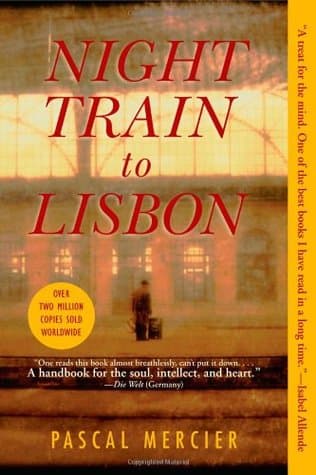
Raimund Gregorius, a meticulous Latin teacher in Bern, Switzerland, has an ordinary morning suddenly disrupted. On his way to school, he sees a young Portuguese woman on a bridge, seemingly about to jump. He talks to her, asking about her language, and she replies in Portuguese. Later, she appears in his classroom, writes 'Silveira' on the blackboard, and then disappears. This encounter, along with finding a forgotten book by a Portuguese author, Amadeu de Prado, in an old bookstore, deeply affects Gregorius. The book, 'A Goldsmith of Words,' resonates with him. Feeling an unexplained pull, he impulsively buys a train ticket, leaves a note for the school, and departs on the night train to Lisbon, leaving his predictable life behind.
Immersion in Prado's World
Arriving in Lisbon, Gregorius, who renames himself 'Mundus' in his mind, immediately reads Amadeu de Prado's writings. He finds another copy of 'A Goldsmith of Words' and starts translating it, feeling a strong connection to Prado's thoughts on life, death, and human experience. He is particularly moved by Prado's eloquent and often sad reflections. Gregorius decides that to truly understand Prado's words, he must understand the man himself. He starts his investigation by visiting the bookstore where he found the book, hoping for clues about the author. His first attempts to find information about Prado lead nowhere, but his determination grows.
The Ophthalmologist and the Sister
Gregorius's search leads him to Dr. João Eça, an ophthalmologist who treated Amadeu de Prado and still wears glasses Prado prescribed. Eça is initially cautious but eventually shares some insights into Prado's character and his reputation as a brilliant, yet mysterious, doctor and intellectual. Eça also directs Gregorius to Prado's sister, Adriana, who lives in the old family house. Adriana is devoted to her deceased brother and has kept the house as a memorial to him, preserving his room exactly as he left it. She is reluctant to talk about Amadeu but is interested in Gregorius's genuine interest and deep respect for her brother's work, slowly opening up to him.
The Priest and the Resistance
Through Adriana, Gregorius learns about Amadeu's difficult relationship with his father, a well-known judge with traditional views, and his early intellectual development. He also meets Father Bartolomeu, Amadeu's former Latin teacher and a close friend. Father Bartolomeu reveals Amadeu's deep opposition to the Salazar dictatorship and his secret involvement in the resistance movement. He recounts how Amadeu, despite his privileged background, became a doctor for the poor and a quiet but active participant against the regime, using his medical skills to help injured resistance fighters. This adds another layer to Prado's complex character, showing him as a man of deep thought and courageous action.
The Friendship of Jorge O'Kelly
Gregorius seeks out Jorge O'Kelly, Amadeu's closest friend from their youth, now a successful lawyer. O'Kelly provides a different view of Amadeu, describing their intense intellectual discussions and their strong bond. He speaks of Amadeu's sharp mind, his philosophical depth, and his often melancholic mood. O'Kelly also reveals the complexities of Amadeu's personal life, including his unrequited love for Catarina, a fellow resistance member. Their friendship, though marked by intellectual rivalry and occasional disagreements, was important to Amadeu's life, and O'Kelly's memories give Gregorius a glimpse into Prado's private world and emotional state.
Estefânia and the Resistance Network
Continuing his investigation, Gregorius finds Estefânia, an elderly woman who was important in the resistance network and knew Amadeu well. She describes Amadeu's role in the underground movement, especially his medical skills and his courage in treating injured dissidents at great personal risk. Estefânia speaks of Amadeu's quiet determination and his commitment to justice, despite the dangers. She also mentions a complex emotional dynamic within the group, particularly between Amadeu, Jorge, and Catarina, hinting at the personal sacrifices and emotional toll of their secret activities.
Catarina and the Unspoken Love
Gregorius eventually finds Catarina, the woman Amadeu loved. She is now an old woman, living a quiet life. Catarina reveals the depth of Amadeu's unspoken love for her and the difficult choices they had to make during the dictatorship. She explains that their shared commitment to the resistance made a conventional romantic relationship impossible. She speaks of Amadeu's deep respect for her and her own complex feelings for him. This encounter gives Gregorius a key piece of the puzzle, showing Amadeu's emotional vulnerability and the personal cost of his political beliefs, adding a sad dimension to his character.
The Death and the Legacy
Through his various interviews, Gregorius learns about Amadeu de Prado's death from an aneurysm at a relatively young age. The suddenness of his death left many questions unanswered and his philosophical work unfinished. Gregorius also discovers that Prado, despite his reclusive nature, had a great impact on everyone he met, whether through his medical care, his intellectual discussions, or his quiet acts of rebellion. The more Gregorius learns, the more he understands that Prado's life was a demonstration of individuality, intellectual honesty, and quiet defiance in the face of oppression, leaving a lasting philosophical and personal mark.
Reflections on a Borrowed Life
As Gregorius compiles his notes and finishes his translation of 'A Goldsmith of Words,' he begins to reflect on his own life in Bern. His journey to Lisbon, initially an impulsive escape, has become an exploration of identity, purpose, and the meaning of a well-lived life. He realizes that by learning about Prado's life, he has, in a way, lived a parallel existence, experiencing emotions and ideas he had long suppressed. He thinks about whether he truly understood Prado, or if his quest was more about understanding himself through the lens of another's extraordinary life. He considers the courage it takes to live authentically.
The Return and the Transformation
After months in Lisbon, having gathered all the details of Amadeu de Prado's life, Gregorius decides to return to Bern. He carries with him not only his completed translation and notes but also a changed view on life. He is no longer the timid Latin teacher he once was. The encounter with the Portuguese woman, the discovery of Prado's book, and the subsequent journey have opened him up to new possibilities and a deeper understanding of human experience. While his old life awaits, he knows he cannot simply go back to his previous existence; he has been permanently changed by the lives he has touched and the insights he has gained in Lisbon.