“The past is never dead. It's not even past.”
— A recurring theme about the lingering effects of historical events.

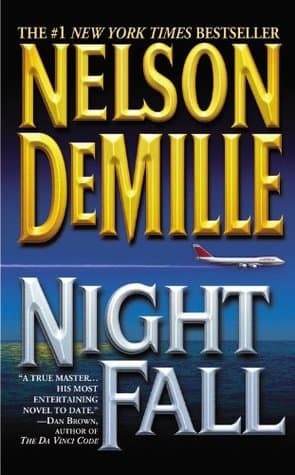
Nelson DeMille (2001)
Genre
Thriller / Mystery
Reading Time
1160 min
Key Themes
See below
Sign in to track this book
A detective and his FBI agent wife race to find a hidden videotape, which could expose a terrifying truth behind the catastrophic explosion of TWA Flight 800 and challenge the official story of mechanical failure.
It is July 17, 2001, the fifth anniversary of the TWA Flight 800 explosion. John Corey, a former NYPD homicide detective now with the Federal Anti-Terrorist Task Force (ATTF), and his wife, FBI agent Kate Mayfield, are given a routine task: review the original investigation files. The official conclusion was mechanical failure, a fuel tank explosion. Corey, known for his cynical and unconventional approach, immediately suspects there is more to the story. Their superiors, Captain Steve Landis and FBI Director Ted Nash, seem to want a quick confirmation of the original findings, which makes Corey suspect a cover-up about the true cause of the disaster that killed 230 people.
During their review, Corey and Kate find references to a missing videotape. This tape was supposedly made by a couple on a Long Island beach the night of the crash, and it might have accidentally captured the explosion. The original investigators quickly dismissed this tape. Corey becomes determined to find it, believing it holds evidence that could contradict the mechanical failure theory. He learns that the couple, Larry and Mary, were questioned, but their tape never officially appeared or was analyzed. This tape becomes the main focus of their unofficial investigation, much to their superiors' annoyance.
As Corey and Kate investigate, they meet significant resistance from various government agencies, including the FBI, CIA, and NTSB. Files are incomplete, witnesses are unwilling to speak, and their information requests are often denied. Their superior, Captain Landis, repeatedly warns them to stick to the official story and not cause trouble. This pushback only strengthens Corey's belief that the government is hiding information. He uses his detective skills to navigate the bureaucracy, often bypassing official channels, which worries Kate about their careers and safety.
Corey and Kate work to find Larry and Mary, the couple who supposedly filmed the crash. They discover that Larry was a lawyer and Mary a real estate agent, both married to other people. Their affair was a secret, making them reluctant to come forward with the tape. The investigation shows that Larry died by suicide a few years after the crash, and Mary disappeared, likely to avoid scandal and government inquiries. Corey believes Larry's death was suspicious and linked to the tape, not just personal shame or legal problems.
Corey tracks down a retired fisherman named Jack, who was on the water near the crash site on July 17, 1996. Jack initially dismissed what he saw but is now willing to talk. He describes seeing a small boat in an unusual spot shortly before the explosion, and then a flash of light going up towards the plane. His account, though vague, suggests an external object, possibly a missile, hit the aircraft. This testimony directly contradicts the official mechanical failure theory and gives Corey a key piece of evidence, further fueling his belief in a government cover-up to avoid a major international incident.
As Corey and Kate get closer to the truth, they realize they are being watched. Unmarked cars appear, their conversations are interrupted, and their movements are tracked. They suspect it is not just their own agency watching them, but possibly other, more secretive government groups. This surveillance creates paranoia and danger, making them realize the power of the forces they are against. This confirms their suspicions that the truth about Flight 800 is a highly sensitive secret that some parties want to keep hidden, even using intimidation.
After much searching, Kate finds Mary, who has been living under a new identity. Mary is initially scared and unwilling to speak, fearing for her life. She eventually tells Kate about the videotape. She explains that she and Larry had hidden the tape, fearing what would happen if it fell into the wrong hands after Larry's suspicious 'suicide.' Mary gives a cryptic clue to the tape's location, a place only she and Larry knew about, making their search more urgent.
Following Mary's instructions, Corey and Kate go on a dangerous mission to get the hidden videotape. They find it, but not without a close call, realizing they are still being pursued. When they watch the tape, their fears are confirmed: the video clearly shows an object rising from the ocean surface and hitting TWA Flight 800, followed by the explosion. The evidence is clear — the plane was shot down by a missile. This revelation disproves the official mechanical failure theory and exposes a large government cover-up that lasted five years.
Armed with the videotape, Corey and Kate confront their superiors, Captain Landis and Director Nash, with the evidence. The officials, initially dismissive, must admit the tape's authenticity. They reveal the true reason for the cover-up: TWA Flight 800 was accidentally shot down by a U.S. Navy missile during a secret military exercise. The government chose to hide the truth to prevent panic, avoid international condemnation, and protect the Navy's reputation, opting for a story of mechanical failure instead of admitting a devastating friendly fire incident.
The revelation of the missile strike causes a government crisis. Corey and Kate are pressured to keep silent, but Corey, ever the maverick, leaks parts of the story. The government, unable to completely suppress the truth, must create a new narrative, admitting to a 'friendly fire' incident but downplaying the cover-up. Public reaction is mixed, with some feeling betrayed and others accepting the deception for national security. Corey and Kate, though they exposed the truth, find their careers and lives changed forever by their pursuit of justice for the victims of Flight 800.
The Protagonist
Corey begins as a jaded detective assigned to a review, and through his relentless pursuit, he uncovers a massive government conspiracy, solidifying his role as a truth-teller despite personal and professional risks.
The Protagonist
Kate evolves from a cautious FBI agent concerned with protocol to a fierce advocate for truth, willing to risk her career and safety to expose government deception.
The Supporting/Antagonist
Landis begins as an obstructive superior, but eventually, his role in the cover-up is revealed, showing him as a man making difficult choices under immense pressure.
The Antagonist
Nash remains largely static in his conviction that the cover-up is necessary, acting as the ultimate authority figure Corey and Kate must challenge to reveal the truth.
The Supporting/Mentioned
Larry's arc is tragic; he inadvertently captures a national secret, attempts to hide it, and pays the ultimate price, becoming a martyr for the truth.
The Supporting
Mary moves from a terrified, hidden witness to a courageous informant, providing the key to unlocking the truth about the crash.
The Supporting
Jack's arc involves moving from a silent witness to a crucial informant, providing vital, albeit delayed, evidence.
The main theme is the government's deliberate hiding of the truth about the TWA Flight 800 explosion. This appears in the official story of mechanical failure, the suppression of evidence like the videotape, and the intimidation of witnesses. The novel explores the ethics of such deception, balancing national security and public panic against the right to know the truth. Corey and Kate constantly face resistance and attempts to discredit them, showing the power and resources used to maintain the false story. The government's reason is to prevent panic and avoid international incident, but this costs public trust and justice for the victims.
““The truth is a terrible thing to waste, especially when you’ve spent five years burying it.””
This theme explores the conflict between an individual's search for truth and justice against the power of government bureaucracy and its stories. John Corey, with his unconventional methods and distrust of authority, embodies the maverick. He constantly clashes with his superiors and various agencies, who represent 'the system' and its desire for order, control, and a convenient lie. The novel suggests that sometimes, an outsider or a rebel must expose deep secrets, even if it means risking their career and safety. Kate Mayfield initially tries to work within the system but ultimately joins Corey in challenging it.
““You can’t fight the government, John. They have more lawyers than God.””
The novel looks at how truth can be twisted, hidden, and reinterpreted, and how memory can be flawed or intentionally manipulated. The official report on Flight 800 becomes the 'truth' for five years, despite conflicting evidence. Eyewitness accounts, like Jack's, are initially dismissed or self-censored. The videotape itself is a physical representation of objective truth, but its existence is denied. The book questions whether a 'greater good' can justify lying to the public and how individuals reconcile personal knowledge with official stories. It also highlights the fragility of memory and the power of collective forgetting when a convenient lie is spread.
““There’s the truth, and then there’s what the government wants you to believe.””
The search for truth comes at a significant personal cost for Corey and Kate. Their careers are at risk, their marriage is strained by pressure and danger, and their lives are threatened by surveillance and intimidation. Larry and Mary's story shows this theme tragically, as Larry dies and Mary must hide. The novel shows that challenging powerful groups has severe consequences, not only professionally but also psychologically and emotionally. It forces the characters to weigh the importance of uncovering a terrible truth against their own well-being and security.
““Sometimes, knowing the truth is a heavier burden than living with the lie.””
A crucial piece of evidence that drives the entire investigation.
The videotape filmed by Larry and Mary is the central MacGuffin and plot device. Its existence, disappearance, and eventual retrieval propel the narrative forward. It represents the objective, undeniable truth that contradicts the official narrative. The search for the tape forces Corey and Kate to navigate bureaucratic obstacles, track down reluctant witnesses, and confront dangerous adversaries. The tape acts as both a source of hope for justice and a symbol of the immense power of the government to suppress inconvenient facts. Its contents ultimately provide the irrefutable proof needed to expose the cover-up.
The temporal setting that reopens the cold case.
The five-year anniversary of the TWA Flight 800 crash serves as the narrative catalyst. It provides a plausible reason for the ATTF to conduct a 'review' of the original investigation, thereby allowing Corey and Kate to stumble upon the inconsistencies. This specific timeframe also adds a sense of urgency and reflection, as the memory of the tragedy is still fresh for many, but the official story has had time to solidify. It allows for characters to have processed the initial shock and perhaps be more willing to speak out, while also highlighting the long-standing nature of the cover-up.
A character archetype whose unconventional methods challenge the status quo.
John Corey embodies the 'maverick detective' archetype. His cynicism, disregard for protocol, sarcastic humor, and intuitive investigative style are crucial plot devices. He consistently questions authority and refuses to accept official explanations, driving the narrative by digging deeper where others would stop. His clashes with superiors and his tendency to operate outside official channels create tension and allow for breakthroughs that a more by-the-book investigator might miss. His personality is not just characterization; it's the engine that propels the plot against overwhelming institutional resistance.
The hidden truth behind the crash, revealed as the story's climax.
The revelation that TWA Flight 800 was brought down by a 'friendly fire' missile strike during a secret U.S. Navy exercise serves as the ultimate plot twist and the core of the government's cover-up. This device provides a compelling and plausible reason for the extensive deception, elevating the stakes from a mere accident to a national security nightmare. It explains why so many agencies were involved in suppressing the truth and why the government went to such lengths to maintain the mechanical failure narrative, making the conspiracy both horrifying and, from a certain perspective, understandable in its motives.
“The past is never dead. It's not even past.”
— A recurring theme about the lingering effects of historical events.
“There are no coincidences, only the inevitable.”
— John Corey's cynical view on seemingly random events, hinting at deeper plots.
“Ignorance is not bliss, it's dangerous.”
— Corey reflecting on the public's lack of awareness regarding national security threats.
“The truth is a fickle mistress, and she rarely reveals herself fully.”
— Corey's ongoing struggle to uncover the complete story behind Flight 800.
“Every secret has a shelf life, and eventually, they all rot.”
— A contemplation on the impossibility of keeping major secrets buried forever.
“Patriotism is the last refuge of a scoundrel, and the first excuse of a murderer.”
— Corey's jaded perspective on motivations for extreme actions in the name of country.
“Sometimes the most obvious explanation is the one they want you to believe.”
— A classic Corey suspicion, always looking beyond the surface narrative.
“The government never lies, but it often withholds the truth.”
— A nuanced take on official statements and the selective release of information.
“Even heroes have feet of clay, and sometimes the whole statue crumbles.”
— Reflecting on the fallibility of esteemed figures and the impact of their flaws.
“The ocean keeps its secrets well, but not forever.”
— Referring to the evidence submerged after the plane crash.
“Paranoia is just heightened awareness in a dangerous world.”
— Corey's self-justification for his constant vigilance and distrust.
“Justice is a long and winding road, often paved with good intentions and bad outcomes.”
— Corey's reflections on the pursuit of justice for the victims of the crash.
“There's a difference between what happened and what you can prove happened.”
— Highlighting the legal and evidentiary challenges in uncovering the truth.
“Some wounds never heal, they just scar over, waiting to be reopened.”
— Referring to the psychological impact of traumatic events on individuals.
Ready to see how well you understood this book? Take our interactive quiz with 10 questions.
Biography coming soon.







