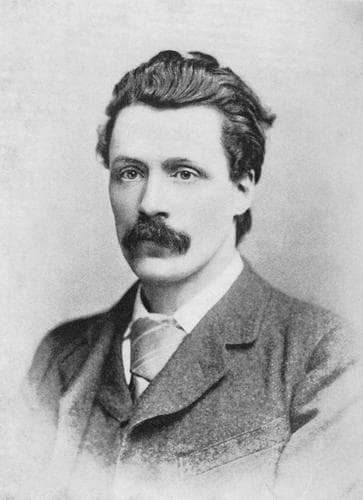
George Robert Gissing was an English novelist, who published 23 novels between 1880 and 1903. His best-known works have reappeared in modern editions. They include The Nether World (1889), New Grub Street (1891) and The Odd Women (1893).

George Gissing (1891)
Genre
Historical Fiction
Reading Time
12 Minutes
Key Themes
See below
Sign in to track this book
In the cutthroat world of Victorian publishing, aspiring writers grapple with artistic integrity and financial ruin as they navigate the currents of fame and failure.
Edwin Reardon, a sensitive novelist, struggles to finish his latest work, 'Hours in Spring,' while battling poverty and illness. His wife, Amy, has her own writing ambitions but lacks his talent. Reardon feels great pressure to produce fiction that sells, a task he finds difficult as his artistic standards conflict with market demands. Meanwhile, his friend Jasper Milvain, a more cynical writer, advances his career by cultivating influential connections and writing for various publications. Reardon's other friend, Harold Biffen, a dedicated but unsuccessful author, lives in extreme poverty, meticulously writing a novel about the everyday lives of the poor, a work he knows will never sell.
Marian Yule, an intelligent and hardworking young woman, works as a secretary to her demanding and scholarly father, Alfred Yule, a respected but financially unstable literary critic. Marian is deeply involved in her father's work, often ghostwriting for him, and dreams of a successful writing career for financial independence. Jasper Milvain, a distant cousin of the Yules, begins to court Marian. He sees her as an intellectual partner and a way to a more secure future, even though he ultimately wants to marry for wealth. He knows how uncertain a purely literary income is and seeks a more stable life.
Reardon's health worsens, making writing an agonizing process. He cannot produce work fast enough to support his family, and their financial situation becomes desperate. Amy, who once admired his artistic ideals, grows frustrated with their poverty and his inability to provide. She believes he should compromise his artistic principles for commercial success, a suggestion Reardon finds painful. Their marriage, already strained by money worries, suffers further from their differing views on art and money, leading to emotional distance. Reardon's attempts to write popular fiction are half-hearted and fail to impress publishers.
Unable to tolerate their poverty and Reardon's perceived failure, Amy suggests they separate. She moves back to her mother's home in the countryside with their young son, Willie. Reardon, heartbroken, moves into a dreary lodging house, where he continues to struggle with writing and his declining health. He tries to write a more commercial novel but finds himself without inspiration or energy. Meanwhile, Harold Biffen, unaware of his own destitution, continues to labor on his novel, 'Mr. Bailey, Grocer,' a detailed and unsentimental portrayal of working-class life, driven by artistic integrity rather than hope of money or recognition.
Jasper Milvain, always practical, continues to build his literary connections and carefully considers marriage. He learns of the wealthy Miss Dora Milvain, his distant cousin, and begins to weigh marrying for money against his intellectual connection with Marian. The Yule family faces increasing financial difficulties. Alfred Yule's literary projects do not bring in enough income, and his health is failing. Marian, burdened by her father's demands and the family's uncertain situation, feels pressure to secure her own financial future, recognizing that her writing ambitions must also serve practical needs.
Tragedy strikes Reardon when his young son, Willie, dies. This loss plunges Reardon into deeper despair, crushing any remaining will to live or write. He blames himself for his son's death, believing his poverty contributed to the child's poor health and inadequate care. The separation from Amy, their financial struggles, and now the death of his only child leave Reardon broken. His physical health, already fragile, declines rapidly, made worse by his grief and lack of care. He becomes a shadow of his former self.
Jasper Milvain learns of the substantial inheritance of his distant cousin, Miss Dora Milvain, after her father's death. Seizing the opportunity, he quickly shifts his attention from Marian Yule to Dora, carefully calculating the financial benefits of such a match. Despite his intellectual connection with Marian, his desire for financial security outweighs any romantic feelings. He proposes to Dora, a somewhat naive woman, and she accepts. This engagement guarantees Milvain the comfortable, secure future he has always wanted, freeing him from the anxieties of a writer's life and allowing him to pursue his literary ambitions from a position of strength.
Reardon's health continues to decline. He returns to London, living in squalor, unable to care for himself. Harold Biffen, despite his own difficult circumstances, remains a devoted friend, visiting Reardon regularly, offering comfort, and tending to his needs. Biffen reads to Reardon from his own manuscript, a gesture of literary solidarity between two men who understand the harsh realities of their profession. Reardon eventually dies, a victim of consumption and the pressures of the literary market. His death is the tragic end of a sensitive artist unable to compromise his ideals for survival.
Marian Yule is hurt by Jasper Milvain's engagement to Dora, recognizing it as a calculated act of self-interest. Her trust in him is shattered, and she becomes more cynical about love and artistic integrity in the literary world. At the same time, her father, Alfred Yule, suffers a stroke, which leaves him partially paralyzed and unable to work. This makes the family's financial distress worse and places a greater burden on Marian, who must now care for him and increase her efforts to earn money through her own writing, often sacrificing her own literary aspirations for paid work.
After Reardon's death, Biffen manages to get his novel, 'Mr. Bailey, Grocer,' published, largely thanks to Mrs. Alfred Yule's connections. The novel receives some critical acclaim for its realism, but it fails to sell, bringing him little money. Biffen, already living in poverty and deeply affected by Reardon's death and his own failures, sees no future. Overwhelmed by despair and the futility of his artistic endeavors in a commercial world, he commits suicide by taking poison. His death shows the bleak fate of artists who prioritize integrity over marketability.
Jasper Milvain, now financially secure through his marriage to Dora, thrives in the literary world. He becomes a successful journalist, critic, and editor, able to write on any subject to meet demand, unburdened by financial worries. His practical approach to life and literature works well. Marian Yule, after her father's death and the continued struggle for financial stability, eventually marries a kind but uninspiring man named Mr. Fadge, a minor literary figure. She settles for a life of practical, unfulfilling literary work, writing articles and reviews to support herself and her husband, having abandoned her earlier, more ambitious artistic dreams.
Following Reardon's death, Amy, now free from the burdens of her first marriage and its associated poverty, finds herself in a better position. She eventually remarries, choosing a wealthy and conventional businessman. This marriage provides her with the financial security and social standing she always wanted, a contrast to her life with Reardon. Her new life is one of comfort and stability, without the artistic struggles and intellectual anxieties that plagued her first marriage. She represents the triumph of practicality and material comfort over the idealism and suffering of the literary life as depicted through Reardon.
The Protagonist
Reardon descends from a struggling but hopeful author to a broken, despairing man, crushed by poverty, the loss of his son, and the inability to reconcile his artistic integrity with commercial demands, ultimately dying a defeated man.
The Supporting
Amy evolves from a hopeful wife to a resentful spouse, eventually leaving Reardon for financial security, and ultimately remarries into wealth, achieving the stability she always desired, free from the burdens of artistic struggle.
The Protagonist/Antagonist
Milvain successfully navigates the literary world by prioritizing financial gain and strategic alliances, culminating in a wealthy marriage and a flourishing career, demonstrating the rewards of pragmatism over principle.
The Protagonist
Marian starts with intellectual aspirations and a romantic interest in Milvain, but she is repeatedly disappointed by male opportunism and familial burdens, eventually resigning herself to a life of practical, less fulfilling literary labor.
The Supporting
Biffen remains steadfast in his artistic integrity despite extreme poverty, ultimately achieving minor critical recognition for his work but no financial success, leading him to despair and suicide, mirroring Reardon's fate.
The Supporting
Alfred Yule declines physically and financially, becoming increasingly dependent on Marian and ultimately succumbing to illness, symbolizing the obsolescence of his generation's literary values in the face of commercialism.
The Supporting
Mrs. Yule navigates the financial precarity of her husband's career with quiet resignation, later demonstrating a pragmatic ability to help others (like Biffen), and adapts to her family's changing circumstances.
The Supporting
Dora remains a largely static character whose primary function is to provide the financial means for Jasper Milvain's success through her inheritance and marriage.
This is the central theme of 'New Grub Street,' exploring the clash between artistic integrity and the commercial demands of the literary market. Authors like Reardon and Biffen, who prioritize artistic truth, are destroyed by poverty and lack of recognition. In contrast, pragmatic writers like Milvain, who compromise their ideals and cater to popular tastes, succeed. The novel shows how the need to earn a living corrupts artistic production, forcing writers to choose between starvation and selling out, often leading to despair and the loss of genuine talent.
“Literature nowadays is a trade. In a trade everything depends on being a sharp man of business.”
Poverty is a relentless force throughout the novel, eroding the health, relationships, and spirits of the characters. For Reardon, it worsens his illness, strains his marriage, and contributes to his death and the death of his child. For Biffen, it leads to extreme deprivation and despair, ending in suicide. Even for Marian, poverty dictates her choices, forcing her into unfulfilling work. The novel details the dehumanizing effects of constant financial struggle, showing how it can crush artistic ambition, destroy personal dignity, and make human connection almost impossible.
“Poverty is the root of all evil. It is the great curse of life.”
Gissing explores the grim prospects for intellectuals and serious artists in late Victorian society, which increasingly values entertainment and profit over deep thought or aesthetic merit. Characters like Reardon, Biffen, and Marian Yule, who have genuine intellectual and artistic abilities, are marginalized, unappreciated, and impoverished. Their dedication to serious work is met with indifference or scorn by a public seeking sensationalism and easy content. The novel suggests that true intellectual and artistic pursuit often leads to suffering and obscurity, while superficiality and opportunism lead to success.
“The public doesn't want thought; it wants amusement. It doesn't want art; it wants journalism.”
Marriage in 'New Grub Street' is often a transactional arrangement, especially for men seeking financial stability and social advancement. Jasper Milvain shows this, carefully calculating the benefits of marrying for wealth, leaving Marian for Dora. For women like Amy and Marian, marriage offers a potential escape from poverty and a way to secure their future, sometimes at the cost of personal happiness. The novel critiques the societal pressures that turn marriage into a strategic move rather than a union of love, showing how economic necessity dictates personal relationships and reinforces social hierarchies.
“To marry for money is not so bad as to marry for love, if you can get money enough.”
The novel examines what makes for 'success' and 'failure' in the literary world. Reardon and Biffen, despite their artistic integrity and talent, are seen as failures because they cannot sell their work. Milvain, who is less principled but more commercially astute, achieves great success. Gissing argues that true literary merit often goes unrewarded, while mediocrity and sensationalism thrive. Success is defined by marketability and public reception, not by artistic quality, leading to a profound sense of injustice and futility for those who truly strive for art.
“The man who writes for money is a slave; the man who writes for art is a fool.”
Contrasting characters to highlight thematic differences.
Gissing masterfully uses foil characters to underscore the novel's central themes. Edwin Reardon and Jasper Milvain are the primary foils, representing two opposing approaches to the literary profession: Reardon, the principled artist who perishes, and Milvain, the pragmatic opportunist who thrives. Similarly, Harold Biffen serves as an even more extreme foil to Milvain, embodying absolute artistic integrity and poverty, mirroring Reardon's fate. Marian Yule, with her intellectual aspirations, contrasts with Amy Reardon, who prioritizes material comfort, further highlighting the difficult choices faced by women in this environment.
Situational and dramatic irony to emphasize the harsh realities.
Irony permeates 'New Grub Street,' particularly situational irony. The most talented and dedicated writers (Reardon and Biffen) suffer the most and ultimately fail, while the cynical and less artistically inclined (Milvain) achieve success and comfort. There is also a tragic irony in Reardon's attempts to write commercial fiction, which only further drains his spirit and fails to save him. The novel's title itself is ironic, as 'Grub Street' was historically associated with impoverished writers, and Gissing shows that the 'New' Grub Street, despite its modernization, is just as, if not more, brutal for the artist.
Physical and financial decay symbolizing artistic and moral decline.
Reardon's chronic illness (consumption) is a powerful symbol throughout the novel. It represents not only his physical decline but also the 'consumption' of his spirit and artistic integrity by the pressures of poverty and the literary market. His failing health is inextricably linked to his financial struggles and his inability to compromise. Similarly, the squalid living conditions of Reardon and Biffen symbolize the moral and artistic decay that results from the commercialization of literature, suggesting that the environment literally poisons the artist.
Omniscient narrator providing critical social commentary.
The novel employs an omniscient third-person narrator who not only describes events and characters but also offers trenchant social commentary on the literary world and Victorian society. This perspective allows Gissing to present a comprehensive, often bleak, view of the struggles faced by writers. The narrator frequently interjects with observations about the nature of art, money, and human ambition, guiding the reader's understanding of the novel's themes and reinforcing its critical stance against the commercialization of literature and the suffering it inflicts upon sensitive souls.
Ready to see how well you understood this book? Take our interactive quiz with 10 questions.
George Robert Gissing was an English novelist, who published 23 novels between 1880 and 1903. His best-known works have reappeared in modern editions. They include The Nether World (1889), New Grub Street (1891) and The Odd Women (1893).







