“London. The most wonderful city in the world.”
— Richard Mayhew's initial perspective on his ordinary life in London.

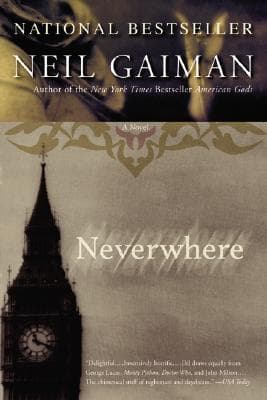
Neil Gaiman (1996)
Genre
Fantasy / Science Fiction / Young Adult
Reading Time
7 hr 24 min
Key Themes
See below
Sign in to track this book
An act of kindness plunges an ordinary London businessman into a perilous, hidden world beneath the city, where forgotten souls, ancient evils, and dark wonders lurk.
Richard Mayhew, a young, somewhat meek London businessman, is on his way to an engagement dinner with his ambitious fiancée, Jessica. His life is meticulously planned and conventional. However, as they walk, Richard discovers a severely injured, bleeding young woman lying on the pavement. Despite Jessica's protests and insistence on calling an ambulance, Richard, moved by a sudden impulse of kindness, cannot leave her. He carries her back to his flat, much to Jessica's disgust, and tries to tend to her wounds. This act of compassion immediately begins to unravel his normal existence. The girl, who introduces herself as Door, reveals she is from 'London Below' and is being hunted. The next morning, Richard finds his life beginning to disappear as if he never existed in London Above.
After Door leaves his flat, Richard discovers that his life in London Above has become a blank slate. He is invisible to his former friends, colleagues, and even Jessica, who does not recognize him. His flat is rented to someone else, his bank accounts are frozen, and he can no longer hail taxis or buy food. Desperate and utterly alone, Richard realizes his only hope lies with Door and the strange world she spoke of. He begins to see glimpses of London Below – people living in sewers, strange creatures, and a general air of decay and magic coexisting with the familiar city. He follows a lead from a homeless man who recognizes his 'new' scent, eventually finding the Marquis de Carabas, a mysterious figure, who promises to lead him to Door.
Richard, now a part of London Below, joins Door and the Marquis de Carabas. Door reveals that her entire family – her father, mother, and younger sister – were brutally murdered by the assassins, Mr. Croup and Mr. Vandemar, who are now hunting her. She is seeking answers and revenge for her family's murder and believes the Floating Market, a nomadic gathering of London Below's inhabitants, will hold clues. Their journey to the market is dangerous, encountering various strange denizens and navigating treacherous pathways. Richard struggles to adapt to the harsh realities and bizarre rules of this hidden world, constantly questioning his sanity and the strange events unfolding around him.
The group finally reaches the Floating Market, a chaotic and dangerous hub of trade and information, constantly changing location. Here, Door hopes to find the Angel Islington, a powerful, ancient angel who guards London Below, to ask for protection and help in avenging her family. Door consults with various denizens, including the Rat-Speakers, to gather information about her family's murder. Richard, meanwhile, feels increasingly out of place and longs for his old life, but also finds himself drawn into the strange allure of London Below. He witnesses the unique customs and harsh justice of this world, including a bizarre trial where the accused is judged by a beast.
To reach the Angel Islington, Door must acquire a key. The group learns of a challenge to retrieve a key from the lair of the Beast of London, a monstrous creature dwelling in the sewers. Richard, despite his fear, is forced to accompany Door, the Marquis, and Hunter, a formidable warrior hired for their protection. They navigate the dangerous tunnels beneath the city, facing not only the Beast but also traps and the constant threat of Croup and Vandemar. Through cunning and bravery, they defeat the Beast and retrieve the key, a significant step towards reaching Islington. This experience further solidifies Richard's unwilling immersion into London Below.
After acquiring the key, the group is ambushed by Mr. Croup and Mr. Vandemar. In the ensuing chaos, they are separated. Hunter is gravely injured, and the Marquis de Carabas is captured by the assassins. Croup and Vandemar torture the Marquis, eventually killing him and taking the key. Richard and Door manage to escape, but are now without their protector and their key, and the Marquis, their guide and ally, is seemingly gone. Richard is devastated by the loss of the Marquis, who, despite his enigmatic nature, had become a vital presence. The pursuit by Croup and Vandemar intensifies, leaving Door and Richard more vulnerable than ever.
Door and Richard seek refuge at the Earl's Court, a hidden community in the London Underground station of the same name, ruled by the eccentric Earl. Here, they hope to regroup and find a way to get the key back. They discover that Hunter, gravely wounded by Croup and Vandemar, is also there, slowly dying. The Earl's Court is a strange place, where the residents live by their own peculiar rules, including a system of bartering favors and stories. Door tries to find information about her family and the assassins, while Richard struggles with the grim reality of Hunter's deteriorating condition and the increasing danger they face. Door learns of a prophecy involving the Angel Islington.
With a new plan, Door and Richard embark on the final leg of their journey to the Angel Islington. They must navigate a perilous, living maze beneath the British Museum, a place filled with ancient traps and guardian creatures. Richard's resourcefulness and Door's unique abilities are tested as they face the challenges of the labyrinth. They overcome the maze and finally reach the chamber where the Angel Islington resides, a place of ethereal beauty and immense power. Islington, a majestic and ancient being, appears to them, seemingly offering the answers and protection they have sought.
The Angel Islington reveals the truth: it orchestrated the murder of Door's family. Islington was exiled to London Below millennia ago for failing to protect the lost city of Atlantis. It desperately desires to return to Heaven and believes that by destroying Door's family, whose lineage holds an ancient power to 'open' things, it can create a breach to its former home. Croup and Vandemar were merely its hired hands. Islington offers Door the chance to 'open' a gate to Heaven, but the true purpose is to sacrifice Door and her bloodline. Richard, horrified by the revelation, realizes the extent of their peril and that Islington is the ultimate antagonist.
Just as Islington prepares to enact its plan, the Marquis de Carabas dramatically reappears. He reveals that his 'death' was a temporary state, a part of his unique nature as a 'collector of favors,' and that he used a favor to be resurrected. He brings with him the key that Croup and Vandemar had stolen. A fierce confrontation ensues between the group and Islington, who unleashes its angelic power. With Door's unique ability to open doors, Richard's unexpected bravery, Hunter's sacrifice (who arrives just in time to assist), and the Marquis's cunning, they defeat Islington, foiling its plan to destroy London Below and escape to Heaven.
With Islington defeated, London Below is safe, and Door's family's murderers are brought to justice. Door offers Richard a chance to return to his old life in London Above, restoring everything that was taken from him. Richard is faced with a choice: return to his mundane, safe existence, or remain in the dangerous, magical, and real world of London Below. After much contemplation, and realizing how much he has changed and how much he now values the experiences and connections he made, Richard chooses to stay in London Below. He knows he can no longer fit into the predictable world he once inhabited, having seen and experienced too much.
Richard fully embraces his decision and begins his new life in London Below. He is no longer the timid, invisible man he was. He has found courage, friendship, and a sense of belonging in this strange world. While he misses certain aspects of London Above, he finds a new purpose as a resident of the underworld, assisting Door and the Marquis in their various endeavors. He has truly fallen between the cracks, but in doing so, he has found himself. The ending shows Richard's complete transformation from a passive bystander to an active participant in a world far more meaningful to him than his former life.
The Protagonist
Transforms from a passive, invisible man into a brave, self-assured individual who finds his true home in London Below.
The Protagonist
Seeks justice and revenge for her family's murder, ultimately uncovering the true villain and finding a new purpose.
The Supporting
Serves as a guide and protector, facing death and returning to aid his allies.
The Supporting
A dedicated protector who ultimately makes the ultimate sacrifice for Door's cause.
The Antagonist
Serves as a persistent, sadistic antagonist, driven by a love for destruction and fulfilling his master's will.
The Antagonist
Serves as the physical, brutal force of the antagonist duo, carrying out violence with relish.
The Antagonist
Revealed as the mastermind behind the central conflict, seeking to escape its exile through destructive means.
The Mentioned
Remains unchanged, serving as a static representation of Richard's discarded past.
The Supporting
A static, powerful figure who aids the protagonists indirectly through his unique domain.
Richard Mayhew's journey is one of self-discovery. Stripped of his conventional identity in London Above, he is forced to confront who he truly is without the societal constructs he once relied upon. His initial invisibility and longing for his old life give way to a growing sense of courage and belonging in London Below. He discovers he is not the meek man he thought he was, but capable of bravery and loyalty. His ultimate choice to remain in London Below signifies his acceptance of his true, transformed self, one that can no longer fit into the 'normal' world.
“He knew that if he went back to his own life, he would find it diminished, like a coat that no longer fit. He had seen too much, and too little. He had been to Neverwhere.”
The novel explores the existence of a magical, dangerous, and hidden world (London Below) that coexists with the mundane, ordinary world (London Above). This theme highlights the idea that there are layers of reality beyond our everyday perception, and that the fantastical can lurk just beneath the surface of the familiar. Richard's inability to see London Below initially, and then his complete immersion, emphasizes how most people are oblivious to the magic and peril surrounding them. The contrast makes the mundane seem dull and lifeless, while the hidden world is rich with meaning and consequence.
“There are always doors. We just don't see them.”
Richard's entire journey begins with a single, impulsive act of kindness: helping a bleeding stranger. This seemingly small decision has monumental, life-altering consequences, tearing him from his comfortable existence and plunging him into a world of danger and magic. The theme suggests that even the simplest acts of compassion can have unforeseen and profound ripple effects, changing not only the recipient's life but also the giver's. It contrasts Richard's selfless act with the self-serving nature of many characters in London Below, highlighting the purity of his initial motivation.
“An act of kindness, he had discovered, was not a simple thing.”
Both Door and Richard experience profound loss. Door loses her entire family and her privileged position, driving her quest for justice. Richard loses his entire life, his identity, and his sense of reality in London Above. This shared experience of loss creates a bond between them. As the story progresses, both characters, particularly Richard, find a new sense of belonging in the unconventional community of London Below. Richard's ultimate choice to stay signifies that he has found a place where he truly belongs, even if it is a world he never knew existed.
“He was a hole in the world. He was a piece of white paper in a world of black, a black paper in a world of white. He was nobody.”
The novel presents a clear struggle between good and evil, embodied by characters like Door and Richard against the sadistic Croup and Vandemar, and ultimately the manipulative Angel Islington. However, it also explores moral ambiguity. Characters like the Marquis de Carabas operate in shades of grey, driven by self-interest and a complex system of favors, yet ultimately align with the protagonists. London Below itself is a world where survival often dictates morality, blurring the lines between hero and rogue. This complexity suggests that good and evil are not always clear-cut, especially in a world where ancient powers and primal instincts hold sway.
“There are two kinds of people in the world, said the Earl, those who are from London Above, and those who are from London Below. And never the twain shall meet. Unless they do.”
A literal and metaphorical representation of two coexisting realities.
This is the central conceit of the novel, establishing two distinct Londons. London Above is the familiar, mundane city, representing order, predictability, and societal norms. London Below is a hidden, fantastical, and dangerous underworld, populated by those who have 'fallen between the cracks.' This device creates a stark contrast, highlighting the magic and peril that lie beneath the surface of the ordinary. It serves as the setting for Richard's transformation and the allegorical battle between the mundane and the magical, the visible and the invisible.
A literal magical ability and a metaphorical symbol of transition and opportunity.
Door's inherited ability to 'open' anything – literal doors, locks, and even pathways between worlds – is a key magical element. Metaphorically, 'doors' represent choices, opportunities, and transitions between different states or realities. Richard's journey begins when he opens the 'door' to kindness, and his ultimate decision to stay in London Below is another 'door' he chooses to walk through. The constant presence of actual and metaphorical doors emphasizes the themes of choice, access to hidden knowledge, and the permeability of boundaries.
A supernatural punishment for interacting with London Below.
Richard's gradual erasure from London Above – becoming invisible to former friends, his life vanishing – is a powerful plot device that immediately establishes the severe consequences of crossing into London Below. This literal invisibility serves as a metaphor for his former life's insignificance and his feeling of being overlooked. It forces him to shed his old identity and embrace his new reality, creating a sense of urgency and isolation that propels his journey and transformation.
A nomadic, chaotic hub of trade, information, and community for London Below.
The Floating Market is a recurring, unpredictable gathering of London Below's inhabitants, serving as a vital plot device for information exchange, character introductions, and advancing the narrative. Its constantly changing location and chaotic nature reflect the unpredictable world of Neverwhere. It's a place where characters can buy, sell, or trade anything, including favors and information, and where crucial clues and allies are often found. It symbolizes the resilience and unique culture of London Below's denizens.
The overarching structure of the plot, driving characters towards a goal.
The novel employs a classic quest narrative structure. Door is on a quest for vengeance and truth regarding her family's murder, while Richard, unwillingly at first, joins her quest for survival and to find a way back to his old life. This structure provides clear objectives, introduces a series of challenges and allies, and allows for the exploration of the world and the characters' development. The quest ultimately transforms Richard, making him a hero in his own right, and resolves the central conflict of Door's family's fate.
“London. The most wonderful city in the world.”
— Richard Mayhew's initial perspective on his ordinary life in London.
“There are always a lot of people in London who are going somewhere.”
— A reflection on the constant movement and anonymity of the city.
“You'd be surprised how many things in life are a matter of 'who knows whom'.”
— The Marquis de Carabas explaining the hidden networks of London Below.
“There are doors in the world that are not doors. A book can be a door, you know. Or the sky, or a tree, or a personal memory that has some especial significance.”
— Hunter explaining the nature of portals and transitions between worlds.
“Fall. That's all there is. Just fall.”
— Richard's feeling of helplessness and loss when he first enters London Below.
“London Below is not a place for the faint of heart.”
— A general warning about the dangers and harshness of the underground world.
“It's a poor sort of memory that only works backwards.”
— The Door's remark to Richard, hinting at the malleability of time and memory.
“You can never go home again, but the truth is you can never really leave home, either.”
— A poignant reflection on the enduring impact of one's origins, even after great change.
“There are people who believe that the world is a game, and they are the players.”
— The Marquis de Carabas discussing the different philosophies of life in London Below.
“A good story is always more than just a story. It's a key to understanding.”
— Hunter's perspective on the importance of narratives and their deeper meanings.
“The problem with a plan is that it can go wrong.”
— Mr. Croup or Mr. Vandemar's cynical observation about human endeavor.
“It was not a place for tourists. It was a place for people who had nowhere else to go.”
— Describing the desolate and desperate nature of parts of London Below.
“Sometimes you have to step outside of your comfort zone to find out who you really are.”
— Richard's journey forcing him to confront his true self.
“There are holes in the world. And some people fall through them.”
— A metaphorical description of how people disappear from ordinary life into London Below.
Ready to see how well you understood this book? Take our interactive quiz with 10 questions.
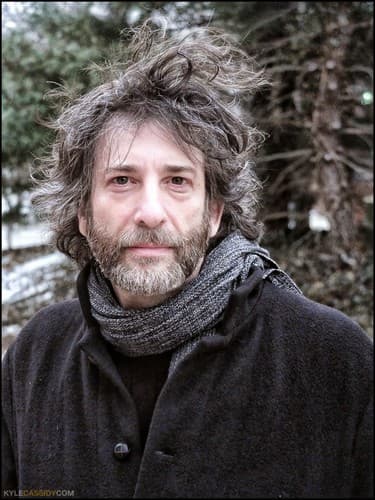
Neil Richard MacKinnon Gaiman is an English author of short fiction, novels, comic books, graphic novels, audio theatre, and a screenwriter. His works include the comic book series The Sandman and the novels Good Omens, Stardust, Anansi Boys, American Gods, Coraline, and The Graveyard Book. He has won numerous awards, including the Hugo, Nebula, and Bram Stoker awards, as well as the Newbery and Carnegie medals. He is the first author to win both the Newbery and the Carnegie medals for the same work, The Graveyard Book (2008). In 2013, The Ocean at the End of the Lane was voted Book of the Year in the British National Book Awards. It was later adapted into a critically acclaimed stage play at the Royal National Theatre in London.







