“Never trust a dead man, for they have nothing to lose.”
— The overarching warning given to the protagonist, Wick, by his father.

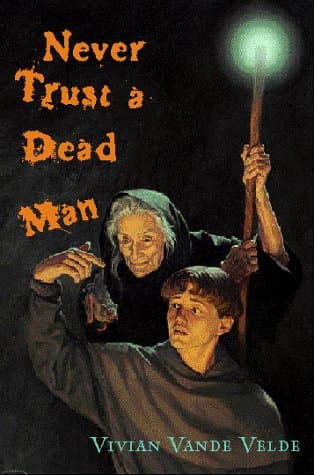
Vivian Vande Velde (1999)
Genre
Fantasy / Children's / Mystery / Young Adult
Reading Time
180 min
Key Themes
See below
Sign in to track this book
Accused of murder and sealed in a burial cave with his rival's corpse, Selwyn must grudgingly team up with the resurrected dead man and a witch to unmask the true killer before he starves or succumbs to something far more sinister.
Selwyn Roweson's life takes a turn for the worse when Anora, the girl he loves, rejects him for Farold, a stronger and more popular villager. Their rivalry escalates into a public brawl where Farold humiliates Selwyn. Later that night, Farold is discovered dead, impaled by Selwyn's knife. Despite Selwyn's pleas of innocence, the villagers, led by Farold's influential father, Lord Gower, quickly convict him based on the evidence and his previous threats. As punishment, Selwyn is sealed alive in the village burial cave, a grim tomb shared with Farold's corpse, left to die of starvation or despair. His hopes dwindle as the heavy stone door closes, plunging him into darkness and the stench of death.
Just as Selwyn succumbs to despair in the burial cave, a mysterious old woman, Sybil, appears from a hidden passage. She introduces herself as a witch and, after a brief, painful demonstration of her magical abilities (a sharp slap), she offers Selwyn a way out of his predicament. Sybil explains that she can bring Farold back from the dead, but only temporarily, and that this reanimated corpse can help Selwyn find the true killer. Selwyn is initially horrified by the idea of working with his deceased rival, but seeing no other option, he reluctantly agrees. He understands this is his only chance at clearing his name and escaping the cave.
Sybil performs a ritual, bringing Farold's corpse back to a semblance of life. The reanimated Farold is a grotesque sight, still bearing the knife wound, and his personality remains as arrogant and disagreeable as ever, much to Selwyn's dismay. He is confused and angry, demanding to know what happened to him. Sybil explains their predicament and the need for him to help Selwyn. Despite his initial reluctance and constant bickering with Selwyn, Farold is bound by Sybil's magic to cooperate. The witch then gives them specific instructions for their investigation, emphasizing that Farold's time is limited and they must uncover the truth quickly before he fully decays.
Under Sybil's guidance, Selwyn and Farold escape the cave through a hidden passage. Their first stop is Farold's house, where they hope to find clues. Farold, still adjusting to his undead state, is helpful in navigating his former home. They find Anora, Farold's newly widowed wife, who appears to be grieving, but Selwyn notices an unusual composure about her. She expresses sorrow but also a strange lack of surprise or anger regarding the murder. Their interaction is tense, with Anora unaware of Farold's spectral presence. They observe her behavior and search for anything out of place, but the initial visit yields no definitive answers, only more questions about Anora's true feelings.
Continuing their investigation, Selwyn and Farold visit the village weaver, known for her gossip. The weaver reluctantly reveals that Farold was having an affair with a married woman, Elara, the daughter of a prominent merchant. This revelation complicates Selwyn's initial assumption that Anora was the primary suspect. Later, while observing Anora, Selwyn and Farold witness her meeting secretly with another man, a young stable hand named Fenn. Their interaction is intimate, suggesting a deeper relationship than mere acquaintances. This discovery immediately shifts Selwyn's focus, making Fenn a new person of interest and raising further doubts about Anora's supposed grief and innocence.
Selwyn, accompanied by the unseen Farold, decides to confront Fenn directly. He finds Fenn in the stable and pressures him about his relationship with Anora. Fenn, initially defensive, eventually confesses his deep love for Anora. He admits they had planned to run away together, but he vehemently denies any involvement in Farold's murder. Fenn insists that he would never resort to violence, especially not against Farold, who he knew was a powerful and well-connected man. Selwyn, despite his personal feelings for Anora, tries to discern the truth from Fenn's emotional plea, while Farold's spectral presence watches with anger and disbelief.
Following the lead about Farold's affair, Selwyn and Farold approach Elara, the merchant's daughter. They find her in distress and fear. She confesses to the affair, revealing that Farold had been pressuring her and threatening to expose their secret if she didn't comply. Elara also reveals that her husband, Borin, is prone to extreme jealousy and has a violent temper, having beaten her before. She expresses fear that Borin would kill her if he ever found out about the affair. This information immediately makes Borin a strong suspect, as he had a clear motive and a history of violence.
Selwyn and Farold track down Borin, Elara's husband, and confront him. Borin, a large and menacing man, quickly becomes aggressive when questioned about Farold. He admits he hated Farold for his perceived arrogance and for flirting with Elara, but denies killing him. However, under pressure, Borin reveals a crucial detail: he saw someone else near Farold's house on the night of the murder, a figure he couldn't clearly identify but described as having a distinctive limp. This new piece of information shifts the focus away from Borin and points towards a different, unknown perpetrator, while Farold grows increasingly agitated by the revelations.
With the detail of the limp, Selwyn and Farold realize that Ulf, a village guard known for his lameness, fits the description. They follow Ulf, observing his movements and behavior. They eventually uncover that Ulf was bribed by Lord Gower, Farold's father, to frame Selwyn. Ulf, it turns out, was not the killer, but he was instrumental in planting Selwyn's knife and ensuring Selwyn was found guilty. This revelation exposes a deeper conspiracy, indicating that Lord Gower had a hand in manipulating the evidence, though his motive remains unclear at this point, further complicating the web of deceit surrounding Farold's death.
Selwyn and Farold, with Sybil's guidance, finally confront Lord Gower. Under intense questioning and with the threat of Sybil's magic, Lord Gower breaks down and confesses. He reveals that Farold was not his biological son, but the product of an affair his wife had with a traveling merchant. Farold had recently discovered this truth and was threatening to expose it, which would have ruined Lord Gower's reputation and political standing. To prevent this, Lord Gower arranged for Farold's murder, manipulating Ulf to frame Selwyn, who was already unpopular. The true killer, however, remains a mystery, as Lord Gower only orchestrated the plot.
As Farold's time runs out and his body visibly deteriorates, Sybil pushes for the final truth. Anora, cornered and with nowhere left to hide, finally confesses. She reveals that Farold was abusive and cruel, and that he had discovered her secret relationship with Fenn. Farold had threatened to publicly shame Fenn and make Anora's life a misery. In desperation, fearing for her own safety and Fenn's future, Anora stabbed Farold with Selwyn's knife, which she knew he often left lying around. She then fled, leaving the knife in place, knowing that Selwyn would be the prime suspect, thus ensuring her escape from Farold and protecting Fenn.
With Anora's confession, the truth is laid bare. Anora is arrested and faces justice for Farold's murder. Selwyn is exonerated and released from the cave, his name cleared. As Farold's reanimated body can no longer sustain itself, he gives Selwyn a final, surprisingly sincere, nod of respect before crumbling into dust, returning to his eternal rest. Sybil, her mission complete, disappears as mysteriously as she arrived. Selwyn, though scarred by the ordeal, has gained understanding of the complexities of human nature and the hidden lives within his village. He emerges from the ordeal a changed man, no longer naive, but with a clearer vision of justice and truth.
The Protagonist
From a heartbroken and falsely accused victim, Selwyn transforms into a determined investigator, learning to question assumptions and uncover complex truths.
The Victim/Antagonist (posthumous)
Though technically dead, Farold's 'arc' involves confronting the unpleasant truths about his own life and the people around him, leading to a grudging respect for Selwyn.
The Supporting
Sybil's arc is largely static; she is a force of nature who facilitates the main characters' growth without undergoing significant personal change herself.
The Antagonist
Anora transitions from a perceived victim to the unexpected perpetrator, revealing the lengths to which a desperate individual will go.
The Antagonist
Lord Gower's arc involves his fall from respected leader to a man exposed for his deceit and moral failings.
The Supporting
Fenn remains largely static, serving as a catalyst for revealing Anora's true motivations.
The Supporting
Elara's arc is brief, focusing on her revelation of Farold's character and her husband's violent tendencies.
The Supporting
Borin serves as a red herring, his arc demonstrating how initial impressions can be misleading in a murder investigation.
The Mentioned
Ulf's role is primarily functional, serving as a key piece of evidence in uncovering Lord Gower's plot.
The novel explores the disparity between perceived justice and actual truth. Selwyn is condemned based on circumstantial evidence and his reputation, while the true killer remains hidden behind layers of deceit. The story highlights how easily appearances can mislead and how difficult it is to uncover real motives and actions. From Farold's public persona to Anora's feigned grief and Lord Gower's respected status, the narrative constantly challenges characters and readers to look beyond the surface, emphasizing that true justice requires a thorough and unbiased search for facts, not quick judgments.
““They say the dead tell no tales, but sometimes the living lie even better.””
The theme of power's corrupting influence is central, particularly through Lord Gower. His high status and desire to protect his family's reputation lead him to orchestrate the framing of an innocent man and cover up a murder. Farold's arrogance stems from his family's influence, allowing him to bully and manipulate others without consequence. The villagers' readiness to believe Lord Gower's accusations against Selwyn demonstrates how easily authority can sway public opinion, even in the face of injustice. The story suggests that power, unchecked by morality, can lead to severe abuses and a perversion of justice.
““A man with a good name can do murder and call it justice, if he’s clever enough.””
The narrative uncovers the hidden lives and secret motivations of nearly every character. Farold, initially seen as merely arrogant, is revealed to be an abuser and blackmailer. Anora, the grieving fiancée, harbors a secret love and a desperate capacity for violence. Lord Gower maintains a facade of honor while hiding a scandalous family secret. Even seemingly minor characters like Elara and Fenn have their own concealed struggles and desires. This theme shows that people are rarely what they seem on the surface and that complex, often dark, reasons drive their actions, making the search for truth a journey through personal secrets.
““Everyone has secrets, Selwyn. Some are just better at hiding them.””
A significant theme is the forced reconciliation and unexpected alliance between Selwyn and the reanimated Farold. Despite their intense rivalry and mutual dislike, they are compelled to work together to achieve a common goal: uncovering the truth of Farold's murder. This unlikely partnership forces both characters to set aside their animosity, at least partially, and view each other in a new light. Farold, in death, gains perspective on his own life and Selwyn's character, while Selwyn learns to tolerate and even begrudgingly respect certain aspects of his former enemy. This theme suggests that even the most bitter enemies can find common ground when faced with a shared objective, leading to surprising moments of understanding.
““Funny how being dead changes your perspective on who your friends are. Or aren’t.””
Farold's magical resurrection drives the investigation.
The reanimated corpse of Farold is the central plot device. It provides Selwyn with an unwilling, yet crucial, partner in his investigation. Farold's unique perspective as the victim, combined with his ability to interact with the living (albeit unseen by most), allows for direct access to information and situations that Selwyn alone could not achieve. It also adds a layer of dark humor and constant conflict, as Selwyn must tolerate his former rival, even in death. This device not only propels the plot forward but also deepens the character development of both Selwyn and Farold as they are forced to interact.
Initial perceptions and testimonies are repeatedly proven false.
While Selwyn is the primary point-of-view character, the 'narrative of events' presented by the villagers and initial evidence is highly unreliable. Selwyn's immediate conviction based on planted evidence and prejudiced testimonies serves as an example. As the investigation progresses, every witness's account, every character's initial appearance, and every assumed motive is revealed to be either incomplete, biased, or outright false. This device keeps the reader guessing and reinforces the theme that truth is often hidden beneath layers of deceit and personal agendas, requiring careful and critical examination.
A secret route for escape and magical operations.
The hidden passage within the burial cave serves as a practical plot device, allowing Selwyn and Farold to escape their imprisonment and conduct their investigation without being detected by the villagers. It also functions as Sybil's lair and a place for her magical rituals, emphasizing her secretive and otherworldly nature. This device facilitates the covert nature of their quest, enabling them to observe and gather information without alerting the suspects, which is crucial for uncovering the village's deep-seated secrets and conspiracies.
Farold's decaying body creates urgency for the investigation.
Farold's reanimated state is temporary and his body is visibly decaying, creating a constant sense of urgency for the investigation. This 'ticking clock' mechanism forces Selwyn and Farold to work quickly and efficiently, preventing them from lingering on false leads or succumbing to despair. It adds tension to the plot and serves as a constant reminder of the stakes involved. The gradual deterioration of Farold's body also provides a visual representation of the fleeting nature of their opportunity to uncover the truth.
“Never trust a dead man, for they have nothing to lose.”
— The overarching warning given to the protagonist, Wick, by his father.
“The wind was cold, but it carried no secrets.”
— Wick observes the weather while searching for clues in the graveyard.
“It's not a lie if you believe it yourself.”
— A deceptive character's justification for their actions.
“Sometimes the greatest mysteries are hidden in plain sight.”
— Wick reflects on his investigation and overlooked details.
“The dead don't care about your excuses.”
— Wick feels the pressure of solving the murder, regardless of his difficulties.
“A good story always has a twist, even if it's not a happy one.”
— A character comments on the unfolding events of the murder.
“Fear can make even the bravest man a coward.”
— Wick grapples with his own anxieties and the dangers he faces.
“The past is never truly buried; it just waits for someone to dig it up.”
— The uncovering of old secrets relevant to the murder.
“What you don't know can hurt you, but what you *think* you know can hurt you more.”
— Wick considers the dangers of assumptions during his investigation.
“Even the smallest spark can ignite a great fire.”
— A minor detail leads to a significant breakthrough in the case.
“Justice isn't always fair, but it demands to be heard.”
— Wick reflects on the complicated nature of seeking justice for the deceased.
“The silence of the grave holds more answers than any living tongue.”
— Wick tries to interpret the limited clues from the dead man.
“Sometimes, the only way to find the truth is to get lost in the search.”
— Wick becomes deeply immersed in the mystery, often feeling overwhelmed.
Ready to see how well you understood this book? Take our interactive quiz with 10 questions.

Biography coming soon.







