“Luego pensé que era una de esas mujeres que nacen para que se las ame, y que no necesitan aprender a amar.”
— Andrea observes Ena's effortless charm and impact on others.

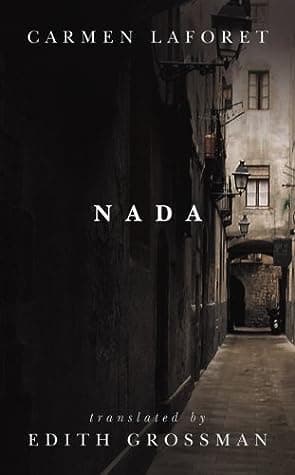
Carmen Laforet (1945)
Genre
Historical Fiction
Reading Time
240 min
Key Themes
See below
Sign in to track this book
After the Spanish Civil War, an orphaned student in Barcelona navigates her family's bohemian home and her university friends' glittering world, slowly learning unsettling truths that shape her coming-of-age.
Eighteen-year-old Andrea arrives in Barcelona, full of hope, to attend university. Orphaned and seeking a new life, she expects a good experience. However, her arrival at the family house on Calle de Aribau changes her expectations. Instead of the warm home she imagined, she finds a run-down, dirty apartment with her unusual, argumentative relatives: her strict aunt Angustias, her artistic and cruel uncle Román, her violent uncle Juan, and Juan's beautiful, suffering wife Gloria, along with the quiet grandmother and the maid Antonia. The house immediately feels oppressive, marked by poverty, old fights, and a suffocating mood of decay and sadness. Andrea's initial optimism quickly turns to unease and disappointment.
Andrea's first few months are controlled by her aunt Angustias. Angustias tells Andrea what to do, from her studies to her social life, often scolding her and trying to teach her conservative values. Andrea feels trapped and wants personal freedom. The tension between Angustias and the other family members, especially Román and Gloria, is clear, adding to the house's oppressive mood. Angustias then announces she will leave the house and enter a convent, saying she is disgusted by the family's behavior. Her departure, while creating a gap, also gives Andrea a new, though fragile, sense of freedom, letting her explore Barcelona and university life more openly.
With Angustias gone, Andrea focuses on her university studies. She quickly becomes friends with Ena, a striking and smart classmate from a wealthy family. Ena introduces Andrea to her friends, including Jaime, Ena's quiet boyfriend, and Pons, an artist. This group shows a world of intellectual activity, art, and comfort that contrasts with the dirt and emotional lack of the Calle de Aribau house. Andrea likes their talks, their freedom, and their seemingly carefree lives. She often joins them for coffee, walks, and art gallery visits, finding a temporary escape from her family's problems and a look at a more hopeful future.
Andrea finds herself drawn to her uncle Román, a charming and mysterious man who has a strong appeal despite his cruel nature. Román is a talented musician and intellectual, able to charm anyone with his stories and ideas. He often invites Andrea to his room, where he plays the violin and talks about philosophy, art, and life, giving her a different kind of education. However, Andrea also sees his manipulative side and his cruel treatment of Gloria and Juan. She observes his power over others, including some of her university friends, and senses a deep emptiness in him. Román's complex personality both fascinates and repels Andrea, making him a central, unsettling presence in her life at Calle de Aribau.
As Andrea spends more time in the house, she starts to understand the family's past. She learns about the bitter fights between Román and Juan, caused by their shared past and Román's past affair with Gloria. Gloria, despite her beauty, lives a life of quiet sadness, constantly abused by Juan and manipulated by Román. Andrea discovers that Gloria secretly gambles to provide for the family, which further shows their poverty and the falseness of their respectable appearance. The house, once a symbol of her family, becomes a monument to their failures, resentments, and the psychological scars of the Civil War. Andrea's innocence fades with these discoveries, forcing her to face her relatives' harsh lives.
Andrea observes with growing unease Ena's increasing interest in Román. Ena, usually so self-controlled, seems drawn to Román's dark charm, spending time alone with him in his room. This puzzles and disturbs Andrea, as she knows about Román's manipulative ways and his past with Gloria. Ena and Román's relationship becomes a source of tension and mystery, straining Andrea's friendship with Ena. Andrea tries to understand Ena's reasons, sensing a dangerous game. This interaction shows Román's wide influence, even outside the immediate family, and further complicates Andrea's already difficult emotions.
The mood in the Calle de Aribau house becomes more unstable. Juan's violence towards Gloria grows, often turning into public outbursts of rage and physical abuse. The grandmother's health worsens, and the family's money problems become more severe. Román, seemingly detached, continues to use his psychological power. One day, a shocking event hits the household: Román is found dead in his room, having killed himself. The discovery throws the family into deeper sadness and disorder. His death, while removing a central figure of manipulation, leaves a deep emptiness and forces the remaining family members to face their shared tragedies and the emptiness of their lives.
After Román's suicide, the house is quiet, filled with grief and unspoken blame. Juan is especially sad, showing the complex bond he had with his brother. At this time, Ena finally tells Andrea the truth behind her involvement with Román. She confesses that she had sought out Román to understand her mother's past relationship with him, a secret that had long bothered her family. Ena had planned to get revenge for the pain Román had caused her mother, but Román's death happened first. This revelation clarifies Ena's actions and strengthens the bond between the two friends, as Andrea finally understands Ena's true reasons.
Through the year's events, Andrea changes a lot. The initial shock and sadness of her arrival slowly turn into a more mature and detached view. She sees that trying to change her family's deep-seated behavior and suffering is pointless. While she still cares for them, she understands she needs emotional distance for her own well-being. Her university studies and her friendship with Ena become her anchors, giving her intellectual stimulation and emotional support. Andrea's experiences in the Calle de Aribau house, though hard, have removed her youthful innocence, leaving her with a clearer understanding of people and the strength needed to live in a difficult world.
As the school year ends, Andrea gets a life-changing offer. Ena, whose family is moving to Madrid, invites Andrea to come with them and continue her studies there. The invitation is a lifeline, a chance to escape the stifling atmosphere of Calle de Aribau and truly start fresh. Despite the sadness of leaving her family, Andrea takes the opportunity with new purpose and hope. She packs her few things, takes one last look at the dark, oppressive house, and steps out into the morning light. Her leaving Barcelona shows her clear break from the past and her brave step towards an independent future, free from the 'nothing' that had filled her year.
The Protagonist
Andrea transforms from a hopeful but naive girl into a wiser, more resilient young woman, shedding her illusions and embracing her independence.
The Supporting
Angustias's arc is brief, serving to establish the oppressive atmosphere of the house before her departure frees Andrea.
The Antagonist/Supporting
Román's arc is one of sustained psychological manipulation, culminating in his dramatic self-destruction, which leaves a lasting impact.
The Supporting
Juan's arc is one of sustained suffering and violence, ending in deeper despair after Román's death, without significant personal growth.
The Supporting
Gloria endures her circumstances with quiet resilience, her arc highlighting her unwavering, if desperate, commitment to survival.
The Supporting
Ena's arc involves pursuing a complex personal vendetta, which she eventually confides in Andrea, strengthening their bond.
The Supporting
The Grandmother's arc is one of slow physical and mental decline, symbolizing the decay of the family and their past.
The Supporting
Antonia's role is largely static, serving as a constant, reliable presence within the chaotic household.
The Supporting
Pons's arc is minor, serving mainly to highlight Andrea's foray into a different social world and a brief, unfulfilled romantic possibility.
Andrea's journey is one of self-discovery. Arriving in Barcelona, she is new, full of simple hopes. Through her experiences in the Calle de Aribau house and her time with university friends, she loses her innocence and starts to define herself apart from her oppressive surroundings. The novel explores how surroundings shape identity, but Andrea's strength allows her to make her own path. She learns who she is by seeing who she is not, rejecting her family's 'nothing' existence. Her decision to leave Barcelona at the end shows her active choice to build her own future.
“And I, who knew nothing of life, who had just come from a small town, found myself alone in the midst of a family of madmen. It was as if I had fallen into a well.”
The novel is set in post-Civil War Spain, especially Barcelona. The physical decay of the Calle de Aribau house reflects the societal and moral decay that followed the war. Poverty, hunger, and a deep sense of sadness fill the lives of Andrea's relatives, who are psychologically hurt and stuck in their past grievances. The contrast between the house's dirt and the relative wealth and intellectual freedom of Andrea's university friends shows the clear divisions and struggles in a society dealing with its recent history. The 'nada' in the title reflects the emptiness and hopelessness many felt then.
“The house was a symbol of all our ruin, of all our poverty, of the nothingness that had consumed us.”
The Calle de Aribau household is an example of extreme family problems. The relationships involve rivalry, abuse (physical and psychological), manipulation, and deep resentment. Angustias's strictness, Román's cruel manipulation, and Juan's violent outbursts create an oppressive environment for Andrea. The family is stuck in a cycle of suffering, unable to escape their past or present. Andrea, as an observer, analyzes the destructive patterns, which eventually leads her to seek escape from her relatives' suffocating ties and their 'cursed' house.
“It was as if I were living in a nightmare from which I could not wake up, a nightmare made of people and their passions.”
The novel explores the different experiences of women in post-war Spain, from Andrea's search for independence to Gloria's quiet suffering and Ena's strong intelligence. Andrea lives in a world where women are often controlled by men and societal expectations. Gloria's secret gambling to support her family shows the hidden strengths and sacrifices of women. Ena, with her intellectual curiosity and bold search for understanding, represents a more modern, free woman. Despite the oppressive conditions, the female characters show remarkable strength and ability to survive, each in her own way fighting against or adapting to her limits.
“I had to be strong. I had to learn to live with the nothingness, or to escape it.”
The title 'Nada' (Nothing) is a main theme, representing the emptiness, sadness, and lack of meaning that fill Andrea's life in Barcelona. The characters at Calle de Aribau seem stuck in a state of existential 'nothingness,' their lives without hope or purpose beyond their internal conflicts. Andrea initially feels this 'nothing' strongly, but her journey is about actively finding meaning and purpose despite it. Her university studies, her friendships, and her observations of the world outside the house offer glimpses of something beyond the 'nothingness.' Ultimately, her departure is an act of defiance against the 'nothing,' choosing hope and a future over the void.
“There was a void in my heart, a terrible nothingness that no one could fill.”
Andrea's subjective account of her year in Barcelona, filtering events through her evolving perspective.
The entire novel is narrated by Andrea in the first person, looking back at her year in Barcelona. This allows for a deeply intimate and subjective portrayal of events, filtered through her evolving consciousness. Her initial naivety gives way to a more mature understanding, and the retrospective nature allows her to reflect on the significance of what she experienced. This narrative choice immerses the reader directly into Andrea's emotional and intellectual journey, making her observations and interpretations central to the story, and emphasizing her role as an outsider-observer within her own family.
The dilapidated house on Calle de Aribau symbolizes the decay of a family and post-war Spanish society.
The house on Calle de Aribau is much more than just a setting; it acts as a powerful metaphor for the entire novel's themes. Its physical dilapidation, dirt, and claustrophobia mirror the moral, psychological, and economic decay of the family living within its walls. It is a symbol of the lingering scars of the Civil War, the 'genteel poverty' that masks deeper dysfunction, and the suffocating grip of the past. The house embodies the 'nada' (nothingness) that permeates the lives of Andrea's relatives, trapping them in a cycle of despair and resentment. Andrea's eventual escape from the house signifies her liberation from its oppressive influence.
The juxtaposition of Andrea's two worlds highlights societal divisions and personal growth.
Laforet masterfully uses contrast to emphasize the novel's themes. The most prominent contrast is between the squalid, emotionally charged, and impoverished world of the Calle de Aribau house and the vibrant, intellectual, and relatively privileged world of Andrea's university friends, particularly Ena. This juxtaposition highlights the stark societal divisions in post-Civil War Barcelona. Furthermore, Andrea's initial youthful optimism is contrasted with the despair of her relatives, and her growing maturity stands in contrast to their static dysfunction. This device effectively underscores the 'nada' of one world versus the potential for meaning in another.
The scarcity and quality of food symbolize the family's poverty and spiritual deprivation.
Food, or rather the lack thereof and its poor quality, serves as a significant symbol in 'Nada.' The constant hunger Andrea experiences, the meager and unappetizing meals, and the family's obsession with basic sustenance underscore their extreme poverty and the material deprivation of post-war Spain. Beyond physical hunger, the lack of nourishing food also symbolizes the spiritual and emotional starvation within the Calle de Aribau household. The rare instances of good food or the act of sharing it (like with Ena) stand out as moments of warmth or connection, highlighting the general absence of such comforts in Andrea's home life.
“Luego pensé que era una de esas mujeres que nacen para que se las ame, y que no necesitan aprender a amar.”
— Andrea observes Ena's effortless charm and impact on others.
“La vida era para mí una cosa de color gris, sin matices, sin alegría, sin sentido. Una cosa que había que soportar.”
— Andrea reflects on her initial disillusionment and despair in Barcelona.
“Mi familia, como todas las familias que se respetan, guardaba un montón de secretos.”
— Andrea's early observation about the hidden complexities of her family.
“Sentía que el mundo era una cosa extraña, llena de posibilidades, pero también de peligros.”
— Andrea's growing awareness of the world's dual nature as she matures.
“La pobreza era una sombra que se cernía sobre todo, que lo empañaba y lo hacía triste.”
— Andrea's vivid perception of the pervasive impact of poverty on her family and surroundings.
“Y la vida seguía, estúpida, monótona, cruel, y yo con ella, arrastrándome como un insecto.”
— Andrea's feeling of powerlessness and insignificance amidst her difficult circumstances.
“Era curioso cómo las cosas más sencillas podían ser a la vez las más complicadas.”
— Andrea's reflection on the deceptive simplicity of life's challenges.
“Había en ella una curiosa mezcla de candor y de perversidad, de inocencia y de experiencia.”
— Andrea describing Ena's multifaceted and enigmatic personality.
“La luz de la luna entraba por la ventana, llena de melancolía y de promesas.”
— A poetic description of the atmosphere, reflecting Andrea's inner state.
“Yo quería vivir, y sentía que la vida se me escapaba, se me escurría entre los dedos.”
— Andrea's yearning for life and her frustration at its elusiveness.
“El tiempo pasaba, pero no se llevaba el dolor, solo lo escondía un poco.”
— Andrea's realization that time doesn't necessarily heal all wounds.
“Todo era nada, y yo también era nada, perdida en medio de la ciudad, de la vida, del mundo.”
— Andrea's ultimate feeling of insignificance and emptiness, a central theme of the novel.
“No había más que una salida: huir. Huir de todo, de todos, de mí misma.”
— Andrea's desperate thought about escaping her oppressive circumstances.
“Y entonces comprendí que la vida era una cosa que se movía, que no se detenía nunca, que había que seguir.”
— Andrea's final realization about the relentless forward motion of life, despite its challenges.
Ready to see how well you understood this book? Take our interactive quiz with 10 questions.

Carmen Laforet was a Spanish writer best known for her debut novel, 'Nada' (1945). This critically acclaimed work, which won the Nadal Prize, is considered a seminal piece of post-war Spanish literature, capturing the disillusionment and atmosphere of the time. Laforet's writing is noted for its psychological depth and exploration of female experience.







