“Femi makes three, you know. Three, and they label you a serial killer.”
— Korede's sister Ayoola has killed three boyfriends, and Korede reflects on the pattern.

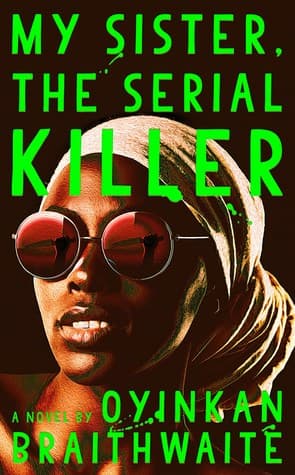
Oyinkan Braithwaite (2018)
Genre
Thriller / Mystery
Reading Time
180 min
Key Themes
See below
Sign in to track this book
A Nigerian nurse’s loyalty to her charming, homicidal sister is tested when the man she loves becomes her sister's next potential victim, forcing a darkly comedic choice between family and justice.
The novel starts with Korede getting a frantic call from her beautiful younger sister, Ayoola. This is common; Ayoola has killed a boyfriend again, claiming self-defense. Korede, a nurse, finds Femi, a known architect, dead in the bathtub with a knife wound. Korede, calm and efficient, helps Ayoola clean the crime scene. She meticulously scrubs blood, disposes of the body in a river, and removes all evidence. This grim routine shows their pattern: Ayoola is the impulsive, charming killer, and Korede is her unwilling, yet loyal, accomplice. Korede's thoughts show her mixed feelings: disgust at Ayoola's acts, but a strong commitment to protect her sister.
After disposing of Femi's body, Korede returns to her job as a nurse at a Lagos hospital. The secret of Ayoola's crimes weighs on her, making her cynical and causing her to talk to a comatose patient about her sister's murderous tendencies. Korede loves Tade Otumu, a kind doctor at the hospital, but she thinks she is too plain and burdened by her family's dark secrets to ever be with him. She watches Tade from afar, wanting his attention but feeling unworthy. Her inner conflict grows as she wants a normal life, free from Ayoola's violence, but feels permanently connected to her.
After Femi's 'disappearance,' Ayoola, a fashion designer, publicly mourns him on social media. She posts heartfelt tributes and photos, acting like a heartbroken girlfriend. This planned performance gains her public sympathy and more social media followers, boosting her brand. Korede watches this show with resentment and a grim respect for Ayoola's manipulative skills. The public sees Ayoola as a beautiful, grieving victim, which is far from the reality Korede knows. This further isolates Korede in her secret knowledge and deepens her cynicism about human nature and appearances.
Korede's worst fears come true when Ayoola visits the hospital and, with her usual charm, catches Tade's eye. Despite Korede's desperate attempts to subtly warn Tade away from her sister, Ayoola and Tade begin dating. Korede feels consumed by jealousy and terror. She is horrified at the thought of Tade, the man she loves, becoming Ayoola's next victim. This makes Korede face the ultimate choice: protect her sister, as she always has, or save the man she loves, possibly exposing Ayoola and destroying their family forever. Her loyalty is pushed to its limit.
As Ayoola and Tade's relationship grows, Korede's anxiety increases. She tries subtle ways to deter Tade, making veiled comments about Ayoola's past relationships and hinting at her sister's superficiality. But Tade, completely charmed by Ayoola's beauty and energy, misunderstands or dismisses her warnings. Korede even tries to make herself more appealing to Tade, changing her appearance, but her efforts fail. Her attempts to protect Tade are hindered by her inability to tell the truth, as that would implicate herself and betray Ayoola, whom she still feels bound to protect.
The relationship between Ayoola and Tade moves fast, to Korede's horror. One evening, Tade calls Korede, supposedly to discuss Ayoola, but instead reveals he has proposed marriage to her sister. This news devastates Korede. The thought of Tade marrying Ayoola, knowing what she is capable of, is unbearable. The proposal makes Korede's inner conflict, the choice between loyalty and justice, love and complicity, even more urgent and painful. She feels a desperate need to act, but any action has huge consequences.
Throughout the story, Korede remembers her childhood. Their father was physically abusive and often beat their mother. One day, their father attacked their mother with a knife. Ayoola, then a young girl, stepped in and stabbed him to death. Korede, also a child, helped Ayoola clean up and dispose of the body, starting their pattern of complicity. These flashbacks show where Ayoola's violence and Korede's protective instincts came from, revealing the traumatic basis of their bond and hinting at the psychological reasons for Ayoola's later actions, without excusing them.
Driven to despair by Tade's engagement to Ayoola, Korede reaches her breaking point. She confesses the entire truth about Ayoola's serial killings, Femi's murder, and their father's death to the comatose patient she has been talking to for months. This confession, while not directly affecting the plot at this moment, is a big emotional release for Korede and a full expression of her burden. It shows her desperate need to unburden herself, even to someone unresponsive, and highlights her inner struggle with morality and loyalty.
Despite Korede's desperate attempts, the inevitable happens. Tade is found dead, stabbed by Ayoola. The details of his death are unclear at first, but Ayoola is clearly responsible. Korede is devastated, her worst fears realized. The police investigate, but Ayoola's story of self-defense, along with her innocent look and lack of evidence, makes her seem like a grieving victim again. Korede must deal with the aftermath, struggling with her grief, guilt, and the familiar, sickening task of protecting her sister from the results of her actions.
In a cruel twist, the comatose patient to whom Korede confessed Ayoola's crimes begins to recover. Korede is terrified that her detailed confessions will be revealed, implicating both her and Ayoola. This creates a new, immediate threat to their secret. Korede now faces the possibility of the truth coming out, not by her choice, but by an external, uncontrollable factor. The irony is clear: her only confidante might be their downfall.
As the investigation into Tade's death continues, Korede sees Ayoola's detached and calculating behavior. She realizes that Ayoola's 'self-defense' claims are a carefully made story and that her sister is a true psychopath, with no remorse. Korede faces the painful truth that her loyalty has not only enabled Ayoola but has also made her complicit in the murders. This realization changes Korede's view significantly, moving her from unwilling accomplice to someone who, for the first time, truly considers the meaning of her choices and the nature of her sister's evil. She sees Ayoola not just as her sister, but as a dangerous predator.
Faced with the recovering patient, Korede visits him, bringing him a gift and making sure he is comfortable. She subtly reminds him that he was comatose and could not have heard anything. The meaning is clear: Korede is reinforcing the idea that he heard nothing, protecting Ayoola one last time. However, this act has an unclear quality. While she continues to shield her sister, it is a choice from a deeper, more complicated understanding of their bond and the impossibility of escape. The ending makes the reader think about the true nature of Korede's loyalty and if she has truly broken free from Ayoola's influence, or if she is forever bound by blood.
The Protagonist
Korede struggles with her loyalty to Ayoola, eventually realizing the depth of her sister's psychopathy and the extent of her own complicity, leading to a complex, unresolved choice to continue protecting her.
The Antagonist
Ayoola remains static in her psychopathic tendencies, never expressing remorse or changing her behavior, instead perfecting her manipulative facade.
The Supporting
Tade's arc is tragically cut short; he is introduced as a beacon of hope for Korede but becomes another victim of Ayoola's unchecked violence.
The Supporting
Starts as a silent recipient of Korede's confessions and ends as a potential threat, forcing Korede to make a final choice.
The Mentioned
Femi's arc is brief, serving as an initial catalyst for the plot and demonstrating Ayoola's pattern of behavior.
The Supporting
Her arc is largely in the past, her trauma shaping the sisters' present, but she remains a passive figure, unable to break the cycle of family secrets.
The Mentioned
His arc is entirely in the past, his death serving as the traumatic origin point for the sisters' complicity.
The Supporting
His role is to investigate, but he remains largely ineffective against Ayoola's manipulative charm, reinforcing the theme of justice being blind to beauty.
This is the novel's main conflict. Korede feels pulled between her strong loyalty to her sister, Ayoola, and her own morals, which disagree with Ayoola's serial killings. Her actions, from cleaning crime scenes to actively protecting Ayoola, come from a deep, though resentful, family bond made strong by childhood trauma. The novel explores how far someone will go for family, even when that family is clearly evil, showing how complex and often irrational such bonds are. Korede's thoughts constantly examine this ethical problem, questioning her own involvement.
“I love Ayoola. I do. But she is a serial killer, and I am her accomplice. How does one reconcile these two things?”
The novel looks at how beauty and charm can blind people to the truth and let individuals act without punishment. Ayoola's stunning looks are her strongest weapon; they disarm her victims, charm the public, and even influence law enforcement. Korede, who sees herself as plain, watches with bitter resentment how Ayoola's beauty lets her avoid consequences, while Korede's own good qualities go unnoticed. This theme shows societal biases and how superficial perception is, where outward appearance often matters more than character or truth, letting evil hide in plain sight.
“Beauty is a gift, Ayoola often says. And she uses hers like a weapon. A very effective one.”
The sisters' traumatic childhood, especially their father's extreme domestic abuse and Ayoola killing him in self-defense, is a key part of the story. This shared trauma connects them and is presented as a possible reason for Ayoola's later psychopathy and Korede's protective instincts. The novel suggests that the cycle of violence and the secrets that follow can deeply hurt individuals and shape their future actions, creating a dysfunctional situation that is very hard to break. The past always bothers Korede, affecting her current choices.
“Our father had been a monster, and Ayoola had been a child. She had done what she had to do.”
Korede's job as Ayoola's 'cleaner' puts her in a position of active complicity, blurring the lines between victim and perpetrator. The novel explores the psychological cost of enabling someone else's crimes, even when driven by love or loyalty. Korede struggles with intense guilt, self-hatred, and the constant fear of being found out. Her thoughts are full of her attempts to match her actions with her own moral code, showing how complicity can corrupt a person's sense of self and trap them in lies.
“I was an accomplice. I was a part of it. And that made me just as bad.”
Provides direct access to Korede's conflicted thoughts and feelings.
The story is told entirely from Korede's perspective, immersing the reader in her cynical, pragmatic, and morally conflicted mind. This narrative choice is crucial for understanding the depth of her internal struggle, her unique perspective on Ayoola, and the heavy burden of her complicity. It allows for direct access to her dark humor, her unrequited love for Tade, and her constant battle between loyalty and conscience. The limited perspective also creates dramatic irony, as the reader experiences the world through Korede's biased and burdened lens.
Reveals the traumatic origins of the sisters' bond and Ayoola's violence.
Throughout the narrative, Korede experiences fragmented flashbacks to her childhood, particularly the traumatic event of their father's abuse and his subsequent death at Ayoola's hands. These flashbacks serve to explain the deep-seated loyalty Korede feels for her sister and provide a psychological context for Ayoola's murderous tendencies, even if they don't fully justify them. They reveal the 'original sin' that binds the sisters and establishes the pattern of cover-ups, adding depth to their complex relationship.
A symbolic confidant who becomes a literal threat.
The unnamed comatose patient serves as a unique plot device. Initially, he is a symbolic 'confidant' for Korede, allowing her to vocalize her deepest fears, guilt, and the truth about Ayoola without fear of judgment or exposure. He represents her desperate need to unburden herself. His unexpected recovery late in the novel transforms him into a literal ticking time bomb, a potential witness who heard all of Korede's confessions, thus creating a new layer of suspense and forcing Korede into a final, ambiguous act to protect her sister.
Uses black comedy to highlight the absurdity and horror of the situation.
Braithwaite employs dark humor and satirical elements, particularly through Korede's internal monologues, to underscore the grim absurdity of the sisters' situation. Korede's dry wit and cynical observations about life, love, and the meticulous process of body disposal provide moments of levity against the horrific backdrop of serial murder. This device makes the uncomfortable subject matter more accessible and highlights the author's commentary on societal norms, particularly the superficiality and corruption that allow Ayoola to thrive.
“Femi makes three, you know. Three, and they label you a serial killer.”
— Korede's sister Ayoola has killed three boyfriends, and Korede reflects on the pattern.
“I am not a bad person. I am just a person who has done bad things.”
— Korede justifies her actions in covering up her sister's crimes.
“Beauty is a curse. You might not think so, but it is.”
— Korede muses on her sister Ayoola's attractiveness and its consequences.
“The problem with cleaning up after a murder is that you can never be sure you got everything.”
— Korede describes the meticulous and anxiety-inducing process of disposing of evidence.
“Love is not a rational thing. It is a feeling, and feelings are not bound by logic.”
— Korede reflects on her unrequited love for Tade, a doctor at her hospital.
“Sometimes I think I am the only sane person in this family.”
— Korede feels burdened by her family's dysfunction and her role as the responsible one.
“A sister is both your mirror—and your opposite.”
— Korede contemplates her complex relationship with Ayoola.
“I have learned that the best way to avoid suspicion is to act normal. But what is normal, really?”
— Korede discusses the psychological toll of maintaining appearances after the murders.
“The dead are easy to love. They make no demands.”
— Korede thinks about the simplicity of her affection for a comatose patient compared to her living relationships.
“Jealousy is a green-eyed monster, but it is also a very human emotion.”
— Korede admits her envy of Ayoola's beauty and carefree life.
“We are bound by blood, and blood is thicker than water, but it is also stickier and harder to clean.”
— Korede reflects on the inescapable ties and messiness of family loyalty.
“In the end, we are all just trying to survive, by any means necessary.”
— Korede rationalizes her and Ayoola's actions as survival mechanisms.
“The truth is a fragile thing. It can be bent, broken, or buried, but it never really goes away.”
— Korede acknowledges the persistent nature of truth despite her efforts to conceal it.
“Sometimes the people we love the most are the ones who hurt us the deepest.”
— Korede laments the pain caused by her sister's actions and her own complicity.
Ready to see how well you understood this book? Take our interactive quiz with 10 questions.

Biography coming soon.







