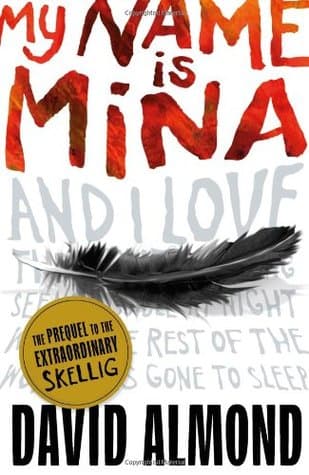
“I am Mina and I am a writer. I live in the house that is full of books.”
— Mina's self-introduction and her environment.

David Almond (2010)
Genre
Fantasy / Children's / Young Adult
Reading Time
320 min
Key Themes
See below
Sign in to track this book
Mina, an imaginative young girl, fills her journal with thoughts, poems, and stories, creating a portrait of her unique world before the events of Skellig.
The story begins with Mina deciding to start a journal, inspired by an empty notebook. She immediately states her unusual approach to writing, choosing a free-flowing exploration of her mind over a linear story. Mina introduces herself, her love for the night, and her home. She mentions her mother and her father's absence, showing a deep inner world she wants to write about. Her first entries declare her intent to capture her thoughts and feelings, not just events.
Mina writes about her school experiences, showing her dislike for its rigid structure and the dullness of traditional lessons. She recounts being homeschooled and how much more engaging learning felt then, especially with her father. She contrasts the 'dead' knowledge from school with the 'living' knowledge she seeks, often found in nature, books, and her observations. Mina describes her difficulty conforming, often distracted by her thoughts and the world outside the classroom. This section shows her independent spirit and belief that true understanding comes from personal exploration and curiosity, not memorization.
Mina dedicates several entries to watching a crow build a nest in a nearby tree. She describes the crow's work, its gathering of materials, and the hatching of its chicks. This observation becomes a symbol for creation, life, and nature's wisdom. Mina feels a strong connection to the crow, seeing its actions as a reflection of her own creative impulses and life's beauty. The crow's nest symbolizes home, vulnerability, and the cycle of life and death, leading Mina to consider the mysteries of birth and continuity.
Mina often recalls her father, whose death left a hole in her life. She remembers his quirks, his love for learning, his encouragement of her unique thinking, and their shared moments of wonder. Her father was creative and free-spirited, nurturing Mina's imagination by taking her on adventures and teaching her about the world in unusual ways. Her memories also hint at sadness and his struggles, though the details are vague. His presence, even in absence, shapes her view of creativity, knowledge, and life's mysteries.
Mina thinks a lot about abstract ideas like time, eternity, and immortality. She considers how humans see time, comparing it to nature's flow and the universe's vastness. She imagines different forms of immortality – through art, memory, or the continuation of life – and questions what it means to live forever. These philosophical thoughts often mix with her observations of nature, like trees or birds. She grapples with her own mortality and the legacy she might leave, connecting these ideas to her experiences and journal stories.
Mina expresses a deep respect for words, language, and storytelling. She marvels at words' origins, sounds, and power to evoke images and emotions. Her journal is an exploration of how language creates meaning and shapes perception. She plays with words, invents new ones, and reflects on the stories people tell. Mina sees writing as a magical act, a way to capture fleeting thoughts and create new realities. This section shows her as a young writer and philosopher, always engaging with communication's basic tools.
While Mina often enjoys her own company and introspection, she also acknowledges a desire for connection. She briefly mentions a friend from school, Michael, and her mixed feelings about social interactions. Her journal acts as a confidante, helping her process her feelings about solitude and the challenge of finding others who understand her. She values the deep, unspoken connections she feels with nature and her deceased father, but also hints at a yearning for human companionship that matches her intellectual and emotional depth, hinting at future relationships.
Mina often looks at the night sky, finding endless fascination in the stars, planets, and universe. She considers the origins of everything, the possibility of other life forms, and the cosmic scale. These observations lead her to deep philosophical questions about humanity's importance and insignificance. She imagines herself as a tiny part of something immense and beautiful, feeling both humbled and inspired by the cosmos. Her reflections on the universe show her curiosity and intuitive understanding of interconnectedness.
Mina often records and analyzes her dreams, seeing them as expressions of her unconscious mind, not just random events. She views dreams as a way to understand deeper truths, a source of inspiration, and a realm where the impossible becomes possible. She describes vivid dreamscapes and their emotions, often linking them to her waking thoughts and philosophical questions. For Mina, dreams are another form of storytelling, a way for the mind to process experiences and explore alternative realities, supporting her belief in existence's fluid and imaginative nature.
Mina's descriptions of her house and garden are full of personal meaning. The garden, with its life and changing seasons, acts as a small world for observation and thought. The house, especially her room, is her sanctuary, a place where her thoughts can roam freely and her journal comes to life. She sees both as living things, shaped by memories and emotions. These physical spaces are not just settings but active parts of her self-discovery journey, reflecting her inner world and providing a backdrop for her intellectual adventures.
Throughout her journal, Mina questions traditional ideas of truth, especially as taught in school. She argues that truth is not fixed but multifaceted and subjective, shaped by individual perception and imagination. She enjoys paradoxes and contradictions, finding beauty in existence's ambiguity. Mina's skepticism toward absolute truths allows her to embrace a more fluid and creative understanding of the world, where stories and poems can offer as much insight as scientific facts. This philosophical stance underlies her entire project, allowing her to write in a way that defies linear logic.
Mina's fascination extends to small creatures, and she observes an ant colony. She marvels at their social structure, their work, and the apparent lack of individual identity within the group. This observation leads her to consider the balance between individuality and community, and how different species manage these dynamics. She draws parallels between the ants' organized chaos and life's larger patterns, seeing in their tiny world a reflection of grander universal principles. The ants symbolize persistent life and the complex, often unseen, forces that govern existence.
As her journal continues, Mina occasionally touches on the idea of growing up and her future. She expresses a mix of anticipation and apprehension, knowing that her unique way of seeing the world might not always fit societal expectations. She considers what kind of person she will become and what role her thoughts and writings will play in her adult life. While she doesn't outline specific plans, there's a sense of readiness to embrace whatever comes, armed with her imagination and commitment to her own truth. Her journal shows her preparedness for the journey ahead.
Mina consistently refers to her journal not just as a book, but as a living thing, a 'beast' or a 'tree' that grows with her. She describes its pages filling, its thoughts expanding, and its form taking on a life of its own. This commentary on writing reinforces her unusual approach and her belief that creativity is an organic process. The journal is a dynamic space where ideas mix, evolve, and sometimes contradict each other, mirroring her mind's complexity. It shows the power of self-expression and intellectual growth.
In her final entries, Mina repeats her core beliefs and who she is. She embraces her love for the night, her unusual thoughts, and her father's influence. There is no grand resolution, but a sense of ongoing development. She has poured her heart and mind into the journal, creating a collection of observations, philosophies, and personal reflections. The journal ends with Mina still questioning, still observing, and still committed to her imaginative and independent way of experiencing the world, leaving the reader with a sense of her enduring spirit and curiosity.
The Protagonist
Mina's arc is less about dramatic change and more about a deepening self-awareness and a strengthening of her unique identity as she fills her journal with her thoughts and observations.
The Supporting
Her arc is subtle, primarily showing her quiet strength and adaptability in raising Mina after her husband's death.
The Mentioned/Influential
His 'arc' is entirely through Mina's memories, revealing his character and influence on her without direct participation in the present narrative.
The Mentioned
No arc, as he is merely mentioned.
The Supporting
The crow's 'arc' follows the natural cycle of nesting and raising young, observed and interpreted by Mina.
The Supporting
The journal's 'arc' is its transformation from an empty book into a dense, complex record of Mina's inner life and intellectual growth.
Mina's journal shows the power of imagination. She invents, questions, and thinks, seeing the world with wonder. Her rejection of linear narrative and embrace of a free-flowing style shows her belief that creativity is an organic process. This theme is clear in her descriptions of the crow, her thoughts on the universe, and her play with words, showing how imagination transforms observations into insights, reflecting her father's encouragement.
“Why should a book tell a tale in a dull straight line? I'll let my journal grow just like the mind does, just like a tree or a beast does, just like life does.”
Mina is driven by curiosity and a desire to understand the world, but she rejects traditional learning methods. She finds school stifling, preferring self-directed exploration, observation, and philosophical inquiry. She questions truth, embracing subjectivity and paradox over rigid facts. Her journey is about seeking 'living' knowledge, whether from a crow, stars, or words. This theme highlights independent thought and seeking understanding on one's own terms.
“The knowledge they gave us in school was dead. The knowledge I'm looking for is alive. It breathes and moves and changes.”
The presence of Mina's deceased father shapes her story. His memory inspires her intellectual pursuits and validates her unconventional spirit. Mina often recounts his wisdom, encouragement, and shared moments of wonder, showing how love and influence continue after death. Her journal itself can be seen as a way to preserve his legacy and process grief, turning sorrow into creative energy. This theme explores how the past informs the present and how those we lose live on in our thoughts and actions.
“He taught me to look properly, to listen properly, to think properly. He taught me to wonder.”
Mina feels a deep connection to nature and the cosmos. Her observations of a crow, an ant colony, and the night sky are not just scientific studies but personal thoughts on life, death, and existence. She sees patterns and meaning in everything, from an insect to a distant star, and feels like a part of this connected web. This theme emphasizes nature's inspiring power, and how thinking about the universe can lead to self-discovery and belonging.
“The stars are always there, always watching, always reminding us how small we are and how immense everything else is.”
Mina struggles with pressure to conform, especially in the traditional school system. She celebrates her unique way of thinking, her 'scattered' mind, and her preference for self-directed learning. Her journal is an act of rebellion against dullness and linearity, a declaration of her right to be different. This theme explores the challenges and triumphs of maintaining individuality in a world that often demands conformity, showing the value of embracing one's true self even when it means standing apart. Her father's influence supports her belief in her own path.
“I can't just write that this happened then this happened then this happened to boring infinitum.”
The entire story is told through Mina's handwritten journal entries.
The novel is presented entirely as Mina's personal journal, giving readers direct access to her unfiltered thoughts, observations, poems, and philosophical musings. This device allows for a highly intimate and subjective portrayal of her inner world, reflecting her unconventional mind by eschewing a linear plot in favor of associative and thematic explorations. It reinforces the idea of the journal as a 'living entity' and allows Mina's unique voice and intellect to shine through without external narration or judgment. It also makes the reader a confidante in Mina's private world.
Mina's thoughts flow freely, often without linear progression, mirroring her unique mind.
Mina's journal entries often follow a stream of consciousness, jumping between topics, memories, observations, and philosophical questions. This non-linear style reflects her 'scattered' but brilliant mind, where ideas are interconnected by association rather than strict logic. It allows for a rich tapestry of thought, embracing digressions and sudden insights. This device is crucial for portraying Mina's intellectual depth and her rejection of conventional narrative structures, making the reading experience an immersive dive into her unique perception of the world.
Natural elements serve as metaphors for life, death, creation, and universal truths.
Throughout her journal, Mina uses meticulous observations of nature—particularly the crow, the stars, and an ant colony—as powerful symbols. The crow's nesting cycle represents creation, vulnerability, and the continuity of life. The stars and the vast universe symbolize the immensity of existence, humanity's place within it, and the mysteries beyond human comprehension. The ant colony reflects community, order, and the intricate workings of life. These natural elements serve as grounding points for Mina's abstract philosophical inquiries, allowing her to connect grand ideas to tangible, observable phenomena and enriching the thematic depth of her reflections.
The story is told through a series of written entries, giving it an intimate and personal feel.
The novel's epistolary format, specifically as a journal, grants an extraordinary level of intimacy and authenticity to Mina's voice. This device allows her to directly address her thoughts and feelings to the page, creating a sense of a private conversation between Mina and the reader. It also justifies the highly personal and philosophical nature of the content, as a journal is traditionally a space for uninhibited self-expression. The entries, sometimes dated, sometimes not, emphasize the fluid and evolving nature of her inner world, reinforcing the idea of the journal as a living document.
“I am Mina and I am a writer. I live in the house that is full of books.”
— Mina's self-introduction and her environment.
“The world is full of names. My name is Mina. What is yours?”
— Mina's direct address to the reader, emphasizing names.
“I will make a book. It will be called My Name Is Mina. It will be about everything.”
— Mina's declaration of her writing project and its scope.
“I am not like other children. I do not go to school. I am home-schooled.”
— Mina explaining her unique educational situation.
“Words. Words. Words. They are like birds. They fly. They sing. They make nests.”
— Mina's poetic description of words and their power.
“The sky is a great big book. The clouds are the pages. The sun is the light that lets us read.”
— Mina's metaphorical view of nature as a book.
“I believe in the power of stories. I believe in the power of words.”
— Mina's core belief about literature and language.
“Sometimes I think I am a bird. I want to fly. I want to see everything from up high.”
— Mina's longing for freedom and a different perspective.
“My mother says I am a 'difficult' child. I say I am a 'thinking' child.”
— Mina's reinterpretation of how she is perceived.
“What is a 'normal' child anyway? Who decides what 'normal' is?”
— Mina questioning societal norms and definitions.
“The world is full of questions. And I am full of questions.”
— Mina expressing her inquisitive nature.
“We are all different. That is a good thing. Imagine if we were all the same!”
— Mina celebrating diversity and individuality.
“Writing is like magic. You take nothing and make something. You make worlds.”
— Mina's view on the creative power of writing.
“I am not afraid of the dark. The dark is just another kind of light.”
— Mina's philosophical outlook on fear and perception.
Ready to see how well you understood this book? Take our interactive quiz with 10 questions.
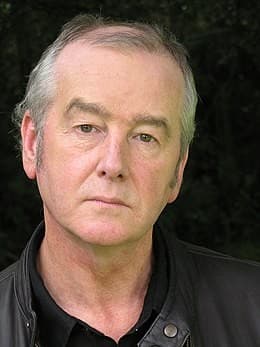
David Almond is an acclaimed British author celebrated for his evocative and often magical realist children's and young adult fiction. His notable works include the award-winning "Skellig," "Kit's Wilderness," and "Clay," as well as the prequel "My Name Is Mina." Almond's writing is characterized by its lyrical prose, exploration of profound themes, and a unique blend of the ordinary and the extraordinary.







