“When you're the only game in town, you don't have to be good.”
— Ishmael explaining the competitive advantage of the Takers.

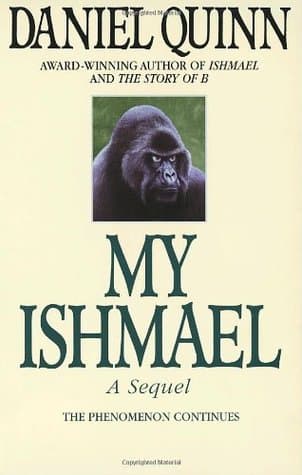
Daniel Quinn (1997)
Genre
Fantasy / Spirituality / Philosophy
Reading Time
240 min
Key Themes
See below
Sign in to track this book
A wise gorilla seeks to save humanity by teaching a spirited twelve-year-old girl the forgotten truths of the world, challenging her to forge her own path and become an unexpected savior.
Ishmael, a telepathic gorilla, places an advertisement seeking a student with a "desire to save the world," expecting an adult like his previous pupil, Alan Lomax. To his surprise, the only person to respond is Julie Gerchak, a determined twelve-year-old girl. Ishmael hesitates, believing Julie is too young for complex philosophy. He tries to deter her, citing her age and the mission's seriousness. However, Julie's conviction, intelligence, and passion persuade Ishmael. She argues that children are more open to new ideas and less influenced by society, making her a good student. Ishmael, intrigued by her reasoning and spirit, agrees to teach her, knowing it will require a different method than he used with Alan.
Ishmael begins Julie's education by introducing the basic ideas of "Leavers" and "Takers," two cultural narratives that have shaped human history. He explains how Taker culture, with its belief in human control over nature and its pursuit of progress, has led to environmental destruction and societal imbalance. Julie, despite her age, quickly understands these ideas, often expressing them in her own simple terms. She questions Taker culture's assumptions with a directness that surprises Ishmael. Unlike Alan, who struggled with Taker biases, Julie seems more open to challenging these ideas, seeing the world with fresh eyes. Her understanding gives Ishmael new ways to communicate his ideas.
Ishmael discusses the "Law of Life," which governs all species in nature, except for Taker humans. He explains that this law is not a set of rules but an understanding of how to live sustainably within the global community of life, ensuring the world's survival. Julie learns about the relationships in ecosystems, where every species has a role and none is above others. Ishmael uses analogies to show how Takers have broken this law by creating a culture that sees itself as exempt from natural limits. Julie's imagination helps her visualize these ideas, connecting human actions to their broader ecological effects, leading to a deep respect for the natural order.
Ishmael and Julie explore the "story" that Taker culture tells itself about its origins and future. This story, from ancient agricultural revolutions, claims humanity is the peak of creation, meant to conquer Earth. Julie, with her innocent yet sharp questions, challenges the logic of these foundational myths. She questions the idea of human exceptionalism and that Earth was made only for human use. Her questions often make Ishmael rethink how he presents these complex ideas, finding simpler, more relatable ways to explain the flaws in Taker thinking. Julie's ability to see through her own culture's assumptions shows her unique receptiveness and curiosity, making her a truly exceptional student.
Ishmael explains the "Mother Culture"—the invisible, all-encompassing force that shapes Taker society's values, beliefs, and behaviors from birth. He shows how this culture subtly indoctrinates individuals, making them believe the Taker way of life is the only natural or moral way. Julie starts to see how the Mother Culture appears in her own life, from school lessons to media messages, which reinforce human dominance and endless growth. This realization is both unsettling and empowering for her, as she begins to understand the mechanisms behind the societal problems Ishmael describes. Understanding the Mother Culture is a step for Julie to develop independent thinking and resist its influence.
Ishmael reveals his teachings' ultimate purpose: to find someone who can articulate a new story for humanity, one that replaces the destructive Taker narrative with a sustainable Leaver idea. He stresses that the goal is not to destroy Taker civilization but to help it evolve by recognizing and correcting its flaws. Julie, despite her age, fully accepts the mission's importance. She begins to consider how a different story might be told, one that celebrates connection and respect for all life. Ishmael observes her understanding and her natural inclination to seek solutions, realizing her unique view might be what is needed to reach a wider audience and truly change the world.
During their lessons, Julie has an important insight. She realizes that adults, deeply rooted in Taker culture, often resist changing their worldview. She suggests that the best way to introduce a new story—one that respects the Law of Life—is to teach it to children. Julie argues that children are not yet fully indoctrinated by the Mother Culture and are more open to understanding and adopting a sustainable way of living. She imagines a way to communicate that connects with young minds, making complex philosophical ideas accessible and engaging. This insight impresses Ishmael, who recognizes the wisdom in her suggestion, realizing that reaching children could be the most powerful and lasting path to change.
Inspired by Julie's insight, Ishmael challenges her to create a way to share the Leaver message with other children. He emphasizes that this new story cannot be a dry lesson but must be engaging, memorable, and easily understood by young minds. Julie enthusiastically accepts this challenge, considering different mediums. She thinks about stories, games, and interactive experiences, using her own childhood experiences and understanding of how children learn. Ishmael guides her, encouraging creative thinking and focusing on the core principles of the Law of Life in a way that avoids jargon and speaks to a child's sense of wonder and fairness. This task becomes the main focus of her remaining time with Ishmael.
After much thought, Julie proposes creating a comic book series as the perfect way to convey Ishmael's teachings to children. She explains that comic books are visually engaging, accessible, and popular among her age group. She envisions characters and storylines that show the principles of the Law of Life, contrast Leaver and Taker ways of living, and inspire young readers to think critically about their world. Julie sketches initial ideas for characters and plot points, showing a natural talent for storytelling. Ishmael is impressed by her ingenuity and practicality. He sees the potential for this simple medium to bypass the defenses of adult Taker culture and plant seeds of change in the minds of the next generation.
As their time together ends, Ishmael makes a big decision: he chooses Julie to carry out his greatest mission. He entrusts her with the task of developing and spreading the comic book series, believing her unique perspective and ability to connect with children make her the ideal messenger. Ishmael emphasizes her work's importance, explaining that this is not just a project but a step in moving humanity towards sustainability. He offers encouragement and wisdom, knowing the real work now falls to her. This decision marks a moment of trust and responsibility, as the future of Ishmael's legacy and the world rests on this remarkable young girl.
With Ishmael's blessing, Julie prepares to leave. She understands the great responsibility placed upon her but is filled with purpose and determination. She has deeply absorbed Ishmael's teachings and is committed to translating them into a form that can reach and inspire her peers. The book ends with Julie starting her mission, ready to create the comic book series that will introduce the 'Law of Life' to a new generation. Her departure is a beginning—the start of a potentially world-changing movement led by a young girl armed with wisdom and a powerful new story. Humanity's future, as Ishmael sees it, now depends on children like Julie embracing a different way of living.
The Protagonist/Mentor
Ishmael evolves from seeking an adult intellectual successor to realizing the unique potential of a child to spread his message, adapting his methods and expanding his hope for humanity's future.
The Protagonist/Student
Julie transforms from an eager but naive student into a confident and visionary leader, entrusted with the crucial mission of re-storying humanity for the next generation.
The Mentioned
Not applicable to this novel, as he is only mentioned.
This theme explores how children, free from years of cultural conditioning, can be more open to new ideas and have a clear vision. Julie's ability to grasp Ishmael's concepts, question Taker myths, and propose solutions like the comic book series, shows that youth is an advantage. Her innocence allows her to see the world's problems clearly, unclouded by cynicism or fixed beliefs, making her a strong agent for change. This contrasts with the implied difficulties Alan Lomax faced as an adult. Julie's perspective suggests that real change might begin with the next generation.
“Children, after all, are the ones who aren't yet completely under the spell of the Mother Culture.”
The book's central philosophical theme is that humanity lives by a "story"—a basic narrative about its place in the world and its relationship with other life forms. The current "Taker" story, based on human dominance and endless growth, is presented as destructive. The novel highlights the need to replace this story with a new one, a "Leaver" narrative that respects the "Law of Life" and promotes sustainable living. Ishmael's mission, and then Julie's, is to find a way to explain and share this new, life-affirming story. The comic book idea is a practical part of this re-storying effort.
“The world is not going to be saved by people who are trying to 'fix' it. It's going to be saved by people who are telling a new story.”
The "Mother Culture" represents the invisible but all-encompassing system of beliefs, values, and assumptions that shape Taker society. It is the unspoken narrative that dictates how people think, what they believe is normal, and what they see as progress. The novel shows how deeply ingrained this culture is, making it hard for adults to break free from its influence. Julie's journey involves recognizing how the Mother Culture works, from education to media, and learning to question its basic ideas. Understanding its reach is important for anyone trying to introduce an alternative worldview.
“The Mother Culture is the story that tells itself about itself, and it tells it so well that you don't even know it's a story.”
This theme centers on the idea of an inherent "Law of Life" that governs all species in the natural world, dictating how they live in balance and ensure the survival of the whole. Ishmael teaches Julie that Taker culture believes itself exempt from this law, leading to unsustainable practices and ecological damage. The book argues for a return to understanding and respecting this natural law, which emphasizes connection, limited growth, and living in harmony with the environment rather than trying to conquer it. Julie's task is to make this complex ecological principle understandable to a new generation.
“There's no law against going on living... but there IS a law against destroying the world in order to do it.”
Ishmael's primary teaching method, involving question-and-answer to guide students to their own conclusions.
Ishmael predominantly uses the Socratic method to educate Julie. Instead of lecturing, he poses a series of questions that guide her to discover the answers and develop her own understanding of complex philosophical and ecological concepts. This approach encourages critical thinking and active participation, allowing Julie to internalize the lessons rather than simply memorizing them. It also highlights Ishmael's respect for his students' intelligence and their capacity for independent thought. This device is crucial for showing Julie's intellectual growth and her eventual ability to formulate her own solutions, such as the comic book idea.
A fundamental conceptual framework used to categorize human cultures and their relationship with the world.
This is the central conceptual framework of the novel, dividing human cultures into two distinct types: 'Leavers' (indigenous, sustainable cultures living within the 'Law of Life') and 'Takers' (modern, agricultural/industrial cultures believing themselves exempt from natural laws). This dichotomy serves as a powerful lens through which Ishmael and Julie analyze human history, societal problems, and environmental degradation. It simplifies complex anthropological ideas into an accessible framework, allowing Julie to quickly grasp the core issues and understand the fundamental conflict driving humanity's destructive path.
The idea that humanity's actions are driven by a foundational cultural narrative.
The concept of humanity living by a 'story' is a key metaphorical device. Ishmael explains that the 'Taker story' is a narrative that dictates human exceptionalism, divine mandate to rule the Earth, and the belief in endless growth. This metaphor allows the characters to discuss profound cultural programming in a relatable way. The solution to the world's problems, therefore, isn't just about changing behaviors, but about changing the underlying 'story' that informs those behaviors. Julie's mission to create a comic book is, in essence, an attempt to tell a new, more sustainable story.
A specific narrative device proposed by Julie to communicate complex ideas to a younger audience.
The comic book is a crucial plot device that emerges from Julie's unique perspective. It serves as the practical application of Ishmael's teachings and Julie's breakthrough idea. By choosing a medium typically associated with children's entertainment, the novel underscores the theme of youth's power and the need for innovative communication strategies. The comic book represents a tangible hope for disseminating the 'new story' effectively, bypassing the intellectual resistance often found in adults and reaching a generation more open to fundamental change.
“When you're the only game in town, you don't have to be good.”
— Ishmael explaining the competitive advantage of the Takers.
“The world was not made for man, it was made for life.”
— Ishmael correcting Alan's anthropocentric view.
“Every time you look at the world, you're looking at it through the lens of a story.”
— Ishmael introducing the concept of 'story' as a framework for understanding.
“We're not here to conquer the world, we're here to live in it.”
— Ishmael contrasting the Taker mindset with a more sustainable approach.
“The story of the Takers is a story of conquest, of domination, of war.”
— Ishmael summarizing the core narrative of modern civilization.
“There's nothing inherently wrong with agriculture. It's how you do it.”
— Ishmael clarifying that the problem isn't farming itself, but the Taker approach to it.
“The idea that man is the pinnacle of creation is just a story.”
— Ishmael deconstructing anthropocentric arrogance.
“You don't need a god to tell you what's right or wrong. You just need to listen to the world.”
— Ishmael advocating for an ecological ethic over a divine one.
“The Takers have made themselves into gods, but they're still just animals.”
— Ishmael highlighting the irony and hubris of human exceptionalism.
“The problem isn't that we don't know what to do, it's that we don't want to do it.”
— Ishmael lamenting humanity's resistance to change despite awareness.
“What if the world isn't broken? What if it's just being used wrong?”
— Ishmael posing a fundamental question about the state of the world.
“The future of humanity depends on our ability to outgrow our stories.”
— Ishmael emphasizing the need to abandon destructive narratives.
“You can't solve a problem with the same thinking that created it.”
— Ishmael's advice on approaching systemic issues.
“To save the world, you have to let go of the idea that you own it.”
— Ishmael challenging the concept of human dominion over nature.
Ready to see how well you understood this book? Take our interactive quiz with 10 questions.

Daniel Quinn was an American author best known for his philosophical novels exploring civilization and its impact on humanity. His breakout work, 'Ishmael' (1992), a philosophical novel framed as a dialogue between a man and a gorilla, won the Turner Tomorrow Fellowship Award. Other notable works include 'My Ishmael' and 'The Story of B'.







