“The wind was a friend, the sun a companion, the trees were his brothers, and the horses his kin.”
— Describing Ken's deep connection to nature and the ranch.

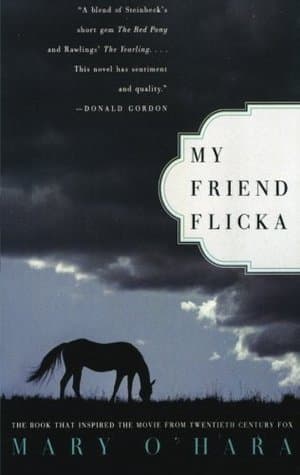
Mary O'Hara (1941)
Genre
Children's / Historical Fiction / Young Adult
Reading Time
300 min
Key Themes
See below
Sign in to track this book
On a Wyoming ranch, a boy and a wild filly form a bond that teaches them courage and responsibility.
Ten-year-old Ken McLaughlin, the younger son of Rob and Nell McLaughlin, returns to the Goose Bar Ranch in Wyoming with a bad report card, meaning he failed a grade. His father, Rob, a strict but fair man, is disappointed by Ken's lack of focus and daydreaming. Rob decides Ken will work on the ranch for the summer, hoping hard work will teach him discipline. As a reward, Rob promises Ken he can choose any colt from the spring foals, a big privilege that excites Ken, despite his initial dread of the summer's work.
When it's time to choose, Ken is drawn to a wild chestnut filly, whose family line includes a legendary, untamable stallion called The Albino. Nell, Ken's mother, sees a similar wild and independent spirit in the filly and Ken. Rob, however, opposes the choice, saying the filly, whom Ken names Flicka (Swedish for 'little girl'), is too wild and will only cause trouble. Despite Rob's doubts, Nell convinces him to let Ken keep Flicka, believing it might be good for Ken to have such a challenging project.
Ken's attempts to tame Flicka are frustrating. Flicka is incredibly wild, resisting all efforts to halter or handle her. She repeatedly escapes her enclosure, often hurting herself by running into fences or barbed wire. Rob's patience wears thin as Ken's project becomes a problem, needing extra work and vet care. Ken, despite loving Flicka, feels despair and inadequacy, believing he cannot connect with the spirited horse.
One day, Flicka makes a violent escape, crashing through a fence and badly cutting her leg. The wound is deep and gets infected, causing a high fever. The ranch hands and Rob believe Flicka cannot be saved and suggest putting her down to end her suffering. Ken is heartbroken and refuses, pleading with his father to give Flicka a chance. Nell supports Ken, and together they try to nurse Flicka back to health, but her condition worsens, and she becomes weaker and confused.
Despite their efforts, Flicka's fever continues, and she eventually runs away into a dangerous, rocky canyon known for its difficult terrain and wild animals. Ken, upset, goes against his father's orders and searches for her alone. He searches tirelessly, driven by a deep bond he feels for the filly. After a dangerous search, he finds Flicka, weak and near death, trapped in a narrow crevice. Ken spends the night with her, comforting her and protecting her from predators, showing deep dedication.
The next morning, Rob, who has been searching for Ken, finds him in the canyon with Flicka. Seeing his son's tired but determined face, and the gentle way Ken cares for the dying filly, Rob has a change of heart. He realizes the depth of Ken's love and their bond. Rob, for the first time, truly understands what Flicka means to Ken and decides to do everything to save the filly, knowing that saving Flicka is also saving a part of Ken.
Rob, Ken, and the ranch hands work hard to bring Flicka back to the ranch. Her condition is critical, and she gets a severe infection, falling into a coma. Dr. Hicks, the local vet, is called, but has little hope. Nell takes charge of Flicka's care, giving medicine and keeping her warm, while Ken stays by her side constantly, talking to her and wanting her to live. The whole family works together, putting aside past frustrations and doubts, hoping for a miracle.
Against all odds, Flicka slowly begins to recover. Her fever breaks, and she gradually regains strength. Her wildness is still there, but it is now softened by a growing trust in Ken. She starts to respond to his voice and touch, letting him approach without fear. The experience creates an unbreakable bond between Ken and Flicka. Ken has matured greatly through the ordeal, showing responsibility, perseverance, and a deep, unwavering love, earning his father's respect and admiration.
As Flicka recovers, her wild instincts are reawakened by The Albino, the legendary white stallion and her father, who sometimes appears on the ranch lands. Flicka is drawn to him, her wild blood calling her back to the freedom of the open range. Ken fears losing her, understanding that her wild nature is a part of her. This creates a new challenge: how to balance Flicka's wild spirit with her growing connection to him and ranch life.
At a key moment, Flicka stands at the fence between the ranch and the open plains, torn between The Albino's call and Ken's gentle presence. Ken approaches her slowly, not trying to force her, but simply offering his presence. After an internal struggle, Flicka turns from the wild stallion and lets Ken approach and touch her. This act shows her choice to stay with Ken, not out of submission, but from a unique bond of trust and affection. Ken has truly earned her friendship.
By the end of the summer, Ken is changed. He is no longer the daydreaming, irresponsible child who failed school. The challenges and successes with Flicka have matured him, giving him purpose and self-worth. His relationship with his father, Rob, has also changed. Rob now sees and respects Ken's inner strength and his ability for love and dedication. While Flicka remains spirited, she is no longer untamable, and her wildness is now a beautiful part of her character, reflecting Ken's own journey of self-discovery and acceptance.
The Protagonist
Ken transforms from an irresponsible daydreamer into a mature, dedicated, and courageous young man who earns his father's respect.
The Supporting/Antagonist (initially)
Rob learns to look beyond practicality and sees the value in Ken's emotional connection and the unique bond with Flicka, leading to a deeper understanding and respect for his son.
The Supporting
Nell consistently demonstrates unwavering support and emotional intelligence, helping to bridge the gap between Rob and Ken.
The Supporting
Flicka gradually learns to trust Ken, transforming from a completely wild animal into a spirited but loyal companion, without losing her innate wildness.
The Supporting
Gus remains a consistent, reliable figure, embodying the steadfastness of ranch life.
The Supporting
Howard remains a consistent, well-adjusted character, highlighting Ken's journey of self-discovery by contrast.
The Mentioned
The Albino remains a symbol of wildness, a constant presence in the background that influences Flicka's choices.
This theme explores the tension between wild nature and the human desire to control it. Flicka embodies the untamed spirit, always resisting efforts to be broken, while Ken represents the human desire for connection. The story suggests that true connection comes from understanding and respecting a spirit, not breaking it. This is clear in Flicka's escapes and her choice between The Albino and Ken, ultimately choosing Ken on her own terms, without losing her wildness.
“She was not a horse, but a spirit. Wild. Untamable. And Ken, in his heart, knew it was not his job to break her, but to understand her.”
Ken's journey is about growing up and learning responsibility. His school failure and his father's decision to make him work on the ranch start this theme. The challenge of caring for Flicka, especially when she is sick, forces Ken to move past daydreaming and make difficult decisions and consistent effort. He learns that loving Flicka requires dedication, sacrifice, and perseverance, changing him from an irresponsible boy into a mature young man capable of deep commitment. His actions, like staying with Flicka in the canyon, show his new sense of duty.
“It was no longer a game, no longer a dream. It was life and death, and he was responsible.”
The story shows how love and empathy can bridge differences and encourage growth. Ken's unwavering love for Flicka, even when she is wild, hurt, or seemingly beyond help, helps her recover and strengthens their bond. Nell also shows this theme, consistently being empathetic towards Ken and Flicka, and advocating for understanding over harshness. Rob's change of heart, seeing Ken's devotion in the canyon, shows how even practical people can be moved by genuine, empathetic connection, leading to healing and deeper relationships.
“He knew then that love was not about possessing, but about understanding, and letting be.”
The complex relationship between Ken and Rob is a central theme. Initially, their dynamic is strained by Rob's strictness and Ken's perceived irresponsibility. Rob struggles to understand his dreamy son, often showing disappointment. However, as Ken shows dedication and courage in saving Flicka, Rob gradually sees and respects his son's inner strength. The shared experience with Flicka builds a bridge, allowing them to form a deeper connection based on mutual respect and understanding, moving past their initial misunderstandings.
“Rob looked at his son, truly looked at him, and saw not a boy, but a man in the making, forged by love and suffering.”
Flicka's wildness and journey reflect Ken's own internal struggles and growth.
Flicka serves as a powerful symbolic mirror for Ken. Her untamed spirit, resistance to control, and eventual connection with Ken without losing her essence reflect Ken's own struggle to find his place, tame his daydreaming nature, and ultimately find self-acceptance. Flicka's physical injuries and recovery parallel Ken's emotional wounds and his journey to maturity. The wildness in Flicka is the same spirit that Nell recognizes in Ken, suggesting that both must be understood and nurtured, not broken.
A dangerous, isolated setting where Ken's dedication is tested and his bond with Flicka is forged.
The canyon where Flicka flees and Ken finds her serves as a crucible, a place of severe test and transformation. It is a dangerous, wild environment that strips away the comforts of the ranch and forces Ken to confront his deepest fears and demonstrate his unwavering commitment to Flicka. His solitary vigil with the dying filly in the harsh wilderness solidifies his bond with her and marks a crucial turning point in his character development, proving his courage and dedication to himself and, eventually, to his father.
An initial inciting incident that sets Ken's summer journey in motion.
Ken's failing report card is the initial catalyst for the entire plot. It highlights his perceived irresponsibility and his father's frustration, leading directly to Rob's decision to make Ken work on the ranch and offering him a colt. Without this inciting incident, Ken would not have been given the opportunity to choose Flicka, and his transformative summer would not have occurred. It establishes the conflict and the need for Ken's personal growth from the very beginning of the story.
A recurring symbol of untamed freedom and Flicka's wild heritage.
The Albino, Flicka's legendary wild sire, serves as a powerful symbol throughout the narrative. He represents the ultimate untamed spirit of the wilderness and the strong genetic pull that Flicka feels towards freedom. His occasional appearances on the ranch lands act as a constant reminder of Flicka's wild instincts and the internal struggle she faces between her heritage and her growing bond with Ken. He embodies the 'wild' aspect of the 'wild vs. domestication' theme.
“The wind was a friend, the sun a companion, the trees were his brothers, and the horses his kin.”
— Describing Ken's deep connection to nature and the ranch.
“It was not enough to be good. He had to be good for something.”
— Ken's internal struggle to prove himself to his father.
“A wild thing, he thought, belonged to no one. It was free.”
— Ken reflecting on Flicka's wild nature and his desire to tame her without breaking her spirit.
“He didn't want a horse to ride. He wanted a horse to love.”
— Ken's unique perspective on his relationship with Flicka, contrasting with his father's practical view.
“She was beautiful and wild and untamed, like a dream.”
— Ken's initial impressions of Flicka, highlighting her allure.
“The ranch was not merely a place; it was a way of life, hard and demanding, but also deeply rewarding.”
— General description of the setting and the challenges of ranch life.
“Sometimes you have to let go of what you want to get what you need.”
— Nell's advice to Ken, often in the context of Flicka's well-being.
“A boy and his horse. It was an old story, but always new.”
— Narrator's reflection on the timeless bond between Ken and Flicka.
“He understood then that loving something meant accepting it, flaws and all.”
— Ken's growing maturity in his relationship with Flicka.
“The wilderness was not empty; it was full of life, and full of lessons.”
— Ken's observations of the natural world around him.
“To truly know a horse, you had to speak its language, not just with your voice, but with your heart.”
— Ken's intuitive understanding of horses, contrasting with more conventional training methods.
“Hope was a thing with feathers, but sometimes it had hooves.”
— A poetic reflection on the source of Ken's hope, often tied to Flicka.
“He knew what it was to fight for something you believed in, even when everyone else told you it was foolish.”
— Ken's determination to save Flicka despite his father's objections.
“The wind could carry secrets, and the earth could hold them.”
— A more atmospheric quote reflecting the deep connection to the land.
Ready to see how well you understood this book? Take our interactive quiz with 10 questions.
Dan Gemeinhart
4.5
Kate O'Hearn
4.4

Jeanne Birdsall
4.4

Jen Wang
4.4
Wendelin Van Draanen
4.3

John Marsden
4.3

Chris Van Allsburg
4.3
Jennifer A. Nielsen
4.2