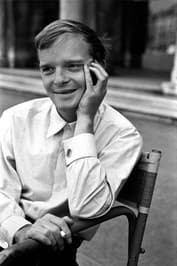
Biography coming soon.

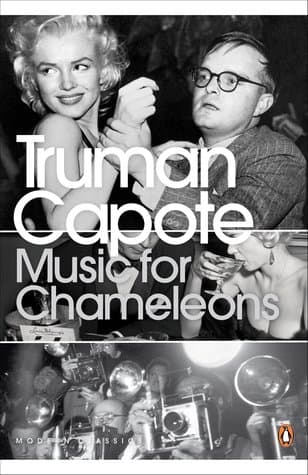
Truman Capote (1979)
Genre
Literary Fiction
Reading Time
12 Minutes
Key Themes
See below
Sign in to track this book
Truman Capote's collection explores a Midwestern murderer, the beauty of Marilyn Monroe, and the humor of a New York cleaning lady, all written with his distinctive prose.
Truman Capote begins the collection by discussing his long struggle with writer's block and his wish for a new, more direct way to tell stories. He describes a dream where he is a prisoner, constantly writing and rewriting, which shows his artistic confinement. This leads him to talk about his interest in real events and the growing popularity of 'nonfiction novels,' specifically mentioning his book 'In Cold Blood.' He explains his detailed research and his belief that truth, when presented with the artistry of fiction, can be more engaging than pure invention. This introduction prepares the reader for 'Handcarved Coffins,' the main piece in the collection, by showing Capote's personal artistic journey and his view on storytelling.
The story of 'Handcarved Coffins' starts with Capote's involvement in investigating a series of strange deaths in a small Midwestern town. He first focuses on a rancher named Robert Morse. Each victim receives a small, handcarved coffin before they die, containing a picture of the victim and their death date. The local police, especially Sheriff Alvin Dewey (a character based on the detective from 'In Cold Blood'), are confused. The deaths look like accidents or suicides, but the advance delivery of the coffins strongly suggests a killer. Capote, drawn by the unusual nature of the crimes, joins the investigation, interviewing townspeople and trying to understand the pattern.
As more people die and the strange coffins keep appearing, the investigation grows more intense. Capote, with Sheriff Dewey, begins to focus on Quinn, a well-known and seemingly charming local who is wealthy and influential. Quinn at first seems innocent, known for his generosity and good standing. However, small inconsistencies in his alibis and his odd behavior during questioning start to raise concerns. The victims, though seemingly unrelated, had some past connection to Quinn, often through business or social interactions. This leads Dewey and Capote to consider a more complex motive than simple revenge or money.
The killer, called 'the Handcarved Coffin Killer,' shows an increasingly clever and taunting method, seeming to enjoy playing a game with the police. Sheriff Dewey becomes very stressed; he grows more and more obsessed with the case, sacrificing his personal life and mental health in his relentless pursuit. Capote, watching Dewey's obsession, becomes not just an investigator but also someone who records the detective's struggle. The lack of physical evidence and the killer's ability to arrange 'accidents' makes catching him almost impossible, increasing Dewey's frustration and the community's growing fear.
Capote never directly names the killer in 'Handcarved Coffins' due to legal reasons (as it was presented as a 'nonfiction novel' based on real, unresolved events), but the story strongly suggests Quinn. Through carefully built circumstantial evidence and psychological profiles, Capote makes a strong case against him. However, despite the growing suspicion and Dewey's firm belief, the legal system cannot get a conviction. The story ends with the killer seemingly escaping justice, leaving a lasting feeling of unease and the impact of the unsolved crimes on the community and, especially, on Sheriff Dewey, who remains bothered by his failure to catch the person. This unclear ending shows the limits of justice when faced with clever evil.
This short story introduces Walter and Elizabeth, a seemingly perfect couple living a privileged life in a beautiful home. Their relationship appears good, but a deep secret lies beneath the surface. Elizabeth finds a hidden compartment containing photographs of young boys. This discovery shatters her view of Walter, revealing a disturbing part of his character. The story explores hidden evil, the fragility of trust, and the devastating effect of confronting unpleasant truths about loved ones. Elizabeth's struggle to match the man she thought she knew with the predator shown in the photographs is the core of the story, leaving her with a sense of betrayal and a ruined life.
In 'Dazzle,' a young girl named Lily talks about her interest in an older, flashy woman named Mrs. Williams, who lives nearby. Mrs. Williams is mysterious and appealing, known for her extravagant clothes, exotic pets, and unusual life. Lily is drawn to Mrs. Williams's personality, which contrasts sharply with her own everyday life. The story captures the innocence of childhood wonder and the effect of meeting someone who does not follow social rules. It subtly explores beauty, eccentricity, and the power of imagination and unusual mentorship, as Lily sees a reflection of her own emerging individuality in Mrs. Williams.
Capote offers a touching and personal description of Marilyn Monroe, whom he calls a 'beautiful child.' He recounts their conversations and his observations of her during a time when she struggled with her public image and personal problems. Capote highlights her fragility, deep insecurities, and her desire for real connection and respect beyond her fame. He shows her as a sensitive, intelligent woman trapped by the persona she had created and Hollywood's expectations. This portrait is full of empathy, showing a woman far more complex and vulnerable than her public image suggested, highlighting her inner conflict and her struggle for authenticity under immense pressure.
This conversational portrait presents a funny and insightful meeting with a cleaning lady in New York City. Capote describes her as a sharp, no-nonsense woman who openly discusses her cannabis use as a way to cope with her demanding job and the drudgery of her life. Through their talk, Capote captures her unique view on life, her observations of the wealthy people whose homes she cleans, and her unpretentious philosophy. The portrait is rich with humor and vivid characterization, offering a glimpse into a rarely seen part of society and challenging common ideas about drug users. It shows Capote's ability to find compelling stories and complex people in unexpected places.
The piece 'Music for Chameleons' is a reflective essay where Capote discusses his writing style and his interest in human stories. He recounts an experience in Martinique, where he watched a woman playing music for her pet chameleons, believing it calmed them. This image becomes a metaphor for his own work—creating stories that connect with and perhaps soothe the different 'chameleons' of human experience. He stresses the importance of deep listening, observation, and empathy in capturing the essence of individuals and their lives. The essay reinforces his commitment to combining journalistic accuracy with literary art, finding the profound in the ordinary, and the universal in the unique.
The Narrator/Investigator
Capote evolves from a writer grappling with creative stagnation to one who finds a renewed artistic direction by immersing himself in real-life narratives and the complexities of human nature.
The Supporting
Dewey's initial determination transforms into a profound, almost tragic obsession, leaving him emotionally scarred by the elusive nature of justice.
The Antagonist
Quinn remains largely static as a character, a fixed force of malevolence who consistently evades capture, highlighting the enduring nature of his cunning.
The Supporting
Monroe is presented in a moment of profound vulnerability, struggling with her identity and the pressures of fame, without a clear arc of resolution within the brief portrait.
The Protagonist
Elizabeth's journey is one from blissful ignorance to shattering disillusionment, marking a permanent and tragic shift in her understanding of love and trust.
The Antagonist
Walter remains a static, concealed antagonist, his true nature only revealed to Elizabeth, without any internal or external shift in his character.
The Protagonist
Lily's arc is one of awakening curiosity and expanded perception, as she encounters and is influenced by the unconventional Mrs. Williams.
The Supporting
Mrs. Williams serves as a catalyst for Lily's growth, her eccentric nature inspiring the young girl, without undergoing significant personal change herself.
The Supporting
This character is presented as a fully formed individual, whose wisdom and unique perspective are revealed through conversation, rather than through a developmental arc.
This theme is most prominent in 'Handcarved Coffins' and 'Mojave,' exploring how evil can appear in subtle, sophisticated, and often unpunished ways. It examines the idea that monsters are not always obvious, but can hide behind charm and respectability, making them more terrifying. Capote looks at the psychological depth of malevolence, showing how it can be a calculated, almost artistic effort for some perpetrators, and its devastating impact on victims and those who seek justice. The elusiveness of the Handcarved Coffin Killer and Walter's hidden life highlight the chilling reality that evil often goes undetected or unpunished.
“It was like trying to catch smoke in a sieve. He was there, you knew he was there, but he left no trace.”
Throughout the collection, especially in 'Handcarved Coffins,' Capote struggles with the limits of the legal system and the difficulty of proving truth, particularly against cunning and manipulative evil. The story highlights how circumstantial evidence, though compelling, may not be enough for a conviction, leaving a deep sense of injustice. This theme also applies to the 'nonfiction novel' format itself, where Capote must balance reporting facts and creating a compelling narrative, acknowledging that truth can be subjective even in real events. The unresolved nature of the 'Handcarved Coffins' case leaves a lasting impression that truth is ultimately hard to reach.
“The truth is, you can't always get to the bottom of things. Some shadows just stay shadows.”
Capote often reflects on his own creative process, his struggles with writer's block, and his renewed dedication to storytelling through real-life events. This theme explores the artist's need to observe, document, and turn reality into narrative, often at a personal cost. His involvement in the 'Handcarved Coffins' investigation, similar to Sheriff Dewey's obsession, shows the intense dedication needed to uncover and express truth. The collection itself shows Capote's belief in the power of narrative to illuminate human experience, whether through true crime, personal portraits, or fictional tales, emphasizing the connection between the storyteller and their subject.
“I wanted to write something that was absolutely true, yet had the texture and tension of a novel.”
Many stories and portraits in the collection explore the hidden parts of individuals' lives, showing the stark contrast between public appearances and private realities. From Walter's secret life in 'Mojave' to Marilyn Monroe's inner struggles behind her glamorous image, Capote consistently peels back layers to expose the complexities and often unsettling truths beneath the surface. This theme also applies to the 'dope-smoking cleaning lady,' whose openness reveals a world rarely seen by the privileged, and Mrs. Williams, whose eccentricity marks her as an outsider. Capote's sharp observational skills allow him to enter these hidden worlds, offering personal glimpses into the secret lives people lead.
“We all carry secrets, some visible, some buried so deep they become part of the bone.”
Despite the darker themes, Capote's work is filled with empathy for his subjects, even the flawed and tragic ones. His conversational portraits, especially of Marilyn Monroe and the cleaning lady, show his ability to connect with diverse individuals, understand their struggles, and present them with dignity and nuance. This theme highlights the importance of listening, observing, and trying to understand the inner lives of others. Even when facing profound evil, Capote seeks to understand the human element, building a connection between the reader and the often-complex characters he brings to life, emphasizing shared vulnerability and the search for understanding.
“To truly see someone, you have to listen, not just to their words, but to the silence around them.”
Blending journalistic rigor with literary artistry.
This innovative genre, pioneered by Capote with 'In Cold Blood' and continued in 'Handcarved Coffins,' combines extensive journalistic research and factual reporting with the narrative techniques, character development, and evocative language typically found in fiction. It allows Capote to explore real-life events with the depth and psychological insight of a novel, blurring the lines between fact and art. This device provides a unique lens through which to examine true crime, making the events feel immediate and profoundly human, while also inviting reflection on the nature of truth in storytelling.
The author's subjective lens shaping 'objective' reality.
While Capote presents himself as an objective reporter in 'Handcarved Coffins,' his personal involvement, emotional responses, and selective focus on certain details implicitly introduce an element of subjectivity. The 'nonfiction novel' format itself, by its very nature, involves authorial interpretation and shaping of events, meaning the reader experiences the 'truth' through Capote's specific lens. This device encourages readers to critically engage with the narrative, recognizing that even 'true' stories are filtered through a storyteller's perspective and artistic choices, adding a layer of complexity to the pursuit of truth.
A chilling premonition of death and psychological terror.
The miniature handcarved coffins in the central narrative serve as a powerful and macabre symbol. They represent not just the impending death of the victims but also the killer's calculated cruelty, his psychological dominance, and his perverse artistry. The coffins transform the murders from random acts of violence into a deliberate, taunting game, intensifying the terror for both the victims and the investigators. This symbol elevates the crimes beyond mere physical acts, imbuing them with a deeper, more disturbing psychological dimension that haunts the community and the reader.
Revealing character through intimate dialogue and observation.
This unique device allows Capote to capture the essence of individuals through direct conversation, personal anecdotes, and keen observation, rather than traditional plot-driven narratives. By focusing on dialogue and the nuances of human interaction, Capote reveals character, philosophy, and hidden depths. These portraits are often brief but incredibly insightful, showcasing his ability to distil a person's entire being into a few pages, highlighting their uniqueness and universal humanity. It's a testament to his belief that profound stories can be found in everyday encounters.
Ready to see how well you understood this book? Take our interactive quiz with 10 questions.
Biography coming soon.







