“The ultimate aim of martial arts is not having to use them.”
— Musashi reflects on the deeper purpose of his training after a battle.

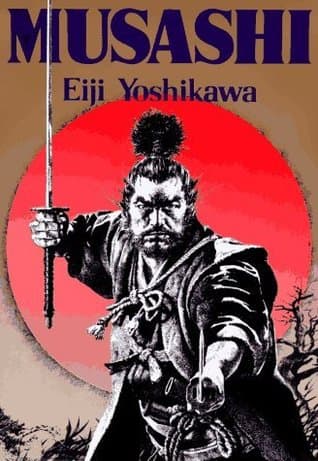
Eiji Yoshikawa (1936)
Genre
Historical Fiction
Reading Time
2500 min
Key Themes
See below
Sign in to track this book
From untamed youth to enlightened master, follow Miyamoto Musashi's perilous path through 17th-century Japan, where every duel and every choice shapes his legend as the greatest swordsman under heaven.
The novel opens after the Battle of Sekigahara in 1600. The young, impulsive Takezo Shinmen and his friend Matahachi Hon'iden fight on the losing side of the Western Army. They survive the aftermath, hiding among the corpses. Takezo, known for his violent nature, insists on returning to his village, Miyamoto, despite the dangers. They meet Oko and Akemi, two women who loot the dead, and Takezo's aggressive behavior leads to a confrontation. Upon their return to Miyamoto, Matahachi is swayed by Oko and Akemi, abandoning his betrothed, Otsu. Takezo, however, is called a fugitive and a danger to the village by local authorities, especially the monk Takuan Soho, who sees potential but also danger in the young man's untamed spirit.
Takezo is a hunted man, fleeing into the mountains and forests. He is eventually cornered and captured by Takuan Soho, who, with help from Otsu (who fled the village after Matahachi's betrayal), subdues the powerful youth. Instead of handing him over for execution, Takuan takes Takezo to Himeji Castle and hangs him in a tree for days, exposing him to the elements and forcing him to confront his own mortality and wildness. This physical ordeal combines with Takuan's psychological and spiritual instruction. He makes Takezo read, study the classics, and reflect on his violent past, aiming to change him from a wild person into a disciplined warrior and enlightened human being. During this time, Takezo adopts the new name 'Musashi Miyamoto,' marking his rebirth.
After his 're-education' under Takuan, Musashi Miyamoto begins a musha shugyo, a warrior's pilgrimage, to improve his swordsmanship and character. He travels the land, engaging in duels and seeking out masters. His initial encounters often show his raw power and lack of refinement, but he gradually improves his technique and philosophy. He learns to observe, anticipate, and understand the deeper ideas of strategy and self-control. During this time, Otsu, who has feelings for Musashi, often meets him by chance, as she travels the country looking for him. Musashi, however, remains focused on his path, often pushing her away for her safety and to keep his focus on the Way of the Sword.
Musashi arrives in Kyoto, determined to challenge the Yoshioka School, a dojo known for its swordsmanship. He confronts Seijuro Yoshioka, the head of the school, demanding a duel. Seijuro, initially dismissive of Musashi's appearance, is persuaded. The duel happens at Rendaiji Moor, where Musashi uses an unconventional strategy, using a wooden sword to defeat Seijuro with a single blow to the head, humiliating the master. This victory immediately makes Musashi a formidable, if controversial, figure in swordsmanship, earning him respect and the enmity of the Yoshioka clan, who vow revenge for their master's disgrace.
After Seijuro's defeat, his younger brother, Denshichiro Yoshioka, steps forward to uphold family honor and challenge Musashi. Denshichiro is skilled with a heavy wooden sword and wants to avenge his brother. They agree to duel at Ichijoji Temple. Musashi, always a strategist, arrives late, unsettling Denshichiro and his followers. The duel is intense, with Denshichiro fighting with determination. However, Musashi, again using his wooden sword, defeats Denshichiro, breaking his arm and further damaging the Yoshioka School's reputation. This second victory makes Musashi a legend, but also increases the Yoshioka's hatred, leading them to plan a more treacherous revenge.
Angry about the defeats, the Yoshioka clan, led by the young Matashichiro (Seijuro's and Denshichiro's nephew), plans an ambush against Musashi. They send a challenge for a duel with Matashichiro at Ichijoji Temple, but their true intention is to gather over seventy swordsmen to overwhelm Musashi. Musashi, suspecting a trap, arrives early and hides. When the Yoshioka forces gather, he emerges and, despite being outnumbered, fights with ferocity and strategic skill. He defeats many of his attackers and escapes the ambush, leaving the Yoshioka clan shattered and their legacy in ruins. This event marks a turning point, solidifying Musashi's legend as an unparalleled swordsman.
Throughout his travels, Musashi hears about another swordsman, Kojiro Sasaki, known for his 'Swallow Reversal' technique and his long sword, the 'Monohoshizao.' Kojiro is a brilliant, yet arrogant genius. Their paths often cross, indirectly, building tension and a sense of an inevitable confrontation. Kojiro is often with his retainer, Gonnosuke, and is involved with women, including Akemi, who becomes infatuated with him. Musashi, learning of Kojiro's skill, sees him as a worthy rival and begins to seek him out, understanding that a duel with Kojiro will be the ultimate test of his skill and philosophy.
Musashi's journey is not just about physical combat; he also explores broader aspects of life and art. He studies calligraphy, painting, and sculpture, seeing that art and strategy are connected. He seeks guidance from various masters, including the monk In'ei, who teaches him the spear, and the wise Yagyu Sekishusai, though he never formally becomes his student. Musashi's philosophy goes beyond technique; he strives for a state of mushin, 'no-mind,' where action flows from intuition and understanding. He also meets many women, including Otsu, who continues to follow him, and the courtesan Yoshino, but he largely resists emotional attachments to keep his focus on his path.
While Musashi dedicates himself, his childhood friend Matahachi spirals into a life of pleasure and regret. After leaving Otsu for Oko and Akemi, he drifts from one affair to another, never finding purpose or happiness. He often tries to use his past connection to Musashi, sometimes claiming to be him or seeking to profit from his fame. His life shows cowardice, betrayal, and a growing sense of self-loathing. He eventually loses Oko and Akemi, becomes a wandering ronin, and repeatedly fails to live up to any honorable standard. His character contrasts with Musashi's disciplined journey, showing the different paths of two men from the same village.
The long-anticipated duel between Musashi Miyamoto and Kojiro Sasaki is arranged for Ganryu Island (also known as Funa-jima). The local lord, Hosokawa Tadaoki, is among those eager to witness this clash. Musashi, always a strategist, arrives late, deliberately unsettling Kojiro and his supporters. He rows to the island in a small boat, carving a wooden sword from an oar on the way. Upon landing, he faces Kojiro, who has his signature long sword. The duel is swift and decisive. Musashi, using his wooden sword, strikes Kojiro, defeating him with a blow to the head. Musashi's legend is cemented, and he leaves the island, reflecting on the meaning of victory and the Way of the Empty Hand.
After the duel on Ganryu Island, Musashi largely withdraws from public life as a duelist. He continues to refine his philosophy and artistic skills, focusing on painting, calligraphy, and sculpture. He teaches a few students, notably Iori, a young boy he adopted. He serves various lords, including Hosokawa Tadaoki, but mainly as an advisor and artist rather than a fighting master. His later life is dedicated to writing his treatise on strategy, 'The Book of Five Rings,' which summarizes his life's learning about swordsmanship, strategy, and the Way of the warrior. He reflects on his past, the people he met, and the meaning of his journey, eventually finding a deeper peace and understanding beyond martial skill.
The Protagonist
From a feral, violent youth to a disciplined, enlightened swordsman and philosopher, embodying the Way of the Empty Hand.
The Antagonist/Rival
From a celebrated, arrogant genius to a tragic figure defeated by Musashi's holistic approach to the sword.
The Supporting
Remains a steadfast mentor figure, consistently offering wisdom and subtle guidance to Musashi.
The Supporting
From a heartbroken, abandoned fiancée to a resilient woman who finds purpose in following Musashi, even if from a distance.
The Supporting
From an eager but weak-willed youth to a regretful, wandering ronin, a stark contrast to Musashi's growth.
The Supporting
Remains a self-serving and opportunistic character, always looking for advantage.
The Supporting
From a flirtatious young woman to a figure caught in the romantic webs of powerful swordsmen.
The Supporting
From a proud and respected master to a humiliated and defeated figure.
The Supporting
Attempts to restore family honor but ultimately suffers defeat, further cementing Musashi's legend.
The Mentioned/Supporting
His initial curiosity about Musashi evolves into respect and patronage.
The main theme is Musashi's pursuit of mastery in swordsmanship, which becomes a philosophy for life. It is not just about winning duels, but about understanding oneself, nature, and the universe. Musashi's musha shugyo is a journey of constant learning, discipline, and self-refinement. The change from the wild Takezo to the enlightened Musashi shows that true strength comes from inner peace and strategic wisdom, not just brute force. This theme is clear in his eventual retreat to write 'The Book of Five Rings,' combining his martial and philosophical insights.
“''The Way of the warrior is to master the two-sword technique, to master the Way of the Empty Hand.''”
Musashi's entire journey is one of change. He begins as a feared, violent, and uncultured youth, Takezo. Through Takuan's harsh but insightful guidance, and his own self-discipline, he sheds his old identity and is reborn as Musashi Miyamoto. This theme explores the potential for redemption and growth, even for those with a troubled past. It shows that true change comes from within, through self-reflection, discipline, and a dedicated pursuit of a higher purpose. His change is a continuous process, not a single event, as he constantly tries to improve his character and understanding.
“''Think lightly of yourself and deeply of the world.''”
The novel explores love and its sacrifices in a warrior's life. Otsu's enduring, unrequited love for Musashi shows the emotional cost of his dedication. Musashi often pushes away personal attachments, believing they will hinder his path, leading to moments of loneliness and regret. The contrasting relationships of Matahachi, Oko, and Akemi show the destructive nature of selfish desires. This theme explores whether personal happiness and deep connections are compatible with the path of a true master, and the sacrifices such a pursuit often demands.
“''A warrior's love is a heavy burden, a distraction from the true path.''”
The constant presence of death and violence in Musashi's world forces him to confront life's temporary nature. Duels are not just tests of skill but moments of life-or-death. This theme explores how thinking about death can lead to a deeper appreciation for life and a more focused existence. Musashi learns to face death without fear, to accept life's impermanence, and to find meaning in the present moment. This duality shapes his philosophy, where the sword is both an instrument of death and a tool for spiritual understanding, leading to the idea of 'living as if already dead.'
“''Regard your body as a tool, not as yourself.''”
Musashi's journey often pits his unconventional approach against the traditions of established sword schools like the Yoshioka. His use of a wooden sword, his strategic thinking, and his holistic philosophy challenge the methods and pride of older masters. This theme explores the tension between honoring the past and adapting to the present, showing how true mastery often requires breaking free from conventional wisdom. Musashi's victories against the Yoshioka School show the triumph of adaptable skill and insight over mere adherence to traditional forms, ultimately shaping a new way for swordsmanship.
“''The Way is not fixed. It is a path that must be forged anew by each man.''”
Musashi's journey of self-discovery and martial refinement.
The musha shugyo is a central plot device, serving as the framework for Musashi's entire character arc. It's a period of wandering and training where a samurai hones his skills and philosophy through duels and encounters with various masters. This device allows for episodic encounters, introducing a diverse cast of characters and showcasing Musashi's evolving skills and understanding. It provides the narrative structure for his transformation from a wild youth to an enlightened master, emphasizing continuous learning and the solitary nature of his quest. The journey itself is as important as the destination.
Contrasting characters highlighting Musashi's path.
The novel extensively uses foil characters to highlight Musashi's growth and choices. Matahachi, with his indulgence and lack of discipline, serves as a direct contrast to Musashi's self-mastery. Kojiro Sasaki, with his natural genius but arrogance and lack of deeper spiritual insight, is a foil to Musashi's holistic approach. These characters, through their diverging paths and ultimate fates, emphasize the themes of discipline, purpose, and the consequences of one's choices, making Musashi's journey more impactful and his achievements more profound.
Symbolizing more than just a weapon, but a path to enlightenment.
The sword in 'Musashi' is far more than a weapon; it is a profound metaphor for the Way of life, self-mastery, and spiritual enlightenment. Musashi's journey with the sword represents his quest to understand the universe and himself. His shift from a sharpened blade to a wooden sword (or even 'the empty hand') symbolizes his evolution beyond mere killing to a state where the sword is an extension of his will and understanding. It embodies the principles of Zen Buddhism and the idea that true victory is achieved without fighting, reflecting a deeper philosophical meaning.
A recurring emotional anchor and source of internal conflict for Musashi.
The enduring love triangle (or more accurately, unrequited devotion) between Musashi, Otsu, and Matahachi serves as a significant emotional subplot. Otsu's unwavering love for Musashi, contrasted with Matahachi's betrayal and subsequent decline, highlights Musashi's internal struggle between personal happiness and his dedicated path. It provides a recurring human element and emotional stakes, frequently pulling Musashi back into moments of introspection about his choices. This device keeps the protagonist grounded and adds depth to his often solitary and detached journey.
Musashi's ultimate legacy and the culmination of his life's philosophy.
Though written by the historical Musashi after the events depicted, the novel subtly builds towards and references 'The Book of Five Rings' as the culmination of Musashi's journey. It functions as a meta-narrative device, representing the ultimate synthesis of his martial and philosophical learning. The anticipation of this magnum opus reinforces the idea that Musashi's path is not merely about dueling, but about distilling his experiences into a profound and lasting wisdom. It signifies his transition from a warrior to a sage, solidifying his legacy beyond mere swordsmanship.
“The ultimate aim of martial arts is not having to use them.”
— Musashi reflects on the deeper purpose of his training after a battle.
“Do nothing that is of no use.”
— Musashi's principle from his later teachings, emphasizing efficiency.
“Perceive that which cannot be seen with the eye.”
— Musashi advises a student on developing intuition and awareness.
“A man cannot understand the art he is studying if he only looks for the end result without taking the time to delve deeply into the reasoning of the study.”
— Musashi criticizes superficial learning in a conversation about mastery.
“The way of the warrior is the resolute acceptance of death.”
— Musashi contemplates the samurai ethos during a moment of crisis.
“In strategy, it is important to see distant things as if they were close and to take a distanced view of close things.”
— From Musashi's strategic musings before a duel.
“There is nothing outside of yourself that can ever enable you to get better, stronger, richer, quicker, or smarter. Everything is within. Everything exists. Seek nothing outside of yourself.”
— Musashi's inner reflection during his solitary training period.
“The true science of martial arts means practicing them in such a way that they will be useful at any time, and to teach them in such a way that they will be useful in all things.”
— Musashi explains his approach to a curious observer.
“Do not regret what you have done.”
— Musashi advises a follower who is haunted by past mistakes.
“To know ten thousand things, know one well.”
— Musashi's teaching on the depth of mastery over breadth.
“The spirit of the warrior is not geared to petty things.”
— Musashi dismisses trivial concerns in a discussion about honor.
“If you do not control the enemy, the enemy will control you.”
— Musashi strategizes before facing multiple opponents.
“It is difficult to understand the universe if you only study one planet.”
— Musashi uses a metaphor to explain the need for broad perspective.
“The only reason a warrior is alive is to fight, and the only reason a warrior fights is to win.”
— Musashi's stark declaration during a moment of determination.
Ready to see how well you understood this book? Take our interactive quiz with 10 questions.

Biography coming soon.







