“The impossible could not have happened, therefore the impossible must be possible in spite of appearances.”
— Hercule Poirot reflects on the contradictory evidence in the murder case.


Agatha Christie (2001)
Genre
Thriller / Mystery
Reading Time
240 min
Key Themes
See below
Sign in to track this book
A luxurious train journey through the snow-laden European landscape turns deadly when a ruthless American business magnate is found stabbed to death, leaving Hercule Poirot to untangle a web of twelve suspects, each with a hidden connection to the victim's dark past and a shared secret.
The Belgian detective, Hercule Poirot, has solved a case for the French military in Aleppo, Syria. He plans to return to London, but a rockfall delays him for four days near Taurus. He meets Monsieur Bouc, director of the Compagnie Internationale des Wagons-Lits, who is also traveling. Poirot observes the passengers, including the rich and threatening American, Samuel Ratchett, and his secretary, Hector MacQueen. Ratchett, feeling unsafe, tries to hire Poirot for protection, but Poirot dislikes him and refuses.
The Orient Express is unusually full for winter. Monsieur Bouc gets Poirot a first-class compartment on the Calais coach. As the train leaves Istanbul, Poirot watches other passengers in the dining car. He notices tension, especially around Samuel Ratchett. During the night, Poirot hears loud groans from Ratchett's compartment, then a crash, and sees a woman in a scarlet kimono in the corridor. He also overhears a conversation next door, but cannot understand it.
The train gets stuck in a deep snowdrift in Yugoslavia, completely isolated. The next morning, Ratchett does not appear for breakfast. Pierre Michel, the conductor, knocks on his door with no response. Monsieur Bouc, worried, asks Poirot to investigate. After forcing the door open, they find Samuel Ratchett's body, stabbed twelve times. The window is open, suggesting an escape, but the snow makes this impossible. The murder weapon is missing, and the circumstances point to a killer still on the train.
With the train stranded and no local police available, Monsieur Bouc asks Poirot for help. Poirot agrees, understanding the need to solve the crime before the train moves. Dr. Constantine, the Greek doctor, makes a discovery: Ratchett is actually Cassetti, an American gangster who arranged the kidnapping and murder of three-year-old Daisy Armstrong years ago. Cassetti had escaped punishment, and the Armstrong case was a national tragedy that affected many people.
Poirot carefully examines Cassetti's compartment. He finds a burned piece of paper with the words '—member little Daisy Armstrong', a pipe cleaner, and a handkerchief with the initial 'H'. The window is open, and a broken watch is found. Initial interviews with passengers show many inconsistencies. Everyone claims to have heard or seen nothing unusual, but their stories conflict with each other or the evidence. For example, some heard no sounds, while Poirot heard a groan. A missing uniform button from the conductor's jacket is also noted.
Poirot finds the scarlet kimono, which he saw the previous night, hidden in Mrs. Hubbard's compartment. This contradicts her earlier statement. Later, a conductor's uniform, too large for Pierre Michel, is found in a suitcase in another compartment. These discoveries suggest a more complex plot than a simple opportunistic murder. The open window in Cassetti's compartment, first thought to be an escape route, now seems to be a deliberate distraction, as no one could have jumped into the snow.
As Poirot interviews each passenger, he learns about their hidden pasts and surprising connections to the Armstrong case. Princess Dragomiroff says Mrs. Armstrong was her goddaughter. Colonel Arbuthnot was a friend of Daisy's father. Greta Ohlsson was Daisy's nurse. Mary Debenham was Mrs. Armstrong's secretary. Hector MacQueen's father was the district attorney for the Armstrong case. Even the Italian, Antonio Foscarelli, was the Armstrongs' chauffeur. Almost every passenger had a direct or indirect link to the Armstrong family, suggesting a motive for revenge against Cassetti.
The broken watch in Cassetti's compartment stopped at 1:15 AM, indicating the time of death. However, some testimonies suggest activity around 12:40 AM. This difference makes Poirot consider two different times of death or a staged scene. Also, the stab wounds—some deep, some shallow, some from a right-handed person, others from a left-handed one—suggest multiple attackers. This challenges the idea of a single killer and points to a coordinated effort, making the crime much more complex.
After much thought, Poirot gathers all the suspects. He presents two possible solutions. The first, simpler one, is that a stranger entered the train, killed Cassetti, and escaped through the snow. Poirot quickly dismisses this as unlikely. He then reveals his true solution: Cassetti's murder was a planned act of collective revenge. All twelve passengers, plus the conductor, were connected to the Armstrong tragedy and conspired to kill Cassetti, each delivering one of the twelve stab wounds.
Poirot explains that Mrs. Hubbard is Linda Arden, Daisy Armstrong's grandmother and a famous actress, who planned the plot. Colonel Arbuthnot was Daisy's father's best friend. Mary Debenham was Daisy's governess. Greta Ohlsson was Daisy's nurse. Princess Dragomiroff was Mrs. Armstrong's godmother. Antonio Foscarelli was the chauffeur. MacQueen's father was the DA. Even Pierre Michel, the conductor, was the father of the Armstrong family's maid, who killed herself after being wrongly accused. Each person stabbed Cassetti, so no single individual could be easily identified as the sole murderer. Facing a moral choice, Poirot, Monsieur Bouc, and Dr. Constantine agree to present only the first, simpler, and less plausible solution to the Yugoslavian police, letting the conspirators go free, believing that justice, in this unique case, was served.
The Protagonist
Poirot initially seeks to solve a clear-cut murder but evolves to make a profound moral decision, choosing a form of justice outside the law.
The Victim/Antagonist
Cassetti's past crimes catch up to him, culminating in his brutal murder, which serves as the central mystery.
The Supporting
Initially focused on solving the crime quickly, Bouc ultimately accepts and supports Poirot's morally complex decision.
The Supporting
Dr. Constantine's medical expertise aids the investigation, and he becomes a confidant in Poirot's moral dilemma.
The Supporting/Antagonist (Leader of the Conspiracy)
From a seemingly oblivious passenger, she is unmasked as the cunning leader of the revenge plot, driven by profound grief.
The Supporting/Antagonist
Her reserved exterior hides a participant in the revenge plot, driven by loyalty to the Armstrongs.
The Supporting/Antagonist
His upright military persona conceals his role as a vengeful friend, acting for justice.
The Supporting/Antagonist
The Princess uses her aristocratic facade to hide her involvement in the revenge plot, driven by loyalty and grief.
The Supporting/Antagonist
MacQueen's seemingly innocent role as secretary is a cover for his deep personal connection to the Armstrong case and his participation in the revenge.
The Supporting/Antagonist
The seemingly neutral conductor is revealed to be a vengeful father, driven to murder by personal tragedy.
This theme explores the conflict between legal justice and a personal, moral justice. Samuel Ratchett (Cassetti) escaped legal punishment for the murder of Daisy Armstrong, leaving a void the law could not fill. The conspirators, all affected by the Armstrong tragedy, take action, believing they are giving rightful punishment. Poirot, who supports law and order, faces a situation where the law failed. This leads him to an extraordinary moral decision to let the murderers go free, acknowledging that 'justice' in a higher sense was served. This makes the reader question their own ideas of right and wrong.
“"The impossible cannot have happened, therefore the impossible must be possible in spite of appearances."”
The entire plot is a planned act of revenge. Each of the twelve conspirators has a direct or indirect personal connection to the Armstrong family and the trauma from Cassetti's crime. Their group action is a form of retribution for the suffering he caused and the legal system's failure to punish him. The multiple stab wounds, each by a different person, represent the shared grief and anger of those whose lives were shattered. The theme questions if revenge, even for a terrible crime, brings peace or just continues violence.
“"There are two solutions to this case. I shall put them both before you. Then you, Monsieur Bouc, and you, Doctor, can decide which solution you will put before the Yugoslavian police."”
Almost every character on the Orient Express uses a false identity or hides their connection to the Armstrong case. Samuel Ratchett is actually Lanfranco Cassetti. Mrs. Hubbard is Linda Arden, a famous actress. Mary Debenham, Colonel Arbuthnot, Greta Ohlsson, and others hide their pasts and their deep personal grievances. This widespread deception creates a complex web of lies that Poirot must untangle. It shows how people create elaborate facades to reach their goals, whether for protection or vengeance. The theme explores how identity can be changed and manipulated.
“"The truth, however ugly in itself, is always curious and beautiful to the seeker after it."”
The novel shows two kinds of evil: Cassetti's open, unrepentant evil, who murdered a child and escaped justice, and the more morally complex evil of the conspirators, who murder out of a desire for retribution. Cassetti's actions are clearly monstrous, justifying the intense hatred toward him. However, the conspirators' act of murder, while understandable given their trauma, still makes the reader think about the moral implications of taking a life, even a 'deserving' one. Poirot's final decision reflects the complex nature of evil and justice.
“"I have a feeling that there is something evil in that man."”
A murder committed in an isolated setting with a finite number of suspects.
The Orient Express, stranded by a snowdrift, perfectly creates a closed-circle mystery. With no one able to enter or leave the train, the murderer must be one of the passengers or staff on board. This device intensifies the suspense and forces Poirot to focus his investigation solely on the confined group, eliminating external possibilities. It allows for detailed character studies and a deep dive into the psychology of the suspects, as they are all trapped together with the detective and the victim.
Misleading clues designed to distract the detective and reader.
Christie masterfully employs numerous red herrings. The open window in Ratchett's compartment, suggesting an escape, is a prime example. The missing uniform button, the handkerchief with 'H', the pipe cleaner, and the mysterious scarlet kimono all serve to point towards individual suspects or create confusion. These false clues are meticulously planted by the conspirators to obscure the truth and make the crime appear more random or committed by a single, unknown assailant, thereby diverting Poirot's attention from the true, collective nature of the murder.
A crime that initially appears to defy all logical explanation.
The murder of Samuel Ratchett seems impossible to solve by conventional means. He was stabbed twelve times, with wounds suggesting both right and left-handed assailants, and at seemingly two different times. No single person could have achieved this in the confined space and time. This 'impossible' nature of the crime forces Poirot to think outside the box and consider unconventional solutions, ultimately leading him to the truth that defies the initial assumptions of a single killer. It's a hallmark of Christie's genius, challenging the reader's expectations.
A past crime that serves as the central motive for the present murder.
The Daisy Armstrong case is not just a backstory; it is the entire foundation upon which the plot of 'Murder on the Orient Express' is built. This horrific past event, a child's abduction and murder, provides the motive for every single conspirator. It creates a powerful emotional resonance and justifies the extreme measures taken by the passengers. Without the Armstrong case, there would be no reason for the diverse group of individuals to be united in their desire for revenge, making it the ultimate catalyst for the present murder.
“The impossible could not have happened, therefore the impossible must be possible in spite of appearances.”
— Hercule Poirot reflects on the contradictory evidence in the murder case.
“I do not approve of murder.”
— Poirot states his moral stance early in the investigation.
“The evidence is there. The little grey cells, they are what matter.”
— Poirot emphasizes the importance of deductive reasoning over physical clues.
“It is the brain, the little grey cells on which one must rely.”
— Poirot explains his method of solving crimes through mental analysis.
“There is too much evidence. That is what is wrong.”
— Poirot observes the overwhelming and contradictory clues at the crime scene.
“The murderer is with us—on the train now...”
— Poirot reveals that the killer is among the passengers.
“I have a little idea...”
— Poirot hints at a developing theory about the case.
“The truth, however ugly in itself, is always curious and beautiful to seekers after it.”
— Poirot discusses the nature of truth and the pursuit of justice.
“We are all strangers on a train.”
— A passenger reflects on the isolated and transient nature of their situation.
“It is completely unimportant. That is why it is so interesting.”
— Poirot remarks on a seemingly trivial detail that becomes key to the mystery.
“The past is the father of the present.”
— Poirot connects the murder to events from years earlier.
“There are two solutions to this case. One very simple, the other very complex.”
— Poirot presents the dual possibilities in the resolution of the mystery.
“I am not a policeman, I am a detective.”
— Poirot distinguishes his role from conventional law enforcement.
“The snow has stopped us. It has also saved us.”
— A passenger comments on the blizzard that traps the train, isolating the crime.
Ready to see how well you understood this book? Take our interactive quiz with 10 questions.
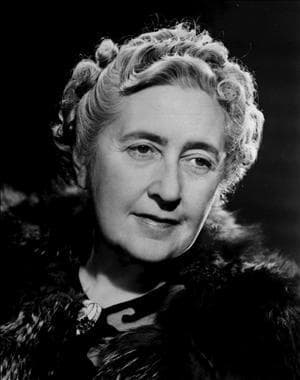
Dame Agatha Mary Clarissa Christie, Lady Mallowan, was an English writer known for her 66 detective novels and 14 short story collections, particularly those revolving around fictional detectives Hercule Poirot and Miss Marple. She also wrote the world's longest-running play, the murder mystery The Mousetrap, which has been performed in the West End since 1952. A writer during the "Golden Age of Detective Fiction", Christie has been called the "Queen of Crime". She also wrote six novels under the pseudonym Mary Westmacott. In 1971, she was made a Dame (DBE) by Queen Elizabeth II for her contributions to literature. Guinness World Records lists Christie as the best-selling fiction writer of all time, her novels having sold more than two billion copies.







