“I am the daughter of a detective. I have been trained to observe.”
— Daisy Wells introduces herself, emphasizing her background and skills.

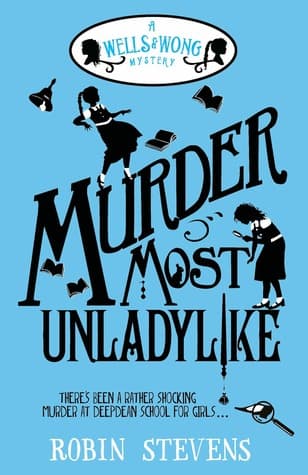
Robin Stevens (2014)
Genre
Children's / Historical Fiction / Mystery / Young Adult
Reading Time
350 min
Key Themes
See below
Sign in to track this book
At a 1934 English boarding school, two intrepid girls form a secret detective agency only to stumble upon a vanished body, forcing them to solve a very real murder before the killer strikes again or their headmistress finds out.
In 1934, at Deepdean School for Girls, Hazel Wong, a new student from Hong Kong, struggles to fit in. Her only friend is the lively and often bossy Daisy Wells, who loves detective stories. Together, they decide to form a secret detective agency, the Wells & Wong Detective Society. Their first cases are mundane, like finding Lavinia's missing tie, which Daisy says is not worth their time. Hazel, who is practical and observant, writes down their rules and notes in her book. They want a real, exciting mystery to solve, something challenging that will test their skills, not knowing what will happen in their boarding school.
Deepdean's normal routine breaks when Hazel, on her way to find Daisy, discovers Miss Bell, the Science Mistress, dead on the gymnasium floor. Shocked, Hazel rushes to find Daisy. When they return to the gym minutes later, the body has vanished. Daisy, at first doubtful, soon understands the situation's seriousness. The girls now face a double mystery: a murder, and the removal of the evidence. They decide they must solve the murder themselves, before the killer strikes again or the police arrive and mess up the investigation, as Daisy believes.
Daisy and Hazel start their investigation, making a list of suspects. They learn that Miss Bell was not well-liked and had arguments with several people. They find that Miss Bell was meeting someone secretly, shown by a love letter in her room—though the recipient's name is torn off. Their investigation leads them to suspect Miss Bell's fiancé, Mr. Curtis, the History Master, and Miss Bell's former best friend and rival, Miss Lappet, the English Mistress. The girls also learn Miss Bell argued with other teachers and some older girls, making their initial ideas about the killer's identity and motive more complex.
To the girls' dismay, Miss Bell's body is found in the school grounds, moved again. The police arrive, led by Inspector Mallory and Sergeant Witney, but Daisy and Hazel continue their secret investigation, sure they can do better. The situation gets worse when a second body is found: Elizabeth Hurst, the Head Girl, is discovered dead in the school library. Elizabeth was known for being strict and bullying younger girls. This second murder causes fear at Deepdean, showing a dangerous killer is still at large in the school, targeting its residents.
The Wells & Wong Detective Society focuses on Elizabeth Hurst, realizing her death must connect to Miss Bell's. They find that Elizabeth had a secret life beyond her role as Head Girl. She blackmailed people, using information to manipulate peers and some teachers. It becomes clear Elizabeth was involved in covering up Miss Bell's body, possibly moving it to protect someone or gain power. The girls also find evidence Elizabeth was meeting someone secretly, and she knew an important secret about Miss Bell's past, giving a strong reason for her to be silenced by the killer.
Daisy and Hazel conclude Miss Bell was poisoned with cyanide, likely in her tea. They also find Miss Bell's hidden diary, which shows her unhappiness and difficult relationships with several people at school. The diary entries hint at a secret affair and a past wrong Miss Bell wanted to hide. It seems the killer was close to Miss Bell, someone who knew her habits and had access to her. The diary also has cryptic mentions of events from years ago, suggesting the murders' origins lie in a long-buried secret.
As Daisy and Hazel get closer to the truth, they face more danger. They receive threats and are almost caught several times while investigating. The pressure of the investigation also strains their friendship, with Daisy's bossiness and Hazel's caution clashing. Hazel starts to question Daisy's methods and rule-breaking, while Daisy gets frustrated with Hazel's fears. Despite their disagreements, their friendship and shared goal to solve the case keep them working together, even as the killer's shadow grows, making them realize the true risks of their detective work.
Through careful thinking, clue gathering, and some daring listening, Daisy and Hazel put the puzzle together. They realize the killer is Miss Lavinia Lappet, the English Mistress. Miss Lappet had been Miss Bell's best friend years ago, but their friendship ended after Miss Bell stole Miss Lappet's fiancé, Mr. Curtis. Miss Lappet, driven by years of anger and a desire for revenge, poisoned Miss Bell. Elizabeth Hurst found out Miss Lappet's secret and was blackmailing her, leading Miss Lappet to murder Elizabeth to silence her and keep her secret from the police.
Daisy and Hazel set a trap for Miss Lappet, confronting her with their evidence. They explain how she moved Miss Bell's body, used school chemicals for the poison, and murdered Elizabeth to cover her actions. At first, Miss Lappet denies everything, but with the girls' detailed evidence and emotional pressure, she breaks down and confesses to both murders. She describes her long-held hatred for Miss Bell and her desperate act to silence Elizabeth, showing her deep pain and anger. The girls' bold and clever plan brings the killer to justice, though through unusual means.
With Miss Lappet's confession, Daisy and Hazel present their findings to Inspector Mallory and Sergeant Witney, who are surprised by the girls' involvement but impressed by their accurate conclusions. Miss Lappet is arrested, and the Deepdean School murders are solved. The school slowly returns to normal, but forever changed. Daisy and Hazel, having solved their first truly exciting mystery, confirm their partnership. They think about the dangers they faced and the complexities of human nature, strengthening their bond and their resolve to continue their detective work, ready for more mysteries.
The Protagonist
Daisy learns the serious consequences of real-life murder and the importance of collaborative detective work, tempering her self-assuredness with a greater appreciation for Hazel's contributions.
The Protagonist
Hazel gains confidence in her own detective skills and learns to assert herself more, realizing her unique contributions are essential to their success.
The Murder Victim
Her character arc is explored posthumously, revealing a complex woman whose past actions led to her tragic end.
The Antagonist
Her arc reveals the devastating consequences of unresolved bitterness and how past grievances can lead to extreme violence.
The Supporting/Victim
Her arc illustrates how manipulation and blackmail can lead to fatal consequences, revealing the dangerous secrets she kept.
The Supporting/Red Herring
His arc reveals his unwitting role in the central conflict between Miss Bell and Miss Lappet, highlighting the long-term impact of his past relationships.
The Supporting
She remains largely unchanged, serving as a background character who highlights the contrast between the girls' detective work and normal school life.
The Supporting
She remains a static character, her role primarily to maintain order and provide context about the school's social dynamics.
The Supporting
He transitions from underestimating the girls to begrudgingly respecting their investigative abilities, though he maintains professional distance.
The Supporting
He remains a largely static character, serving as a foil to Inspector Mallory and a slightly more receptive ear for the girls.
The friendship between Daisy and Hazel is the novel's core. Despite their different personalities—Daisy's assertiveness and Hazel's quiet observation—they are very loyal to each other. Their bond is tested by the investigation's dangers and their different methods, but it strengthens as they use each other's unique skills. Hazel's belief in Daisy and Daisy's reliance on Hazel's carefulness are key to their success, showing how their complementary strengths make them a good team. The theme explores how true friendship can overcome challenges and even dangerous situations.
““We are the Wells & Wong Detective Society,” Daisy said. “And we are going to solve this murder. Together.””
The novel explores the girls' pursuit of justice outside the legal system. Daisy and Hazel are driven by a strong moral sense to find the truth, even when adults are dismissive or cannot solve the crime. They deal with the moral issues of murder and its reasons, learning that even respected people can do terrible things. Their actions raise questions about who is best at delivering justice and if rules can sometimes prevent the truth. The girls' commitment to finding the killer, regardless of personal risk, shows their strong sense of right and wrong.
““Grown-ups are always wrong,” Daisy said. “We are the only ones who can possibly solve this.””
Deepdean School, at first a safe and respectable place, hides dark secrets and dangers. The appearance of an orderly boarding school breaks with the murders, revealing complex, often sinister, realities below the surface. Characters like Miss Lappet and Elizabeth Hurst appear one way but have different, darker reasons. The girls, as innocent schoolgirls, are underestimated by adults, allowing them to uncover truths others miss. This theme shows that things are rarely as they seem, and real understanding needs looking past appearances.
““It’s a good thing,” said Daisy, “that nobody ever suspects us, isn’t it?””
Hazel Wong's experience as an East Asian girl in an English boarding school in the 1930s shows themes of prejudice and being an outsider. She often feels like an outsider, struggling to understand English customs and sometimes facing subtle biases. Her unique perspective, however, also helps their detective work, as her observation skills are sharpened by her constant need to understand new environments. Daisy, despite their friendship, sometimes shows casual insensitivity, making Hazel navigate both the murder mystery and her new world's social dynamics. This theme explores the challenges of belonging and the value of different viewpoints.
““Being foreign is an advantage,” I told myself. “People don’t notice you.””
Set in the 1930s, the novel touches on societal expectations for women and girls. Daisy and Hazel, as young girls, are largely ignored by the adult male police, which ironically lets them work more freely. Their intelligence and deductive skills challenge the idea that serious investigation is only for men. The female teachers, driven by personal grievances and secrets, also show the limited choices and social pressures women faced. The girls' agency and skill in solving a complex crime challenge the gender norms of the era, showing female intelligence and capability.
““No one ever listens to girls,” Daisy said with satisfaction. “It’s our greatest weapon.””
Provides an intimate, observant, and often self-effacing perspective on the events.
The story is narrated by Hazel Wong, which allows readers to experience the mystery through her meticulous observations and internal thoughts. Hazel's perspective, as an outsider at Deepdean, offers a unique lens, highlighting details that an English-born character might overlook. Her careful documentation in her notebook, which is essentially the narrative, grounds the fantastical elements of Daisy's theories in practical evidence. This device builds suspense as readers only know what Hazel knows, and her personal struggles with belonging add an emotional layer to the thrilling mystery.
Misleading clues and false suspects designed to divert attention from the real killer.
The novel cleverly employs several red herrings to keep readers guessing. Characters like Mr. Curtis, Miss Tennyson, and even initially, Elizabeth Hurst, are presented with plausible motives or suspicious behaviors that draw the girls' and the reader's attention away from the true culprit, Miss Lappet. For instance, the strained relationship between Miss Bell and Mr. Curtis, and Miss Bell's general unpopularity, make many characters seem like potential murderers. These diversions increase the complexity of the mystery and force Daisy and Hazel to constantly re-evaluate their theories, making the final reveal more satisfying.
Hazel's journal, serving as both a narrative device and a record of the investigation.
Hazel's notebook is a central plot device, functioning as a tangible record of the Wells & Wong Detective Society's rules, observations, suspect lists, and theories. It allows the reader to follow the girls' deductive process step-by-step and highlights Hazel's methodical nature. The notebook also serves as a confessional space for Hazel's personal feelings and anxieties, adding depth to her character. Its physical presence in the story, with entries and diagrams, makes the investigation feel real and organized, contrasting with the chaotic nature of the murders.
A covert organization allowing the protagonists to operate outside adult supervision.
The Wells & Wong Detective Society itself is a key plot device. By forming a secret club, Daisy and Hazel are able to conduct their investigation largely unsupervised by adults, who would otherwise dismiss or forbid their activities. The secrecy adds an element of thrill and danger, as they must hide their snooping from teachers and the police. This device not only facilitates the plot by allowing the girls freedom of movement and inquiry but also reinforces their bond and sense of shared purpose against the adult world, which often underestimates them.
A crucial piece of evidence that reveals past secrets and motives.
Miss Bell's hidden diary is a classic mystery trope used to unveil critical backstory and motivations. Its discovery provides the girls with intimate details of Miss Bell's personal life, her strained relationships, and her past grievances with Miss Lappet and Mr. Curtis. The diary entries fill in crucial gaps in the timeline and expose the deep-seated resentment that ultimately led to the murder. It serves as a direct link to the killer's motive, moving the investigation from speculation to concrete evidence and helping the girls piece together the complex web of relationships and betrayals.
“I am the daughter of a detective. I have been trained to observe.”
— Daisy Wells introduces herself, emphasizing her background and skills.
“There is no such thing as a perfect crime, only imperfect detectives.”
— Hazel Wong reflects on the nature of solving mysteries.
“Friendship is the most important clue of all.”
— Hazel and Daisy discuss their partnership in solving the case.
“A lady must always be prepared for the unexpected.”
— Daisy advises Hazel on navigating their boarding school environment.
“The truth is like a puzzle; you have to find all the pieces before it makes sense.”
— Hazel explains her methodical approach to investigation.
“Sometimes the quietest people see the most.”
— Hazel notes how her unassuming nature helps her gather information.
“Murder doesn't care about ladylike behavior.”
— Daisy challenges the societal expectations placed on them during the investigation.
“In a world of secrets, the smallest detail can be the key.”
— Hazel emphasizes attention to detail in their detective work.
“We are the Wells and Wong Detective Society, and we will solve this.”
— Daisy declares their determination to uncover the truth.
“Being different isn't a weakness; it's what makes you strong.”
— Hazel comforts a friend or reflects on her own experiences as an outsider.
“The past always leaves traces, if you know where to look.”
— Daisy discusses how history and clues interconnect in the case.
“A good detective listens more than she speaks.”
— Hazel shares a lesson learned from her father about detective work.
“Fear is just another clue to be examined.”
— Daisy encourages Hazel when they face dangerous situations.
“In the end, justice must be served, no matter how ladylike or not.”
— Hazel reflects on the moral imperative behind their investigations.
Ready to see how well you understood this book? Take our interactive quiz with 10 questions.

Dan Gemeinhart
4.5

Kate O'Hearn
4.4

Jeanne Birdsall
4.4

Jen Wang
4.4

Wendelin Van Draanen
4.3

John Marsden
4.3

Chris Van Allsburg
4.3
Jennifer A. Nielsen
4.2