“For ill-doing, the circle of our action is altered.”
— One of the Four Tempters speaking to Thomas Becket.

T.S. Eliot (1962)
Genre
Historical Fiction / Spirituality
Reading Time
120 min
Key Themes
See below
Sign in to track this book
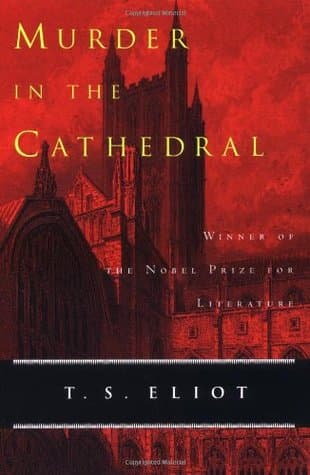
In T.S. Eliot's poetic play, Archbishop Thomas Becket defies his king and accepts a brutal martyrdom within Canterbury Cathedral.
The play starts with the Chorus, the Women of Canterbury, showing deep fear and resignation. They talk about a heavy quiet and a feeling of coming disaster, worried about the trouble Thomas Becket's return from exile will bring to their already hard lives. They are not happy about his return; instead, they see it causing suffering for Becket and themselves. They expect violent conflict between his spiritual power and King Henry II's worldly power. Their fear comes from wanting peace and avoiding the spiritual and political unrest Becket represents.
Thomas Becket arrives back in Canterbury, met by three Priests who are relieved but also worried about the dangers he faces. They tell him about the political problems with King Henry II and the chance of more conflict. Becket, however, seems to accept his fate, seeing his return as part of a divine plan. He thinks about his past and what martyrdom means, acknowledging the risks but also the spiritual importance of his stand. The Chorus continues to voice their fear, seeing Becket's presence as attracting trouble and upsetting their fragile peace.
Four Tempters confront Thomas Becket, each offering a different temptation. The First Tempter reminds Becket of their old friendship and tempts him with worldly pleasures and old times. Becket dismisses this, having moved past such desires. The Second Tempter offers him political power and his old job as Chancellor, suggesting he make peace with the King and get back his worldly authority. Becket rejects this, as he has chosen his spiritual path. He easily overcomes these first temptations, having already given up these parts of his former life.
The Third Tempter appeals to Becket's pride as a spiritual leader, suggesting he could join the barons against the King, gaining both political and religious power. Becket, seeing the trap of worldly ambition disguised as righteousness, rejects this. The Fourth Tempter presents the most subtle and dangerous temptation: wanting spiritual glory and martyrdom for its own sake, seeking fame as a saint rather than submitting to God's will. This temptation deeply bothers Becket, as it touches his spiritual honesty. He struggles with the idea of wanting to be a martyr, instead of simply accepting martyrdom as God's will.
On Christmas Day, Thomas Becket preaches to the people of Canterbury. He talks about peace, not as a lack of conflict, but as the peace of God which 'passeth all understanding.' He links the joy of Christmas with the sadness of martyrdom, explaining that a Christian's joy is tied to suffering. He prepares his congregation, and himself, for his coming death, saying that a martyr does not seek death, but is chosen by God to bear witness. He emphasizes that true martyrdom is God's design, not human ambition, and asks for prayers for himself and his killers.
Four Knights, sent by King Henry II, burst into the Cathedral. They accuse Becket of treason, of undermining the King's power, and of excommunicating bishops who sided with the King. They demand that Becket forgive the excommunicated bishops and obey the King's will. Becket calmly and firmly refuses, stating the Church's independence and authority. He defends his actions as upholding divine law and the Church's rights, directly challenging the King's worldly power. The confrontation is tense and hostile, bringing the conflict to a head.
As the Knights become more angry and threatening, Thomas Becket stays firm. He refuses to give in to their demands, knowing that doing so would compromise his spiritual beliefs and the Church's independence. The Priests urge him to run or hide, but Becket rejects their pleas, saying he must face his fate. He understands that his death is now certain and accepts it as his final witness to God's truth. He specifically forbids the Priests from locking the Cathedral doors, saying that the Church must always be open to its people, even in danger.
The Knights, furious at Becket's defiance, return to the Cathedral, now armed. They chase Becket, who does not try to resist or escape. The Priests and the Chorus watch in horror as the Knights strike Becket down at the altar. Becket says his last words, giving his soul to God and the saints. His death is violent and brutal, fulfilling the Chorus's earlier fears and Becket's own acceptance of martyrdom. The act is a sacrilege, a violation of holy ground, and a deep shock to everyone present.
Immediately after the murder, the four Knights turn to the audience and give a chilling speech. They offer a logical, worldly reason for their actions, arguing that Becket was a dangerous, arrogant, and disloyal man who threatened the kingdom's stability. They claim they acted out of duty to the King and the state, suggesting that Becket essentially caused his own death through his stubbornness. They try to frame the murder as a necessary political act, not a crime, and try to clear themselves of guilt by appealing to logic and the public good.
Following the murder and the Knights' speech, the Chorus, at first overwhelmed with terror and sadness, begins to understand the event. They mourn the innocent blood shed and the desecration of the Cathedral. However, as they reflect, their understanding changes. They move from passive fear to a deeper spiritual comprehension, seeing Becket's martyrdom as a divine act. They accept the suffering and the sacrifice as part of God's greater plan, finding peace in knowing that a saint has been made, and that spiritual order has been affirmed through the chaos.
The Priests, having seen the horrific murder, offer a final blessing. They speak of the sacredness of Becket's sacrifice and the spiritual triumph of his martyrdom. They acknowledge the pain and the loss but emphasize the glory and lasting meaning of his death. They call upon God to forgive the murderers and to bless the faithful. Their words turn the tragedy into a moment of spiritual victory and confirm the Church's lasting faith and the power of divine will, even when faced with extreme violence.
The Protagonist
Becket transforms from a man wrestling with the temptation of spiritual pride into a serene martyr who fully submits to God's will.
The Supporting
The Chorus evolves from fearful and passive observers to individuals who achieve a deeper spiritual understanding and acceptance of divine order through suffering.
The Supporting
The Priests' initial fear and pragmatism give way to a courageous affirmation of faith and the sanctity of martyrdom.
The Antagonists
The Tempters provide the crucible for Becket's final spiritual purification, disappearing once his resolve is absolute.
The Antagonists
The Knights act as instruments of the King's wrath, demonstrating the clash between secular and spiritual authority.
The Mentioned
Though absent, Henry's conflict with Becket escalates to the point of Becket's martyrdom.
This theme explores what true martyrdom means, separating it from suicide or seeking glory. Becket's struggle with the Fourth Tempter shows the danger of wanting martyrdom for personal fame instead of accepting it as God's will. His Christmas Day sermon further clarifies this, explaining that a martyr is 'not one who desires to die, but one who is chosen to die.' Becket eventually accepts his death not as a personal win, but as a sacrifice for a greater divine plan, making his death a sign of faith and a spiritual victory.
“A martyrdom is never the design of man; for the true martyr is he who has become the instrument of God, who has lost his will in the will of God, and who no longer desires anything for himself, not even the glory of martyrdom.”
The play clearly shows the ongoing conflict between worldly and spiritual power. King Henry II, though unseen, represents the state's desire for total power, while Thomas Becket champions the Church's independence and divine authority. Becket's refusal to compromise on the Church's rights and his excommunication of bishops loyal to the King directly lead to his death. The Knights' explanations after the murder highlight this conflict, presenting their actions as a defense of the King's law and the kingdom's stability against an 'unruly' Churchman.
“For good or ill, let the wheel turn. The Archbishop must stand firm.”
The Chorus at first fears suffering and disruption, wanting simple peace. However, through Becket's martyrdom, they must face the reality of pain and sacrifice. Their journey shows a collective spiritual awakening, as they move from sadness and dread to a deeper understanding of suffering as a way to redemption and divine grace. Becket's own suffering is shown as a necessary cleansing, leading to his final spiritual triumph and the glorification of God. His death changes their passive fear into a deep, though painful, acceptance of divine order.
“We have not been happy, my Lord, we have not been too happy. We are not ignorant women, we know what we risk.”
Becket struggles with the idea of his coming death, asking if it is his choice or God's plan. The Tempters, especially the Fourth, challenge him to check his reasons, making sure his acceptance of martyrdom comes from genuine submission to divine will, not pride. Becket finally concludes that while he has free will, his true freedom lies in aligning his will with God's. His death becomes an act of acceptance rather than an active pursuit, showing the paradox of freely choosing a predetermined path.
“I have had my share of women, wine and laughter. I have had my share of power and of pride. I do not wish to multiply my sins, nor do I wish to die for a worldly cause.”
A collective voice representing the common people and foreshadowing events.
The Chorus, composed of the Women of Canterbury, serves as a crucial dramatic device. They provide a collective emotional response to the unfolding events, expressing fear, anxiety, and eventually spiritual understanding. Their laments and premonitions heighten the sense of impending doom and create a palpable atmosphere of dread. They also function as a moral barometer, reflecting the impact of the spiritual and political conflicts on ordinary lives, and guiding the audience's emotional journey from fear to acceptance of divine will.
Personifications of internal and external temptations challenging the protagonist's resolve.
The Four Tempters are a classical dramatic device used to test the protagonist's moral and spiritual strength. They represent the various forms of temptation Becket faces: worldly pleasure, political power, secular alliance, and the subtle pride of seeking martyrdom for its own sake. Their appearance externalizes Becket's internal struggles, allowing the audience to witness his spiritual purification as he systematically rejects each offer, ensuring his eventual martyrdom is an act of pure faith rather than ambition or self-glorification.
The Knights directly address the audience to justify their actions.
Immediately after the murder of Becket, the Four Knights turn to the audience and deliver a rationalized defense of their actions. This dramatic device is highly effective in disrupting the audience's emotional response and forcing them to engage intellectually with the conflict. By presenting a secular, almost bureaucratic, justification for their violence, the Knights challenge the audience to consider the differing perspectives on Becket's death, highlighting the clash between spiritual conviction and political expediency. It also underscores the play's historical context and the enduring debate around such events.
The physical setting representing the Church, sanctuary, and a place of sacrifice.
The Canterbury Cathedral is more than just a setting; it is a powerful symbol. It represents the sanctity and authority of the Church, a refuge, and a place of divine presence. Its desecration by Becket's murder within its walls amplifies the horror and sacrilege of the act. The open doors of the Cathedral, insisted upon by Becket, symbolize the Church's openness to all, even its persecutors, and its vulnerability. Ultimately, it becomes the hallowed ground of martyrdom, transforming from a physical structure into a spiritual beacon of sacrifice and faith.
“For ill-doing, the circle of our action is altered.”
— One of the Four Tempters speaking to Thomas Becket.
“The last temptation is the greatest treason: To do the right deed for the wrong reason.”
— The Fourth Tempter trying to persuade Thomas to seek martyrdom for glory.
“Seven years have passed, seven years since Thomas left England. Seven years of waiting, of knowing, not knowing, waiting for when the time should be.”
— The Chorus of Women of Canterbury reflecting on Becket's exile.
“I am not afraid, my Lord, I am not afraid. Only I have not understood.”
— One of the Priests expressing fear and confusion about Becket's return.
“Human kind cannot bear very much reality.”
— Thomas Becket speaking to the Priests, reflecting on human limitations.
“We are not here to worship God with words, but with suffering.”
— Thomas Becket preparing for his martyrdom.
“Peace, peace, peace, say the world. But I cannot find it. I cannot find it.”
— The Chorus lamenting the lack of true peace in their lives.
“A martyrdom is never the design of man; for the true martyr is he who has become the instrument of God, who has lost his will in the will of God, and who no longer desires anything for himself, not even the glory of martyrdom.”
— Thomas Becket explaining the nature of true martyrdom.
“For us, the poor, there is no action, but only to wait and to witness.”
— The Chorus expressing their powerlessness in the face of great events.
“Is there no way, in my soul's sickness, to find release from the meaning of fate?”
— Thomas Becket grappling with his predetermined destiny.
“Living and partly living.”
— The Chorus describing their existence, lacking full spiritual life.
“The pattern is the action of God, but the meaning is the meaning of men.”
— Thomas Becket reflecting on the interplay between divine plan and human interpretation.
“The Church must be for ever, and for ever, and for ever.”
— One of the Priests asserting the eternal nature of the Church.
“We have suffered and are suffering, And there is no end in sight.”
— The Chorus lamenting their ongoing hardship and lack of hope.
Ready to see how well you understood this book? Take our interactive quiz with 10 questions.

Biography coming soon.







