“The greatest truths are often found in the darkest places.”
— Thomas De Quincey's reflection on his morbid fascinations.

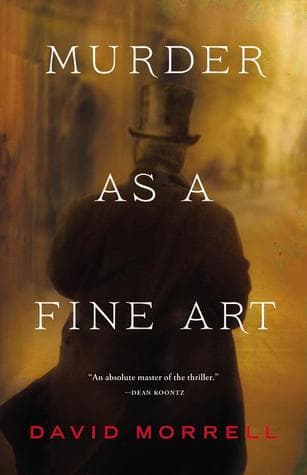
David Morrell (2013)
Genre
Thriller / Historical Fiction / Mystery
Reading Time
9-12 hours
Key Themes
See below
Sign in to track this book
In gaslit Victorian London, opium-addled writer Thomas De Quincey must clear his name when brutal murders, mirroring his own macabre essay, terrorize the city and make him the prime suspect.
In 1854 London, a family is brutally murdered in their home, their bodies mutilated in a way that recalls the Ratcliffe Highway murders of 1811. The only witness is a young, traumatized boy who cannot speak. The public and press demand swift justice. Inspector Ryan of Scotland Yard takes the case, quickly realizing the meticulous and horrific nature of the crime points to a killer with a disturbing method. The city becomes fearful and suspicious, with many fearing a return of the terror that gripped London decades earlier.
Due to striking similarities between the recent murders and the historical Ratcliffe Highway killings, and the fact that the crimes seem to mirror the macabre ideas in his essay 'On Murder Considered as One of the Fine Arts,' Thomas De Quincey, the renowned but reclusive author, becomes the prime suspect. De Quincey, now elderly and deep in his opium addiction, lives with his devoted daughter, Emily. He initially dismisses the accusations, his mind often clouded by laudanum. However, as evidence mounts and the police, led by Inspector Ryan and Sergeant Becker, close in, De Quincey understands the seriousness of his situation.
Emily De Quincey, fiercely loyal to her father, is horrified by the accusations. She knows her father, despite his eccentricities and addiction, is incapable of such acts. She tries to reason with Inspector Ryan, explaining her father's frail condition and the unlikeliness of his involvement. However, Ryan, under immense pressure, sees De Quincey's writings as a blueprint for the crimes. Emily begins her own investigation, determined to find the real killer and save her father from public condemnation and a potential hanging. She navigates the dangerous streets of London and the skepticism of the authorities.
Before De Quincey can fully understand the first accusation, another family is murdered in a similarly gruesome way, again mirroring the Ratcliffe Highway incidents. Public fear turns to panic, and the press condemns De Quincey, portraying him as a diabolical mastermind. Inspector Ryan is under intense pressure from his superiors and the Home Secretary to make an arrest. The evidence, though circumstantial, seems to point strongly to De Quincey, especially given the obscure details of the historical murders that only someone intimately familiar with them, like De Quincey through his writings, would know.
Faced with the real threat of execution, De Quincey's opium-addled mind begins to clear, slowly. He realizes that the killer is not just mimicking his essay, but is recreating the 1811 murders with chilling accuracy, even replicating details that were never publicly known. This insight sparks a desperate intellectual awakening. He begins to use his formidable analytical skills, usually applied to literature and philosophy, to examine the crimes. He believes that by understanding the original Ratcliffe Highway murders, he can identify the current perpetrator.
With Emily's help, De Quincey meticulously researches the original Ratcliffe Highway murders, studying old newspaper articles, police reports, and historical accounts. He discovers inconsistencies and suppressed details that authorities at the time overlooked or intentionally hid. This deep dive into the past reveals that the official story of the 1811 murders was incomplete, and that the true perpetrator or motive might have been obscured. Their investigation leads them down a dark path, hinting at a conspiracy that stretches back decades and possibly involves powerful figures.
As De Quincey and Emily make progress, the killer seems to become aware of their investigation. Cryptic clues, often referencing De Quincey's writings or obscure historical facts about the 1811 murders, appear at crime scenes or are sent directly to De Quincey. This suggests the murderer is not just a copycat, but someone with intimate knowledge of De Quincey's work and the original crimes, perhaps even someone who sees the murders as a 'fine art' and directly challenges De Quincey to a deadly intellectual duel.
Despite his initial skepticism and the mounting public pressure, Inspector Ryan begins to notice De Quincey's insights into the killer's methods and motives. De Quincey's ability to deduce details that only the murderer or an extremely astute historian would know slowly sways Ryan. Reluctantly, Ryan and Sergeant Becker agree to a covert collaboration with De Quincey and Emily. This uneasy alliance combines official police resources with De Quincey's brilliant, though erratic, intellect, as they race to prevent further bloodshed.
Through De Quincey's historical analysis, Emily's practical work, and Ryan's police resources, they piece together the complex puzzle. De Quincey deduces that the killer is not merely a madman, but someone with a deeply personal connection to the original Ratcliffe Highway murders. They are possibly seeking revenge or trying to correct a perceived historical injustice. The killer is revealed to be someone unexpectedly connected to the highest levels of London society, a figure who had manipulated events for decades, driven by a twisted grievance and a desire for literary immortality.
The investigation ends in a tense and dangerous confrontation. De Quincey, despite his physical frailty, uses his sharp intellect to outmaneuver the killer, who is a formidable and ruthless adversary. Emily is instrumental in the physical confrontation, protecting her father and engaging the killer directly. Inspector Ryan and Sergeant Becker arrive, providing critical backup. The climax is a dramatic battle of wits and will, set against the atmospheric backdrop of gaslit London, where the truth about the 1811 murders and the current reign of terror is finally exposed, and justice is served.
The Protagonist
From a self-absorbed, opium-addicted recluse, De Quincey is forced to engage with the real world, using his intellect to clear his name and rediscover a sense of purpose.
The Supporting
Emily grows from a caretaker to an active participant in a dangerous investigation, proving her strength and resourcefulness beyond her domestic role.
The Supporting
Ryan moves from a rigid adherence to evidence and suspicion of De Quincey to a more flexible, collaborative approach, acknowledging the value of unconventional methods.
The Supporting
Becker maintains his steadfast dedication to police work while witnessing, and adapting to, the unconventional methods required to solve the complex case.
The Antagonist
The killer's arc is one of escalating ambition and a desperate attempt to achieve a specific goal, culminating in their final confrontation with De Quincey.
The Mentioned
N/A (functions as a plot device for pressure)
The Mentioned
N/A (historical figures providing context)
The novel explores the controversial idea from De Quincey's essay, 'On Murder Considered as One of the Fine Arts.' It forces characters and readers to consider the line between intellectual curiosity, morbid fascination, and actual depravity. The killer's actions are a literal manifestation of this twisted philosophy, pushing De Quincey to confront the potential misinterpretation and dangerous influence of his own work. The theme questions whether aesthetic appreciation can apply to something as heinous as murder, and the artist's responsibility for their creations. This is clear in De Quincey's initial dismissiveness and later horror at how his work is used.
“If once a man indulges himself in murder, very soon he comes to think little of robbing; and from robbing he comes next to drinking and Sabbath-breaking, and from that to incivility and procrastination.”
Thomas De Quincey's severe opium addiction is central to his character and initial problem. It makes him largely unable to function and an easy target for suspicion. However, the threat of being accused of murder forces him to confront and, to some extent, overcome his addiction. The clarity of mind he gains, though intermittent, is crucial to his ability to solve the complex mystery. His redemption is not a full cure from addiction, but a recovery of his intellectual prowess and a re-engagement with the world. This shows that even in despair, purpose can lead to a form of salvation. This is seen in his struggle to focus and his reliance on Emily.
“Opium had given him the power to dream, but the threat of the gallows had given him the power to wake.”
The novel shows how historical events, even those seemingly resolved, can continue to influence decades later. The Ratcliffe Highway murders of 1811 are not just a backdrop but a direct cause for the present-day crimes. The killer's motivation is deeply rooted in the past, seeking to rectify perceived injustices or achieve a twisted form of historical closure. De Quincey's historical expertise and his ability to re-examine old facts are key to finding the truth, showing that understanding the past is essential to understanding the present. The story constantly draws parallels between 1811 and 1854, emphasizing this cyclical nature.
“The past, he realized, was not a dead thing, but a living, breathing entity, capable of reaching out and throttling the present.”
A significant theme is the struggle between objective truth and subjective perception, especially in public opinion and legal justice. De Quincey is seen as a murderer because of his controversial writings and reclusive lifestyle, despite his innocence. Inspector Ryan initially acts on circumstantial evidence and public pressure, which shapes his view of De Quincey. The novel explores how easily truth can be hidden by popular sentiment, media sensationalism, and preconceived notions. The search for the real killer is also a search to reveal the hidden truths of both the present and the past. This is evident in the newspaper headlines and public outcry against De Quincey.
“London believed what it wanted to believe, and the truth, like a whisper in a gale, was often lost.”
Both Thomas De Quincey and Emily are outsiders in Victorian society. De Quincey is an intellectual recluse and an opium addict, placing him outside conventional norms. Emily, as his caretaker, is often isolated with him. This outsider status initially makes De Quincey a convenient scapegoat, but it also gives him a unique perspective. Unbound by conventional thinking or the pressures of the establishment, he can see patterns and connections that others miss. Their ability to solve the crime comes from their position on the fringes, highlighting how different perspectives can be crucial to uncovering hidden truths.
“It was often the ones on the periphery, the observers, who saw the clearest.”
Misleading clues or suspects designed to divert attention from the true perpetrator.
The most prominent red herring is Thomas De Quincey himself. His infamous essay 'On Murder Considered as One of the Fine Arts' and his reclusive, opium-addled state make him the perfect, albeit innocent, suspect. The police, and the public, are easily convinced of his guilt, allowing the real killer to operate longer. Other minor characters or circumstantial evidence are also introduced to briefly mislead the reader and the investigators, adding layers of complexity to the mystery and highlighting the difficulty of distinguishing truth from appearance.
The direct mirroring and investigation of a real historical event as the core of the plot.
The entire premise of the novel hinges on the re-enactment of the historical Ratcliffe Highway murders of 1811. This isn't just a thematic nod; the killer meticulously recreates the details, and De Quincey's investigation becomes a deep dive into the historical records of the original crimes. This device allows the author to draw upon real historical events, adding a layer of authenticity and intrigue, while also using the historical 'solution' as a starting point for uncovering a new, more complex truth, blurring the lines between fact and fiction within the narrative.
De Quincey's opium-influenced perspective often skews his initial understanding of events.
While the novel is not strictly narrated by De Quincey, his perspective is central, and his opium addiction frequently renders him an unreliable interpreter of reality. His initial confusion, memory lapses, and vivid hallucinations mean that the reader experiences the early stages of the investigation through a distorted lens. This device not only emphasizes his struggle with addiction but also creates suspense, as the reader must discern what is real from what is a product of his altered state, making his eventual clarity all the more impactful.
Focuses on how the killer entered and exited, rather than a single victim in an enclosed space.
While not a traditional locked-room mystery with a single victim, the Ratcliffe Highway murders, both historical and contemporary, feature victims killed in their homes with seemingly no forced entry. The 'how' of the killer's access and escape from these private residences is a recurring puzzle for the investigators. This inverted approach focuses on the killer's meticulous planning and knowledge of the victims' routines and architecture, adding to their aura of cunning and making their capture more challenging than a simple 'who-done-it'.
“The greatest truths are often found in the darkest places.”
— Thomas De Quincey's reflection on his morbid fascinations.
“London was a city of a million secrets, each one waiting to be unearthed.”
— Narrator's description of Victorian London's hidden depths.
“Murder, when elevated to an art, reveals the human soul in its most extreme form.”
— De Quincey's controversial lecture on murder as a fine art.
“The past is never truly dead; it merely waits for the right moment to return and haunt us.”
— De Quincey contemplating the lingering effects of past events.
“Fear is a powerful motivator, capable of making men do things they never imagined.”
— Observation on the psychological impact of the murders on London's populace.
“Every lock has a key, and every secret has a weakness.”
— Detective Ryan's methodical approach to solving the crimes.
“The greatest monsters often wear the most charming disguises.”
— De Quincey's musings on the deceptive nature of evil.
“To truly understand the criminal mind, one must be willing to walk in its shadows.”
— De Quincey's immersion in the psychology of the murderers.
“Silence can be more terrifying than any scream.”
— Describing the eerie quiet after a violent act.
“The pursuit of knowledge is never without its dangers.”
— De Quincey's realization of the risks involved in his investigations.
“Even in the heart of chaos, there is an underlying order, if one only knows how to look for it.”
— De Quincey's attempt to find patterns in the seemingly random murders.
“The line between genius and madness is often blurred, especially when dealing with the extremes of human behavior.”
— Reflection on De Quincey's own intellect and the minds of the killers.
“Justice is not always swift, but it is relentless.”
— Ryan's determination to bring the culprits to account.
“There are some truths too terrible for the world to bear.”
— De Quincey's contemplation of the dark revelations uncovered.
Ready to see how well you understood this book? Take our interactive quiz with 10 questions.

David Morrell is a critically acclaimed author known for his gripping thrillers and suspense novels. He is best known for creating the iconic character John Rambo in his debut novel, *First Blood*. Morrell's other notable works include *Fireflies* and the award-winning historical mystery *Murder as a Fine Art*, showcasing his versatility across genres.







