“The world is a book and those who do not travel read only one page.”
— Clay Jannon reflecting on the nature of knowledge and experience, a twist on a common aphorism.

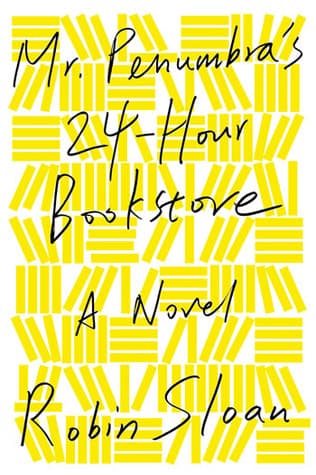
Robin Sloan (2012)
Genre
Fantasy / Mystery
Reading Time
360 min
Key Themes
See below
Sign in to track this book
A jobless web designer finds a peculiar 24-hour bookstore, discovering its cryptic patrons and the ancient secret they guard, which forces him to solve a mystery combining modern technology with centuries-old lore.
After losing his job at a web design startup during the Great Recession, Clay Jannon finds a job opening at Mr. Penumbra's 24-Hour Bookstore in San Francisco. The store is dimly lit, filled with tall, old shelves, and run by the mysterious Mr. Penumbra. Clay's first tasks are simple: mind the register during the night shift and record the unusual 'customers' who never buy books but instead check out obscure, coded volumes from a restricted section. He is told not to look at the books, but his curiosity is immediately sparked by the strange rituals and the secretive nature of the place.
Clay soon notices that the bookstore's patrons are a small, dedicated group, mostly older individuals, who carefully follow a specific check-out process for the ancient, often unreadable books. These books are not for sale and seem to contain no clear text, only symbols and diagrams. Mr. Penumbra has strict rules, forbidding Clay from opening or reading these 'codex' books. Driven by his web designer's feel for data and patterns, Clay secretly begins to record details about the patrons and the books they borrow, hoping to find the system or purpose behind these mysterious transactions.
Unable to decipher the patterns alone, Clay asks his friends for help. He brings in Neel Shah, a wealthy and brilliant software engineer who founded the Google-like company 'Goolge,' and Kat Potente, a data visualization expert at Goolge. Later, he also involves his girlfriend, Kat's best friend, who works as a sculptor for a special effects company. Together, they begin to process the information Clay has gathered about the patrons, their borrowing habits, and the coded books. Their combined technological skills aim to solve the mystery of Penumbra's bookstore, using advanced algorithms and data analysis.
Using Goolge's immense processing power, Neel and Kat analyze the data from the books. They discover that the seemingly random symbols within the codices are a complex, multi-layered cipher. Their first discovery reveals a hidden message and points to a secret society called the Unbroken Spine, which preserves the works of a forgotten Renaissance printer named Aldus Manutius. This society, they learn, believes that Manutius embedded clues to immortality within his typography and book designs, and the books in Penumbra's store are part of this grand, centuries-old search.
With their initial discoveries, Clay and his friends confront Mr. Penumbra. Though guarded at first, Penumbra is surprised and interested by their technological approach to a mystery that has puzzled the society for centuries. He reveals that he is a 'Reader' in the Unbroken Spine, and the books are part of a vast, ongoing project to decipher Aldus Manutius's 'Great Work' — a search for eternal life or understanding. He explains the society's long history and their traditional, slow methods of deciphering the texts, which are very different from Clay's modern, digital approach.
Mr. Penumbra, seeing the potential of Clay's methods, decides to take him to the headquarters of the Unbroken Spine in New York City. There, they meet the society's leaders, including the stern and traditional Corvina, who views technology with suspicion. Clay, Neel, and Kat, through a video conference, present their findings and show how Goolge's algorithms can speed up the deciphering process. While some members resist this modern intrusion, the potential for a breakthrough is too great to ignore, and they are given a limited chance to prove their methods.
The society grants Clay and his team access to their vast archives, including the legendary 'Scion of Aldus' — a complete, pristine collection of Aldus Manutius's works. With this access, Neel and Kat use Goolge's advanced imaging and text recognition software to scan and analyze every page. They race against time, converting centuries of physical text into digital data, searching for the key to Manutius's great work. Clay learns more about the society's history, its rivalries, and its deep belief in the power of typography and knowledge.
After much effort, the Goolge team, led by Neel and Kat, finally cracks the code. The 'Great Work' is not a formula for literal immortality, but a deep philosophical text on the nature of knowledge, learning, and the human condition. Aldus Manutius, it is revealed, intended his typography and books to spread understanding and connect minds across generations, not to achieve physical immortality. The 'immortality' he sought was the lasting legacy of ideas and the continuous growth of human thought through shared knowledge.
The revelation greatly impacts the Unbroken Spine. While some traditionalists are initially disappointed that the Great Work is not a literal key to eternal life, the deeper meaning resonates. The society, guided by Mr. Penumbra and influenced by Clay and his friends, begins to use technology to achieve Aldus's true vision: the wide spread and preservation of knowledge. They start digitizing their archives and making them accessible, changing from a secretive, isolated group to one dedicated to sharing past wisdom with the future.
Clay Jannon, having played a key role in this change, finds his purpose. He continues to work closely with the Unbroken Spine, helping them navigate the digital world and establish an online presence. He also keeps his connection with Goolge and his friends, acting as a bridge between the ancient world of printed knowledge and the modern realm of digital information. The bookstore, now more of a center for digital archiving and collaboration, continues to do well, fulfilling a new, expanded mission under Mr. Penumbra, who seems content with this evolution.
The Protagonist
Clay evolves from a somewhat aimless, laid-off tech worker to a purposeful individual who finds his calling in connecting ancient knowledge with modern digital tools.
The Supporting
Penumbra transitions from a staunch traditionalist of the Unbroken Spine to an advocate for integrating modern technology into the society's mission.
The Supporting
Neel uses his vast technological resources and intellect to solve a historical mystery, finding a new avenue for his company's power beyond typical commercial applications.
The Supporting
Kat applies her cutting-edge data visualization skills to an ancient mystery, demonstrating the power of modern interpretation.
The Antagonist/Supporting
Corvina slowly shifts from being a rigid traditionalist to reluctantly accepting the necessity and efficacy of modern technology in advancing the society's goals.
The Mentioned
His historical work is reinterpreted and understood in a new light through modern analysis, revealing his true legacy.
The novel explores the tension and eventual cooperation between ancient traditions and modern technology. The Unbroken Spine, with its centuries-old rituals and physical books, represents the 'old,' while Clay's digital methods and Goolge's algorithms represent the 'new.' At first, there is resistance from traditionalists like Corvina, but the story shows how these different approaches can work together, leading to discoveries that neither could achieve alone. This is clear when Goolge's supercomputers finally crack the code that generations of human 'Readers' could not.
“What is the point of a book if you don't read it?”
The Unbroken Spine's search is for literal immortality, but the ending reveals a deeper understanding of the concept. Aldus Manutius's 'Great Work' is not a magical cure but a philosophical framework for the lasting power of knowledge and shared ideas. True 'immortality' lies in the continuous transmission and evolution of human thought through books and information, ensuring that ideas and insights live on beyond an individual's life. This changes the society's purpose from a selfish goal to a selfless one.
“The true immortal is not the one who lives forever, but the one whose ideas live forever.”
The story highlights the power of information, both in its physical, coded forms within the ancient books and in its digital, analyzable forms. Clay's initial instinct to collect and analyze data, combined with Neel and Kat's sophisticated Goolge tools, shows how structured information can unlock deep secrets. The team's success comes from their ability to see patterns and connections where others saw only random symbols, showing that data, when properly collected and processed, holds the key to understanding complex systems, whether ancient or modern.
“Data is a tool, and like any tool, its power lies in how you use it.”
Despite its focus on secretive societies and individual quests, the novel emphasizes the importance of community and collaboration. Clay relies heavily on his diverse group of friends — Neel's tech genius, Kat's data visualization skills, and even his girlfriend's artistic eye — to solve the mystery. The Unbroken Spine is a community, though a very traditional one. The ending suggests that Aldus Manutius's true 'Great Work' was about connecting minds and creating shared understanding, stressing that knowledge thrives best when many people share and build upon it.
“No man is an island, and no great work is created in isolation.”
Ancient, mysterious volumes containing a multi-layered cipher.
The coded books are the central mystery and the primary MacGuffin of the story. They serve as a physical manifestation of the Unbroken Spine's centuries-long quest. Their inscrutable nature drives Clay's curiosity and necessitates the blend of traditional scholarship and modern technology to decipher them. They symbolize the hidden knowledge of the past waiting to be unlocked, and their eventual decoding reveals the true philosophical core of the narrative.
Advanced technological tools used to analyze and decipher ancient texts.
Goolge's technology acts as a powerful deus ex machina, providing the means to overcome the seemingly impossible task of deciphering the Great Work. It represents the transformative potential of modern computing power when applied to historical mysteries. This device highlights the novel's core theme of old meeting new, demonstrating how algorithms can process vast amounts of data and identify patterns far beyond human capability, accelerating a quest that had been stalled for centuries.
A secret society dedicated to preserving and deciphering the work of Aldus Manutius.
The Unbroken Spine serves as the primary external conflict and the source of the novel's mystery. It provides the historical context and the high stakes for the quest. The society's secretive nature, its ancient rituals, and its rigid hierarchy create an intriguing backdrop against which Clay's modern, open approach can be contrasted. Its existence introduces elements of fantasy and mystery, drawing the reader into a world beyond the ordinary bookstore.
The ultimate goal of the Unbroken Spine's quest, believed to hold the key to immortality.
The 'Great Work' functions as the ultimate prize and the central enigma driving the plot. Initially presented as a literal key to immortality, its true nature is revealed to be a profound philosophical statement on the enduring power of knowledge and human connection. This device allows for a satisfying twist, shifting the focus from a fantastical pursuit to a more grounded, yet equally profound, understanding of legacy and purpose. It provides the thematic resolution for the entire narrative.
“The world is a book and those who do not travel read only one page.”
— Clay Jannon reflecting on the nature of knowledge and experience, a twist on a common aphorism.
“I am a man of simple tastes. I am always satisfied with the best.”
— Mr. Penumbra discussing his preferences, hinting at the high standards of the Unbroken Spine.
“Because the internet is a series of tubes, and those tubes are filled with cats.”
— Clay Jannon's humorous observation about the internet's content.
“A book is a string of words; a life is a string of experiences. You can read a book in a thousand ways; you can live a life in a thousand ways.”
— Clay Jannon's realization about the parallel between reading and living.
“We are looking for a few good people who are able to work the night shift. Previous experience in this field is not necessary.”
— The mysterious job advertisement for Mr. Penumbra's bookstore.
“The greatest treasure in the world is not gold or jewels, but the stories that we tell.”
— Mr. Penumbra imparting wisdom about the value of narrative.
“When you have a thing to say, say it; don't make me pull it out of you with wild horses.”
— Mr. Penumbra's direct communication style with Clay.
“The internet is not a library. It's a gigantic, sprawling, uncurated, chaotic, and often beautiful conversation.”
— Clay Jannon's evolving understanding of the internet's nature.
“Every book is a world. Every world is a story. Every story is a mystery.”
— A philosophical musing on the interconnectedness of books, worlds, and mysteries.
“We're not just selling books, we're selling worlds.”
— Mr. Penumbra describing the true purpose and magic of his bookstore.
“There are people who read to understand, and there are people who read to escape.”
— Clay Jannon distinguishing between different motivations for reading.
“The true meaning of a book is not in its words, but in the connections it makes within your mind.”
— A reflection on the subjective and personal experience of reading.
“You can never truly know a place until you've worked the night shift there.”
— Clay Jannon's realization about the unique perspective gained from working at night.
“The internet is a vast ocean of information, and most of it is just seaweed.”
— A humorous and slightly cynical view on the quality of information online.
Ready to see how well you understood this book? Take our interactive quiz with 10 questions.

Biography coming soon.







