“There’s a Mr. Mercedes. He drives a Mercedes. He killed your mom and little brother.”
— Brady Hartsfield's anonymous letter to Janey Patterson, taunting her about the massacre.

Stephen King (2014)
Genre
Thriller / Mystery
Reading Time
9-10 hours
Key Themes
See below
Sign in to track this book
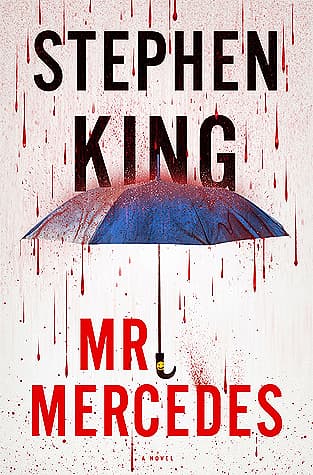
A haunted, retired detective and his allies race to stop a killer, who previously massacred job seekers with a stolen Mercedes, from launching a deadlier attack.
One cold morning in Akron, Ohio, hundreds of jobless people wait for a job fair. Suddenly, a masked driver in a stolen Mercedes-Benz S500 speeds into the crowd, hitting people. The driver backs up and charges again, causing more damage before escaping. Eight people die, and fifteen are seriously hurt. This event, called the 'Mercedes Massacre,' leaves a lasting mark and haunts Detective Bill Hodges, who fails to catch the killer before he retires.
Months after retiring, Bill Hodges is lonely and depressed, thinking about suicide. He lives alone, watches TV, and feels bad about not solving the Mercedes Massacre. He gets a letter from someone claiming to be the Mercedes Killer, calling himself 'Mr. Mercedes.' The letter details the killer's reasons and mocks Hodges for failing to catch him, even suggesting Hodges finish the job he couldn't. This letter gives Hodges a new purpose: to find the killer.
The story introduces Brady Hartsfield, the Mercedes Killer. He lives with his alcoholic, unstable mother, Deborah Hartsfield, with whom he has an incestuous relationship. Brady works two jobs: an ice cream truck driver and a computer technician. He carefully plans his next terror act, driven by a deep hatred for society and a wish for fame. He enjoys manipulating Hodges and re-watches the massacre on hidden camera footage, showing his twisted mind and planning.
Hodges realizes his lack of tech skills and asks for help from Jerome Robinson, a smart, tech-savvy teenager who mows his lawn. Jerome, a Harvard student, is hesitant at first but becomes interested. He helps Hodges set up a secure computer and email. Together, they analyze the killer's messages and online activity. Jerome's skills are key to finding clues and tracking the killer's digital trail, forming the first partnership in Hodges's unofficial investigation.
Olivia Trelawney, the wealthy owner of the stolen Mercedes, kills herself due to guilt and public criticism, made worse by cruel messages from Brady Hartsfield. Her sister, Janey Patterson, hires Hodges, at first to investigate Olivia's death as a possible murder, believing her sister was not suicidal. Hodges quickly sees Olivia was driven to suicide by Brady's psychological abuse. Janey, impressed by Hodges's insight, decides to stay and help him, giving financial support and becoming his second important ally.
As Hodges, Janey, and Jerome investigate, Brady Hartsfield learns about their work. He tries to kill Hodges by rigging his car with explosives, but it fails because of luck and Jerome's quick thinking. Later, he puts a poisoned hamburger in Hodges's fridge. Janey eats it by mistake and dies. These growing attacks confirm the killer's danger and ruthlessness, strengthening Hodges's resolve to stop him, now driven by personal loss and a desire for justice for Janey.
After Janey's death, her cousin, Holly Gibney, arrives to help with Janey's affairs. Holly is socially awkward but very smart and observant, with OCD. At first hesitant, Holly gets pulled into Hodges's investigation. Her unique view, photographic memory, and ability to notice small details others miss prove very useful. She quickly becomes a vital team member, offering key insights and showing unexpected bravery, becoming Hodges's third and final main ally.
Through careful investigation, combining Jerome's tech skills, Holly's detailed observations, and Hodges's detective instincts, they start to focus on Brady Hartsfield. Clues like Brady's ice cream truck route matching anonymous calls to Olivia Trelawney, his access to explosives through his mother's work, and his odd behavior lead them to suspect him. They also discover his incestuous relationship with his mother and her later death, which removes a big obstacle for Brady and pushes him toward his final, big plan.
Brady Hartsfield, having lost his mother and feeling cornered, plans his most daring and deadly act yet: to blow up a crowded concert venue where a popular teen idol, 'Round Here,' is performing. He plans to hide explosives in a remote-controlled toy dog, aiming for a bigger massacre than the Mercedes incident. His goal is to gain maximum fame and leave a lasting mark of terror, believing this act will finally give him the recognition he wants.
Hodges, Jerome, and Holly realize Brady's plan only hours before the concert. They try to alert the police, but their unusual methods and Hodges's retired status make it hard to be taken seriously. They decide to act themselves, rushing to the concert venue. Tension builds as they move through the crowded arena, desperately looking for Brady and the bomb, knowing thousands of lives are at risk.
At the concert, Hodges sees Brady, disguised as a vendor. A chase starts. Hodges confronts Brady, but Holly stops the attack. As Brady is about to set off the bomb, Holly hits him in the head with a weighted 'Happy Slapper' (a sock with ball bearings). The blow knocks him out, stopping him from detonating the device. Brady is left in a persistent vegetative state, and the concertgoers are safe. The team's efforts succeed, but the cost was high.
The Protagonist
From a suicidal, retired detective, Hodges transforms into an active, determined investigator, finding a new lease on life and purpose in stopping Brady Hartsfield.
The Antagonist
Brady descends further into his psychopathic tendencies, escalating his violent plans until he is incapacitated.
The Supporting
Jerome grows from a helpful neighbor to an indispensable member of the investigative team, demonstrating courage and loyalty.
The Supporting
Janey transforms from a grieving sister seeking answers into a brave, supportive partner before her tragic death fuels Hodges's resolve.
The Supporting
Holly evolves from a sheltered, anxious individual into a courageous and vital member of the team, finding her strength and purpose.
The Mentioned
Her character remains largely static, serving as a catalyst for Brady's actions, and she is ultimately murdered by him.
The Mentioned
Her character serves as an initial victim, whose death fuels the subsequent investigation.
The novel looks closely at the mind of a psychopath, Brady Hartsfield, exploring his reasons, lack of empathy, and manipulative nature. King shows evil not as supernatural, but as a human ability for cruelty and a wish for fame through destruction. Brady's careful planning, his joy in suffering, and his ability to seem normal (ice cream man, computer tech) highlight the hidden nature of his psychopathy. His incestuous relationship with his mother and his deep anger at society are shown as main drivers, illustrating how a damaged person can use their pain as a weapon. This theme is key to understanding the villain's constant pursuit of fame.
“He just wanted to be remembered. And if he couldn't be remembered for saving lives, he'd be remembered for taking them.”
Bill Hodges's journey from a suicidal, depressed retired person to a man with new purpose makes up the core of this theme. His retirement at first leaves him feeling useless and haunted by past failures, especially the Mercedes Massacre. The taunting letter from Brady acts as a spark, pulling him out of his despair and giving him a reason to live. His unofficial investigation becomes a quest for personal recovery, proving to himself and others that he still has worth. This theme is strongly shown as Hodges's mental and physical health improve along with his dedication to solving the case, showing that purpose can be found at any age.
“He'd discovered that the world, for all its horrors, still had things worth fighting for. And he was still a fighter.”
The novel stresses how an unlikely group of people can defeat great evil. Hodges, an older detective with limited tech skills, relies heavily on his allies' different abilities: Jerome Robinson, a smart young tech genius; Janey Patterson, a kind and resourceful woman; and Holly Gibney, a socially awkward but very observant person with OCD. Each member brings a unique strength, showing that working together, even among different personalities, can be more effective than individual effort. This theme is clear in the final fight, where Holly's ability to notice details and act quickly saves many lives.
“He needed help. More than that, he needed a team. And he had found one, in the most unlikely places.”
Technology, especially the internet and social media, is shown as having both good and bad sides. While Jerome's tech skills are important for Hodges's investigation, Brady Hartsfield uses technology for his evil plans. He uses social media to stalk victims, cause psychological distress (like with Olivia Trelawney), and plan his attacks. He uses online forums to research explosives and create a fake online identity. The ease with which he can stay anonymous online while causing real harm shows the dangers of digital anonymity and how technology can be used for bad purposes, making the villain a modern, tech-savvy killer.
“The internet was a vast, dark ocean, and Brady Hartsfield was a shark swimming in its depths.”
A letter from the killer that re-energizes the protagonist.
The taunting letter sent by Brady Hartsfield to Bill Hodges serves as the primary inciting incident for the main plot. It pulls Hodges out of his suicidal depression by giving him a renewed sense of purpose: to catch the killer who has haunted his retirement. The letter is carefully crafted by Brady to mock Hodges, reveal intimate details about the massacre, and challenge the former detective, thus initiating their cat-and-mouse game. It functions as a classic 'call to adventure' and establishes the personal connection between the protagonist and antagonist.
An unconventional weapon used to incapacitate the killer.
The 'Happy Slapper' is a sock filled with ball bearings, initially used by Jerome to defend himself. It becomes a crucial plot device in the climax of the novel. Its seemingly innocuous nature belies its effectiveness as a blunt weapon. Holly Gibney, in a moment of desperate bravery, uses the 'Happy Slapper' to strike Brady Hartsfield in the head, preventing him from detonating his bomb. This device highlights Holly's unexpected resourcefulness and the theme that even ordinary objects can be instrumental in extraordinary circumstances.
A seemingly innocent vehicle used by the killer for surveillance and planning.
Brady Hartsfield's job as an ice cream truck driver serves as a brilliant disguise and a significant plot device. The truck allows him to move freely and inconspicuously through neighborhoods, enabling him to conduct surveillance on his targets, including Bill Hodges, without arousing suspicion. It also provides a mobile base for his planning and psychological torment. The juxtaposition of the cheerful ice cream truck music with Brady's sinister intentions creates a chilling irony, emphasizing the killer's ability to hide in plain sight.
The disguised bomb delivery system for the final attack.
The remote-controlled toy dog is the ingenious and horrifying device Brady Hartsfield plans to use to deliver his bomb into the concert venue. Its innocent appearance allows it to bypass security and move unnoticed among the crowd. This device is key to Brady's plan for mass casualties, symbolizing his twisted creativity and his desire to maximize terror through deception. The race against time to find and disarm this specific object creates immense tension in the novel's climax.
“There’s a Mr. Mercedes. He drives a Mercedes. He killed your mom and little brother.”
— Brady Hartsfield's anonymous letter to Janey Patterson, taunting her about the massacre.
“The past is a ghost, the future a dream, and all we ever have is now.”
— Bill Hodges reflecting on his life and the case, contemplating his retirement and purpose.
“Some things, once you've loved them, become yours forever. And if you try to let them go, they only circle back and become yours again. They just wait.”
— Bill Hodges thinking about his past cases and how they still affect him.
“There's a thin line between the world of the living and the world of the dead, and sometimes that line gets blurry.”
— Holly Gibney discussing the lingering presence of victims and perpetrators.
“It’s not just the car, it’s the guy behind the wheel. The car is just a tool.”
— Bill Hodges explaining to Janey Patterson that the driver, not the vehicle, is the true evil.
“Sometimes the world don’t make sense, but you can’t let that stop you.”
— Jerome Robinson offering advice and encouragement to Bill Hodges.
“The worst thing about being a cop is that you get to see a lot of people at their worst.”
— Bill Hodges' internal monologue about the difficult aspects of his former profession.
“He didn’t just kill them; he killed their future.”
— Bill Hodges reflecting on the devastating impact of the Mercedes killer's actions on his victims and their families.
“The dead don’t care if they’re avenged. The living do.”
— Bill Hodges considering his motivation for pursuing Brady, driven by the desire for justice for the survivors.
“You can’t always save everyone, but you can try.”
— Bill Hodges' internal thought process while trying to prevent Brady's next attack.
“He understood that some monsters don’t have fangs or claws; they have smiles and clever minds.”
— Bill Hodges realizing the true nature of Brady Hartsfield as a manipulative psychopath.
“It was impossible to feel sorry for someone who was so clearly enjoying his own evil.”
— Bill Hodges' reaction to Brady Hartsfield's unrepentant glee in his crimes.
“The world is a dangerous place, not because of those who do evil, but because of those who look on and do nothing.”
— Bill Hodges' broader perspective on societal responsibility and inaction.
“Sometimes you have to break the rules to do the right thing.”
— Bill Hodges justifying his unconventional methods in pursuing the Mercedes Killer.
Ready to see how well you understood this book? Take our interactive quiz with 10 questions.

Stephen Edwin King is an American author of horror, supernatural fiction, suspense, crime, science-fiction, and fantasy novels. Described as the "King of Horror", his books have sold more than 350 million copies as of 2006, and many have been adapted into films, television series, miniseries, and comic books. King has published over 65 novels/novellas, including seven under the pen name Richard Bachman, and five non-fiction books. He has also written approximately 200 short stories, most of which have been published in book collections.







