“We are what we pretend to be, so we must be careful about what we pretend to be.”
— Howard W. Campbell Jr. reflecting on his life as a Nazi propagandist and American spy.

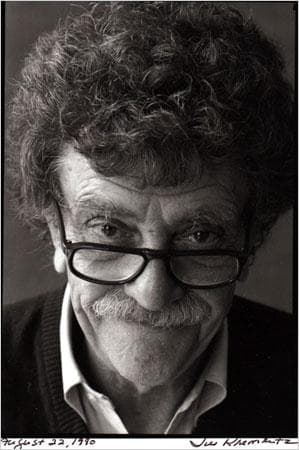
Kurt Vonnegut Jr. (1961)
Genre
Historical Fiction / Science Fiction
Reading Time
282 min
Key Themes
See below
Sign in to track this book
An American spy, accused of Nazi war crimes, struggles with his past as a propagandist, forcing readers to consider the line between hero and monster.
Howard W. Campbell, Jr., an American writer and former Nazi propagandist, introduces himself from his Jerusalem cell, where he awaits trial for war crimes. He writes his memoirs on toilet paper, reflecting on his life and how he got there. Campbell claims innocence, stating he was a double agent for the U.S. during World War II, a fact known only to his handler, Frank Wirtanen. He describes his childhood in Schenectady, New York, and his early career as a playwright in pre-war Germany, where he met and married Helga Noth.
Campbell details his life in Berlin, where he found success as a playwright and became an expatriate. He describes his deep love for Helga Noth, an actress, whom he married. Their life was filled with art, discussions, and an unawareness of the coming political unrest. This period contrasts sharply with the horrors that would soon engulf Europe and Campbell's life. He emphasizes his connection with Helga, calling her his 'nation of two,' a bond that would influence his later decisions.
As war nears, Campbell is approached by Frank Wirtanen, an American intelligence officer, who recruits him as a spy. Wirtanen's plan is simple: Campbell is to become a prominent Nazi propagandist, his broadcasts filled with coded messages for the Allies. The more convincing his Nazi performance, the more valuable he would be. Campbell, initially hesitant, agrees, driven by a desire to protect Helga and a naive belief he could control the narrative. This decision begins his moral descent and the blurring of his true self and his created persona.
Howard W. Campbell, Jr. becomes 'The Voice of the American Reich,' a powerful Nazi propagandist. His broadcasts, full of anti-Semitic and pro-Nazi messages, reach millions and are very persuasive. Unknown to the public, these broadcasts contain subtle coughs, stutters, and pauses that form a secret code for the Allies, sending vital intelligence. Campbell's public persona becomes so convincing that even he struggles to separate his true self from the monster he portrays, leading to deep psychological distress and growing isolation.
After Germany's defeat, Campbell is not publicly identified as an American agent. Instead, he disappears, living quietly in a small Greenwich Village apartment in New York City for nearly two decades. He becomes a ghost, known to few, haunted by his past and his role. During this time, he writes his memoirs, trying to understand his life and justify his actions. He lives alone, his only companion a parakeet named Polly, and the constant memory of Helga, whom he believes died during the war.
Campbell's solitude is broken by a woman claiming to be Helga Noth, his long-lost wife. This 'Helga' is with her supposed father, Krapptauer, and a young girl named Resi, who claims to be Helga's sister. Campbell is overjoyed, desperate to believe his love has returned. However, he soon suspects their motives and inconsistencies in their story. It is revealed that this 'Helga' is a Soviet agent named Resi Noth, who had plastic surgery to resemble the real Helga, as part of a plan to kidnap Campbell for Soviet propaganda.
As the plot progresses, Campbell's apartment becomes a meeting place for various characters. Reverend Lionel J. D. Jones, an American Nazi sympathizer, seeks Campbell's endorsement for his new fascist movement. George Kraft, a fellow tenant and Soviet agent, tries to manipulate Campbell. Dr. Abraham Epstein, a Jewish Holocaust survivor, confronts Campbell about his wartime broadcasts. These figures, each with their own agenda, force Campbell to confront the moral complexities of his past and the present danger he faces, complicating his already difficult situation.
The truth about 'Helga' is revealed: she is Resi Noth, the real Helga's younger sister. Resi was trained by the Soviets and had extensive plastic surgery to impersonate Helga. Her mission was to lure Campbell out of hiding and abduct him for Soviet propaganda. This revelation crushes Campbell, who had hoped for a reunion with his wife. The deception highlights the pervasive manipulation and deep loneliness that define Campbell's existence, showing he is a pawn in larger geopolitical games.
Overwhelmed by guilt, the failure of her mission, and perhaps a genuine affection for Campbell, Resi Noth commits suicide by ingesting cyanide. Her death is a tragic and shocking event that deeply affects Campbell. It emphasizes the destructive power of deception and the human cost of political schemes. Resi's suicide also removes Campbell's last tangible link to his past and to the possibility of a renewed connection, leaving him even more isolated and resigned to his fate.
After the chaos and revelations in his apartment, Howard W. Campbell, Jr. is apprehended by Israeli agents. His past as a Nazi propagandist, though secretly a double agent, has caught up with him. He is extradited to Jerusalem to stand trial for war crimes. This ends his long reclusion and begins his public reckoning. The journey to Israel is symbolic, taking him from the anonymity of his New York apartment to the global stage, where his life will be judged by a world that knows only his monstrous public persona.
Campbell's trial in Jerusalem begins, drawing international attention. He is accused of heinous war crimes, with his wartime broadcasts as damning evidence. The world sees him as a monster, a willing participant in the Nazi regime. Just as hope seems lost, Frank Wirtanen, his former handler from the Office of Strategic Services, arrives in Jerusalem. Wirtanen's appearance offers a glimmer of hope, as he is the only person who can confirm Campbell's story of being a double agent and clear his name. His testimony is essential to revealing the truth behind Campbell's actions.
Frank Wirtanen testifies, confirming that Howard W. Campbell, Jr. was an American spy and his Nazi broadcasts contained coded information for the Allies. This testimony should clear Campbell, proving his innocence in the eyes of the law. However, Campbell has a personal realization: while innocent of war crimes, he was guilty of something worse—becoming the evil he pretended to be. He understands that his propaganda, regardless of its secret purpose, truly incited hatred and violence, and that 'we are what we pretend to be, so we must be careful what we pretend to be.'
With Wirtanen's testimony, Campbell is legally cleared of war crimes. The court, and potentially the world, now understands his true role. However, Campbell cannot escape the moral implications of his actions. The realization that his pretense had real-world consequences, that his evil performance was indistinguishable from actual evil, weighs heavily on him. He feels inescapable guilt for the hatred he helped spread and the lives affected by his words, regardless of his intentions. The exoneration feels empty, a legal victory that does not morally absolve him.
In a cruel twist, Campbell receives a letter from the real Helga, written years ago and held by the Soviets. The letter reveals that Helga was alive for a time after the war but later died in a Soviet prison camp. This news shatters Campbell, confirming the complete loss of his 'nation of two' and the ultimate futility of his sacrifices. The letter highlights the tragic irony of his life: he endured years of moral compromise and isolation, believing he was protecting Helga, only to discover she suffered a terrible fate anyway. This final blow deepens his despair.
After reading Helga's letter and fully understanding the devastating impact of his dual life, Campbell makes a final, tragic decision. He uses a piece of baling wire, which he had been meticulously shaping into a miniature gallows, to hang himself in his prison cell. His suicide is not an act of cowardice but a profound statement about inescapable moral responsibility for one's actions, regardless of intentions. He cannot live with the knowledge of what he became, even if it was a pretense, and the ultimate loss of everything he held dear. His death seals the novel's dark message about identity and guilt.
The Protagonist
Campbell starts as a man convinced of his moral innocence due to his intentions, but ultimately realizes he is responsible for the evil he pretended to be, leading to his tragic end.
The Supporting
Helga's arc is largely symbolic, representing lost innocence and the devastating impact of war on personal relationships, even in absence.
The Supporting
Wirtanen remains largely unchanged, a pragmatic operative focused on the mission, serving as a catalyst for Campbell's final realization.
The Supporting
Resi transforms from a determined, deceptive agent to a tormented individual overwhelmed by guilt, leading to her self-destruction.
The Supporting
Jones remains a static character, a symbol of unwavering ideological extremism.
The Supporting
Kraft remains a consistent figure of cynical manipulation, serving as a foil to Campbell's internal struggle.
The Supporting
Epstein's role is primarily to serve as a moral accuser, representing the collective suffering caused by the war.
The novel explores the idea that 'we are what we pretend to be, so we must be careful what we pretend to be.' Campbell's life shows this, as his long performance as a Nazi propagandist blurs the lines between his true self and his monstrous persona. Despite his secret intentions, his words had real-world consequences, inciting hatred and violence. This theme appears in his isolation, his inability to shed his past, and his realization that his pretense made him morally complicit, regardless of his internal justifications. The 'nation of two' he shared with Helga shows his desperate attempt to keep a core identity separate from his public role.
“''We are what we pretend to be, so we must be careful what we pretend to be.''”
Mother Night questions traditional ideas of good and evil, showing a world of moral ambiguity. Campbell is a spy for the Allies, yet his propaganda genuinely helps the Nazi cause. His intentions were 'good,' but his actions were 'evil.' The novel asks if intentions can excuse responsibility for the impact of one's actions. This ambiguity is clear in Campbell's trial, where legal exoneration does not ease his deep moral guilt. The characters around him, from the deceptive Resi to the fanatical Reverend Jones, further show the complex and often contradictory nature of human morality during war and political upheaval.
“''There are plenty of good reasons for fighting,'' I said, ''but no good reasons ever to hate.''”
Vonnegut shows war not as a glorious struggle but as an absurd and cruel machine that destroys lives and distorts identities. Campbell's existence is a product of this absurdity, forced into a role that obliterates his sense of self and ultimately leads to his destruction. The characters, from the earnest spies to the unrepentant fascists, are all caught in the illogical and destructive currents of global conflict. The revelation of the real Helga's death in a Soviet prison camp, despite Campbell's efforts to protect her, highlights the senseless and indiscriminate nature of war's cruelty, where even 'good' intentions lead to tragic outcomes.
“''The world is full of things that are tragic, and things that are absurd. But I have never seen anything so tragically absurd as the world of Howard W. Campbell, Jr.''”
Campbell's love for Helga Noth is the novel's emotional core, representing his only true connection and a refuge from his life's moral chaos. He calls their bond his 'nation of two,' showing his extreme isolation from any other sense of belonging. This theme explores how love can be both a strong motivator and a source of deep vulnerability. His long separation from Helga, the deception involving Resi Noth, and the eventual revelation of Helga's death, strip Campbell of his last emotional anchor, leaving him utterly alone. His isolation is a direct result of his dual identity, a man without a country, without a true self, and ultimately, without love.
“''I had a country, and it was Helga.''”
The novel shows the immense power of propaganda and language to shape perceptions, incite hatred, and manipulate populations. Campbell, as 'The Voice of the American Reich,' masters this, his words having a profound and devastating impact, regardless of his secret intentions. The story demonstrates how even coded messages, meant for a select few, contribute to a larger narrative that can be genuinely harmful. The lasting influence of Campbell's broadcasts, even decades later, shows how words, once spoken, take on a life of their own, independent of the speaker's true beliefs. This theme warns about the responsibility inherent in wielding such power.
“''A lot of people were helped by my being a Nazi. A lot of people were hurt by my being a Nazi. The good I did was a secret. The evil I did was a public scandal.''”
The entire story is told from Howard W. Campbell, Jr.'s perspective as he writes his memoirs in prison.
This device allows for deep immersion into Campbell's subjective experience, giving readers direct access to his thoughts, justifications, and moral struggles. It creates a sense of intimacy and challenges the reader to grapple with his version of events, forcing them to question the reliability of his narration. The memoir format also allows for nonlinear storytelling, with Campbell frequently reflecting on his past, providing context and deepening the moral ambiguities of his character.
The pervasive use of situational, dramatic, and verbal irony to highlight moral paradoxes.
Irony is central to the novel's dark humor and its exploration of moral ambiguity. Situational irony is evident in Campbell, a secret Allied spy, becoming a celebrated Nazi propagandist. Dramatic irony occurs as the reader knows Campbell's true role, while the world condemns him. Verbal irony is present in Campbell's cynical observations and the often absurd situations he finds himself in. This device underscores the novel's central theme that intentions do not always align with outcomes, and that life is often a series of tragic paradoxes.
Campbell's symbolic term for his exclusive bond with his wife, Helga.
This metaphorical device emphasizes Campbell's profound isolation and his lack of allegiance to any actual country or ideology. His 'nation of two' represents his only true identity and loyalty, making his actions as a spy and propagandist feel like a betrayal of nothing but his own conscience. It highlights his desperate need for personal connection in a world of political deceit and ultimately underscores the tragedy of his life when this 'nation' is irrevocably lost.
A miniature gallows Campbell constructs throughout the novel, foreshadowing his end.
This recurring symbol serves as a constant, morbid reminder of Campbell's impending judgment and ultimate fate. He meticulously crafts it from baling wire, a seemingly innocuous act that takes on profound significance as the narrative progresses. The gallows represents both the legal justice he faces and the self-imposed moral reckoning that consumes him. Its final use in his suicide is a powerful, grim culmination of his journey, illustrating his inescapable guilt and the novel's dark resolution.
“We are what we pretend to be, so we must be careful about what we pretend to be.”
— Howard W. Campbell Jr. reflecting on his life as a Nazi propagandist and American spy.
“Make love when you can. It's good for you.”
— Campbell recalling his mother's advice.
“There are too many of us, and we are all too far apart.”
— Campbell's general observation about humanity.
“When you're dead, you're dead. No more, no less.”
— Campbell's stark view on death.
“The only difference between a hero and a villain is that the hero is the one who wins.”
— A cynical reflection on how history judges individuals.
“I was a man who had given up on himself, so what did it matter if I fooled a few people?”
— Campbell justifying his actions and lack of self-worth.
“It was a time when the world was full of monsters, and sometimes, I was one of them.”
— Campbell acknowledging his role in the atrocities of WWII.
“The greatest patriotic service you can render your country is to die for it.”
— A bitter commentary on wartime propaganda.
“There are no innocent bystanders.”
— Campbell's belief that everyone is complicit to some degree in global events.
“I had hoped to be a great artist, but I settled for being a great liar.”
— Campbell's lament about the path his life took.
“A lot of people are going to think you're a monster, Howard. But you're not. You're just a man who did his job too well.”
— Campbell's American handler's perspective on his wartime actions.
“The only way to keep your sanity is to tell yourself that you are doing the right thing, even if you know you are not.”
— Campbell's coping mechanism for his moral compromises.
“Every man has to decide for himself whether he's going to be a human being or a piece of garbage.”
— A fundamental philosophical question posed by the narrative.
“How many people do you think you can fool before you start fooling yourself?”
— A core question about the nature of Campbell's identity and pretense.
Ready to see how well you understood this book? Take our interactive quiz with 10 questions.
Biography coming soon.







