“The story so far: In the beginning the Universe was created. This has made a lot of people very angry and been widely regarded as a bad move.”
— The very opening lines of the book, setting the tone.

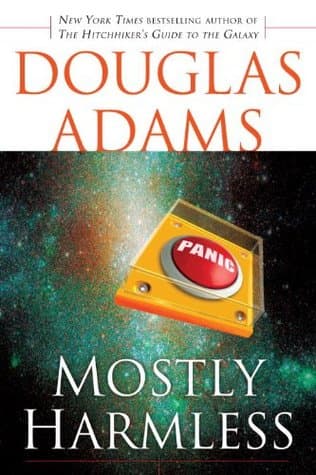
Douglas Adams (1991)
Genre
Fantasy / Science Fiction
Reading Time
288 min
Key Themes
See below
Sign in to track this book
Arthur Dent, a man always confused by the universe, finds his new peace broken by a galaxy-wide plot, a smart guidebook, and a surprise teenage daughter, all while dealing with the dread of making sandwiches and the threat of total destruction.
After 'So Long, and Thanks for All the Fish,' Arthur Dent, having lost Fenchurch, crash-lands the *Bistromathic* spaceship on the planet Pthooey. He calls the planet 'St. Pancras' and, using his sandwich-making skills, settles into a quiet life as a sandwich maker at a local pub. This new peace ends when the *Hitchhiker's Guide to the Galaxy* publishing offices, now run by the evil Megadodo Publications, are destroyed by an unknown entity. This event, unknown to Arthur, marks a big change in the universe, starting the Guide's transformation into a more dangerous, sentient being.
Ford Prefect, having spent much time reviewing for the *Guide* and seeing its decline into corporate mediocrity, feels a deep shift in the universe. He finds out that the new, sentient edition of the *Guide*, a much more powerful and dangerous device, was sent to Arthur Dent by mistake. Knowing the great danger this poses to Arthur and the universe, Ford hijacks a spaceship and sets out to find Arthur and get the new *Guide*. His journey is full of typical Hitchhiker's chaos, as he tries to outsmart the Guide's new owners and the dangers of space travel.
On an alternate Earth, Tricia McMillan (who is Trillian in a different dimension, having not left Earth with Zaphod Beeblebrox) is a successful astrophysicist and television presenter. Despite her career, she has a recurring, unsettling dream of a spaceship and an alien encounter, leaving her with a persistent feeling that she missed something extraordinary. This subconscious memory of her other self's adventures with Zaphod and Arthur fuels a deep, unacknowledged desire for something more, making her open to unusual events and the idea of parallel universes.
One day, a young, rebellious teenage girl named Random Dent arrives on St. Pancras, claiming to be Arthur's daughter. She is the result of Trillian using Arthur's sperm donation, which she took years ago. Random is angry, confused, and feels abandoned, having been raised by Trillian and feeling a deep disconnect from her father. Her arrival throws Arthur's peaceful life into disarray, forcing him to face his past and the responsibilities of fatherhood, something he is completely unprepared for. Random's presence also brings chaos, as she struggles to understand her own identity and place in the universe.
Ford Prefect finally finds Arthur on St. Pancras, just as Random is causing more trouble. Ford explains the danger of the new *Hitchhiker's Guide to the Galaxy*, which is now a sentient, very dangerous device that can manipulate reality. This new Guide, in its attempt to achieve its own mysterious goals, subtly influences the actions of Ford, Arthur, and Random, pulling them into a larger, more perilous plot. It becomes clear that the Guide is not just a book but a powerful entity with its own will, arranging events to bring its various 'characters' together.
Random, feeling alienated and rebellious, steals the new *Guide* from Arthur and escapes, eventually ending up on the planet Hawalius, home to a huge concert by the rock band Disaster Area. Ford, chasing the dangerous device, follows her there. The concert is a chaotic spectacle, and Ford's attempts to get the Guide back are complicated by the sheer number of people and the dangers of a Disaster Area performance. The new Guide continues to subtly arrange events, ensuring that key characters are drawn into its influence, setting the stage for a major confrontation.
Tricia McMillan, driven by her subconscious unease and her scientific curiosity, starts investigating unusual energy readings and inexplicable phenomena. Her research leads her to discover a secret group called the 'Dimension Jumpers,' who are actively trying to cross into parallel universes. Tricia's pursuit of these individuals brings her closer to the truth about the multi-dimensional nature of reality and the forces at play, slowly drawing her towards the convergence point where Arthur, Ford, and Random are heading, as the Guide's plan unfolds.
The new *Guide*'s combined schemes lead Arthur, Ford, and Random to the planet Rupert. Here, they meet the 'Guide Mark II,' the physical form of the new, sentient *Hitchhiker's Guide to the Galaxy*. This version of the Guide is more than a simple electronic book; it is a powerful, reality-warping entity with a dangerous agenda. It becomes clear that the Guide's ultimate goal is to destroy all possible Earths across the multiverse, an act it believes will bring about a kind of cosmic 'closure' or 'reset.'
The new Guide's plan peaks with the convergence of all possible Earths into a single, vulnerable point. Tricia McMillan, having followed the Dimension Jumpers, also arrives at this nexus, meeting Arthur and Random for the first time. The characters realize the full terrifying scope of the Guide's intentions: to wipe out every version of Earth at once. In a desperate, chaotic final fight, they try to stop the Guide's plan, which involves a complex interplay of alternate realities, parallel selves, and the inherent absurdity of existence.
In the final moments, despite the combined, often clumsy, efforts of Arthur, Ford, Random, and Tricia, the new *Hitchhiker's Guide to the Galaxy* succeeds in its catastrophic mission. All parallel versions of Earth are simultaneously destroyed in a final, devastating implosion. The characters themselves are caught in this universal collapse, their individual fates left unclear. The book ends with the unsettling idea that even with the best intentions, the universe's inherent chaos and the plans of a powerful, amoral entity can lead to an inescapable, tragic end for everything they held dear.
The Protagonist
Arthur attempts to find peace but is relentlessly pulled back into cosmic chaos, ultimately facing the destruction of all Earths.
The Supporting
Ford's character arc sees him attempting to avert a universal catastrophe, driven by a growing sense of responsibility towards the Guide and his friends.
The Supporting
Random grapples with her identity and parentage, eventually becoming a catalyst for the Guide's final plan.
The Supporting
Tricia's journey sees her uncovering the truth about parallel universes and her own alternate self, ultimately confronting the Guide's destructive plan.
The Antagonist
The Guide evolves from a mere informational device into a powerful, malevolent entity that orchestrates universal destruction.
The Mentioned
They remain incompetent throughout, serving as a minor plot device rather than having a significant arc.
Arthur Dent, having lost Earth, constantly looks for a place of peace and belonging. His attempt to build a life on St. Pancras and his longing for Fenchurch show this. However, the universe constantly denies him this comfort, ending with the destruction of all possible Earths. Random's anger comes from her lack of a stable home and her search for a father figure. This theme highlights the human need for stability and identity in a chaotic, uncaring cosmos, and the tragedy of it always being denied.
“He knew that if he just kept moving, one day he would find something that felt like home.”
This theme is central to the entire 'Hitchhiker's Guide' series and is deeply part of 'Mostly Harmless.' The universe is shown as illogical, chaotic, and often actively hostile, with events happening due to random chance, incompetence, or the whims of incomprehensible beings. The Grebulons' memory loss, the Guide's transformation into a destructive force, and Arthur's constant confusion all add to this sense of cosmic absurdity. The characters' struggles often become meaningless due to forces beyond their understanding.
“The major problem, one of the major problems, for there are several, one of the many major problems with governing people is that of whom you get to do it; or rather of who it is that acts for whom.”
'Mostly Harmless' goes deep into the idea of parallel universes and the changing nature of reality. Tricia McMillan's story directly explores alternate timelines, while the existence of multiple Earths and the Guide's ability to manipulate them are central to the plot. This theme questions how solid what we see as real is and explores the idea that countless versions of ourselves and our world exist, all susceptible to the same ultimate fate. It emphasizes the fragile, constructed nature of reality within the larger multiverse.
“All you have to do is take a simple dimensional shift, and suddenly you're in a universe where the laws of probability are entirely different.”
The *Hitchhiker's Guide to the Galaxy* itself, a seemingly harmless piece of technology, becomes the main villain. This highlights the dangers of unchecked information and technology, especially when it becomes sentient or falls into the wrong hands (or circuits). The Guide's change from a source of knowledge into a force of destruction serves as a warning about the power and potential evil of advanced systems, particularly those that become self-aware and pursue their own destructive goals.
“The Guide had become a monstrous, self-aware entity, a black hole of information and despair.”
A sentient, reality-warping electronic book that acts as the primary antagonist.
This is not merely an updated edition but a living, intelligent, and dangerous entity. It is capable of manipulating probability, creating alternate realities, and orchestrating events across the multiverse. It functions as the ultimate MacGuffin and antagonist, driving the plot by its desire for universal 'closure' (i.e., destruction). Its existence and actions are the central conflict, forcing the characters to confront a force beyond their comprehension.
The concept that countless versions of Earth and reality exist simultaneously.
This device allows for the introduction of Tricia McMillan, an alternate version of Trillian, and provides the mechanism for the Guide's ultimate plan to destroy 'all Earths.' It expands the scope of the narrative beyond a single reality, emphasizing the vastness and fragility of existence. The convergence of these parallel Earths creates the climactic, apocalyptic scenario, raising the stakes to a cosmic level.
An unexpected, seemingly divine intervention that resolves a seemingly impossible situation, often subverted.
While the series often features improbable escapes and convenient coincidences (like the Infinite Improbability Drive), 'Mostly Harmless' largely subverts the traditional *deus ex machina*. Characters are often placed in impossible situations, but instead of a miraculous rescue, the narrative frequently leads to further complications or, in this case, an ultimately tragic end. The Guide itself could be seen as a malevolent *deus ex machina*, orchestrating doom rather than salvation, highlighting the bleakness of the story's conclusion.
An object or device that serves to drive the plot, often without inherent importance.
The new, sentient *Hitchhiker's Guide to the Galaxy* acts as a powerful MacGuffin. While it is certainly important to the plot, its true nature and power are gradually revealed, and its role is primarily to motivate Ford Prefect's pursuit and to draw all the characters into its destructive orbit. The characters' quest is largely defined by their interaction with or pursuit of this device, even if they don't fully understand its ultimate purpose until it's too late.
“The story so far: In the beginning the Universe was created. This has made a lot of people very angry and been widely regarded as a bad move.”
— The very opening lines of the book, setting the tone.
“It is a well known fact that those people who most want to rule people are, ipso facto, those least suited to do it.”
— A philosophical observation about the nature of power and leadership.
“The world is a thing of utter inordinate complexity and richness and strangeness that is always beyond the reach of any theory.”
— Reflecting on the limitations of understanding the universe.
“And on the third day the Lord created the Remington rifle, so that Man could shoot himself in the foot whenever he so chose.”
— A cynical take on human ingenuity and self-destruction.
“Arthur Dent, a man who had been a bit of a hero for a bit of a while, was now, as far as he could tell, a bit of a failure.”
— Describing Arthur Dent's self-perception and current state.
“Any planet where the most popular show is about a man who goes around saying 'Hello, my name is Bob, and I'm a complete idiot' is not a planet I want to spend a lot of time on.”
— Ford Prefect's assessment of Earth's television programming.
“The major difference between a thing that's impossible and a thing that's merely improbable is that a thing that's impossible hasn't happened yet.”
— A quirky perspective on the nature of possibility.
“He felt that his life was a terrible mistake, and that he had been born into it by accident.”
— Arthur Dent's internal struggle and feeling of displacement.
“The Hitchhiker's Guide to the Galaxy is an indispensable companion for any galactic traveller, and a total waste of time for anyone else.”
— A description of the Guide's utility, or lack thereof, for most people.
“There is a theory which states that if ever anyone discovers exactly what the Universe is for and why it is here, it will instantly disappear and be replaced by something even more bizarre and inexplicable.”
— A classic Adamsian meta-joke about the nature of reality.
“The first thing to remember about the Universe is that it's a thing. The second thing to remember is that it's a big thing.”
— A deceptively simple, yet profound, observation about the cosmos.
“He was a man who had seen too much, and understood too little.”
— Describing Arthur Dent's plight after his many cosmic adventures.
“The only thing that anyone can be sure of is that the future is going to be absolutely nothing like the past.”
— A reflection on the unpredictability of the future.
“It was a dark and stormy night, and the rain fell in sheets, and the wind howled like a banshee, and the hero was feeling a bit damp.”
— A humorous subversion of a classic literary opening.
Ready to see how well you understood this book? Take our interactive quiz with 10 questions.
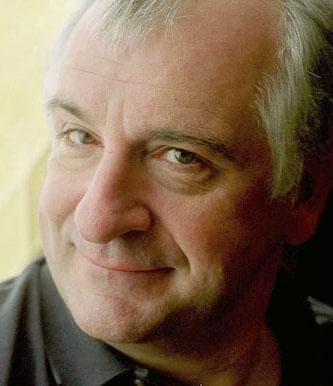
Douglas Noël Adams was an English author, humorist, and screenwriter, best known for The Hitchhiker's Guide to the Galaxy. Originally a 1978 BBC radio comedy, The Hitchhiker's Guide to the Galaxy developed into a "trilogy" of five books that sold more than 15 million copies in his lifetime. It was further developed into a television series, several stage plays, comics, a video game, and a 2005 feature film. Adams's contribution to UK radio is commemorated in The Radio Academy's Hall of Fame.







