“THERE IS NO JUSTICE, ONLY ME.”
— Death's response to Mort questioning the fairness of life and death.

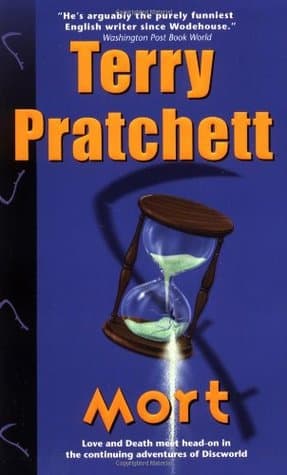
Terry Pratchett (1987)
Genre
Fantasy / Science Fiction
Reading Time
240 min
Key Themes
See below
Sign in to track this book
A bumbling, lovestruck apprentice to Death himself learns that even the Grim Reaper's job comes with soul-crushing relationship drama and the ultimate ethical dilemma.
Mortimer 'Mort' is a gangly, awkward youth from the village of Bad Schüschein, known for his unfortunate habit of thinking. At a local hiring fair, he is the last one left unchosen, much to his father's dismay. As the clock strikes midnight, a skeletal figure on a pale horse, Death himself, appears and offers Mort an apprenticeship. Death, interested by Mort's slight, thoughtful nature, takes him back to his domain, a stark, black-and-white realm outside normal time and space. Mort meets Albert, Death's long-suffering butler and cook, and Ysabell, Death's adopted daughter, a bored and somewhat petulant young woman who at first resents Mort's presence.
Mort's training begins with learning the rules of death and the proper use of Death's scythe. He accompanies Death on several assignments, seeing the final moments of various individuals across the Discworld. He learns about the 'life-timers' in Death's library, hourglasses that represent every living being and their remaining time. Death explains the importance of not interfering with the natural order, only performing the final cut. Mort struggles with the detached nature of the job, especially when faced with the premature death of a young stable boy, which deeply affects him and causes him to question if fate is fair.
Feeling a sudden, unexplainable urge to 'live' and understand humanity, Death decides to take a holiday. He tells Mort to take over his duties, giving him the scythe, Binky (Death's horse), and a stern warning not to interfere with destiny. Mort, despite his worry, accepts the responsibility. Death, disguised and trying to blend in, tries various human experiences like drinking, gambling, and even getting a job as a cook, often with disastrous and literally funny results because he does not understand human metaphor and social cues.
Mort's first major solo assignment is to collect the soul of Princess Keli, a minor royal in the kingdom of Sto Lat, who is scheduled to be assassinated. When Mort arrives, he sees the assassins preparing to strike. Overwhelmed by Keli's beauty and the injustice of her impending death, Mort impulsively prevents the assassination. He cuts the thread of the assassin's life instead, allowing Keli to live. This act of interference immediately creates a ripple effect, causing reality to warp and Keli to exist in a state of 'un-reality' where others struggle to perceive her, and the universe tries to correct itself around her.
Mort's actions have severe consequences. Princess Keli, though alive, is now largely ignored by the world, and her existence becomes less certain. The universe, a self-correcting mechanism, tries to 'un-exist' her, causing strange phenomena. Mort, Ysabell, and Albert discover that the threads of destiny in Death's library are becoming tangled and contradictory. Mort feels immense guilt and a growing affection for Keli. Ysabell, at first annoyed, starts to help Mort, while Albert, always practical, tries to find a solution to the brewing existential crisis before Death returns and discovers Mort's mistake.
Realizing the seriousness of the situation, Mort, with Ysabell and Binky, travels to Ankh-Morpork to seek advice from the wizards of the Unseen University. They explain the problem to the Archchancellor and the other faculty, who are at first confused but eventually understand the concept of a 'living paradox.' The wizards, particularly the Librarian (an orangutan), struggle to find a magical solution to undo Mort's interference without further damaging reality. Their attempts are largely ineffective, showing the unique and unprecedented nature of Mort's mistake.
Because of Mort's interference, Princess Keli's original intended husband, the Duke of Sto Helit, is now without a fated partner. The universe, trying to 'fix' the anomaly, presents him with a ghostly, barely perceptible Keli. The Duke, a man of science and logic, becomes obsessed with her, believing her to be a spectral presence or a unique magical phenomenon. He dedicates himself to making her 'real' again, using various scientific and magical experiments, which further shows the bizarre state of reality and the escalating chaos caused by Mort's actions.
After his unsuccessful attempt at experiencing humanity, Death returns to his domain, feeling somewhat enlightened but mostly bewildered by human customs. He immediately senses that something is wrong. The library of life-timers is in disarray, and the flow of time itself is disturbed. When he confronts Mort, the truth about Princess Keli and Mort's interference comes out. Death is furious, not just at the breach of his rules, but at the potential for cosmic catastrophe. He realizes that Mort has created an impossible paradox that threatens to unravel reality itself.
Death states that the only way to resolve the paradox and restore order is for Mort to 'reap' Princess Keli, effectively undoing his interference. Mort, having fallen in love with Keli and determined to save her, refuses. This leads to a dramatic confrontation where Death challenges Mort to a duel, using their scythes. The duel is not just for Keli's life, but for Mort's right to defy destiny and for the existence of reality. It is a battle of wills and philosophies, fought in Death's dimension, where the stakes are cosmic.
During the intense duel, Mort, fueled by his love for Keli, manages to outmaneuver Death. He uses Death's own scythe against him, a feat thought impossible. Death, surprised and perhaps even a little impressed, yields. As a result of Mort's victory, Keli's existence is solidified, and a new destiny is forged for her. Death, acknowledging Mort's unique perspective and his own growing understanding of humanity, offers him a choice. Mort, no longer wishing to be Death's apprentice, marries Princess Keli and becomes the Duke of Sto Helit, taking on the responsibilities of the kingdom. Death, having learned a valuable lesson about the unpredictable nature of life and love, continues his duties, but with a slightly altered outlook, occasionally even showing a flicker of emotion.
The Protagonist
From an awkward, unchosen apprentice, Mort transforms into a man who challenges destiny and finds love, ultimately becoming a duke.
The Major Character
Death, initially a purely logical entity, gains a nascent understanding of humanity, love, and the nuances of life through his experiences and Mort's actions.
The Supporting Character
From a bored and resentful immortal, Ysabell finds purpose and love with Mort, embracing a more 'human' existence.
The Supporting Character
Albert remains consistently loyal and practical, serving as a steadfast anchor in Death's household.
The Supporting Character
From a fated victim, Keli becomes a living paradox, then a real princess and Mort's wife, gaining agency through her unique circumstances.
The Supporting Character
Binky remains a steadfast and loyal companion, serving both Death and Mort without change.
The Supporting Character
The Duke becomes increasingly obsessed with making the 'un-real' Keli tangible, highlighting the paradox Mort created.
The Mentioned
The wizards attempt to understand and resolve the paradox, largely failing but providing insight into the Discworld's magical laws.
The central conflict of 'Mort' is about whether individuals are bound by a predetermined destiny or if they have the free will to change their fate. Mort's initial role as Death's apprentice is to simply facilitate destiny, but his decision to save Princess Keli directly challenges this. His act of defiance creates a ripple effect, showing that even a single choice can unravel predetermined events. The book explores the consequences of such an act, suggesting that while destiny is powerful, it is not entirely unchangeable, especially when confronted by human will and emotion.
“IT IS NOT A QUESTION OF HOPE, BUT OF FATE. THIS IS THE WAY OF THINGS.”
The novel explores the philosophical concepts of life and death, not just as endpoints, but as connected aspects of existence. Through Death's attempts to understand humanity and Mort's struggles with his duties, the book explores what it means to truly 'live' and what purpose death serves. Death's holiday shows the mundane and profound aspects of human experience he cannot grasp, while Mort's compassion reveals the value of individual lives. It suggests that death, while inevitable, gives meaning and urgency to life, and that interfering with it can lead to existential chaos.
“WHAT IS THE POINT OF LIVING IF IT'S GOING TO BE TAKEN AWAY? WHAT IS THE POINT OF FEELING PAIN, OF FEELING JOY? IF IT'S ALL GOING TO END ANYWAY?”
Love, especially romantic love, is a powerful force for change and defiance in the story. Mort's love for Princess Keli is the driving force behind his decision to save her life, directly challenging his master and the cosmic order. This theme explores how deep emotional connections can compel individuals to act against overwhelming odds and established norms. It shows that compassion and love are not just human emotions but forces capable of altering destiny and creating new realities, even when the universe tries to correct itself.
“I DON'T CARE WHAT THE RULES ARE! SHE'S ALIVE!”
Mort's journey is a classic coming-of-age story. He begins as an awkward, unchosen youth, without direction or confidence. His apprenticeship with Death forces him into situations where he must confront his fears, make difficult choices, and ultimately discover who he is. He deals with the identity of being Death's apprentice versus his own developing sense of self and morality. By defying Death and fighting for Keli, Mort sheds his passive nature and forms a new identity, eventually embracing a life of purpose and leadership as the Duke of Sto Helit.
“IT WAS HIS JOB TO TAKE LIVES. HE HAD NO RIGHT TO GIVE THEM.”
While dealing with cosmic themes, Pratchett uses his humor through the bureaucracy of Death's domain. The meticulous record-keeping, the 'life-timers' library, and Albert's adherence to routine despite the existential nature of their work, all make fun of the human tendency to apply bureaucratic structures to even the most profound concepts. Death himself, despite being a cosmic entity, is bound by a certain 'protocol.' This theme shows the absurdity of trying to systematize and categorize the unpredictable chaos of life and death, often contrasting it with Mort's raw, emotional decisions.
“IT'S ALWAYS THE SAME. YOU GET A NEW APPRENTICE, AND THEY THINK THEY KNOW IT ALL. NO RESPECT FOR THE SYSTEM.”
Hourglasses representing the lifespan of every living being.
In Death's library, every living being on the Discworld has a corresponding hourglass that measures their remaining time. These 'life-timers' serve as a visual representation of destiny and the finite nature of life. They are a crucial plot device, as Mort's interference causes them to become tangled and contradictory, physically manifesting the disruption to reality. Their state directly reflects the stability of the universe, making them a tangible symbol of fate and its potential unraveling. They also serve to emphasize Death's detached, bureaucratic approach to his duties.
An extra-dimensional realm outside time and space.
Death's domain is a stark, monochromatic, and timeless realm that exists outside the normal flow of the Discworld. It serves as a narrative device to separate Death and his household from the vibrant, chaotic world of the living, emphasizing his role as an impartial observer. Its unique properties, such as the ability to view all moments of time simultaneously, allow for exposition and demonstrate the cosmic scale of Death's operations. It also provides a stark contrast to the colorful world Mort saves, highlighting the difference between abstract duty and lived experience.
Death's iconic tool, capable of severing life from body.
The scythe is Death's primary tool, capable of cutting the thread of life. It is more than just a weapon; it is a symbol of Death's authority and his function in the universe. When Mort wields it, he takes on Death's power and responsibility. The duel between Mort and Death, fought with their scythes, symbolizes the clash between destiny and free will. Its use by Mort to save Keli, and then against Death himself, demonstrates the apprentice's growing power and defiance, ultimately becoming an instrument of change rather than just an enforcer of fate.
A living paradox caused by Mort's interference with destiny.
When Mort saves Princess Keli, he creates a paradox: she is alive, but the universe believes she should be dead. This causes her to exist in a state of 'un-reality,' where people struggle to perceive her, and the world actively tries to 'un-exist' her. This plot device is central to the conflict, as it provides a tangible consequence of Mort's actions and drives the efforts to either restore her reality or undo her existence. It effectively demonstrates the Discworld's self-correcting nature and the profound implications of altering a predetermined fate.
“THERE IS NO JUSTICE, ONLY ME.”
— Death's response to Mort questioning the fairness of life and death.
“He'd discovered that being a Prince of the Undead was a lot like being a Prince of the Living, only with more paperwork.”
— Mort reflecting on his new job as Death's apprentice.
“The trouble with always being Death is that you're always Death. There's no time off.”
— Death contemplating the eternal nature of his duties.
“He'd been looking forward to it. He'd even bought a new scythe.”
— Death's enthusiasm for a particular 'appointment'.
“Humanity doesn't need to be saved from itself. It needs to be saved from the people who want to save it.”
— A philosophical observation about intervention and free will.
“Light thinks it travels faster than anything but it is wrong. No matter how fast light travels, it finds the darkness has always got there first, and is waiting for it.”
— A poetic description of the nature of light and darkness.
“It was a dark and stormy night. The rain fell in torrents—”
— The opening line of a book Ysabell is reading, a common Pratchett meta-joke.
“The Senior Wrangler's definition of a philosopher was 'someone who knows the square root of a carrot'.”
— A humorous and absurd definition, typical of Discworld.
“Mort, of course, was trying to make sense of the universe, which is always a bad idea, even if it happens to be in a good mood.”
— Narrator's commentary on Mort's intellectual endeavors.
“AND WHAT IS SO TERRIBLE ABOUT BEING FORGOTTEN? I AM FORGOTTEN BY EVERYONE, EXCEPT YOU.”
— Death speaking to Mort about the nature of his existence.
“The greatest gift a man can give is to let a woman live her own life, even if he doesn't like the way she's doing it.”
— A surprisingly progressive sentiment within the fantasy setting.
“He'd always wanted to be a hero, but hadn't quite got around to working out the details.”
— Mort's initial aspirations and lack of planning.
“The gods don't play dice with the universe; they play an incomprehensible game of their own invention with the pieces.”
— A take on Einstein's famous quote, reinterpreted for the Discworld gods.
“It was impossible to tell where the darkness ended and the universe began.”
— A description of the vastness and mystery of space.
Ready to see how well you understood this book? Take our interactive quiz with 10 questions.
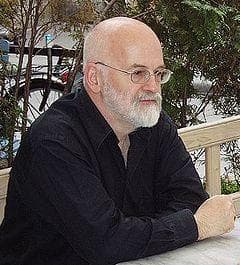
Sir Terence David John Pratchett was an English humorist, satirist, and author of fantasy novels, especially comical works. He is best known for his Discworld series of 41 novels.







