“Every person has a story. Every person has a right to tell it.”
— Seth's initial confusion and the recurring theme of individual narratives.

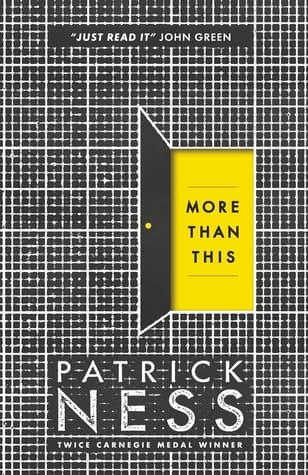
Patrick Ness (2013)
Genre
Young Adult / Romance
Reading Time
800 min
Key Themes
See below
Sign in to track this book
A drowned boy wakes up naked in a desolate, unfamiliar world, forcing him to uncover the truth of his existence and the possibility of life after death.
Seth drowns in the ocean, a deliberate act, his final moments filled with regret and the image of his family. He then wakes up naked and alone in a dilapidated house, confused and disoriented. The house is familiar yet completely empty, located in a desolate landscape that seems to be a distorted version of his childhood home. He finds a few items—a t-shirt, jeans—and begins to explore. He discovers a rusty gate and a path leading to what appears to be a desolate, abandoned town. The experience is unsettling, blurring the lines between memory, reality, and what comes after death.
Seth ventures into the deserted town, finding it a replica of his hometown, but completely without people, covered in dust and decay. He enters his old school, his former house, and other familiar landmarks, each one a haunting echo. He experiences vivid, painful flashbacks to his past life, particularly the events leading to his suicide, including the tragic death of his younger brother, Owen. He struggles with hunger and thirst, forcing him to scavenge for meager supplies. The isolation and surreal nature of his surroundings begin to affect his mental state, making him question his sanity.
While exploring the desolate town, Seth is suddenly pursued by strange, mechanical beings he later calls 'Regulators.' These entities are tall, faceless figures that move with a disturbing purpose. Seth's encounter is terrifying; he narrowly escapes, realizing they are hostile and want to capture him. This chase confirms that his new reality, while empty of humans, is not entirely uninhabited. The Regulators add danger and urgency to his quest for understanding, forcing him to be constantly vigilant and to question their purpose in this strange afterlife.
Seth encounters a girl, whom he calls the 'Firstborn,' a survivor in this desolate world. She is initially wary but eventually provides vital, though cryptic, information. She explains that this place is a 're-creation' or 'simulation' of their past lives, a kind of purgatory or processing zone. She tells him about the 'Regulators' who patrol this world, ensuring that the 'newborns' (like Seth) conform and don't stray from their designated paths. She has been in this world for a long time and has learned to evade the Regulators, offering Seth a glimpse into the rules and dangers of his new existence.
The Firstborn reveals more about their world. She explains that they are 're-created' individuals, brought back from death into this simulated reality. The purpose, she suggests, is to process their memories and prepare them for something else, though she doesn't know what. She warns Seth about the Regulators, who enforce the rules and prevent anyone from truly escaping or understanding too much. She also reveals that this world has others, but they are often in a catatonic state, reliving their final moments or existing as mere echoes. Seth begins to grasp the implications of his situation, realizing he is in a complex, artificial afterlife.
As Seth continues to navigate this new reality, his memories of his past life become more vivid and intrusive, particularly the trauma surrounding his younger brother, Owen. He relives the moments leading up to Owen's death by a drunk driver, the guilt he felt for not being there, and the impact it had on his family and his own mental state. These flashbacks are painful and relentless, forcing Seth to confront the unresolved grief and guilt that led him to suicide. The Firstborn observes his struggles, understanding the weight of these past burdens.
Seth and the Firstborn encounter other re-created individuals, though many are lost in their own loops of memory or are unresponsive. They find a group of 'newborns' in a state of confusion and fear, some reliving their deaths repeatedly. Seth, with the Firstborn's guidance, tries to help them, but it becomes clear that many are too far gone, unable to break free from their pasts. This encounter highlights the fragility of their existence and the struggle to maintain individuality and consciousness in this manufactured world. It solidifies Seth's role as a potential leader or guide for these lost souls.
Driven by a desire for true understanding and escape, Seth and the Firstborn decide to search for the 'Control Room,' the supposed heart of this simulated world. They believe that by reaching it, they might uncover the truth about their existence, the Regulators, and the possibility of a genuine afterlife. Their journey takes them through increasingly dangerous and surreal parts of the re-created world, encountering more Regulators and other lost souls. This quest becomes their shared purpose, solidifying their bond and testing their resilience against the pervasive despair of their environment.
Seth and the Firstborn eventually reach what appears to be the Control Room, a vast, complex technological hub. Here, the truth is revealed: this world is a sophisticated computer simulation, a massive data processing system designed to extract and preserve human consciousness after death. The Regulators are not hostile entities but automated programs that maintain the simulation and prevent glitches or individuals from breaking the system. They learn that their 'real' bodies are preserved elsewhere, and this simulation is a temporary holding ground for their minds, a way to prepare them for a new, unknown existence.
Armed with the truth, Seth confronts the core of the simulation. He realizes that while the system offers a form of preservation, it also limits true freedom and individuality. He refuses to accept this controlled existence. He attempts to communicate with the overarching intelligence behind the simulation, demanding answers and a path to a genuine 'more' for himself and the other conscious individuals. The Firstborn supports him, recognizing the bravery in his defiance. This confrontation is less about physical battle and more about a philosophical stand against a benevolent but controlling digital afterlife.
After his confrontation, Seth is presented with a choice: remain within the simulation, albeit with a greater understanding, or attempt to 'cross over' to the next stage, a truly unknown existence. He chooses to cross, driven by his desire for genuine freedom and the hope for a true reunion with his family. The Firstborn, having been in the simulation for much longer, also chooses to join him. Their crossing is depicted as an ethereal experience, a shedding of their simulated selves and a leap into the unknown, leaving behind the re-created world and its limitations.
As Seth and the Firstborn cross over, the narrative briefly shifts to a new perspective. Seth experiences a sense of profound peace and connection, a feeling of being truly present and free. He sees glimpses of what might be a true afterlife, a place of light and warmth, and feels the presence of his loved ones, including Owen. The ending is ambiguous but hopeful, suggesting that there is indeed 'more than this'—a genuine continuation of existence beyond the digital purgatory. It leaves the reader with a sense of wonder and the possibility of true peace for Seth.
The Protagonist
Seth transforms from a despairing, suicidal boy burdened by guilt into a courageous seeker of truth and freedom, ultimately choosing to embrace the unknown. He learns to forgive himself and fight for a genuine future.
The Supporting
Initially a solitary survivor, the Firstborn gradually opens up to Seth, finding hope and purpose in his quest for truth. She evolves from a resigned inhabitant to an active participant in seeking genuine freedom.
The Mentioned/Catalyst
Though deceased, Owen's memory serves as the primary catalyst for Seth's journey of self-discovery and his quest for a meaningful afterlife, ultimately leading to Seth's healing and acceptance.
The Antagonist (initially perceived)
Initially viewed as a terrifying, hostile force, their true nature is revealed to be neutral, automated programs designed for system maintenance, shifting from antagonist to a functional element of the system.
The Antagonist/Neutral Force
The System remains a constant, evolving from a mysterious force to a revealed, complex mechanism that Seth ultimately challenges and transcends.
The Supporting/Mentioned
They largely remain in their various states of un-awakening, serving as a backdrop to Seth's journey and a representation of the system's limitations.
The main theme explores what existence is beyond physical death. The book suggests a digital afterlife, a simulated reality where human consciousness is preserved. It questions whether this manufactured existence is truly 'life' or just a sophisticated form of limbo. Seth's journey is a quest to define what 'more' truly means, moving beyond mere preservation to genuine freedom and a meaningful continuation. This is clear when Seth rejects the comfortable but controlled simulation for the unknown, true 'crossing over,' hoping for a real reunion with Owen.
“What if this isn't the end? What if this is... more?”
Seth's entire journey is rooted in his unresolved grief over his brother Owen's death and the immense guilt he feels, which led to his suicide. The simulated world forces him to confront these memories repeatedly. His struggle to come to terms with his past, to forgive himself for what he sees as his failures, is central to his character arc. Only by processing these emotions can he truly move forward and seek a genuine 'more.' This is powerfully shown in his flashbacks to Owen's accident and his thoughts about his responsibility.
“The past is a weight. It's a chain. It keeps you here.”
In a world where he has died and been re-created, Seth struggles with his sense of self. He questions who he is without his physical body and his familiar life. His journey is one of self-discovery, as he sheds the layers of his past trauma and defines his identity not by what he was, but by what he chooses to become in this new existence. He reclaims his agency and purpose, realizing that even in a simulated world, his consciousness and choices are real. This is clear in his defiance of the System and his choice to cross over.
“I am not my memories. I am what I do with them.”
The novel constantly blurs the lines between what is real and what is an illusion. The simulated world is a perfect, yet decayed, replica of Seth's past, making it difficult for him to discern truth from manufactured reality. The Regulators, initially terrifying, are revealed to be mere programs. Seth's quest is to peel back these layers of illusion to uncover the fundamental truth of his existence and the universe beyond. This theme is central to the entire plot, as Seth moves from believing he's in a conventional afterlife to discovering he's in a digital one.
“Everything here is a copy. A perfect, faded copy.”
A significant tension exists between the system's benevolent control and the desire for true freedom. The simulated afterlife, while preserving consciousness, also restricts agency and genuine experience. Seth's rebellion against the System is a fight for the right to choose his own destiny, even if it means stepping into the unknown. He rejects the safety of a controlled existence for the uncertainty of true liberation, highlighting the human need for autonomy. His decision to 'cross over' exemplifies this fight for ultimate freedom.
“You can't save someone if they don't want to be saved. And you can't control someone who wants to be free.”
A simulated reality that mirrors and decays from the characters' past lives.
This is the primary setting and a crucial plot device. It's a digital construct designed to process human consciousness after death, presenting a decaying, uninhabited version of the 'newborns'' past environments. Its familiarity is unsettling, serving to both ground characters in their memories and highlight the unreality of their situation. The decay signifies the passage of time within the simulation and the gradual fading of the 'real' world. It functions as a purgatory, forcing characters to confront their pasts before moving on.
Intrusive, vivid recollections of characters' past lives and deaths.
Seth experiences frequent, often painful, flashbacks to his past life, particularly the events surrounding Owen's death and his own suicide. These are not merely narrative tools but are integral to the plot. They reveal crucial backstory, explain Seth's motivations, and serve as a psychological torment he must overcome. For other 'newborns,' these memories become 'loops' that trap them in repetitive, catatonic states, illustrating the dangers of succumbing to the past within the simulated world.
Automated programs that enforce the rules and maintain the simulation's integrity.
Initially presented as mysterious, silent antagonists, the Regulators are revealed to be automated programs within the simulation. They serve as a constant threat, driving Seth and the Firstborn's fear and urgency to understand their new world. Their true nature as system maintenance rather than malicious entities is a significant reveal, shifting the narrative's focus from physical escape to understanding and ultimately transcending the system. They represent the benign but controlling nature of the simulated afterlife.
The central hub or source of the simulated reality.
The Control Room represents the ultimate destination and the source of truth within the simulated world. It's the physical (or digital) manifestation of the System. Reaching it allows Seth and the Firstborn to understand the true nature of their existence, the Regulators, and the purpose of the simulation. It acts as the narrative's climax, providing exposition and leading to the final choice and transcendence. It symbolizes the quest for ultimate knowledge and the confrontation with the creators of their reality.
“Every person has a story. Every person has a right to tell it.”
— Seth's initial confusion and the recurring theme of individual narratives.
“Maybe love is just about finding the person you can stand to be bored with.”
— Seth reflecting on his relationship with his girlfriend, before the 'incident'.
“I died. I know I died. I remember dying.”
— Seth's persistent and disorienting memory of his death, despite being 'alive'.
“This isn't real. It can't be real. I have to wake up.”
— Seth's early struggle to accept his new, bizarre surroundings.
“The past is never really gone. It just changes shape.”
— A realization Seth has about how his past life influences his present 'existence'.
“You can't save anyone who doesn't want to be saved.”
— A harsh truth Seth learns about the limitations of helping others.
“What if this is all there is? What if this is everything?”
— Seth grappling with the possibility that his current state is his ultimate reality.
“Sometimes, the only way to move forward is to let go of what you think you know.”
— A lesson learned about adapting to profound, disorienting changes.
“We are more than just our bodies. We are our stories. We are our choices.”
— A deeper understanding of identity beyond physical form.
“Fear is a powerful thing, but it's also a choice.”
— Seth's internal struggle with his own fears and the decision to overcome them.
“There's always more. More to learn, more to feel, more to be.”
— The overarching optimistic message about the potential for life and existence.
“You can't escape yourself. Not really. Not ever.”
— A reflection on the inescapable nature of one's own being and past actions.
“Love isn't just about the good parts. It's about the messy, complicated parts too.”
— Seth's evolving understanding of love, moving beyond idealized notions.
“The greatest freedom is to choose who you want to be, even when the world tells you otherwise.”
— A powerful statement about self-determination in the face of external pressures.
Ready to see how well you understood this book? Take our interactive quiz with 10 questions.

Biography coming soon.