
Barry Unsworth FRSL was an English writer known for his historical fiction. He published 17 novels, and was shortlisted for the Booker Prize three times, winning once for the 1992 novel Sacred Hunger.

Barry Unsworth (1995)
Genre
Literary Fiction / Historical Fiction / Mystery
Reading Time
12 Minutes
Key Themes
See below
Sign in to track this book
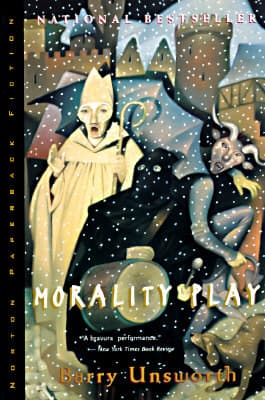
In a snowbound 14th-century English village, a group of actors staging a play about a recent murder become entangled in a dangerous conspiracy that blurs the lines between performance and reality.
Nicholas Barber, a young priest recently unfrocked for an unspecified offense, travels through a harsh winter landscape in 14th-century England. He meets a small, struggling group of traveling actors led by Martin, a practical and somewhat cynical man. Desperate for a warm meal and a place to rest, Nicholas offers his help, claiming some knowledge of plays and Latin. The group, including the loud Bottom and the quiet Tobias, is going to a remote, snowbound village where they hope to perform their traditional Mystery Plays. As they near the village, they hear of a recent tragedy: a young boy has been brutally murdered, and a mute, deaf girl named Jane Cole is accused of the crime and awaits execution. This news creates a somber mood for their arrival and gives Martin an unusual idea.
Upon reaching the village, the group finds the atmosphere heavy with grief, suspicion, and a morbid interest in the murder. Instead of the usual biblical stories, Martin, sensing the villagers' preoccupation and perhaps a deeper truth, suggests an unprecedented and dangerous idea: they will stage a 'morality play' based on the actual murder that just happened. He believes that by re-enacting the events, they might not only entertain but also potentially uncover the truth of what happened. This suggestion meets initial resistance and fear from some group members, especially Bottom, who fears divine punishment and local anger. Nicholas, however, is interested by the intellectual challenge and the moral implications of such a venture, seeing it as a way to use their art to seek justice rather than just preach. Martin persuades them, emphasizing the novelty and potential success of the idea.
The actors begin to 'rehearse' the murder, using the limited information available from the villagers and the local bailiff, Borret. Nicholas, with his sharper mind and observational skills, takes on a more central role in directing the scenes, pushing the actors to consider motivations and actions beyond the official story. As they re-enact the discovery of the boy's body and the subsequent arrest of Jane Cole, inconsistencies and questions start to appear. The official story, that Jane, a simple and isolated girl, impulsively murdered the boy, seems too convenient and lacks convincing details. The actors' immersive experience of playing the roles makes them doubt the guilt of the accused, stirring unease within the group. They realize they are doing more than just putting on a play; they are actively investigating.
As the group continues to develop their play, they interview villagers and gather fragments of information. Nicholas, in particular, observes the subtle reactions of the townspeople, their silences, and their guarded responses. They learn about the victim, Thomas Wells, a boy from a wealthier, more established family, and the accused, Jane Cole, an outcast. The official story, supported by the local lord, Earl De Guise, and his bailiff, Borret, is that Jane acted alone. However, the actors' re-enactments begin to suggest a more complex scenario involving other boys, potential bullying, and a possible cover-up. The group starts to suspect that the murder might be connected to deeper social and class divisions within the village, hinting at a more sinister truth than simple madness.
The group's inquiries lead them to the families of other boys who were with Thomas Wells on the day of the murder. They discover that these boys, from influential families, have been conspicuously silent or have provided vague accounts. Nicholas deduces that the initial 'finding' of Jane Cole at the scene might have been orchestrated or at least convenient for someone powerful. The actors, through their performances, start to feel the weight of the injustice and the pressure from the local authorities to accept the official story. Martin, while initially driven by the novelty of the play, becomes increasingly committed to uncovering the truth, recognizing the moral need. Their probing begins to irritate Borret and the Earl's men, who see their 'play' as dangerous interference in justice.
As the actors get closer to uncomfortable truths, the atmosphere in the village turns hostile. Borret, the bailiff, and his men begin to intimidate the group, warning them to stick to traditional plays and stop their meddling. The actors are threatened with arrest and violence, their performances disrupted. Despite the danger, Martin and Nicholas, now fully invested, refuse to back down. Bottom, initially fearful, finds his resolve strengthened by the injustice he perceives. The group understands that their 'play' has become a direct challenge to the authority and reputation of Earl De Guise, who benefits from a swift and unquestioned verdict. The stakes rise significantly, transforming their artistic endeavor into a perilous quest for justice.
The group decides to perform their 'murder play' for the villagers, gambling that the truth, when presented dramatically, will resonate. During the performance, Nicholas masterfully directs the scene, emphasizing the inconsistencies and pointing fingers not at Jane Cole, but subtly at the sons of the local gentry, particularly one named Mark, and their involvement. The play culminates in a powerful re-enactment that suggests Thomas Wells was accidentally killed during a struggle with other boys, possibly involving a game gone wrong or an act of bullying, and that Jane Cole was merely a convenient scapegoat. The dramatic tension builds as the villagers watch, some with dawning horror, others with defiant denial. The truth, or a strong semblance of it, is laid bare before the community.
The performance, while illuminating, does not immediately lead to justice for Jane Cole. Instead, it incites a furious backlash from Earl De Guise and his men. The powerful families implicated in the play are outraged by the public shaming. The group is attacked, their meager possessions destroyed, and they are forced to flee the village under threat of death. Some members are injured during the escape. The direct confrontation with power proves costly, showing the limits of truth in the face of entrenched authority and class privilege. They realize that while they may have revealed the truth, they lack the power to enforce justice in such a corrupt system, leaving Jane's fate uncertain.
Wounded and dispossessed, the group makes a desperate escape from the vengeful Earl's men, fleeing into the harsh winter night. They are forced to abandon their stage props and costumes, symbolizing the destruction of their artistic endeavor and their brief foray into investigative theater. During their difficult journey, they reflect on their actions and the consequences. Nicholas grapples with the moral complexities of their endeavor — whether revealing the truth was worth the danger and the suffering it brought upon them. Martin, too, considers the fine line between art and activism, and the immense power held by the ruling class. Despite the physical cost and the failure to save Jane, a sense of quiet triumph remains among them, knowing they had, at least for a moment, held a mirror to injustice.
The group, now leaner and more hardened, continues their journey, forever changed by their experience in the snowbound village. Nicholas, having found a new purpose beyond the confines of the church, stays with the actors, his intellect sharpened and his moral compass refined. Martin, though battered, has gained a deeper understanding of the power of their art, even if that power comes with great personal risk. The experience strengthens their bond as a group, forging a new sense of purpose that goes beyond mere entertainment. They carry with them the knowledge of what they uncovered and the heavy price they paid, a reminder of the enduring struggle between truth and power in a harsh, medieval world. Their journey continues, but their understanding of their craft and their world has irrevocably shifted.
The Protagonist
Nicholas transforms from a cynical, detached intellectual into a morally engaged investigator, finding a new vocation and a sense of belonging with the acting troupe.
The Supporting
Martin evolves from a purely pragmatic leader to one willing to risk everything for justice, solidifying his commitment to the power of truth and art.
The Supporting
Bottom overcomes his initial fears and superstition to become a brave participant in the quest for truth, demonstrating personal growth and moral conviction.
The Supporting
Tobias, though young, develops a deeper understanding of the world's harshness and the power of performance through his immersive experience.
The Antagonist/Victim
Jane's arc is tragic; she remains a victim whose fate is determined by the actions of others, highlighting the injustice she faces.
The Antagonist
Borret remains a static character, embodying the rigid and corrupt nature of authority, unwavering in his attempts to suppress the truth.
The Antagonist
The Earl remains a shadowy, powerful figure whose actions reinforce the theme of class power and corruption, his arc being one of unyielding authority.
The Supporting
Mark's arc is one of implied guilt and evasion, serving to highlight the corruption of the justice system.
The novel explores how art, specifically theater, can be a strong tool for uncovering truth and challenging authority. The group's decision to stage a play about a real murder transforms their traditional entertainment into a form of investigative journalism and social commentary. By re-enacting events, they not only bring the story to life but also allow for a critical examination of motives and evidence, revealing inconsistencies that official stories hide. The play becomes a means for collective inquiry and a catalyst for change, demonstrating that stories, whether true or false, shape perception and justice.
“We are not here to tell men what they know, but to show them what they do not know, or will not admit.”
A central theme is the sharp contrast between true justice and the arbitrary application of law by those in power. The legal system, represented by Borret and Earl De Guise, is shown to be corrupt and biased, prioritizing social order and the protection of the elite over the pursuit of truth. Jane Cole, a marginalized and voiceless individual, is an easy scapegoat. The group's quest for justice highlights the vulnerability of the innocent and the difficulty of challenging entrenched authority. The novel suggests that 'justice' in this historical context is often a tool for maintaining power rather than ensuring fairness.
“Truth is a dangerous thing, Nicholas, in the hands of the weak. It can only be spoken by the strong.”
The novel looks at the nature of truth — how it is perceived, manipulated, and suppressed. The official story of Jane Cole's guilt is a convenient lie designed to quickly close the case and protect powerful interests. The group's dramatic re-enactment forces a confrontation with this deception, suggesting that truth is not always obvious but must be actively sought and revealed, often at great personal risk. The characters grapple with the difficulty of discerning truth in a world full of rumor, fear, and self-interest, showing that 'truth' can be a contested and fragile concept.
“What is truth, Nicholas? Is it what men choose to believe, or what actually happens?”
The novel clearly portrays the rigid class structure of 14th-century England and its strong impact on justice. The murder of Thomas Wells, a boy from a prominent family, and the immediate accusation of Jane Cole, a poor, disabled outcast, show how social status dictates one's vulnerability to injustice. The wealthy and powerful (Earl De Guise, the families of the implicated boys) are protected, while the marginalized are expendable. The group's efforts to expose the truth are met with fierce resistance precisely because they threaten this established social hierarchy, revealing the deep-seated inequalities that exist in the society.
“The rich have their own truth, Nicholas. And it is always the one that serves them best.”
The narrative explores the courage and danger of individuals who dare to challenge societal norms and established authority. Nicholas, an unfrocked priest, and the acting group, outsiders by nature, collectively decide to act on their moral convictions, even when it means facing the wrath of the powerful. Their individual choices to pursue truth come together into a collective act of defiance. The novel contrasts this individual agency with the inertia and fear that often grip society, highlighting the personal cost of standing up for what is right in a world where conformity is often safer.
“Better to burn with the truth than to freeze with a lie.”
The central device for investigation and revelation.
The troupe's decision to stage a play re-enacting the murder serves as the primary plot device. This 'play-within-a-play' is not merely entertainment but a method of investigation, a means to critically examine the official narrative, and ultimately, a tool for revealing the truth. By embodying the characters and re-enacting the events, the actors gain insights and expose inconsistencies that traditional inquiry might miss. It allows the author to explore meta-narrative themes about storytelling, truth, and the power of performance to shape reality and influence justice.
The official story is presented as deliberately misleading.
While not a first-person narrative, the 'official' account of the murder and Jane Cole's guilt functions as an unreliable narrator from the perspective of the authorities. The initial information given to the troupe is biased and incomplete, reflecting the desire of Borret and the Earl to quickly close the case. The plot progresses by systematically dismantling this 'unreliable' official narrative, using the actors' investigation and re-enactment to expose its flaws and reveal the deliberate deception or omission of facts. This device creates suspense and drives the troupe's quest for the true story.
The harsh winter and isolated setting hint at danger and grim truths.
The relentless, snowbound winter and the isolated, remote village serve as a powerful atmospheric foreshadowing device. The harsh environment reflects the grim nature of the crime and the unforgiving society. The physical isolation of the village parallels the social isolation of Jane Cole and the moral isolation of the few who seek justice. This oppressive setting creates a sense of foreboding and underscores the danger the troupe faces, hinting that their pursuit of truth will be fraught with peril and that the outcome may be bleak despite their efforts.
Jane Cole as the convenient victim of injustice.
The character of Jane Cole serves as a classic literary scapegoat. Her status as a mute, deaf, and marginalized outcast in the village makes her the perfect, convenient target for the murder accusation. She cannot speak to defend herself, and her social standing means her life is considered less valuable than that of the powerful families. This device highlights the societal tendency to blame the vulnerable to protect the powerful, and it fuels the moral outrage that drives the acting troupe's investigation, making her plight central to the novel's exploration of justice and inequality.
Ready to see how well you understood this book? Take our interactive quiz with 10 questions.
Barry Unsworth FRSL was an English writer known for his historical fiction. He published 17 novels, and was shortlisted for the Booker Prize three times, winning once for the 1992 novel Sacred Hunger.







