“I had arrived at the age when a man's life becomes a series of departures, and the first of these was my cousin.”
— David reflecting on the summer of 1948 and its lasting impact on his life.

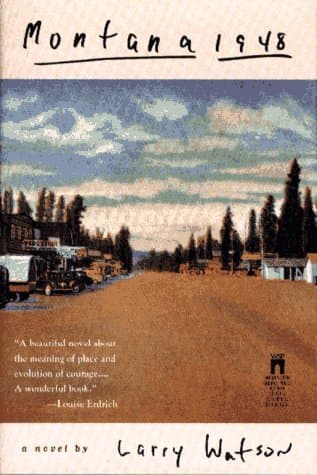
Larry Watson (1993)
Genre
Literary Fiction / Historical Fiction / Young Adult
Reading Time
180 min
Key Themes
See below
Sign in to track this book
In the summer of 1948 Montana, a young boy's image of his heroic uncle shatters under a horrific secret, forcing his family to confront the divide between loyalty and justice.
In 1948, ten-year-old David Hayden lives in Bentrock, Montana, with his father, Wesley, the county sheriff, and his mother, Gail. His uncle, Frank Hayden, is a respected doctor and war hero, married to David's aunt, Julianna. The family employs Marie Little Soldier, a Sioux woman, as their housekeeper. Early in the summer, Marie becomes ill and Gail calls Frank to examine her. Marie initially refuses, but eventually allows Frank to examine her, though she insists Gail stay in the room. Later, Marie tells Gail that Frank has been sexually assaulting her. This accusation upsets the Hayden family, making them confront the respected doctor's dark secret.
Gail is angry and heartbroken by Marie's statement. She immediately pressures Wesley to arrest Frank, believing that as sheriff, he must uphold the law, regardless of family ties. Wesley, however, is deeply conflicted. Frank is his older brother, admired by their father, Julian, who was also a sheriff. Wesley feels great pressure to protect his family's reputation and avoid a scandal that could destroy them. He tries to dismiss Marie's accusation, suggesting she might be mistaken or lying, but Gail remains firm in her belief of Marie and her demand for justice.
Marie, despite speaking out, is scared of Frank and what might happen. She tells Gail about her fear, and Gail tells Wesley. This fear, along with Gail's resolve, finally pushes Wesley to act, though carefully. He begins a quiet investigation, questioning Marie further and trying to gather evidence without alerting Frank or the town. He tries to persuade Marie to leave Bentrock for her safety, offering to pay for her to go to another town, but Marie refuses, saying she has a right to stay.
The presence of Julian Hayden, Wesley and Frank's father and a former sheriff, influences the family. Julian always favored Frank, seeing him as the more charismatic and successful son. This favoritism adds to Wesley's internal struggle, as he fears disappointing his father's memory and destroying the family name Julian worked to build. Frank, as a popular and respected doctor, holds significant influence in the community, making it hard for Wesley to act against him without facing strong public disapproval and possibly losing his position as sheriff.
Realizing Marie's danger, Wesley decides to move her out of Bentrock, hoping to protect her and secure her testimony. He arranges for her to stay with his mother in another town. The plan is for David to pretend to be sick, giving Wesley a reason to drive Marie away without raising suspicion. However, before the plan can happen, Marie is found dead in her bed. The official cause of death is pneumonia, but the circumstances are suspicious, and both Gail and Wesley doubt the official explanation, suspecting Frank's involvement.
Marie's death prompts Wesley to act. Overcoming his hesitation and family loyalty, he confronts Frank and arrests him for Marie's murder. Instead of taking him to the county jail, which is public, Wesley locks Frank in the basement of their own house. This unusual imprisonment is a desperate measure to protect Frank from potential mob justice and to control the situation while Wesley tries to figure out his next steps and gather more evidence against his brother. David sees these tense events unfold in his home.
Julian Hayden, Wesley and Frank's father, learns of Frank's arrest and comes to the house, furious. He confronts Wesley, demanding Frank's release and asserting his authority as head of the family. Julian believes Wesley is making a terrible mistake and shaming the family. A tense standoff occurs between father and son, with Julian trying to free Frank from the basement and Wesley standing firm, determined to do his duty as sheriff. Gail supports Wesley, balancing Julian's pressure, while David watches his family break apart.
During the standoff, Frank, understanding the seriousness of his situation and his coming public disgrace, takes his own life in the basement. He uses a gun Wesley had confiscated but inexplicably left accessible. This tragic event brings a sudden end to the immediate crisis, but leaves a lasting scar on the Hayden family. David discovers Frank's body, a moment that will forever haunt him and solidify the trauma of that summer. The family is left to deal with the aftermath of Frank's crimes and his desperate final act.
Frank's suicide creates new problems. Wesley, to protect Frank's reputation and the family name, invents a story that Frank died from a lingering war injury, a lie the town accepts. Despite this, the summer's events permanently damage the Haydens. Wesley resigns as sheriff, unable to continue in a town where he had to betray his family and compromise justice. A year later, the family moves away from Bentrock, leaving behind the painful memories and the community that had been their home, seeking a fresh start away from Frank's shadow.
As an adult, David Hayden narrates the story, looking back on the summer of 1948 with a mature understanding of the complex moral dilemmas and the tragic results. He reflects on how the events shaped his parents, his own understanding of good and evil, and the nature of justice. He realizes that while his father made difficult choices, he ultimately chose justice over family loyalty, even if imperfectly. The summer is David's coming-of-age, forever changing his view of family, authority, and the darkness that can lie beneath a respectable appearance.
The Protagonist/Narrator
David's innocence is irrevocably lost as he witnesses the corruption and moral compromises within his family, forcing him to confront the complexities of justice and loyalty.
The Protagonist
Wesley transforms from a hesitant, family-loyal sheriff to a man who, despite personal cost, chooses to confront injustice, even if it means destroying his own family.
The Supporting
Gail remains steadfast in her moral convictions, serving as an anchor of justice and truth amidst the family's turmoil.
The Antagonist
Frank's public image as a hero crumbles, revealing him as a perpetrator of sexual abuse, ultimately leading to his self-destruction.
The Supporting
Marie bravely confronts her abuser, becoming a catalyst for justice, even in her death.
The Supporting
Julian's rigid adherence to family honor is challenged and ultimately defeated by his son's pursuit of justice, leaving him a defeated and embittered man.
The Supporting
Julianna remains largely unchanged, illustrating the power of denial in the face of uncomfortable truths.
The Mentioned
N/A, serves as corroborating evidence.
This is the novel's main conflict, shown in Wesley Hayden's struggle. He is torn between his duty as sheriff to uphold the law and his loyalty to his family, especially his respected older brother, Frank. The novel explores the great pressure to protect family reputation, even if it means ignoring serious wrongs. Gail consistently pushes Wesley towards justice, forcing him to choose between the public good and private loyalties. The tragic events show the destructive results when this balance is not kept. For example, Wesley's initial delay in acting, driven by loyalty, accidentally puts Marie in greater danger.
““I had to let him go. He was my brother.””
The novel examines how unchecked power can corrupt. Frank Hayden, as a respected doctor and war hero, holds significant social power in Bentrock. He uses this authority to harm vulnerable Native American women, confident that his standing will protect him. The town's unwillingness to believe accusations against such a prominent figure shows how social respectability can hide deep moral decay. Even Julian Hayden's attempts to cover up Frank's crimes come from a belief that the family's power and reputation are more important than the law, showing how authority can protect the powerful instead of the vulnerable.
““Mercy, it seems, is a quality that is in short supply in our family.””
David Hayden's narration makes the story a key moment in his childhood, marking his painful move from innocence to a more complex understanding of the world. The events of 1948 shatter his idealized view of his family and the seemingly perfect small town. He directly sees the darkness beneath the surface of respectability, the moral failures of adults, and the harsh realities of prejudice and injustice. His experience forces him to confront the capacity for evil in those he loves and trusts, fundamentally shaping his adult view of morality and human nature.
““I never knew my father had it in him to be so brave.””
The vulnerability of Marie Little Soldier and other Native American women to Frank's abuse is rooted in the racial prejudices of 1940s Montana. The novel implies that Frank specifically targets Indigenous women, believing their accusations would be easily dismissed or ignored by the mostly white community and legal system. Marie's fear and the initial doubt she faces highlight the systemic injustice and lack of protection for Native Americans. Her death, officially from pneumonia despite suspicious circumstances, further shows how race can affect the pursuit and denial of justice, revealing a painful undercurrent of social inequality.
““The Haydens were not going to let a Sioux woman, even one who had worked for them for years, bring shame to their family.””
The novel clearly shows how secrets, especially those involving serious misconduct, harm individuals and families. The Hayden family's attempts to hide the truth about Frank's actions create an unbearable tension that ultimately tears them apart. The secret of Frank's abuse and later, the secret of his death and its real cause, weigh heavily on Wesley and Gail. David, as an observer, is burdened by knowing these secrets, which deeply affect his understanding of his family. The story suggests that hiding the truth, even to protect reputation, leads to greater suffering and moral compromise.
““Secrets are like that. They fester.””
The story is told by an adult David looking back on his childhood.
The novel is narrated by an adult David Hayden, reflecting on the pivotal summer of 1948. This retrospective viewpoint allows for a mature understanding of complex events and moral dilemmas that a ten-year-old could not fully grasp at the time. The adult David can provide context, foreshadowing, and deeper psychological insight into his parents' struggles and the societal forces at play. It also emphasizes the lasting impact of these events on his life and worldview, underscoring the novel's themes of loss of innocence and the enduring nature of trauma.
Wesley's reluctance to wear his badge symbolizes his internal conflict.
Wesley Hayden's consistent choice not to wear his sheriff's badge is a powerful symbol of his internal conflict and his initial reluctance to fully embrace his role as a dispenser of justice. The badge represents his public duty, the law, and the authority to enforce it impartially. His avoidance of wearing it reflects his desire to remain a private family man, rather than the public figure who must confront his own brother. When he finally takes decisive action against Frank, the absence of the badge still highlights the personal, agonizing nature of his choice, rather than a purely professional one.
The basement where Frank is imprisoned symbolizes confinement and hidden truth.
The Hayden family's basement, where Wesley imprisons Frank, serves as a significant symbolic space. It represents confinement, both physical and metaphorical, as Frank is trapped by his crimes and the consequences. It also symbolizes the 'hidden' or 'underground' nature of the family's dark secret, which they try to contain within their own home before it explodes into the public sphere. Frank's suicide in this confined, secret space underscores the idea that the truth, once brought to light, can be inescapable and destructive, even to those who tried to bury it.
Hints and warnings about Marie's danger precede her death.
The novel employs subtle but effective foreshadowing regarding Marie Little Soldier's fate. Her expressed fear of Frank, Gail's persistent warnings to Wesley about Marie's safety, and Wesley's attempts to move her out of town all build a sense of impending danger. This foreshadowing heightens the tension and makes Marie's eventual death, though tragic, feel almost inevitable given the circumstances and the power dynamics at play. It also serves to underscore the profound risk she took by speaking out and the consequences of the family's initial inaction.
“I had arrived at the age when a man's life becomes a series of departures, and the first of these was my cousin.”
— David reflecting on the summer of 1948 and its lasting impact on his life.
“But that was the way it was with secrets in our family. They were like a disease, a malady passing from one generation to the next.”
— David discussing the hidden truths and unspoken issues within the Hayden family.
“My father did not make his choices because he was a sheriff; he was a sheriff because he had already made his choices.”
— David contemplating his father's character and the motivations behind his actions and role.
“In our family, we had a sense of right and wrong, and it was as clear-cut as the lines on a baseball field.”
— David describing the seemingly straightforward moral code he was raised with, which later becomes complicated.
“My father, a man of peace, was now a man of war.”
— David observing his father's transformation as he decides to confront his brother, Frank.
“I never saw him again. He was buried, I suppose, somewhere in the wilds of Montana, without a headstone, without a prayer.”
— David reflecting on the ultimate fate of his uncle, Frank Hayden.
“I had learned that things were not always what they seemed, that the most respectable people could be the most corrupt.”
— David's realization about the hidden darkness beneath the surface of his seemingly perfect town.
“It was a story that would never be told, not truly, not in its entirety, not by me, not by anyone.”
— David acknowledging the unspoken aspects of the family tragedy and the difficulty of fully conveying it.
“My father was a good man, but he was also a weak man. And a good man, when he is weak, can be dangerous.”
— David's nuanced understanding of his father's character and the complexities of human morality.
“The past is never dead. It's not even past.”
— David's adult reflection on how the events of 1948 continue to influence his life.
“Sometimes I think that the only way to make sense of the past is to leave it behind, to move on. But then I think that maybe the past is the only thing we have.”
— David grappling with the enduring presence of his childhood memories and their meaning.
“I knew what I knew, and I knew what I didn't know, and I knew that what I didn't know was going to kill me.”
— David's growing awareness of the dark secrets surrounding his uncle and the danger they pose.
“Mercy. God, how I hated that word. It was a word for the weak, for those who couldn't stand up for themselves.”
— David's strong feelings about the concept of mercy in the face of injustice.
“We were not allowed to talk about what happened. Not then, not ever.”
— David describing the family's unspoken pact to suppress the truth of the summer's events.
Ready to see how well you understood this book? Take our interactive quiz with 10 questions.







