“The ocean is a graveyard, and the land is a graveyard, and the sky is a graveyard.”
— Lisamarie reflects on the interconnectedness of life, death, and the natural world.

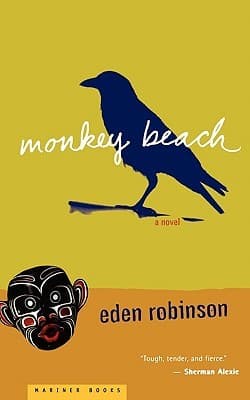
Eden Robinson (1950)
Genre
Fantasy / Mystery
Reading Time
9-10 hours
Key Themes
See below
Sign in to track this book
In the Haisla territory, a young woman with premonitions and ancestral spirits searches for her drowned brother, navigating a world where ancient traditions meet modern grief along the Pacific coast.
The novel begins with Lisamarie Hill on her speedboat, going up the Douglas Channel towards Monkey Beach, a place connected to the spirits of the dead. Her younger brother, Jimmy, a good baseball player, has been missing for days after his boat was found empty. Lisamarie hopes to find him, even though her family increasingly believes he has drowned. As she travels the cold waters, she thinks about her life in Kitamaat, a Haisla community, and the supernatural events that have always been part of her life. Her journey includes flashbacks, showing her complex family and the spiritual world she lives in, setting the scene for the tragedy and her search for understanding.
From a young age, Lisamarie sees visions and meets spirits, including the Little Man and the b'gwus (Sasquatch), which others often dismiss. She sees the ghost of a drowning boy, and later, a recurring premonition of Jimmy's death by water. Her grandmother, Ma-ma-oo, who follows Haisla traditions, recognizes Lisamarie's spiritual sensitivity, teaching her about their beliefs and how the spirit world connects with the physical. These early experiences shape Lisamarie's view of reality and hint at the tragic events to come, making her feel both blessed and burdened by her connection to the unseen.
Lisamarie's family includes her practical father, Albert; her caring mother, Gladys; her activist Uncle Mick; and her traditionalist Ma-ma-oo. The family deals with the tension between Haisla customs and modern Canadian society. Early on, they lose Lisamarie's younger sister, Erica, to sudden infant death syndrome, a tragedy that deeply affects the family, especially her mother. This event introduces an early theme of grief and life's fragility. Despite their struggles, the family has strong bonds, with Ma-ma-oo and Uncle Mick linking them to their Haisla heritage and giving Lisamarie guidance.
As Jimmy gets older, he becomes a talented baseball player, a source of family pride and hope. Lisamarie, however, feels more isolated by her spiritual experiences and rebellious nature. She struggles to fit in at school and in the community, often feeling like an outsider. Her visions become more frequent and disturbing, especially those about water and death, which she tries to ignore. This time shows the siblings' different paths, with Jimmy pursuing a more conventional future and Lisamarie dealing with her spiritual burden and a growing sense of dread.
During her teenage years, Lisamarie joins a rebellious group, experimenting with alcohol and drugs, partly to cope with her visions and general unhappiness. She forms a close, complicated friendship with Frank, a boy from her community. Even during this reckless period, her connection to Ma-ma-oo and Uncle Mick stays strong, providing a grounding influence. She learns more about Haisla stories and traditions, even taking part in some rituals, which deepens her understanding of her spiritual heritage but also increases her awareness of the dangers in the spirit world and in her own premonitions.
Jimmy gets a baseball scholarship to a school in the United States, an important achievement that brings both joy and worry to the family. Lisamarie's premonitions of Jimmy drowning become more vivid, causing her great distress. She tries to warn him, but her warnings are mostly dismissed as her usual 'weirdness.' This departure is a turning point, as Jimmy leaves the protective environment of Kitamaat and his family, making him more open to the fate Lisamarie has foreseen. The story builds a strong sense of tragic inevitability around Jimmy's future, heavily influenced by Lisamarie's visions.
The phone call comes, devastating the family: Jimmy's boat has been found empty, and he is presumed drowned. This event is the central tragedy of the story, starting Lisamarie's current journey. The news causes deep grief and disbelief in the family. For Lisamarie, it confirms her long-held premonitions, a terrifying validation of her spiritual connection and a heavy burden. The community supports the family, but the loss is immense, leaving a void and prompting Lisamarie's desperate search.
Back in the present, Lisamarie's solitary journey up the Douglas Channel includes more spiritual encounters. She sees the ghost of the Little Man again, and other animal spirits, which sometimes offer cryptic messages or warnings. She feels drawn to Monkey Beach, a place where, according to Haisla belief, the spirits of the dead gather before moving on. Ma-ma-oo's teachings about respecting the spirit world and understanding the signs become more relevant. Lisamarie is not just looking for Jimmy's body; she seeks understanding, connection, and perhaps a final farewell in the spiritual realm.
During her journey, Lisamarie often thinks about her complex relationship with Frank. She remembers their shared experiences, their intimacy, and moments of betrayal and hurt. She also reflects on her self-destructive tendencies and how she pushed people away, including Jimmy. Her grief for Jimmy connects with a broader look at her past choices and their impact on her life and relationships. This introspection is important for her emotional processing, as she tries to understand her brother's death and her own place in the world.
Lisamarie eventually arrives at Monkey Beach. Here, she has a powerful, hallucinatory, and spiritual experience. She sees visions of her ancestors and has a final, moving interaction with Jimmy's spirit. This encounter is not a simple reunion but a complex, symbolic farewell, where she deals with his death and her role in his life and passing. It is a moment of both deep sadness and a strange peace, as she accepts his death and the reality of her spiritual gifts. The experience at Monkey Beach completes her journey, bringing her some closure.
After her spiritual experience at Monkey Beach, Lisamarie returns to her family, changed by her journey and the intense spiritual confrontation. While Jimmy's body is never found, Lisamarie has reached a form of acceptance. The novel ends with her still dealing with her grief, but with a deeper understanding of her Haisla heritage and her spiritual connection. She learns to live with her gifts and the knowledge of the spirit world, finding a way to include them in her life. The story concludes not with a simple end to pain, but with Lisamarie's ongoing healing and her acceptance of her identity as a woman rooted in her culture and its spiritual world.
The Protagonist
Lisamarie begins as a troubled youth burdened by premonitions and grief, and through her journey, she learns to accept her spiritual gifts and find a measure of peace and understanding regarding her brother's death and her own identity.
The Supporting/Catalyst
Jimmy's arc is cut short by his tragic death, but his memory and the impact of his life continue to shape Lisamarie's journey of grief and self-discovery.
The Supporting
Ma-ma-oo remains a steadfast source of wisdom and tradition, guiding Lisamarie towards understanding her spiritual path.
The Supporting
Uncle Mick consistently provides support and a unique perspective, acting as a stable, if unconventional, presence in Lisamarie's life.
The Supporting
Gladys endures profound grief and struggles to understand her daughter's spiritual nature, ultimately finding a way to cope with loss.
The Supporting
Albert remains a steady, if quiet, presence, navigating family tragedies with practical strength and enduring love.
The Supporting
Frank's arc is intertwined with Lisamarie's, representing a period of youthful rebellion and complicated affection that ultimately contributes to her understanding of self.
The Mentioned/Spiritual Guide
The Little Man consistently appears as a spiritual messenger or omen, acting as a constant presence in Lisamarie's life.
The Mentioned
Erica's death acts as an early catalyst for the family's experience of grief and sets a tone of vulnerability.
Lisamarie's journey is about understanding who she is, as a Haisla woman and as an individual with spiritual gifts. She struggles with feeling like an outsider in both traditional Haisla society and the modern Western world. Her visions and connection to the spirit world are central to her identity, and searching for Jimmy makes her confront and accept these parts of herself. The novel explores how cultural heritage, family history, and personal experiences shape one's identity, especially when navigating conflicting worlds.
“Sometimes I hated the spirits, hated that I could see them, hated that I was different. But sometimes... sometimes it was like a secret language, just for me.”
The novel deals with themes of grief and loss, starting with the early death of Lisamarie's infant sister, Erica, and ending with the presumed drowning of her brother, Jimmy. The story explores the many sides of grief, from shock and denial to the long process of mourning and acceptance. Each family member processes loss differently, showing the individual and shared impact of tragedy. Lisamarie's journey up the Douglas Channel is a literal and metaphorical journey through her grief, seeking understanding and a final farewell.
“Grief doesn't go away. It just settles in, a quiet companion.”
A main theme is the strong presence of the supernatural and the spiritual connection to the land and Haisla traditions. Lisamarie's ability to see ghosts, animal spirits, and have premonitions is not just a plot device but a central part of the Haisla worldview in the book. The spirit world is not separate from reality but woven into it, influencing events and guiding characters. Ma-ma-oo's teachings emphasize respect for the spirits and the wisdom of their ancestors, showing spiritual sensitivity as both a gift and a burden.
“The spirits don't care if you believe in them or not. They're still there, waiting.”
The novel explores the tensions of living between traditional Haisla culture and modern Western society. Characters like Lisamarie's parents try to balance these worlds, while Ma-ma-oo strongly protects Haisla traditions. The effects of colonialism, residential schools (implied through generational trauma), and the challenges of keeping cultural identity in a changing world are woven throughout the story. Despite these pressures, the resilience of the Haisla people, their stories, and their spiritual beliefs are clear, especially in Lisamarie's acceptance of her heritage.
“We were Haisla. We had our own ways, our own stories, even if the white world tried to bury them.”
The strength and complexities of family bonds are central to the story. The relationships between Lisamarie and Jimmy, her parents, Ma-ma-oo, and Uncle Mick are deeply explored, showing love, conflict, and support. The novel shows the importance of passing on knowledge between generations, especially through Ma-ma-oo's role in teaching Lisamarie about Haisla traditions and spirituality. Family is both a source of comfort and a place of shared trauma, with each member contributing to the collective experience of joy and sorrow.
“Family was a tangled knot, sometimes pulling you apart, sometimes holding you together.”
The story constantly shifts between Lisamarie's present-day search and her past memories.
The novel employs a non-linear narrative structure, constantly interweaving Lisamarie's present-day journey up the Douglas Channel in search of Jimmy with extensive flashbacks to her childhood and adolescence. This device allows the reader to gradually piece together Lisamarie's history, her family dynamics, and the development of her spiritual gifts, creating a rich tapestry of her life leading up to the central tragedy. It builds suspense by revealing information incrementally and emphasizes how past experiences profoundly shape the present.
Supernatural elements are seamlessly integrated into the everyday reality of the Haisla world.
Magical realism is a pervasive device in 'Monkey Beach,' where spirits, premonitions, and shapeshifters are not fantastical intrusions but a natural, accepted part of Lisamarie's Haisla reality. The Little Man, the b'gwus, and the ability to see ghosts are presented without explanation or sensationalism, reflecting a worldview where the spiritual and physical realms are intimately connected. This device grounds the supernatural in the mundane, making Lisamarie's experiences believable within the context of her cultural heritage and adding depth to the narrative's exploration of Haisla spirituality.
Lisamarie's visions and dreams constantly hint at future tragedies, particularly Jimmy's death.
Foreshadowing is heavily used through Lisamarie's recurring premonitions and visions, especially those concerning water and Jimmy's death. From an early age, she sees the ghost of a drowning boy and experiences vivid dreams that hint at future tragedies. This device creates a pervasive sense of dread and inevitability, drawing the reader into Lisamarie's internal struggle with her gifts and the helplessness she feels in trying to prevent what she foresees. It heightens the emotional impact of Jimmy's eventual drowning, making it both anticipated and devastating.
Water represents both life and death, connection and separation, throughout the novel.
Water, particularly the Douglas Channel and the ocean around Kitamaat, is a powerful and multifaceted symbol. It represents life, sustenance, and the Haisla people's connection to their traditional way of life (fishing, travel). However, it also symbolizes death, danger, and the unknown, as it is the element that claims Erica, Jimmy, and haunts Lisamarie's premonitions. The channel becomes a liminal space, a boundary between the living and the dead, and the medium through which Lisamarie undertakes her spiritual quest, highlighting its dual nature as both a source of life and a bringer of sorrow.
“The ocean is a graveyard, and the land is a graveyard, and the sky is a graveyard.”
— Lisamarie reflects on the interconnectedness of life, death, and the natural world.
“You can't run away from who you are, but you can run toward who you want to be.”
— Lisamarie contemplates her identity and future amidst family struggles.
“Ghosts are just memories with nowhere to go.”
— Lisamarie discusses her supernatural experiences and Haisla beliefs.
“The past is a story we tell ourselves to make sense of the present.”
— Reflection on how personal and cultural history shapes current life.
“In our family, silence is a language all its own.”
— Describing the unspoken tensions and communications within her family.
“Sometimes the only way to heal is to remember the wound.”
— Lisamarie grapples with personal and collective trauma.
“The land remembers what people forget.”
— Emphasizing the deep connection between Haisla people and their territory.
“Fear is a ghost that haunts you until you turn and face it.”
— Lisamarie confronts her fears and supernatural encounters.
“We are all just stories in the end.”
— A meditation on life, legacy, and the power of narrative.
“The river doesn't care if you drown; it just keeps flowing.”
— Reflecting on the indifferent, powerful forces of nature.
“Home is not a place, but a feeling you carry inside.”
— Lisamarie's thoughts on belonging and displacement.
“Magic is just another way of seeing the world.”
— Discussing the blend of Haisla spirituality and everyday reality.
“Grief is a tide that pulls you under, then spits you back on shore.”
— Describing the cyclical, overwhelming nature of loss.
“The truth is a slippery fish; hard to catch, harder to hold.”
— Reflecting on the elusive nature of truth in her mystery-filled life.
Ready to see how well you understood this book? Take our interactive quiz with 10 questions.

Eden Robinson is a celebrated Indigenous Canadian author known for her visceral and darkly humorous explorations of identity and culture. Her critically acclaimed novels, including 'Monkey Beach' and the Trickster series ('Son of a Trickster,' 'Savage Conversations,' 'Return of the Trickster'), have earned her numerous accolades. Robinson's work often blends realism with elements of magical realism and Indigenous folklore.







