“The greatest enemy of truth is very often not the lie - deliberate, contrived and dishonest - but the myth - persistent, persuasive and unrealistic.”
— Adelia's internal thoughts on societal beliefs and the challenges to her scientific approach.

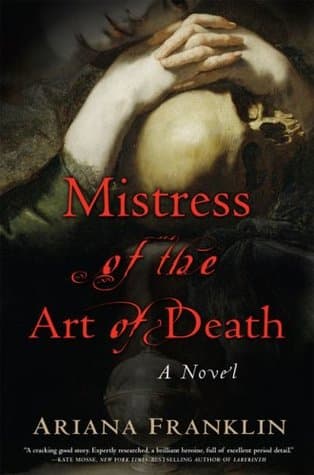
Ariana Franklin (2007)
Genre
Thriller / Historical Fiction / Mystery
Reading Time
8 hours 30 min
Key Themes
See below
Sign in to track this book
In a superstitious medieval England, a brilliant female forensic doctor from Sicily must conceal her identity to unmask a serial killer preying on children and save the Jewish community from a blood libel.
In 1171 Cambridge, England, four children are found dead, each showing signs of ritualistic killing. The superstitious people, fueled by antisemitic beliefs, immediately blame the town's Jewish community, accusing them of blood libel. Riots start, threatening the Jewish residents. King Henry II, though not sympathetic to the Jews, knows their economic importance—their taxes are vital to his treasury. To protect his financial interests and stop more violence, he places the Jewish community under royal protection, moving them to a fortified castle. However, the King understands that only a clear answer to the murders can truly stop the unrest and future scapegoating.
Desperate for a solution that does not involve simply killing a tax-paying population, King Henry II seeks a scientific approach. He asks his cousin, the King of Sicily, known for his advanced medical knowledge and diverse court of scholars, for help. Henry specifically asks for a 'master of the art of death'—an early medical examiner—to investigate the Cambridge murders. He hopes a clear, medically-backed explanation will clear the Jews and restore order. The Sicilian court, known for its progressive views and scientific inquiry, agrees to send their best expert, unaware of the cultural differences and dangers awaiting their chosen physician in England.
To King Henry II's surprise, the 'master' sent from Salerno is not a man, but a young woman named Adelia Aguilar. A brilliant and skilled physician and anatomist, Adelia is accompanied by her companions: Simon of Naples, a Jewish scholar and linguist, and Mansur, a Moorish bodyguard and assistant. Upon their arrival in England, Adelia quickly realizes how patriarchal and superstitious English society is. To avoid accusations of witchcraft and to be taken seriously, she must hide her true identity as a female doctor, posing as a male scholar's assistant. This deception causes constant tension and danger during her investigation.
Adelia, disguised as an assistant, begins her careful examination of the victims' remains, using advanced forensic techniques unknown in England. She reconstructs the crime scenes, analyzes wounds, and looks for patterns, often to the bewilderment of local officials. She quickly sees that the murders are not random but the work of a single, cunning person—a serial killer. Her scientific methods conflict with the deep superstitions and religious dogma of the English clergy and townsfolk, who prefer to blame demonic influence or Jewish ritual rather than a human perpetrator.
During her investigation, Adelia meets Sir Rowley Picot, a practical and intelligent tax collector for King Henry II. Rowley is at first wary of Adelia and her methods but soon recognizes her intellect and deductive abilities. He reveals a personal connection to the case: his own sister disappeared years ago, and he believes her fate might be linked to the current murders. This shared goal—finding the truth—creates an uneasy alliance between them. Rowley becomes Adelia's main contact and protector within the English court, helping her navigate the social landscape.
As Adelia investigates, she uncovers patterns in the killer's methods, including specific surgical techniques and ritualistic elements that suggest a background in medicine or anatomy, possibly from the Crusades. Her suspicions turn towards individuals who have recently returned from the Holy Land, where different medical practices and brutal realities could have shaped a disturbed mind. She starts to investigate returning knights, monks, and other figures with access to medical knowledge, narrowing her list of suspects. The killer's signature suggests a twisted religious zealotry mixed with scientific understanding.
Adelia's forensic expertise allows her to piece together the killer's methods. She discovers that the murders are not random violence but planned reenactments of an ancient, obscure ritual, possibly linked to pagan beliefs or a perversion of Christian iconography. The killer is skilled and precise, suggesting a background in anatomy or surgery. This realization deepens the mystery, as it points to a highly educated and dangerous individual operating within a society ill-equipped to understand such calculated depravity. The killer's intelligence makes them a formidable opponent.
As Adelia and her companions, Simon and Mansur, get closer to identifying the killer, they face increasing danger. The killer, aware of their investigation, begins to stalk them, leaving menacing warnings and even trying to stop their progress. Adelia has several narrow escapes, her life threatened by the person she is hunting. The tension escalates, showing the personal stakes for Adelia and her team. These confrontations highlight the killer's cunning and ruthlessness, demonstrating their willingness to eliminate anyone who stands in their way, including a clever foreign woman disrupting their dark work.
Through forensic evidence, careful observation, and deduction, Adelia finally unmasks the serial killer. The perpetrator is not an obvious outcast, but a seemingly respected, though tormented, figure within the Cambridge community, one who had served in the Crusades. The revelation shocks the local people and the court, as it challenges their ideas of evil and their readiness to blame the marginalized. The killer's motives are a mix of religious fanaticism, personal trauma, and a twisted interpretation of ancient rites, fueled by their experiences in the Holy Land.
With the killer's identity exposed, a confrontation leads to their arrest. While the official narrative still struggles to fully understand Adelia's scientific methods, the undeniable evidence she presented leads to justice for the murdered children. King Henry II, despite his initial skepticism and the awkwardness of dealing with a female 'master,' acknowledges the success of the Sicilian 'expert.' Adelia's true identity as a female doctor remains a carefully guarded secret to protect her from persecution, but her groundbreaking work helps create a new understanding of crime and investigation in a world of superstition. Her mission is complete, but the experience changes her.
The Protagonist
Adelia starts as a brilliant but somewhat naive outsider to English society, forced to conceal her identity. She evolves into a resilient and self-assured investigator, earning respect and finding her place despite the cultural barriers.
The Supporting
Rowley begins as a cynical royal servant and becomes a steadfast supporter and protector of Adelia, learning to trust her unconventional methods and developing deep feelings for her.
The Supporting
Simon remains a steadfast and loyal companion, providing intellectual and emotional support to Adelia throughout the challenging investigation.
The Supporting
Mansur's arc is less about internal change and more about demonstrating unwavering loyalty and competence in a foreign land.
The Supporting
Henry II, initially dismissive of foreign methods and a female 'master,' grudgingly accepts the efficacy of Adelia's work due to its practical results.
The Antagonist
Brother Michael remains a static character, representing the unyielding religious dogma and prejudice Adelia faces.
The Antagonist
The killer remains a consistent force of evil, driven by their twisted ideology until their eventual capture.
This is the main conflict of the novel. Adelia Aguilar, with her advanced forensic knowledge from Salerno, represents the growing scientific method, while medieval England is full of religious dogma, folk beliefs, and a quickness to blame unexplained events on divine or demonic intervention. Adelia's careful examination of bodies and crime scenes contrasts with the local clergy's insistence on blood libel and witchcraft. Her struggle to use logic and evidence in a world that prefers faith and fear shows the slow, often dangerous, shift from a world of magic to one of reason. For example, Adelia must hide her true identity as a doctor to avoid being called a witch, showing the danger of scientific inquiry in a superstitious age.
“What had seemed a miracle in Salerno was considered witchcraft in England.”
The novel shows the deep prejudice against Jews in medieval England, immediately blaming them for the child murders without evidence. Adelia herself, as a foreign woman with unusual knowledge, faces suspicion and hostility, forcing her to hide her identity. Simon, as a Jew, and Mansur, as a Moor, also experience xenophobia. This theme explores how fear of the 'other' can lead to scapegoating, injustice, and violence, and how hard it is to challenge ingrained biases, even with clear evidence. The initial riots against the Jewish community are a strong example of this prejudice.
“It was easier to blame the Jew than to look for the devil you knew.”
Adelia's very existence as a female 'master of the art of death' challenges the strict gender roles of the 12th century. She must pretend to be a man's assistant to do her work, highlighting the limits placed on women, especially those with intellect and ambition. The novel explores society's resistance to female authority and intelligence, and Adelia's quiet defiance in pursuing her calling despite these barriers. Her internal conflict between her identity and her need for secrecy constantly reminds us of this theme.
“A woman's place was in the kitchen, or the birthing bed, not dissecting dead children.”
At its core, the novel is a search for justice for the murdered children and for the wrongly accused Jewish community. Adelia's pursuit of truth through scientific investigation, even when facing danger and opposition, drives the story. The theme questions what justice means in a society where truth can be hidden by prejudice, fear, and political gain. It stresses the importance of objective evidence over popular belief in achieving true justice, and the courage needed to stand for it. King Henry II's practical need for a true killer, rather than a scapegoat, also connects to this theme.
“The dead speak, if you know how to listen.”
Misleading clues or suspects to divert attention from the true killer.
The novel employs red herrings by initially directing suspicion towards the Jewish community, a common and convenient scapegoat in medieval times. This misdirection serves to highlight the pervasive prejudice of the era and the difficulty Adelia faces in shifting focus to empirical evidence. Various other minor characters with suspicious behaviors or backgrounds are also introduced, momentarily drawing Adelia's and the reader's attention away from the actual perpetrator, adding layers to the mystery and keeping the audience guessing until the true killer is revealed.
The audience knows something significant that certain characters do not.
A significant use of dramatic irony is Adelia's concealed identity as a female doctor. The reader is aware from the outset that she is the 'master of the art of death,' while most characters in the story believe her to be a male scholar's assistant. This creates tension and humor, as Adelia must constantly navigate situations where her true skills and knowledge would be shocking or dangerous if revealed. It also underscores the societal constraints she operates under, making her triumphs all the more impressive.
Hints or clues about future events or revelations.
The narrative subtly foreshadows the killer's background and methods through early descriptions of the victims' wounds and the ritualistic nature of the crimes, hinting at a perpetrator with both medical knowledge and a twisted religious zeal. For instance, the specificity of certain cuts or the arrangement of the bodies suggests a deliberate, learned hand. Rowley's mention of his missing sister also foreshadows a deeper connection to the killer's past actions, hinting that the current murders are not isolated incidents but part of a larger, ongoing pattern by the same individual.
A character placed in an unfamiliar environment, leading to conflict and development.
Adelia Aguilar serves as a prime 'fish out of water' character. A highly educated and scientifically minded woman from the advanced Sicilian court, she is plunged into the superstitious, patriarchal, and culturally backward world of medieval England. This device highlights the stark contrast between her progressive understanding of medicine and the prevalent ignorance and fear. Her struggle to adapt, to hide her true identity, and to apply her methods in such an alien environment drives much of the narrative's tension and character development, forcing her to be resourceful and resilient.
“The greatest enemy of truth is very often not the lie - deliberate, contrived and dishonest - but the myth - persistent, persuasive and unrealistic.”
— Adelia's internal thoughts on societal beliefs and the challenges to her scientific approach.
“Women, like men, should be free to follow their own minds and learn what they wish.”
— Adelia's strong belief in intellectual freedom, especially for women, in a restrictive era.
“It is a strange thing, this business of life and death. One moment there is a person, whole and breathing, and the next there is only a shell.”
— Adelia reflecting on the fragility of life and the stark reality of death in her work.
“Fear is a powerful weapon, and ignorance is its shield.”
— Adelia observing how fear and lack of knowledge are manipulated by those in power or to control others.
“The human body, even in death, holds secrets if one knows how to ask the right questions.”
— Adelia's core philosophy as an anatomist and forensic expert.
“Justice is not always about what is right, but what can be proven.”
— Adelia's pragmatic view on the legal system of the time, often at odds with her pursuit of truth.
“There are some things that even the most learned man cannot explain, and some that the most ignorant will understand.”
— Adelia pondering the limits of knowledge and the insights that come from unexpected places.
“Sometimes the greatest evil is not in the act itself, but in the silence that allows it to continue.”
— Adelia's reflection on complicity and the importance of speaking out against injustice.
“To understand the living, you must first understand the dead.”
— A foundational belief for Adelia, highlighting the connection between anatomy, pathology, and life.
“The past is a stubborn thing, and it often refuses to stay buried.”
— Adelia's observation on how past events and secrets invariably resurface.
“Superstition is a comfortable blanket for those who fear the truth.”
— Adelia's disdain for irrational beliefs that hinder scientific inquiry.
“Even the strongest chains can be broken with enough determination.”
— Adelia's internal resolve in the face of societal and personal obstacles.
“It is not enough to simply see; one must observe, and then interpret.”
— Adelia explaining the process of forensic investigation, differentiating casual observation from scientific method.
“The human heart, for all its complexity, is often driven by the simplest desires: love, hate, fear.”
— Adelia's contemplation of human nature and the motives behind crimes.
Ready to see how well you understood this book? Take our interactive quiz with 10 questions.







