“I am your number one fan.”
— Annie Wilkes' chilling declaration to Paul Sheldon.

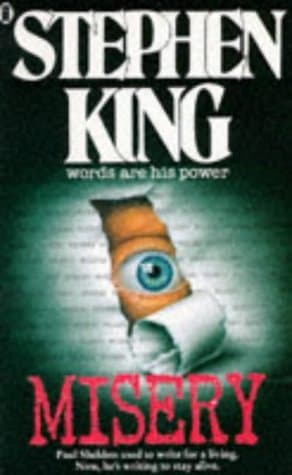
Stephen King (1987)
Genre
Thriller / Mystery
Reading Time
730 min
Key Themes
See below
Sign in to track this book
Held captive by his self-proclaimed 'number one fan,' a famous author is forced to write his greatest work under the threat of unimaginable pain and psychological torture in an isolated house.
Paul Sheldon, a famous author known for his 'Misery Chastain' romance novel series, celebrates finishing his new, more serious novel, 'Fast Cars'. He gets drunk and drives his vintage Camaro. He crashes during a snowstorm in rural Colorado, severely breaking his legs and shoulder. He loses consciousness and wakes up in the home of Annie Wilkes, a former nurse who says she is his 'number one fan'. Annie tells him she found him in the wreckage, brought him to her isolated house, and has been caring for him. Paul is grateful at first, but soon notices Annie's strange behavior and the fact that she does not seem to call for help or take him to a hospital.
Annie's mood changes quickly after she reads the manuscript for 'Fast Cars'. She expresses disappointment that it is not a Misery Chastain novel. Her true fanaticism appears when she buys the latest Misery Chastain book, 'Misery's Child'. She discovers that Paul has killed off her beloved protagonist, Misery. Enraged, Annie confronts Paul, accusing him of betraying his fans. She smashes a ceramic penguin on the floor and forces him to burn the manuscript for 'Fast Cars'. She then reveals her plan: Paul must write a new novel, 'Misery's Return', bringing Misery Chastain back to life, or face bad consequences.
Paul's situation becomes full captivity. Annie takes his wheelchair and limits his movements, making him write 'Misery's Return' on an old Royal typewriter. He learns more about Annie's dark past from newspaper clippings he finds while she is away. He discovers she was accused of murdering infants and the elderly during her nursing career. During one of Annie's absences, Paul leaves his room, finds a knife, and hides it. He tries to drug Annie's food but is caught. This leads to a brutal punishment where Annie cuts off his thumb with an electric knife, calling it a 'payment' for Misery's death.
Paul, severely traumatized and in constant pain from his missing thumb and untreated leg injuries, must continue writing 'Misery's Return'. Annie gives him painkillers but controls the dosage, often withholding them as punishment. She carefully reads every page, giving criticisms and demanding changes. She ensures the story matches her idea of Misery. Paul uses his writing as a mental escape and a desperate plea for survival, putting in subtle messages and references that only a true fan might recognize. He realizes that Annie's approval of the novel is his only chance of staying alive.
As Paul writes the novel, Annie's madness grows. When Paul questions a plot point, she punishes him by chopping off his foot with an axe, saying he tried to escape. This horrific act leaves Paul even more debilitated and reliant on Annie. Meanwhile, local Sheriff Buster begins investigating Paul's disappearance after getting tips and finding Paul's abandoned car. Buster eventually finds Annie's isolated property. Paul hears the police car approaching and tries to alert Buster, but Annie finds the sheriff first. She shoots him dead with a shotgun and then runs over his head with her riding mower, removing the threat.
Paul finishes the first draft of 'Misery's Return'. Annie, very happy, brings him champagne and a cake. However, their celebration ends quickly. Paul, weakened and frustrated, accidentally breaks the typewriter's 'N' key while working on changes. Annie, seeing this as deliberate sabotage, becomes very angry. She tries to kill Paul by ramming him with a lawnmower. Paul barely escapes by falling out of bed. Annie eventually calms down, but the incident shows the constant danger of her unpredictable temper and how fragile Paul's life is.
With the final draft of 'Misery's Return' complete, Paul plans his desperate last stand. He tells Annie he wants to celebrate by burning the manuscript in a ritual, a tradition he says authors often do. Annie, though hesitant at first, agrees. As she prepares a bucket of charcoal lighter fluid, Paul pours it on the manuscript and sets it on fire. While Annie is distracted by the burning papers, Paul, despite his severe injuries, attacks her with the typewriter. A brutal struggle follows. Paul shoves the burning manuscript into Annie's face and chokes her. He escapes the room.
After the fight, Paul crawls out of the room, thinking Annie is dead. He reaches the kitchen, where he finds a kitchen knife. As he tries to leave the house, Annie, severely injured but still alive, comes out of the room and attacks him again. She chases him down the hallway, screaming. Paul, using his last bit of strength, stabs her multiple times with the knife. Annie stumbles and falls, dying from her wounds. Her head hits the corner of the pig statue she liked. Paul then collapses, barely alive.
Eventually, state troopers arrive at Annie's house, alerted by Sheriff Buster's disappearance. They find Paul barely conscious but alive, and Annie Wilkes dead. Paul is rushed to the hospital, where he has extensive surgery for his leg, shoulder, and foot injuries. His recovery is long and painful, both physically and psychologically. He suffers from phantom pain, nightmares, and deep trauma from his experience. Despite the physical healing, the mental scars of his captivity and the horrors Annie Wilkes inflicted continue to haunt him, making it hard to return to a normal life.
Months after his rescue, Paul is still recovering, physically and mentally. He struggles with severe PTSD, often reliving the trauma and hearing Annie's voice. His agents and publishers want him to write again, but he cannot return to his previous work. The experience with Annie has changed him deeply. He eventually feels he must write a new book, not 'Misery's Return' as Annie demanded, but a dark, cathartic novel about his captivity. This new work, a fictionalized account of his ordeal, marks a big change in his literary career and helps him process the trauma, allowing him to slowly begin to heal.
The Protagonist
Paul transforms from a somewhat complacent, successful author into a traumatized survivor who must fight for his life and sanity, ultimately finding a new, darker voice for his writing.
The Antagonist
Annie's character remains consistently deranged and violent, escalating in her brutality and delusions until her death.
The Mentioned/Symbolic
Misery undergoes a fictional resurrection within Paul's forced narrative, symbolizing his struggle for survival and creative control.
The Supporting
Buster's arc is cut short by his murder, serving as a tragic symbol of the outside world's inability to penetrate Annie's isolated madness in time.
The Mentioned
Marcia's primary role is to represent Paul's professional life and the outside world, remaining largely static as a character.
The Plot Device/Symbolic
The typewriter is a static object but its significance evolves from a tool of forced labor to a weapon of liberation.
'Misery' looks deeply at the destructive power of obsession, especially in fan culture. Annie Wilkes shows the extreme, pathological end of fandom, where love for a creation turns into possessive, violent control over its creator. Her inability to tell fiction from reality, and her belief that she owns Paul's creative work, drives the entire plot. The novel shows how unchecked admiration can become a terrifying force, taking away an artist's freedom and even their humanity. Paul's terror comes from being trapped by someone whose 'love' is like hatred and control.
“''I am your number one fan,' she said, and her voice was as dead as a stone.”
Paul Sheldon's wish to move on from the 'Misery Chastain' series and write 'Fast Cars' shows the struggle between artistic integrity and money. Annie Wilkes, as the demanding audience, forces him back into the style he dislikes. This theme looks at the pressure artists face to please their audience's expectations, even if it means sacrificing their own creative ideas. Paul's forced writing of 'Misery's Return' under threat is a harsh example of the artist's struggle against outside demands and how creative work can become a prison instead of a release.
“'You killed Misery!,' she screamed. 'You murdered my Misery!'”
The novel is a hard study of human endurance. Paul Sheldon, despite severe physical injuries, repeated mutilation, psychological torture, and constant fear of death, finds the will to survive. His writing becomes both an escape and a weapon. He endures great pain and degradation, yet his mind stays sharp enough to plan, to write, and eventually, to fight back. The story emphasizes the great strength of the human spirit when pushed to its limits. It shows how the drive for survival can overcome even the most debilitating physical and mental suffering.
“He understood that he was going to die unless he could get this woman into a situation where he could kill her first.”
Storytelling is a powerful force, capable of both creation and destruction. Paul's stories give Annie an escape from her grim reality, but her obsession with them leads to his captivity. Paul uses storytelling, the forced writing of 'Misery's Return', as his main tool for survival. He carefully crafts the narrative to please Annie, using his skill to manipulate his captor and buy himself time. His ability to tell a compelling story, even under duress, keeps him alive. Later, it helps him process his trauma and regain a sense of self.
“He was a storyteller, and he would tell his story, even if it killed him. Which it very well might.”
Annie's remote house as a physical and psychological prison.
Annie Wilkes's isolated farmhouse in the Colorado mountains serves as a crucial plot device. Its remoteness ensures Paul's complete cut-off from the outside world, making escape virtually impossible and amplifying his terror. The isolation also magnifies Annie's control, as there are no neighbors or casual visitors to witness her abuse. Psychologically, the enclosed space becomes a suffocating prison for Paul, mirroring his loss of freedom and the claustrophobia of his situation. The vast, empty landscape outside starkly contrasts with the confined horror within the house.
Paul's struggle to write under duress.
Paul's forced writing of 'Misery's Return' while injured and captive is a central plot device. It inverts the common trope of writer's block, replacing it with forced creativity under extreme duress. This device allows King to explore the psychological toll of creative imprisonment and the artist's relationship with their work. The act of writing becomes a literal fight for survival, where every word is a step towards either freedom or deeper entrapment. The detailed descriptions of Paul's writing process, his internal debates, and Annie's critiques immerse the reader in his desperate struggle.
Exposition of Annie's dark past.
The discovery of newspaper clippings about Annie Wilkes's past, detailing accusations of murder and suspicious deaths in various hospitals, is a vital expositional device. Paul finds these clippings during an unsupervised moment, revealing Annie's true, psychopathic nature to him and, simultaneously, to the reader. This provides crucial backstory and explains the depths of her madness and capacity for violence, confirming Paul's growing fears and raising the stakes of his captivity. It transforms Annie from merely an erratic fan into a proven serial killer, intensifying the horror.
The instrument of creation, destruction, and ultimately, liberation.
Beyond its symbolic role, the Royal typewriter functions as a literal plot device. It is the physical means by which Paul is forced to write, providing the tangible evidence of his captivity and the material for Annie's obsession. Its broken 'N' key becomes a source of tension and a catalyst for Annie's rage. Crucially, the typewriter is transformed into a weapon in the climax, enabling Paul to fight back against Annie. This transformation from tool of torment to instrument of liberation underscores Paul's desperate struggle and ingenuity.
“I am your number one fan.”
— Annie Wilkes' chilling declaration to Paul Sheldon.
“The creative adult is the child who survived.”
— Paul Sheldon's internal reflection on the nature of creation.
“He found himself wondering if there was any such thing as a 'normal' woman, anywhere.”
— Paul's internal musings about Annie's erratic behavior.
“She was like a child with a favorite toy, and he was the toy.”
— Paul's realization of his complete helplessness in Annie's care.
“Writing is not a career, it’s a calling.”
— Paul's internal thoughts about his life as a novelist.
“There are books which are for all time and there are books which are for the moment. This was a book for the moment.”
— Paul's assessment of his 'Misery' novels.
“He thought of the words he had written, of the worlds he had created, and it seemed to him that they were all that mattered.”
— Paul reflecting on his life's work amidst his suffering.
“The world was a bad place, but it was all he had.”
— Paul's grim acceptance of his reality with Annie.
“She had a face that could curdle milk and a smile that could curdle blood.”
— Paul's vivid description of Annie Wilkes.
“It was not a dream. It was not a nightmare. It was real.”
— Paul's stark realization of his terrible predicament.
“Hope was a terrible thing, a beast that clawed and gnawed and would not let go.”
— Paul's internal struggle with the false promise of escape.
“The difference between a bad book and a good book is a good editor.”
— Paul's professional opinion on the writing process.
“There was a fine line between genius and madness, and Annie Wilkes had erased it with a sledgehammer.”
— Paul's observation about Annie's extreme nature.
“He had always believed that the best revenge was living well, but now he knew that the best revenge was living.”
— Paul's revised perspective on survival after his ordeal.
Ready to see how well you understood this book? Take our interactive quiz with 10 questions.

Stephen Edwin King is an American author of horror, supernatural fiction, suspense, crime, science-fiction, and fantasy novels. Described as the "King of Horror", his books have sold more than 350 million copies as of 2006, and many have been adapted into films, television series, miniseries, and comic books. King has published over 65 novels/novellas, including seven under the pen name Richard Bachman, and five non-fiction books. He has also written approximately 200 short stories, most of which have been published in book collections.







