“Every morning when I got up I looked out of my window to see what new thing Hat had added to his yard.”
— The narrator's fascination with Hat's eccentric yard decorations.

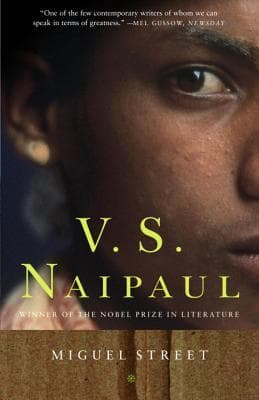
V.S. Naipaul (1959)
Genre
Literary Fiction / Historical Fiction
Reading Time
222 min
Key Themes
See below
Sign in to track this book
Through a boy's eyes, Naipaul depicts Miguel Street's eccentric residents, showing how ordinary life turns mythical amid World War II-era Trinidad's lively disorder.
The unnamed young narrator introduces Miguel Street and its colorful residents. He starts with Bogart, a man who claims to have traveled widely and speaks of mysterious pasts but mostly sits on his porch. Bogart has several wives, each leaving him quickly, and he seems unaffected by their departures. He often says, "What is to be, will be," showing a sense of fate. The narrator watches Bogart's quiet life and the neighborhood's guesses about his true identity and wealth, which always provide gossip and entertainment for residents like Hat, Edward, and Morgan.
Popo, the street's carpenter, is known for being lazy and for his wife's constant complaints about his lack of work. He eventually stops taking carpentry jobs, saying he is working on a special 'thing without a name.' He spends his days in his workshop, making strange, unidentifiable wooden objects. The neighbors are first curious, then dismissive, and finally accept his odd artistic pursuit. His wife, who first tolerated his idleness, eventually leaves him. Popo, however, stays happy in his workshop, surrounded by his mysterious creations, finding a strange peace in his chosen path, to the amusement and confusion of others.
Man-man, a showy and dramatic character, first runs for public office, giving passionate, meaningless speeches that amuse the street. After failing in politics, he becomes more erratic, claiming to be God and doing strange things. His behavior gets worse until he stages his own crucifixion on the street, using a cross made by Popo. The crowd, initially mocking, becomes uneasy and eventually calls the police. Man-man is taken away, a tragicomic figure whose grand delusions lead to his institutionalization, leaving the street talking about his madness and the show he created.
The narrator watches several women on Miguel Street, including Mrs. Hereira, who is in an abusive marriage with her husband, a man who regularly beats her. Despite her suffering, she remains loyal to him, which causes both pity and frustration for the neighbors. Laura is another woman with many children by different fathers, each child showing her turbulent love life. The street views her with a mix of judgment and reluctant respect for her strength. These women, through their personal struggles and choices, show the complex social rules and expectations for women in the community.
The narrator spends much of his childhood watching and talking with the main group of men on Miguel Street: Hat, Edward, and Morgan. Hat is the street's self-proclaimed philosopher and storyteller, often giving advice and telling elaborate tales. Edward is a more quiet and practical person, while Morgan is known for his love of poetry and his romantic adventures. The narrator looks up to Hat, learning about life, love, and the world through their talks and the situations they find themselves in. This group is a central point of activity and commentary, shaping the narrator's understanding of the adult world and his community's oddities.
Elias, a quiet boy, struggles hard with his exams, driven by his mother's wish for him to become a doctor. Despite his efforts, he repeatedly fails, eventually giving up on his academic dreams and becoming a sanitary inspector, a job he hates. Morgan, on the other hand, is a self-declared poet, always writing verses and dreaming of literary fame. He often recites his poems to the street's amusement and occasional admiration. Both characters show different sides of ambition and the often-disappointing reality of chasing dreams in Miguel Street. Elias's failure contrasts with Morgan's persistent, though unrewarded, artistic efforts.
Big Foot is the street's bully, a large, scary man known for his aggressive manner and his unique physical trait: glass tear ducts that make him seem to be always crying. Despite his intimidating presence, he also does unexpected kind acts. He eventually marries a woman who seems to tame him at first, but their relationship is difficult. Big Foot's tears, initially a source of fear and mystery, symbolize his complex character, hinting at an inner sadness beneath his tough exterior. He remains a figure of both fear and fascination on the street.
As the narrator gets older, his view of Miguel Street and its residents begins to change. He starts secondary school, which exposes him to new ideas and a world beyond the street. He sees the repeating patterns of life, the unfulfilled dreams, and the lasting quirks of the people he has known since childhood. His early childlike wonder turns into a more critical, but still fond, understanding of their lives. He realizes that while Miguel Street is a lively place, it is also where many dreams die, creating a wish in him to eventually leave.
Over time, the narrator sees various Miguel Street residents leave, either for other parts of Trinidad or abroad. Edward, one of the main figures, leaves for England, promising to return rich, a common dream among the street's residents. Others simply disappear or move away, leaving empty spots in the community. These departures show the temporary nature of life on the street and the constant coming and going of its population. Each departure reminds them of the wider world and the hopes, often unfulfilled, that drive people away from the familiar world of Miguel Street.
After finishing secondary school, the narrator decides to leave Miguel Street to study abroad. This decision is met with a mix of pride and sadness from his family and the street's residents. He thinks about his childhood, the characters who shaped him, and the unique spirit of Miguel Street. His departure marks the end of his direct observation of the street, but his experiences there have deeply affected him. He leaves with a feeling of both freedom and longing, carrying the memories and lessons learned from the lively, eccentric, and ultimately inescapable world of Miguel Street.
The Protagonist
He transforms from an innocent observer to a more mature and discerning individual, ultimately deciding to leave Miguel Street to pursue his own future.
The Supporting
Hat remains largely consistent in his role as the street's central figure, a beacon of its enduring character.
The Supporting
Bogart remains a consistent enigma, his true past never fully revealed, embodying the street's capacity for mystery.
The Supporting
He transforms from a lazy carpenter to a dedicated, if misunderstood, artist, finding fulfillment in his unique creative endeavor.
The Supporting
He descends from an aspiring, if misguided, politician to a tragically delusional figure, ultimately institutionalized.
The Supporting
Her circumstances remain largely unchanged, symbolizing the enduring challenges faced by women in abusive relationships.
The Supporting
She consistently navigates life on her own terms, embodying a persistent, independent spirit.
The Supporting
He remains a powerful, if enigmatic, presence, his character largely defined by his intimidating nature and unique physical trait.
Many characters on Miguel Street are on a touching, often funny, search for who they are and what their lives mean. Popo stops his usual trade to create his 'thing without a name,' an abstract art project that gives his life purpose, even if it can't be explained. Man-man's belief that he is God and his staged crucifixion are extreme examples of wanting importance and recognition. Bogart's exaggerated travel stories build a more interesting identity than his idle life. The narrator himself is on a journey of self-discovery, watching these lives and eventually deciding to leave Miguel Street to make his own path, realizing his identity is beyond the street's limits.
“What is to be, will be. If you born to be a big man, you will be a big man. If you born to be a small man, you will be a small man. You can't fight fate.”
Miguel Street is a place where dreams often go unfulfilled, and many residents escape reality in various ways. Edward dreams of going to England and returning rich, a common fantasy among the street's people, but his return is not as grand as imagined. Morgan writes poetry, dreaming of literary fame, while Elias struggles with exams without success, showing the heavy burden of unachieved academic goals. The characters' big statements and fantastical stories, like Bogart's travels, are mental escapes from their ordinary lives. The narrator's eventual departure from Miguel Street is his own escape from the repeating cycle of unfulfilled dreams he observes.
“Everybody on Miguel Street was a character. But only a few were really interesting, because the others were too busy trying to be someone else.”
The residents of Miguel Street constantly tell stories and create myths, shaping their own identities and those of their neighbors. Hat is the street's main storyteller, weaving elaborate tales and giving wisdom that often blurs fact and fiction. The community creates stories around figures like Bogart, guessing about his mysterious past and wealth. Man-man's public theatrics are a way of creating his own myth, even if they lead to his downfall. These stories, whether true or exaggerated, are important to the street's social structure, providing entertainment, meaning, and a shared understanding of their eccentric world. The narrator himself becomes the main record-keeper, preserving these stories.
“We did not know what Bogart was doing in his house all day. But we knew he was doing something important.”
The novel shows Miguel Street as a small world where life follows predictable cycles of birth, marriage, leaving, and returning, often leading to a feeling of stagnation. Characters like Laura have many children by different fathers, continuing a cycle of unconventional family structures. Edward and others leave for England with big plans, only to return much the same, or worse off. The repetitive nature of the street's gossip, arguments, and daily routines shows a lack of major change for many residents. The narrator's growth and eventual departure are important because they break this cycle, representing a move towards a different future, while acknowledging the lasting pull of the street's established patterns.
“It was just another day in Miguel Street, full of things that happened and things that didn't happen, and things that were just about to happen.”
Miguel Street is a lively, tight-knit community where everyone knows everyone else's business, yet many characters feel deeply alone. The street offers a strong sense of belonging and shared experience, with residents gathering to gossip, give advice, and witness each other's dramas. However, people like Popo, in his artistic pursuit, or Mrs. Hereira, in her abusive marriage, often endure their struggles alone despite being surrounded by neighbors. Man-man's delusions eventually separate him from the community's understanding. This theme explores the contradiction of being deeply part of a community while also feeling cut off or misunderstood, showing the limits of close relationships.
“Everybody on Miguel Street knew everybody else's business, and everybody else's business was everybody else's business.”
The story is told through the eyes of a young, unnamed boy, providing an innocent yet insightful perspective.
The use of a first-person naive narrator allows the reader to experience the eccentricities of Miguel Street through the fresh, unadulterated perspective of a child. Initially, the narrator accepts events at face value, but as he matures, his observations gain depth and a critical edge. This device enables Naipaul to present the often-harsh realities of the street with a blend of humor, wonder, and eventual disillusionment, creating a poignant contrast between the child's imagination and the adult world's complexities. It also makes the characters' quirks more endearing and relatable.
The novel is composed of distinct, self-contained chapters, each focusing on a different character or event.
The episodic structure of "Miguel Street" allows Naipaul to introduce a wide array of characters and their unique stories without relying on a single overarching plot. Each chapter acts as a vignette, offering a concentrated look at a particular resident's life, dreams, and eccentricities. This structure mirrors the way a child might experience their neighborhood—as a series of individual observations and encounters. It emphasizes the collective personality of Miguel Street, where the community is defined by its diverse, individual stories rather than a unified narrative progression.
Subtle hints and growing disillusionment throughout the narrative suggest the narrator's eventual departure.
Throughout the novel, there are subtle hints and growing signs that the narrator will eventually leave Miguel Street. His increasing academic success, his evolving perspective on the residents' unfulfilled dreams, and his growing awareness of the wider world beyond the street all foreshadow his eventual departure. This device creates a sense of narrative arc for the narrator, even as the lives of the other characters often remain cyclical or stagnant. It builds anticipation for his personal journey and emphasizes the theme of escape from the confines of the street.
The blending of humorous and tragic elements to evoke both laughter and sympathy.
Naipaul masterfully employs tragicomedy throughout "Miguel Street." Characters like Man-man, whose delusions lead to a public crucifixion, evoke both laughter at their absurdity and deep pity for their struggles. Popo's dedication to his 'thing without a name' is comical in its impracticality but also poignant in its pursuit of meaning. This device allows the novel to explore serious themes—such as poverty, unfulfilled dreams, and mental illness—without becoming overly bleak. It reflects the complex reality of human experience, where joy and sorrow often coexist, and allows the reader to connect with the characters on multiple emotional levels.
“Every morning when I got up I looked out of my window to see what new thing Hat had added to his yard.”
— The narrator's fascination with Hat's eccentric yard decorations.
“It had always been like that. People in Miguel Street got only as far as Miguel Street.”
— The narrator's reflection on the limited horizons of the street's inhabitants.
“When you are a boy in Miguel Street you are always looking for people to laugh at.”
— The youthful perspective of finding amusement in the foibles of others.
“Popo was a man who worked with his brains, not with his hands. He was an artist.”
— Describing Popo, who considers himself an artist but produces very little.
“He said, 'When I was at school I was a poet.'”
— Man-man's recurring assertion about his past literary aspirations.
“I felt that I was a part of the Street, and that the Street was a part of me.”
— The narrator's deep sense of belonging and connection to Miguel Street.
“The world was so wide and there were so many people in it, but in Miguel Street we only saw ourselves.”
— The insular nature of life on Miguel Street, despite the wider world.
“He didn't want to work. He just wanted to be a poet. That was his problem.”
— A character's observation about Man-man's reluctance to work and his artistic ambitions.
“I wanted to be like Hat, free and easy, doing what I liked.”
— The narrator's admiration for Hat's carefree and independent lifestyle.
“It was a street of story-tellers, and everybody told a different story.”
— Highlighting the rich tapestry of narratives and personalities on Miguel Street.
“They were all mad, in their different ways, but they were my people.”
— The narrator's acceptance and affection for the eccentric residents of the street.
“I had left Miguel Street, but I hadn't forgotten it.”
— The narrator's reflection after leaving Miguel Street, emphasizing its lasting impact.
“Nothing ever changed in Miguel Street, except the people.”
— A poignant observation about the unchanging nature of the street itself, contrasted with the transient lives of its inhabitants.
“He just liked to talk about things, not to do them.”
— Describing another character's tendency towards grand plans that never materialize.
“It was a good place to be a boy, but not a good place to be a man.”
— The narrator's realization about the limitations of Miguel Street for adult ambition and growth.
Ready to see how well you understood this book? Take our interactive quiz with 10 questions.

Biography coming soon.







