“Words have power. Words can remake the world. Words can unmake the world. Words are the bones of the world, and there is no magic without them.”
— A central theme of the book, explaining the power of language and stories.

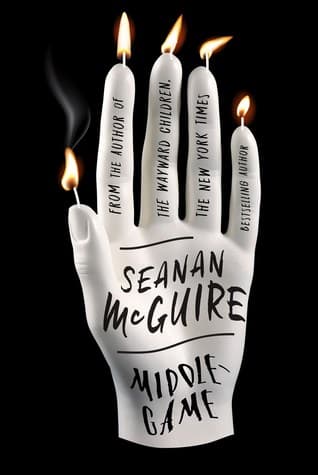
Seanan McGuire (2019)
Genre
Fantasy / Science Fiction
Reading Time
12-15 hours
Key Themes
See below
Sign in to track this book
Two alchemically-created twins, one with language powers and the other with mathematical powers, must join forces to escape their creator, who wants to use their combined abilities to become a god.
James Reed, an alchemist, thinks he can become a god by embodying language and mathematics, the core concepts of reality. He creates many homunculi, including 'If' children, but none perfectly balance these concepts. He then creates Roger and Dodger, twins with innate connections to language and mathematics. Reed, with his mentor Stewart, raises them, subtly guiding their development to make them perfect examples of their concepts. He isolates them, controls their education, and watches their interactions. He records their progress in his quest for power. The twins' early lives are controlled, their abilities nurtured, but their freedom is restricted. This sets the stage for Reed's experiment.
Roger and Dodger, in their first significant version, grow up in a controlled environment, not knowing their true nature or Reed’s plans. Roger learns and uses words easily, often speaking in complex stories. Dodger, in contrast, is good at math, seeing the world in equations and probabilities. They communicate through a unique, almost telepathic bond, sharing thoughts and emotions. As they grow, their powers appear: Roger can influence events through stories, and Dodger can predict and change probabilities. Reed, with Stewart, watches their development, sometimes stepping in to help them understand their concepts better. He keeps up the idea of a normal, though supervised, childhood. This period establishes their bond and early abilities.
As the twins get older, Reed tells them about the Doctrine of Ethos, an alchemical theory that says the universe is built on basic concepts, and mastering these concepts can lead to ultimate power. He explains that Roger is language and Dodger is mathematics. Together, through their 'assimilation' – a merging of their essences – they can become one powerful being. Reed presents this as their destiny and a path to something beyond human, leaving out that he plans to take their power for himself. The twins are at first fascinated and a little overwhelmed by this. They start to accept their roles, believing they are working toward a shared goal, unaware of Reed's manipulation. This revelation changes how they understand their own existence.
Roger and Dodger's abilities grow stronger. Roger can now subtly rewrite reality through stories, while Dodger can change probabilities to an amazing degree, making impossible events seem normal. Reed starts pushing them toward assimilation, the alchemical merging of their beings. Their first attempts are partial and unstable, causing strange time distortions and brief looks into other realities. These experiences are both exciting and scary for the twins; they feel immense power but also the danger of losing themselves. Reed, however, sees these failures as useful data. He refines his methods and pushes them harder. He gives them more complex alchemical texts and rituals, slowly preparing them for the complete assimilation he wants, while still pretending to be a benevolent guide.
Stewart, Reed's assistant and former mentor, is a moral voice in the story, though Reed's ambition often overrides him. He has strong doubts about Reed's methods and the ethics of creating and manipulating the twins. Stewart also maintains the 'If' children, the failed homunculi before Roger and Dodger, who exist in various states of incompleteness and suffering. These 'If' children show Reed's past failures and the casual cruelty in his pursuit of godhood. Their existence reminds Stewart of the risks and what could happen to Roger and Dodger if Reed's plans fail. Stewart's internal conflict and his reluctant involvement highlight the lack of morals in Reed's actions.
Reed thinks the twins are ready and starts a full assimilation ritual. But his true plan is to absorb their combined power for himself, which he has hidden. The ritual goes wrong. Instead of a smooth merging, the process is violent and chaotic. The twins realize Reed's betrayal and fight back. Their powers clash with Reed's alchemy. In the resulting temporal and reality-bending chaos, one of the twins—often Roger in early versions—dies. This death is not permanent, as the story shows their existence is cyclical. The death breaks the surviving twin but also starts their defiance and a growing awareness of their situation in future versions.
After the catastrophic assimilation attempt, the surviving twin (often Dodger) is reborn, usually with no conscious memory of their past life. However, faint echoes and instinctual knowledge remain. These 'memories' appear as unexplained skills, unusual fears, or an innate distrust of Reed. As they grow through later versions, these fragmented memories become stronger, forming a growing awareness of their cycle and Reed's manipulation. This gradual remembering is important to the story; it lets the twins slowly piece together their history and understand their situation. Each rebirth brings them closer to breaking free from Reed and gaining true control, rather than the forced assimilation he wants.
In a key version, both Roger and Dodger remember significant parts of their past lives. Roger, remembering his past deaths and Reed's betrayals, becomes protective of Dodger. Dodger, remembering the mathematical patterns of their existence and the inevitability of their deaths under Reed's plan, starts to look for a way out of the loop. They realize that their individual powers are not enough against Reed. Only by working together, combining Roger's linguistic manipulation of reality and Dodger's mathematical understanding of probability, do they have a chance. This version is a turning point; the twins go from being pawns to active agents, planning their escape and trying to stop Reed's control, instead of just reacting to him.
Roger and Dodger, now fully aware of their history and Reed's plans, approach Stewart. They appeal to his conscience, reminding him of the 'If' children and their suffering. Stewart, conflicted but moved by their situation and his own moral objections to Reed's cruelty, agrees to help them. He gives them important information about Reed's alchemical weaknesses and the assimilation ritual. With this knowledge and their combined powers, the twins confront Reed in a final battle. The fight is a complex mix of language, mathematics, and alchemy, with reality bending and breaking. The twins, with Stewart's help, manage to stop Reed's power, preventing his ascension and freeing themselves from his control.
After Reed's defeat, the twins are finally free. They feel exhausted and relieved, but also uncertain. They are no longer bound by Reed's experiments or the endless cycle of rebirth and death. Stewart, having helped, deals with his own involvement but finds some peace. Roger and Dodger, having assimilated on their own terms, now deeply understand reality. Their individual powers have merged into a unified, balanced whole. They decide to explore the world, understand their place in it, and define their own purpose, free from Reed's ambition. Their journey is just beginning, and they undertake it together, as equals, finally in control of their own destinies and the great power they now have.
The Protagonist
From an unwitting pawn, Roger evolves into a conscious agent, using his understanding of language to challenge and ultimately defeat his creator, forging his own destiny.
The Protagonist
Dodger transforms from a naive creation into a strategic mastermind, leveraging her mathematical insight to break free from a predetermined cycle of existence.
The Antagonist
From a seemingly benevolent mentor, Reed reveals himself as a tyrannical creator, ultimately defeated by the very beings he sought to control.
The Supporting
Stewart grapples with his complicity in Reed's experiments, eventually finding the courage to actively aid the twins in their fight for freedom.
The Mentioned
They serve as static, tragic figures, their suffering underscoring the stakes and motivating other characters.
The Mentioned
Functions as a background influence, establishing Reed's lineage and motivation.
The novel explores identity, especially for Roger and Dodger. As creations made for a purpose, they must figure out if their identity is set by Reed or if they can create their own. They discover their true nature, their bond, and their individual powers, eventually rejecting Reed's imposed identity and defining themselves. This is clear in their increasing defiance across different versions, as they choose their path instead of giving in to assimilation. The 'If' children show the sad results of not having a complete identity, serving as warnings.
“They were meant to be two halves of a whole, but they were also meant to be themselves, and the space between those two truths was a battlefield.”
Middlegame examines the struggle between free will and fate. Reed's project tries to control the twins' development and fate, believing he can arrange their ascension to godhood for himself. However, the twins' repeated rebirths and their growing ability to remember past versions introduce free will. Each time, they make slightly different choices, learn new lessons, and slowly move away from Reed's intended path. Their success in breaking the cycle shows their choice winning over the fate Reed tried to impose, highlighting the power of choice even in a seemingly inescapable loop.
“The loop was a cage, but cages could be broken, if you knew the right words and the right numbers.”
The book looks at the ethics of creation and a creator's responsibilities. James Reed, as the twins' creator, acts with great arrogance and ignores his creations' well-being. He sees them as tools, not beings, causing their repeated suffering and death. Stewart, on the other hand, represents the moral questions of creation, feeling guilt for his involvement and eventually helping the twins. The story questions a creator's obligations to their creations and the dangers of seeking power without ethical thought. The 'If' children are constant reminders of Reed's irresponsibility and the suffering it causes.
“He built them to be gods, and then he treated them like toys.”
The novel explores language and mathematics as the basic parts of reality. Roger represents language, able to shape reality through stories. Dodger represents mathematics, understanding and changing the probabilities and structures that govern existence. The interaction between their powers is central to the plot; their combined abilities let them understand and change reality in deep ways. The book suggests that these two concepts are not just tools for understanding, but active forces that can be used, and that true power comes from their balanced integration.
“Language was the story of the world, and mathematics was the skeleton it hung upon.”
The alchemical theory that guides Reed's pursuit of godhood.
The Doctrine of Ethos is a fictional alchemical theory central to Reed's motivations. It posits that reality is built upon fundamental concepts, and that by mastering and embodying these concepts – specifically language and mathematics – one can achieve ultimate power, or godhood. This doctrine serves as the philosophical backbone for Reed's experiments, providing a pseudo-scientific justification for his creation of Roger and Dodger. It defines the goal of assimilation and the ultimate power the twins are meant to wield, framing the entire conflict around the pursuit of this alchemical ascension. The twins' journey is about understanding and subverting this doctrine for their own ends.
The narrative structure that involves the twins reliving and remembering past iterations of their lives.
The story employs a cyclical narrative structure, where Roger and Dodger are repeatedly born, live, die, and are reborn, often with faint or growing memories of their previous iterations. This temporal loop is a key plot device, allowing the twins to accumulate knowledge, learn from past mistakes, and gradually develop strategies to escape their predetermined fate. It creates a sense of inevitability and urgency, while also providing opportunities for character development across multiple timelines. The 'remembering' aspect allows the audience to piece together the history of their struggle alongside the characters, making their eventual triumph over Reed more impactful as a breaking of the cycle.
The twins' inherent connection to and manifestation of language and mathematics.
Roger and Dodger are not just skilled in language and mathematics; they embody these concepts. Roger can manipulate narrative and reality through words, while Dodger can understand and alter probabilities and the underlying mathematical structures of the universe. This device is crucial as it defines their very being and the source of their immense power. Their powers are not learned skills but intrinsic aspects of their existence, making their struggle against Reed a fight for their essence. The embodiment of these concepts also facilitates their eventual assimilation, which is presented as a natural, if forced, merging of the fundamental building blocks of reality.
The alchemical process of merging Roger and Dodger into a single, omnipotent being.
The Assimilation is the ultimate goal of Reed's experiments: to merge Roger and Dodger into a single, all-powerful being that embodies both language and mathematics. This process is presented as a dangerous, transformative event, capable of granting godhood. For Reed, it's a means to usurp that power. For the twins, it's initially a terrifying unknown, then a forced destiny, and finally, a choice they make on their own terms. The threat of forced assimilation drives much of the plot, and the successful, consensual assimilation at the end represents their triumph and the realization of their true potential, free from Reed's control.
“Words have power. Words can remake the world. Words can unmake the world. Words are the bones of the world, and there is no magic without them.”
— A central theme of the book, explaining the power of language and stories.
“She was a story, and stories always had to end, even if the ending was only the beginning of another story.”
— Reflecting on the nature of existence and narratives.
“There are no monsters, not really. Only people who have forgotten how to be human.”
— A character's philosophical observation about evil.
“The past is never truly gone. It’s just waiting for a chance to catch up to you.”
— A warning about the lingering effects of past actions and events.
“Every story is a lie, but some lies are more true than others.”
— Discussing the nature of truth and narrative.
“To be alive is to be in motion, even if that motion is only the turning of the pages.”
— A reflection on life and the act of reading or experiencing a narrative.
“Sometimes, the only way to win is to change the rules of the game.”
— A strategic insight into overcoming seemingly insurmountable challenges.
“The world doesn’t care if you’re ready. It just keeps turning.”
— A stark reminder of the relentless nature of reality.
“We are all made of stories, and we tell ourselves the ones that help us survive.”
— Highlighting the psychological role of self-narrative.
“Love isn't a spell, it's a decision. A choice you make every single day.”
— A character's understanding of the nature of love, contrasting it with magic.
“There are always other paths. Always other stories. We just have to be brave enough to find them.”
— An encouraging thought about agency and potential.
“Knowledge is power, but power without purpose is just noise.”
— Emphasizing the importance of direction and intention behind one's abilities.
“The greatest danger isn't failing, it's never trying at all.”
— A motivational statement about taking risks.
“Every beginning is just an ending that hasn't happened yet.”
— A cyclical view of time and events, linking beginnings and endings.
“You can't outrun the story you're in, but you can always try to rewrite it.”
— A nuanced perspective on destiny and free will.
Ready to see how well you understood this book? Take our interactive quiz with 10 questions.
Biography coming soon.







