“My mind, you see, was like a sponge, soaking up every bit of knowledge I could find.”
— Rutherford Calhoun reflecting on his early intellectual curiosity and self-education.

Genre
Historical Fiction
Reading Time
210 min
Key Themes
See below
Sign in to track this book
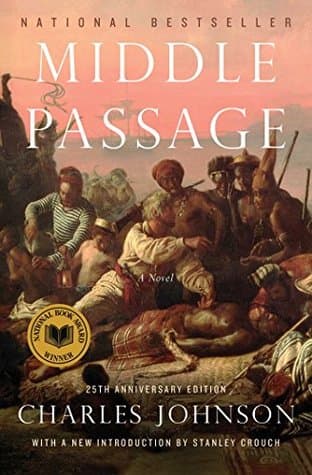
In 1830, a freed slave and roguish bachelor flees his debts and an unwanted marriage by stowing away on a slave ship bound for Africa, embarking on a harrowing voyage that forces him to confront the depths of human cruelty and the meaning of his own freedom.
In 1830 New Orleans, Rutherford Calhoun, a recently freed slave, faces serious financial trouble, owing money to various creditors, including Papa Zett and Monsieur Zoby, the leader of the Creoles of Color. To complicate matters, Isadora Bailey, a stern schoolteacher, wants to marry him, a prospect Rutherford dreads. Desperate to escape both his debts and marriage, Rutherford impulsively stows away on the first ship he sees leaving the harbor, the Republic. He quickly discovers it is a slave ship bound for Africa, a realization that fills him with a mix of fear and a strange sense of ironic destiny, given his own past as an enslaved person.
Aboard the Republic, Rutherford encounters a varied and unsettling crew. The ship is captained by Captain Falcon, an enigmatic and seemingly immortal man of small stature but immense authority. Falcon is obsessed with perfect evil and spiritual exploration. The first mate, Mr. Squibb, is a brutal and cynical man who maintains order through fear. Rutherford, discovered as a stowaway, is put to work in the galley, where he befriends the cook, Josiah Squibb (no relation to the first mate). He learns that the Republic is on a secret mission to acquire a rare and legendary African tribe, the Allmuseri, known for their unique philosophical and spiritual practices.
After a dangerous journey across the Atlantic, the Republic reaches the African coast. Captain Falcon, through manipulation and a strange, almost mystical negotiation, acquires a group of Allmuseri. These individuals are presented as a highly advanced, philosophical people with a deep understanding of the universe, not a typical tribal group. Their arrival on the ship changes the narrative, introducing a spiritual and intellectual challenge to Rutherford and the crew. The Allmuseri are not helpless victims but beings of immense inner strength and an alien worldview, immediately setting them apart from other enslaved people Rutherford has known.
During the return voyage, it is revealed that the Allmuseri are not the ship's only cargo, nor its most important. Captain Falcon has a deeper, more sinister purpose. A massive, mysterious creature, called an 'Allmuseri god' or 'Ur-Allmuseri,' is hidden in the ship's hold, locked in a massive crate. This creature is a being of immense power and unknown nature, described as a personification of the Allmuseri's spiritual core. Its presence deeply affects the ship, causing strange occurrences and unsettling the crew. The creature’s existence raises philosophical questions about divinity, evil, and the limits of human understanding.
The inhumane conditions on the ship, along with the spiritual disruption caused by the hidden god, eventually lead to a violent rebellion by the Allmuseri. They meticulously plan and execute an uprising, showing their intelligence and resilience. The mutiny is brutal and chaotic, with significant casualties on both sides. Rutherford is caught in the middle, forced to choose sides and confront his own moral ambiguities. The rebellion highlights the injustice of slavery and the spirit of those who fight for freedom, making the ship a battleground of conflicting ideas and desperate survival.
Following the mutiny, the Republic is in disarray. Many crew members are dead, and the ship is severely damaged. The surviving Allmuseri take control, but their philosophical approach to life and their alien understanding of the world mean they are not equipped to navigate or maintain the vessel. The ship drifts aimlessly, a ghost ship on the vast ocean. Rutherford, along with a handful of survivors from both the crew and the Allmuseri, struggles to survive amidst dwindling supplies and growing despair. This period tests endurance and leads to a further descent into the absurd and existential nature of their predicament.
As the Republic drifts, the hidden Allmuseri god's presence becomes stronger. Its influence is not just physical; it begins to subtly alter the minds and perceptions of the remaining crew and Allmuseri. Dreams become vivid and disturbing, reality blurs, and the characters must confront their deepest fears and desires. The creature acts as a catalyst for deep introspection, pushing Rutherford to question his own identity, his past, and his place in the universe. Its power goes beyond conventional understanding, challenging the boundaries of the material world and entering the realm of the spiritual and metaphysical.
Rutherford has a series of intense, philosophical confrontations with Captain Falcon, who, despite the chaos, remains eerily calm and focused on his ultimate goal. Falcon reveals his long-standing obsession with the Allmuseri god, seeing it as the embodiment of pure evil and a key to understanding the universe. He believes that by transporting and studying this deity, he can master the forces of good and evil. Rutherford begins to grasp the profound philosophical implications of Falcon’s quest and the creature’s existence, realizing that the voyage is not merely about slavery but a deeper spiritual and intellectual journey into the nature of existence itself.
In a climactic and deeply symbolic sequence, the Allmuseri god dies in the ship's hold. Its death is not a violent event but a slow, agonizing dissolution, accompanied by a deep sense of cosmic grief and emptiness. The death of this ancient, powerful entity has a devastating effect on the remaining Allmuseri, who feel its loss deeply. For Rutherford, it is a moment of deep realization and existential crisis. The death of the god signifies the end of a certain world order and forces him to confront the fragility of existence and the ultimate meaning or meaninglessness of life without such a definitive spiritual presence.
Eventually, the Republic, now a derelict hulk, is discovered and its few remaining survivors, including Rutherford, Captain Falcon, and a few Allmuseri, are rescued by an American naval vessel. The experience has irrevocably altered Rutherford. He is no longer the carefree rogue who fled New Orleans but a man deeply changed by the horrors, philosophical revelations, and spiritual encounters of the middle passage. He has gained a deeper understanding of himself, humanity, and the complex interplay of good and evil, freedom and bondage, existence and non-existence. The trauma and enlightenment of the voyage will forever shape his perception of the world.
The Protagonist
Rutherford transforms from a self-serving rogue into a man profoundly enlightened and burdened by the philosophical and spiritual weight of his experiences.
The Antagonist
Falcon remains largely unchanged, representing a fixed point of intellectual and spiritual obsession, but his ultimate goal is thwarted.
The Supporting
Isadora's role is largely static, serving as a catalyst for Rutherford's flight and a symbol of the life he rejects.
The Supporting
The Allmuseri endure immense suffering and loss, but their spirit and philosophical integrity remain largely unbroken, even in death.
The Mentioned
The god undergoes a slow, agonizing dissolution, symbolizing the death of an ancient spiritual order and leaving a profound void.
The Supporting
Squibb remains consistently cruel, a static representation of human depravity.
The Supporting
Josiah remains a supportive figure, providing warmth and a grounding presence for Rutherford.
The novel explores freedom not just as a physical state but as a philosophical and spiritual condition. Rutherford, a newly freed slave, initially sees freedom as an escape from responsibility, only to find himself metaphorically and literally enslaved on the Republic. The Allmuseri, though physically enslaved, have a deep internal freedom and dignity that challenges Western ideas of bondage. The narrative questions whether true freedom is ever attainable, even for those who are legally 'free,' and whether spiritual enslavement can exist even without physical chains, as seen in Falcon's obsession.
“Freedom, I learned, could be a burden heavier than any chains.”
Johnson uses the picaresque journey of the Republic to expose the absurdity and often grotesque cruelty of human existence. The slave ship itself is a microcosm of a world where suffering is common, and motivations are often unclear or irrational. The casual brutality of the crew, the philosophical detachment of Captain Falcon, and the inexplicable nature of the Allmuseri god all contribute to a sense of a universe that is indifferent to human suffering. Rutherford's journey forces him to confront this absurdity directly, leading to both despair and a strange kind of enlightenment.
“Life, I discovered, was a cosmic joke, and we were all the punchline.”
Rutherford Calhoun begins the novel fleeing his past and unwilling to commit to an identity. The harrowing journey on the Republic, particularly his encounters with the Allmuseri and Captain Falcon, forces him into an intense process of self-examination. He grapples with his identity as a Black man, a former slave, and a human being in a morally ambiguous world. His experiences remove his superficiality, compelling him to confront his fears, desires, and the philosophical questions of existence, ultimately leading to a deep, though painful, understanding of who he is.
“I had run from myself for so long, but the sea had brought me face to face with the man I had become.”
Central to the novel is the exploration of good and evil, particularly through Captain Falcon's obsession with the Allmuseri god as an embodiment of pure evil. The narrative challenges simple definitions, suggesting that evil is not merely an absence of good but a complex, sometimes alluring, force. Rutherford witnesses overt cruelty (Mr. Squibb) but also encounters the more intellectual and philosophical evil of Falcon. The Allmuseri god itself represents a primordial force beyond human morality, forcing characters to confront the limits of their understanding of these concepts. The novel suggests that understanding evil is important for a complete understanding of the human condition.
“Evil, Falcon had taught me, was not merely the absence of good, but a presence, a force to be understood.”
A literal and metaphorical journey of suffering, transformation, and self-discovery.
The Middle Passage serves as the central plot device, not just as a historical event (the transatlantic slave trade) but as a symbolic journey. It is a crucible for Rutherford's transformation, forcing him to confront the depths of human depravity and the heights of spiritual resilience. The physical journey across the ocean mirrors his internal voyage into self-awareness and philosophical enlightenment. It is a space of liminality, where identities are stripped away, and new understandings are forged, embodying both historical horror and existential quest.
A series of episodic adventures and encounters, driven by a roguish protagonist.
The novel employs a picaresque structure, following Rutherford Calhoun, a 'picaro' or rogue, through a series of loosely connected, often humorous but ultimately profound, adventures. This structure allows for a wide range of social commentary, philosophical digressions, and encounters with diverse characters. Rutherford's episodic experiences on the Republic, from stowaway to cook to participant in mutiny, reflect the picaresque tradition of a protagonist navigating a corrupt world, learning and growing through trial and error, while maintaining a witty, detached perspective.
A mysterious, unseen entity that drives the plot and serves as a catalyst for philosophical inquiry.
The Allmuseri god functions as a powerful symbolic and narrative device. Though largely confined to the ship's hold, its presence is the driving force behind Captain Falcon's quest and profoundly influences the spiritual and psychological states of everyone aboard. It represents the unknown, the primordial, and the ultimate philosophical challenge. Its existence forces characters to question reality, divinity, and the limits of human understanding, transforming the slave ship into a metaphysical laboratory. Its death marks a pivotal moment of cosmic loss and existential reckoning.
Rutherford's recounting of his story from a future perspective, adding layers of reflection.
While not explicitly a traditional frame, the narrative is presented as Rutherford Calhoun's retrospective account of his experiences. His voice is one of a man who has lived through the events and is now reflecting on their meaning. This implied frame narrative allows for philosophical commentary and a sense of earned wisdom, as Rutherford interprets his past actions and the profound events of the middle passage with the benefit of hindsight. It imbues the story with a meditative quality, suggesting that the journey is as much about understanding as it is about experiencing.
“My mind, you see, was like a sponge, soaking up every bit of knowledge I could find.”
— Rutherford Calhoun reflecting on his early intellectual curiosity and self-education.
“Freedom, I realized, was not simply the absence of chains, but the presence of choice.”
— Rutherford's developing understanding of freedom beyond mere physical liberty.
“The past, I saw, was not a dead thing, but a living current that flowed through us all.”
— Rutherford's growing awareness of historical legacy and its impact on the present.
“God, I knew, was not just in the churches, but in the thunder and the waves, in the very breath of life.”
— Rutherford's spiritual awakening and perception of divinity in nature during the voyage.
“The sea, I soon discovered, was a mirror, reflecting not just the sky, but the depths of my own soul.”
— Rutherford's introspection while at sea, using the ocean as a metaphor for self-discovery.
“We are all, in a sense, passengers on a ship, bound for destinations unknown.”
— A broader philosophical reflection on the human condition and life's journey.
“The world, I learned, was a tapestry of suffering and joy, woven together with threads of hope and despair.”
— Rutherford's broader view of humanity and the complexities of existence.
“To be truly free, I understood, one must first be free of oneself.”
— Rutherford's realization that true freedom involves overcoming internal limitations and ego.
“Every man, I thought, carries within him a universe of stories, waiting to be told.”
— Rutherford's appreciation for the individual narratives and inner lives of others.
“The greatest journey, I found, was not across the ocean, but into the labyrinth of one's own heart.”
— Rutherford's ultimate conclusion about the importance of internal exploration over external adventure.
“Silence, I came to realize, held its own kind of eloquence, its own profound truths.”
— Rutherford's meditation on the power and meaning found in quietude and unspoken moments.
“We are all haunted by what we leave behind, and shaped by what we carry forward.”
— Rutherford reflecting on the lingering impact of past experiences and the choices that define us.
“Love, I learned, was not a possession, but a shared current, a force that bound us even in separation.”
— Rutherford's evolving understanding of love, transcending physical presence.
“The truest voyage, I saw, was the one that led you back to yourself, transformed.”
— A summary of Rutherford's transformative journey, emphasizing self-reconciliation.
Ready to see how well you understood this book? Take our interactive quiz with 10 questions.
Charles R. Johnson is a MacArthur Genius Grant recipient and a celebrated novelist, philosopher, and essayist. His most acclaimed work, 'Middle Passage,' earned him the National Book Award for Fiction. Johnson's writing often explores themes of identity, race, and the human condition with profound philosophical depth.







