“Time in Midaq Alley was a different kind of time, heavy and slow, like the molasses sold in the shops.”
— Describing the unique, unchanging atmosphere of the alley.

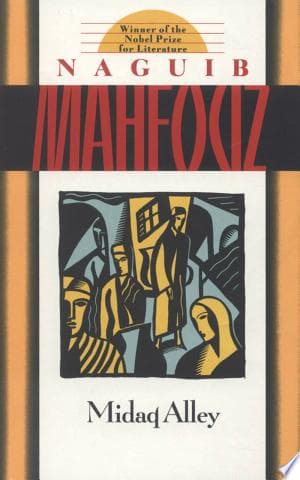
Naguib Mahfouz (2016)
Genre
Historical Fiction
Reading Time
300 min
Key Themes
See below
Sign in to track this book
In 1940s Cairo, Midaq Alley is a small, crowded world where people pursue their dreams and make moral compromises as new ways threaten their old life.
The novel begins by introducing Midaq Alley in 1940s Cairo. We meet its residents: Kirsha, the cafe owner with secret homosexual desires; his nagging wife; Abbas, the barber, in love with Hamida; Zaita, the cripple-maker; Uncle Kamil, the sweet-seller; and Radwan Hussainy, the pious elder. Hamida, the adopted daughter of Umm Hamida, wants to escape the alley's poverty. She rejects Abbas, seeing him as too simple and poor for her dreams of wealth, despite his affection.
Abbas, encouraged by Husniya, the bakery owner, takes a job with the British army in El Alamein, hoping to earn enough to marry Hamida. He talks to Radwan Hussainy, who advises patience, but Abbas is set on making money. His departure leaves Hamida without her main suitor, allowing other men to enter her life. Kirsha's secret life becomes more obvious as he visits male brothels, upsetting his wife and causing rumors, though residents mostly ignore it.
Hamida gets the attention of Salim Alwan, a rich shop owner from a nearby street. He is taken by her beauty and begins to court her, giving her gifts and promising a luxurious life. Hamida sees him as her way out of the alley. Residents gossip, some envious, some disapproving. However, just as they are about to get engaged, Salim Alwan has a heart attack, leaving him unable to keep his promises to Hamida and ending her hopes for a rich marriage.
Disappointed and desperate after Salim Alwan's illness, Hamida is approached by Ibrahim Farhat, a charming but dangerous pimp. He plays on her vanity and ambition, promising her a grander life than Salim Alwan could offer, with fine clothes, jewels, and rich admirers. Hamida, eager to escape, believes him. She secretly leaves the alley with Farhat, thinking she will become a wealthy man's mistress, but soon realizes she has been tricked into prostitution in a high-class brothel. She quickly adjusts, becoming a sophisticated courtesan.
Zaita, the cripple-maker, continues his business, faking injuries for beggars to increase their earnings. He is cynical and opportunistic. Dr. Booshy, the alley's dentist, is also unethical. He practices without qualifications, uses unsanitary methods, and overcharges poor clients. He also fences stolen goods, showing more moral decay in the alley, and how many residents use illegal ways to survive or profit.
Kirsha's wife, suspicious of his late nights, confronts him. She doesn't fully understand his homosexual affairs but knows he is doing something wrong. Their arguments grow, creating tension in the cafe and affecting their son, Hussain, who is ashamed of his father. Hussain, who also works for the British, wants a different life and dislikes his father's actions and the alley's unchanging nature, showing a generational shift.
Abbas returns to Midaq Alley with money saved from his British army job. He wants to marry Hamida, sure his wealth will win her over. He buys her a necklace and dreams of their future. But alley residents are silent about Hamida. Eventually, through questions and rumors, he learns the truth about her life as a prostitute. His dreams are broken, replaced by grief and a desire for revenge against those he believes corrupted her.
Driven by pain, Abbas finds Hamida in the brothel. She is changed, dressed in expensive clothes and makeup, hardened by her job. He confronts her, asking her to return to the alley and offering forgiveness. Hamida has accepted her new identity and cruelly rejects him, mocking his innocence and the alley's poverty. Her coldness breaks Abbas, pushing him to the edge and strengthening his resolve to get revenge on Ibrahim Farhat.
Overwhelmed by pain, Abbas confronts Ibrahim Farhat at a cafe the pimp frequents. In a rage, Abbas attacks Farhat. The fight quickly escalates, drawing in other patrons. Hamida is there and sees the scene. In the chaos, Farhat's associates kill Abbas. His death is a sad end to his dreams and shows the alley's inability to protect its own from outside corruption, leaving residents shocked.
After Abbas's death, a quiet sadness fills Midaq Alley. Residents mourn Abbas, and Umm Hamida is especially devastated. Hamida, though initially shaken, quickly returns to her hardened self, her morals seemingly lost. Life in the alley slowly goes back to normal, but the events leave a lasting mark. The alley remains a small part of Cairo, facing new ways and moral challenges. Some characters, like Radwan Hussainy, find comfort in faith, while others stay caught in their vices and struggles.
The Protagonist
From an ambitious but naive girl desiring escape, she transforms into a cynical, hardened courtesan who has lost her innocence and moral compass.
The Protagonist
Starts as an optimistic, innocent lover, becomes a heartbroken and vengeful man, ultimately dying tragically.
The Supporting
His repressed desires become more evident, causing increasing tension within his family and the alley.
The Supporting
Remains consistently opportunistic and amoral throughout the story, unaffected by the tragedy around him.
The Supporting
Remains a steadfast figure of faith and moral guidance, largely unchanged by external events.
The Supporting
Introduced as a beacon of hope for Hamida, his sudden illness shatters her dreams and sets her on a different path.
The Antagonist
Acts as the catalyst for Hamida's downfall and is ultimately responsible for Abbas's death.
The Supporting
Experiences maternal anxiety and grief over Hamida's choices and Abbas's fate.
The Supporting
Remains a consistent, strong female figure in the alley, providing a sense of stability despite the surrounding turmoil.
The novel shows the conflict between Midaq Alley's old ways and new influences, like the British presence in Cairo and the appeal of outside wealth. Hamida's wish to leave the alley for a better life, Abbas's attempt to earn money with the British, and Hussain's dislike for his father's old ways all show this tension. The alley, while resisting change, cannot fully protect its people from the moral compromises and societal shifts that come with the modern world.
““The alley was a world apart, a closed circle, an island in the midst of a restless sea.””
Many characters in Midaq Alley are driven by strong desires: Hamida wants wealth, Abbas wants Hamida's love, Kirsha wants forbidden pleasure. But these desires often lead to disappointment and sad results. Hamida's pursuit of luxury leads her to prostitution, and Abbas's love for her results in his death. The novel suggests that uncontrolled desire, especially for money or escape, can lead to moral compromises and despair. It highlights the gap between what people hope for and what happens.
““She had sold herself, and she knew it, but she had bought a life that was better than any she had known.””
Midaq Alley, despite being a close community, has much moral corruption. Characters like Zaita, who profits from suffering, Dr. Booshy, who practices unethical dentistry and deals in stolen goods, and Ibrahim Farhat, the pimp, all show parts of this decay. Kirsha's secret life also points to hypocrisy. The novel explores how poverty and the promise of a better life can push people to questionable actions, and how the community often tolerates these wrongs, weakening its honesty.
““The alley had its good and bad, its light and shadow, like any other place, but its shadows were often deep and dark.””
Characters like Hamida and Hussain struggle with their place in Midaq Alley. Hamida wants to leave her alley identity for a more glamorous one, believing her true self is elsewhere. Hussain, Kirsha's son, also feels separate from his father's life and the alley's lack of change, wanting a different future. Abbas, in contrast, feels his identity is tied to the alley and his love for Hamida. The novel explores how people define themselves in relation to their community and the wider world, and the often difficult process of finding where one belongs.
““She hated the alley, hated its smell, its noise, its poverty, and most of all, she hated herself for being part of it.””
Midaq Alley as a small-scale representation of wider Egyptian society.
The alley itself serves as a microcosm, a self-contained world that reflects the larger societal issues and changes happening in Cairo and Egypt during the 1940s. Its diverse inhabitants, from the pious Radwan Hussainy to the opportunistic Zaita and the ambitious Hamida, embody different social classes, moral stances, and responses to the impending modernity. The alley's internal dynamics, conflicts, and tragic events mirror the broader struggles of a nation on the brink of significant transformation, making a small street a stage for universal human experiences.
A series of brief, interconnected character studies to build a composite picture.
Mahfouz uses a narrative structure that frequently shifts focus between the various residents of Midaq Alley, offering detailed vignettes of their lives, thoughts, and daily routines. This technique builds a rich, multi-faceted portrait of the community rather than focusing solely on one protagonist. While Hamida and Abbas eventually become central, the initial chapters are dedicated to introducing a wide array of characters like Kirsha, Zaita, Uncle Kamil, and Radwan Hussainy, allowing the reader to understand the complex web of relationships and the collective psyche of the alley.
Contrasting characters to highlight specific traits or themes.
The novel frequently employs foil characters to emphasize particular traits or thematic elements. For example, the innocent and traditional Abbas serves as a foil to the ambitious and morally flexible Hamida, highlighting the destructive nature of their opposing desires. Similarly, the pious and accepting Radwan Hussainy contrasts sharply with the cynical Zaita, underscoring the different moral paths available within the same community. These contrasts deepen the reader's understanding of the characters' motivations and the novel's central themes.
The physical space of Midaq Alley representing tradition, stagnation, and a contained world.
Midaq Alley is more than just a setting; it functions as a powerful symbol. It represents a closed, traditional world, resistant to change but ultimately vulnerable to external forces. Its narrow confines symbolize the limited opportunities and social constraints faced by its inhabitants. For characters like Hamida, it symbolizes stagnation and poverty, a place from which she desperately seeks escape. For others like Abbas, it represents home and community. The alley's eventual inability to protect its own from the outside world's corrupting influences underscores its symbolic role as a fading relic of tradition.
“Time in Midaq Alley was a different kind of time, heavy and slow, like the molasses sold in the shops.”
— Describing the unique, unchanging atmosphere of the alley.
“The alley was a mother who nourished her children with her own blood, and they, in turn, were her children, bound to her by an invisible umbilical cord.”
— Metaphorically portraying the deep connection between the residents and Midaq Alley.
“Every man is a king in his own house, even if his house is a single room in Midaq Alley.”
— Reflecting on the dignity and self-importance of individuals despite their humble circumstances.
“Life, in Midaq Alley, was a succession of small joys and endless sorrows, like beads on a rosary.”
— A general observation on the cyclical nature of life for the alley's inhabitants.
“The past is a phantom that haunts the present, and the future is a dream that may never come true.”
— A philosophical reflection on the weight of history and the uncertainty of the future.
“Love is a strange thing; it can make a man forget his hunger and his thirst, and even his own name.”
— Hamida's perspective on the powerful, transformative nature of love.
“Money is a cruel master, but a necessary one.”
— Expressing the harsh reality of economic survival in the alley.
“Hope is the last thing that dies in the heart of man.”
— A common sentiment among the characters, despite their hardships.
“The world outside Midaq Alley was a vast, terrifying place, full of temptations and dangers.”
— Describing the perception of the world beyond their familiar confines.
“Beauty is a double-edged sword; it can bring joy and sorrow, love and hatred.”
— Reflecting on the impact of Hamida's beauty on her life and others.
“Every man has his own hell, and his own heaven, within him.”
— A deep psychological observation about internal struggles and contentment.
“Silence in Midaq Alley was never truly silent; it was filled with the whispers of secrets and the echoes of dreams.”
— Highlighting the vibrant, underlying life and hidden narratives of the alley.
“The heart of Cairo beat in its alleys, not in its grand boulevards.”
— Emphasizing the importance and authenticity of the common, everyday life over the superficial.
“Fate is a weaver, and we are but threads in its loom.”
— A common fatalistic view among the characters regarding their predetermined lives.
Ready to see how well you understood this book? Take our interactive quiz with 10 questions.

Naguib Mahfouz Abdelaziz Ibrahim Ahmed Al-Basha was an Egyptian writer who won the 1988 Nobel Prize in Literature. Mahfouz is regarded as one of the first contemporary writers in Arabic literature, along with Taha Hussein, to explore themes of existentialism. He is the only Egyptian to win the Nobel Prize in Literature. He published 35 novels, over 350 short stories, 26 screenplays, hundreds of op-ed columns for Egyptian newspapers, and seven plays over a 70-year career, from the 1930s until 2004. All of his novels take place in Egypt, and always mentions the lane, which equals the world. His most famous works include The Cairo Trilogy and Children of Gebelawi. Many of Mahfouz's works have been made into Egyptian and foreign films; no Arab writer exceeds Mahfouz in number of works that have been adapted for cinema and television. While Mahfouz's literature is classified as realist literature, existential themes appear in it.







