“The problem with artificial intelligence is that it's still artificial.”
— Early discussion about the limitations of current technology.

Michael Crichton (2011)
Genre
Thriller / Mystery / Science Fiction
Reading Time
560 min
Key Themes
See below
Sign in to track this book
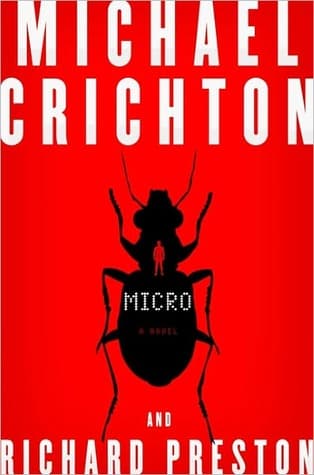
When graduate students are miniaturized and abandoned in the Hawaiian rainforest by a sinister biotech company, they use their science skills to survive a world where insects are monstrous predators.
The story starts with seven bright graduate students from Harvard, including the ambitious Karen King, the practical Peter Jansen, and the quiet Lily Marquette. They are experts in various science fields and are drawn to Hawaii by an appealing offer from Nanigen MicroSensors, a biotech company led by the mysterious CEO, Vincent Drake. The students are excited about important research and good careers, unaware of the dark plans in motion. They fly to Oahu, where they see the company's advanced labs and the promise of revolutionary work, but also meet Drake's odd and controlling personality.
Before the main group arrives, Eric Chan, a graduate student and Peter Jansen's close friend, already works at Nanigen. He finds proof that Vincent Drake is illegally using Nanigen's miniaturization technology for military purposes and human tests, specifically on himself to boost his senses. Eric tries to expose Drake, but Drake, who has already used his technology to enhance his own senses and reflexes, ambushes him. Eric is shrunk to an inch tall and thrown into the Hawaiian rainforest, where a predatory ant kills him. This event sets the stage for the other students' dangerous journey.
After Eric disappears, the other six students — Karen, Peter, Lily, Danny, Rick, and Amanda — become suspicious. They find Eric's hidden research and realize Drake's true goals. In a desperate move to silence them and get back evidence, Drake ambushes the students. During the chaotic fight in Nanigen's lab, Drake's henchman, Jeremy, a former military operative, shrinks the students to half an inch tall using Nanigen's advanced technology. They are then dumped into the thick, dangerous Hawaiian rainforest, left to die among its giant plants and animals.
Immediately after being shrunk, the students face a terrifying new reality. The familiar rainforest becomes an alien, highly detailed world where every leaf is a giant obstacle and every insect is a huge predator. They quickly learn that their vast scientific knowledge is almost useless against nature's raw, overwhelming power at this scale. They get separated during the initial chaos, with Lily and Danny in one group, and Karen, Peter, Rick, and Amanda in another. The sheer scale of their problem, along with the immediate threat of spiders, ants, and other creatures, forces them to adapt or die.
The trip through the miniaturized rainforest is full of danger and devastating losses. Rick is impaled by a thorn after a fall, and Amanda is tragically carried off by a giant wasp. Both die from the overwhelming dangers of their new environment. These deaths deeply affect the remaining students, especially Peter, who struggles with the emotional toll. Lily, with her plant knowledge, becomes vital for finding edible plants and moving through the dense growth, while Danny's engineering skills prove very useful for making temporary tools and defenses.
Unknown to the students, Vincent Drake is not content to let nature handle them. Driven by paranoia and the need to protect his illegal activities, he uses his own miniaturization technology, enhanced senses, and a special drone to actively hunt them. He sees them as loose ends and a threat to his empire. Drake's pursuit adds another layer of terror, as the students realize they are fighting not just the environment but also a determined, technologically advanced human predator. His presence makes their desperate fight for survival even more urgent and terrifying.
The surviving students eventually manage to regroup, forming a stronger, more united team. Peter's leadership emerges, and he, along with Lily and Danny, starts applying their scientific knowledge creatively to their new scale. They make tools from natural materials, use their understanding of insect behavior to avoid predators, and develop ways to communicate and move. Karen, initially more self-interested, also begins to help, driven by the shared threat. Their cleverness becomes their main weapon against the overwhelming dangers of the micro-world and Drake's relentless hunt.
Looking for a temporary safe place from predators and Drake, the students find shelter inside a giant beehive. Here, they observe the complex social structure of the bees and plan to use them to escape. Their idea is to attach themselves to a bee and fly out of the rainforest, hoping to reach a place where they can be found and return to normal size. This bold plan requires precise timing and teamwork, showing their desperate ingenuity and their understanding of the natural world, even at a tiny level.
As the students try to escape, Vincent Drake closes in. A final confrontation happens inside the beehive and its immediate area. Drake, using his enhanced senses and advanced gear, poses a great threat. In the ensuing chaos, Danny makes a heroic sacrifice, distracting Drake long enough for Peter, Lily, and Karen to escape on a bee. Danny's death, though sad, gives the others a small chance at survival, highlighting the high stakes and the bonds formed under extreme pressure.
Peter, Lily, and Karen manage to ride the bee out of the immediate danger zone. A search party eventually finds them, having returned to their normal size, though the details of their re-enlargement are somewhat unclear, suggesting a malfunction or a specific opportunity. With the students safe, Drake's crimes are revealed. The evidence Eric had collected, combined with the survivors' statements, leads to his downfall. Vincent Drake is arrested, and his illegal operations are shut down, bringing some justice to the horrific experience the students went through.
The Protagonist
Peter transforms from a cautious academic into a courageous and resourceful leader, driven by survival and a sense of justice.
The Supporting
Lily's quiet strength and specialized knowledge are recognized and become central to the group's survival, growing more confident in her abilities.
The Supporting
Karen evolves from a selfish individual to a more cooperative and empathetic member of the group, recognizing the value of collective survival.
The Antagonist
Drake's hubris and paranoia lead to his downfall, as his attempts to cover up his crimes only expose them further.
The Supporting
Eric's brief but pivotal role establishes the novel's central conflict and the ruthless nature of the antagonist.
The Supporting
Danny develops from a skilled engineer into a selfless hero, giving his life for his friends.
The Supporting
Rick's arc is tragically cut short, serving as a stark illustration of the dangers of the miniaturized world.
The Supporting
Amanda's brief arc underscores the fragility of life in the miniaturized world and the mercilessness of nature.
The Mentioned
Jeremy remains a static character, serving as Drake's loyal but ultimately expendable henchman.
The novel shows nature as a powerful, uncaring force, especially when seen at a tiny scale. The rainforest, usually beautiful, becomes a terrifying maze where every insect is a huge predator and every plant a giant obstacle. This theme appears from the moment Eric Chan is eaten by an ant, and continues with the deaths of Rick (impaled by a thorn) and Amanda (carried off by a wasp). The students' scientific knowledge, so strong in their normal world, is almost useless against the raw power of the micro-jungle, forcing them to adapt or die.
“At this scale, the rainforest was not beautiful; it was a terrifying, intricate death trap where every leaf was a mountain and every ant a dragon.”
This theme looks at the ethical limits of science and the dangers of technology in the wrong hands. Vincent Drake, a brilliant scientist, uses his new miniaturization technology not to help humanity, but for personal gain, military uses, and to silence threats. His arrogance and lack of morals lead him to commit terrible acts, including trying to murder the graduate students. The very technology meant to shrink objects becomes a weapon of terror, showing Crichton's repeated warning about scientific progress without ethical oversight.
“He saw no moral line, only opportunities. And the world was full of opportunities for those brave enough to seize them, no matter the cost.”
Facing overwhelming challenges, the graduate students, despite their initial disagreements and individual goals, learn that survival depends on their ability to cooperate and use their combined scientific skills. Peter's leadership, Lily's plant knowledge, and Danny's engineering skills become essential for navigating the micro-world, finding food, and planning escapes. Their ability to adapt, innovate, and work as a team, making tools from natural materials and understanding insect behavior, is what ultimately allows a few of them to survive. This contrasts sharply with nature's raw power and Drake's technological threat.
“Their degrees were useless here. Their wits, their teamwork, and whatever they could fashion from a leaf or a twig – those were their only weapons.”
Being miniaturized completely changes how the characters see the world and their place in it. What was once ordinary becomes enormous; a dewdrop is an ocean, a spider a giant. This theme explores how a radical change in scale can force a new look at priorities, values, and even the definition of life itself. The students must face their own smallness in the face of nature's size and brutality. This leads to a deep shift in their understanding of how ecosystems connect and how fragile their own lives are. This transformation is both terrifying and, for the survivors, ultimately insightful.
“The world had not changed; they had. And in that change, every familiar thing became alien, every mundane detail a matter of life or death.”
The central scientific innovation enabling the story's premise.
This advanced technology, developed by Nanigen MicroSensors, allows for the precise and controlled shrinking of organic and inorganic matter to incredibly small scales. It serves as the primary catalyst for the entire plot, transforming the familiar world into a deadly, alien environment for the protagonists. The device is both a marvel of science and a dangerous weapon, highlighting the novel's core theme of unchecked scientific ambition. It's the mechanism by which the students are trapped and the core element of Vincent Drake's power and villainy.
A familiar environment rendered terrifyingly alien at a micro-scale.
The lush Hawaiian rainforest is not merely a backdrop but a character in itself. Once the students are miniaturized, this vibrant ecosystem transforms into a hyper-detailed, dangerous, and overwhelming world. Its dense foliage, diverse insect population, and tropical conditions create countless obstacles and threats, serving as a constant antagonist. The setting emphasizes the theme of nature's indifference and power, as the students must navigate its colossal features and monstrous inhabitants to survive, making their scientific knowledge a double-edged sword.
Vincent Drake's active hunt for the miniaturized students.
Beyond the natural dangers of the micro-world, the students face the constant, active threat of Vincent Drake. Drake's use of augmented senses, drones, and his own miniaturization capabilities to hunt them adds a layer of psychological terror and urgency. This device elevates the stakes from mere survival against nature to a race against a determined, technologically superior human predator. It underscores Drake's psychopathic nature and ensures that the narrative maintains a high level of suspense, preventing the students from ever truly feeling safe.
The characters' diverse scientific backgrounds are crucial for their survival.
Each graduate student possesses a unique scientific specialization (robotics, botany, engineering, etc.). While initially overwhelmed, their combined knowledge becomes their primary tool for survival. They apply their understanding of physics, biology, and engineering to solve problems at a micro-scale: identifying edible plants, fashioning tools, understanding insect behavior, and devising escape plans. This device highlights the power of intellect and interdisciplinary cooperation, contrasting with Drake's misuse of science and reinforcing that knowledge, when applied ethically, can be a formidable force.
“The problem with artificial intelligence is that it's still artificial.”
— Early discussion about the limitations of current technology.
“Nature always finds a way to remind us who's in charge.”
— Reflecting on the unpredictable and powerful forces of the natural world.
“In the jungle, you're not at the top of the food chain anymore.”
— Characters realizing their vulnerability after being shrunk.
“Every solution creates new problems.”
— A character musing on the cyclical nature of scientific progress and its consequences.
“Fear makes you do stupid things. And brave things.”
— Observing the varied reactions of people under extreme duress.
“The world is full of things we don't understand, and that's usually where the real danger lies.”
— Discussing the unknown elements of the micro-world.
“Sometimes the greatest discoveries are made when you're looking for something else entirely.”
— A character reflecting on serendipity in scientific research.
“You never truly appreciate your size until it's gone.”
— The protagonists' initial shock and adjustment to being miniaturized.
“The line between genius and madness is often just a matter of perspective.”
— Describing a brilliant but morally ambiguous scientist.
“Survival is not about being the strongest, but about being the most adaptable.”
— A key lesson learned by the characters in their struggle against micro-predators.
“The greatest threats are often the ones you can't even see.”
— Referring to the microscopic dangers in their new environment.
“Technology is a tool. It can be used for good or for evil.”
— A discussion about the ethical implications of advanced scientific capabilities.
“Even the smallest creature can be a monster if you're small enough.”
— A vivid description of common insects becoming terrifying predators.
“The past is never truly gone; it just waits for an opportunity to resurface.”
— Hinting at unresolved conflicts and hidden agendas.
Ready to see how well you understood this book? Take our interactive quiz with 10 questions.
Biography coming soon.







