“He was an actor, and his life was a stage.”
— Describing Hendrik Höfgen's fundamental nature and ambition.

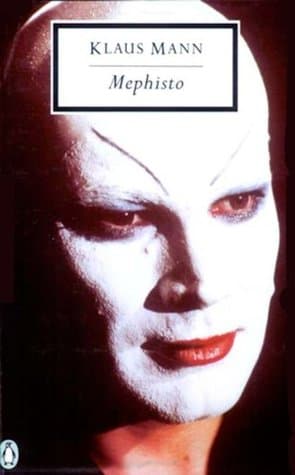
Klaus Mann (1936)
Genre
Literary Fiction / Historical Fiction
Reading Time
360 min
Key Themes
See below
Sign in to track this book
As Nazism takes hold, an actor with great ambition compromises his soul for fame, becoming the devil he plays.
Hendrik Höfgen, an ambitious actor, works at the Hamburg Playhouse. He feels limited by provincial theater and dreams of Berlin's stages. He sees himself as a revolutionary artist, supporting leftist ideas and openly criticizing the rising Nazi Party. He has a complicated relationship with Dora Martin, an older actress who sees his talent and his narcissism. He also has a secret affair with Juliette Martens, a Black dancer, which he hides to protect his career. His marriage to Barbara Bruckner, a professor's daughter, is mainly a strategic move for social standing.
Hendrik moves to Berlin and gets a job at a major theater. The political situation in Germany worsens as the Nazi Party gains power. Hendrik at first tries to appear politically neutral, or even subtly against the Nazis, but his ambition increasingly overpowers his beliefs. He sees his former leftist friends and colleagues, like Hans Miklas, arrested or disappear, and he focuses on self-preservation. While he privately dislikes the Nazis, he publicly avoids anything that might harm his growing career. His relationship with Barbara becomes tense as she, unlike him, holds firm in her moral opposition to the regime.
Hendrik Höfgen's career changes when he plays Mephisto in Goethe's 'Faust'. His performance is powerful, capturing the evil and seductive nature of the character. This role becomes his most famous, bringing him praise and public recognition. More importantly, his performance gets the attention of the 'Prime Minister', a high-ranking Nazi official (a character based on Hermann Göring). The Prime Minister, impressed by Hendrik's talent, starts to take a personal interest in him, seeing him as a cultural asset for the Third Reich. This attention puts Hendrik in a difficult spot, forcing him to choose between his artistic honesty and the tempting promise of power and security.
After his success as Mephisto, Hendrik begins to build his relationship with the Prime Minister. He accepts invitations to parties hosted by Nazi leaders, where he sees the regime's lavish and often brutal reality. He starts to make careful compromises, avoiding political statements and even joining in propaganda efforts, subtly at first. His former friends and colleagues, now exiled or imprisoned, are disgusted by his change. Barbara, upset by his choices, confronts him, but Hendrik ignores her, saying his actions are necessary for his art and survival. He increasingly avoids anyone considered an enemy of the state.
The Prime Minister, now his patron, appoints Hendrik Höfgen as director of the State Theater. This is the peak of Hendrik's career, giving him great power over German culture. He enjoys his new status, the perks, and the respect shown to him. However, his new job comes with moral compromises. He must fire Jewish actors and employees, follow Nazi cultural rules, and take part in propaganda. He tries to justify these actions by claiming he is protecting German art, but the internal conflict affects him. His public image as the famous 'Mephisto' increasingly blends with his private reality as a compliant servant of the regime.
Hendrik's secret affair with Juliette Martens, his 'Black Venus', becomes a risk as the Nazi regime increases its racial purges. The Prime Minister, aware of Hendrik's past, subtly warns him about such a relationship. Hendrik, afraid of being exposed and ruining his career, tries to distance himself from Juliette. He gives her money and arranges for her to leave the country, hoping to erase all signs of their relationship. This shows his cowardice and self-interest, as he prioritizes his safety and career over any real affection or loyalty to Juliette, who is now in great danger due to the regime's racial policies.
As Hendrik Höfgen gains power as director, the line between his stage roles and his real self blurs. He fully embodies Mephisto's manipulative, charming, and ultimately soulless traits, both on and off stage. He becomes skilled at navigating the dangerous political world, flattering his superiors and ruthlessly getting rid of those in his way. The moral compromises he makes build up, leaving him empty. He sometimes feels doubt or self-loathing, especially when he remembers his past ideals or the fate of his exiled friends, but he quickly pushes these feelings away with his need for power and approval from the regime.
Barbara Bruckner, Hendrik's wife, reaches her limit. She has watched in horror as Hendrik changed from an ambitious artist into a willing tool of the Nazi regime. Her moral compass is completely opposite to his practical compromises. After a particularly bad act of complicity or a chilling display of his new self, Barbara decides she cannot stay married to him. She leaves him, choosing exile and poverty over the luxury and moral corruption Hendrik now lives in. Her departure means Hendrik is completely cut off from his past and any remaining connection to his former ideals, leaving him alone in his golden cage.
Hendrik Höfgen achieves all his professional goals: he is the celebrated director of the State Theater, favored by the regime, and a national cultural icon. Yet, he is deeply unhappy. The constant need to please his Nazi masters, the fear of losing favor, and the nagging awareness of his moral compromises weigh heavily on him. He is haunted by his past — his leftist friends, his exiled wife, and Juliette. The applause and praise now feel hollow, and the power he holds offers no real satisfaction. He realizes that in gaining everything he wanted, he has lost himself.
Despite his high position, Hendrik knows he is completely dependent on the Prime Minister. He is a puppet, though a rich one, and his life and career depend entirely on the Nazi leader's continued approval. He tries to appeal to the Prime Minister's humanity or artistic side, but finds only cold calculation. The Prime Minister reminds him that he owes his existence to the regime and that any deviation will lead to his downfall. Hendrik is left in despair, realizing he is trapped in a system he helped create, unable to escape the golden cage he so desperately sought. His final moments are filled with a chilling awareness of his own doom.
The Protagonist
Hendrik transforms from an idealistic, provincial actor into a powerful, celebrated director who is morally compromised and spiritually empty, consumed by the very regime he initially disdained.
The Antagonist
The Prime Minister remains a static force of oppressive power, consistently drawing Hendrik deeper into the regime's web and solidifying his control.
The Supporting
Juliette is forced into exile to escape the escalating racial persecution, a direct consequence of Hendrik's self-serving actions.
The Supporting
Barbara transforms from a supportive wife into a disillusioned exile, choosing moral integrity over personal comfort and her husband's complicity.
The Supporting
Dora maintains her artistic integrity while adapting to the changing political landscape, serving as a witness to Hendrik's moral decline.
The Supporting
Hans Miklas remains steadfast in his political convictions, leading to his tragic downfall and serving as a martyr for the anti-Nazi cause.
The Supporting
Professor Bruckner maintains his intellectual integrity and moral stance, becoming a silent symbol of resistance against the encroaching barbarism.
The Supporting
Nicoletta navigates the changing social and political landscape by adapting to the new power structures, observing Hendrik's ascent with detached interest.
The novel shows how unchecked ambition can lead to moral decay. Hendrik Höfgen's desire for fame and power makes him abandon his political ideals, betray his friends, and sacrifice his personal honesty. His rise to director of the State Theater, achieved by working with the Nazi regime, leaves him empty. This theme appears in Hendrik's pursuit of the Mephisto role, a metaphor for his Faustian bargain, and his reasons for firing Jewish actors and supporting Nazi propaganda.
“He knew that he was a genius, and that the world would one day recognize it, no matter what sacrifices he had to make.”
Mann examines the artist's role under a totalitarian government. Hendrik Höfgen, a talented actor, chooses to serve the Nazi state, believing he can preserve 'art' by cooperating, or that his art is above politics. However, his actions show that artistic neutrality is impossible when art is used for propaganda. His Mephisto portrayal, at first a rebellious act, becomes a tool for the regime, and he becomes a puppet. The novel argues that artists have a moral duty to resist oppression, and that complicity, even to protect art, ultimately harms both the artist and the art.
“To serve art, one had to serve the state. And the state was the Führer. This was the new, terrible truth.”
The novel looks at how identity and performance blend in Hendrik Höfgen's life. His greatest role, Mephisto, becomes part of his public and private self. He is always 'acting,' on stage and with Nazi leaders, changing his personality to gain favor and power. This theme highlights the dangers of losing one's true self to a created image, especially when that image is controlled by a harmful force. Hendrik's inability to tell the difference between the mask and his true face leads to his spiritual emptiness, as he becomes the evil he plays.
“He was Mephisto, and Mephisto was he. The mask had eaten into his face.”
A main theme is the slow loss of moral principles and the betrayal of oneself and others. Hendrik repeatedly compromises his values, from abandoning his leftist friends like Hans Miklas to discarding his lover Juliette Martens, and finally alienating his principled wife, Barbara. Each compromise, small at first, leads to bigger betrayals, ending in his full support of the Nazi regime. The novel shows how moral compromise, even when justified as a means to an end, leads to deep guilt, isolation, and self-hatred, trapping the individual in their own choices.
“Every step he took away from his past was a step closer to a future he would despise.”
Mann explores the evil nature of the Nazi regime. The novel shows how evil is not always obvious brutality but can appear as a slow loss of values, a tempting promise of power, and a demand for complicity. The Prime Minister, representing this evil, is charming and frightening, offering Hendrik everything he wants while subtly tightening his control. Hendrik's change into a servant of this evil shows how individuals, even those with talent and good intentions, can be drawn into and corrupted by a totalitarian system, becoming involved in its atrocities.
“The devil was no longer a grotesque figure in red tights; he was a charming host, a powerful patron, a man who offered everything.”
Hendrik's career ascent mirrors the legend of Faust, trading his soul for fame and power.
The entire narrative of 'Mephisto' is structured around the classic Faustian bargain. Hendrik Höfgen, much like Goethe's Faust, trades his moral integrity and soul for worldly success, fame, and power. His signature role as Mephisto in 'Faust' is not merely a coincidence but a direct, symbolic representation of his life's trajectory. The Prime Minister acts as the contemporary Mephistopheles, offering Hendrik the directorship of the State Theater and immense influence, but at the cost of his conscience and ultimately, his freedom. This device highlights the theme of corrupting ambition and the tragic consequences of such a deal, where the triumph is ultimately empty.
Characters, especially the Prime Minister, are thinly disguised representations of real historical figures.
Klaus Mann employs the device of thinly veiled caricature, particularly with the character of the Prime Minister, who is clearly modeled on Hermann Göring, and Hendrik Höfgen himself, who is based on Mann's brother-in-law, Gustaf Gründgens. This device allows Mann to critique real historical figures and the moral climate of Nazi Germany without explicitly naming them, providing a layer of fictionalization while maintaining a sharp, critical edge. It adds a layer of biting satire and historical relevance to the narrative, making the critique of complicity and totalitarianism deeply personal and resonant for contemporary readers.
The reader is aware of Hendrik's moral decline and the true nature of his 'success' long before he fully comprehends it.
Dramatic irony is prevalent throughout the novel. The reader is often privy to Hendrik's internal justifications and his growing compromises, understanding the tragic implications of his choices, even as Hendrik himself remains oblivious or in denial. For instance, the reader knows that Hendrik's 'success' under the Nazi regime is a gilded cage, a form of enslavement, long before Hendrik fully realizes his entrapment. This creates a sense of foreboding and emphasizes the tragic inevitability of Hendrik's downfall, as his ambition blinds him to the true cost of his actions, while the reader can see the path he is on.
Hendrik's signature role as Mephisto mirrors his own transformation into a servant of evil.
The role of Mephisto in Goethe's 'Faust' serves as a profound symbol throughout the novel. Initially, Hendrik's brilliant portrayal of Mephisto brings him fame and the attention of the Prime Minister. However, the character of Mephisto, the embodiment of seductive evil and manipulative power, gradually consumes Hendrik. The line between the actor and the role blurs, symbolizing Hendrik's own transformation into a complicit servant of the Nazi regime. He doesn't just play Mephisto; he becomes a Mephisto figure in real life, making deals with the devil (the Prime Minister) and leading others to their damnation or abandoning them for his own gain.
“He was an actor, and his life was a stage.”
— Describing Hendrik Höfgen's fundamental nature and ambition.
“The greatest art is to give the illusion of life.”
— A reflection on the craft of acting, particularly relevant to Höfgen's aspirations.
“He loved the theater more than anything, more than people, more than himself.”
— Illustrating Höfgen's obsessive devotion to his profession above all else.
“One could not escape the times, no matter how high one built one's ivory tower.”
— A commentary on the inescapable political realities of the era, even for artists.
“Conscience was a luxury he could no longer afford.”
— Höfgen's internal rationalization for compromising his morals to advance his career under the Nazi regime.
“The devil pays well, but he demands his due.”
— A metaphorical warning about the cost of making a Faustian bargain, central to the novel's theme.
“He played the role of the great artist, the genius, but he was only a puppet.”
— Critique of Höfgen's self-perception versus his reality as a tool of the regime.
“The applause was intoxicating, a drug that dulled all questions of right and wrong.”
— Explaining the seductive power of fame and recognition that blinds Höfgen to ethical concerns.
“To be a great actor, one must be a great liar.”
— A cynical view on the nature of acting, blurring the lines between performance and deceit.
“He had sold his soul for a leading role.”
— A direct summary of Höfgen's moral sacrifice for professional success.
“The mirror showed him a stranger, a caricature of his former self.”
— Höfgen's growing self-alienation and loss of identity as he embodies the persona demanded by the regime.
“Art should be a weapon, not a decoration.”
— A contrasting view on the purpose of art, highlighting the political stakes of the era.
“He was not a monster; he was simply weak.”
— An assessment of Höfgen's character, attributing his complicity more to weakness than inherent evil.
“The stage was his only reality, the world outside a mere backdrop.”
— Emphasizing Höfgen's profound disconnect from the real-world consequences of his actions.
Ready to see how well you understood this book? Take our interactive quiz with 10 questions.

Biography coming soon.







