“The ocean is the last truly wild place on Earth. We think we've explored it, but we've only scratched the surface.”
— Jonas Taylor reflecting on the deep ocean and its mysteries.

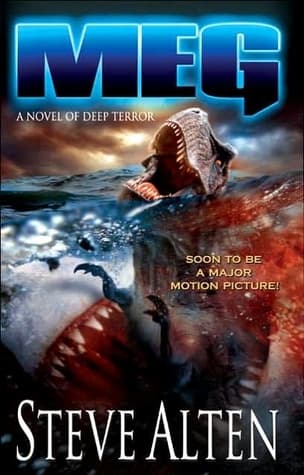
Steve Alten (1997)
Genre
Thriller / Science Fiction
Reading Time
400 min
Key Themes
See below
Sign in to track this book
Haunted by a monstrous prehistoric shark he barely escaped, a disgraced deep-sea diver must confront his ultimate terror when the colossal Megalodon resurfaces from the abyss to claim new victims.
Ten years prior to the main events, deep-sea submersible pilot Jonas Taylor is on a top-secret mission in the Mariana Trench to study the ocean floor's geothermal vents. During the dive, his sub is attacked by an unknown, colossal creature. Two fellow submersibles are destroyed, and their occupants are killed. Taylor, the sole survivor, reports seeing a massive shark, which he identifies as a Carcharodon megalodon, a prehistoric predator thought long extinct. His claims are dismissed by the scientific community, led by Dr. Heller, who attributes the damage to a pressure-induced psychosis. Taylor's career is ruined, and he becomes a disgraced paleontologist, haunted by the incident.
Years later, Jonas Taylor is a paleontologist and author, still ostracized by mainstream science but respected by a niche community. He receives an urgent call from his former colleague, Dr. Masao Tanaka, who now heads the Tanaka Oceanographic Institute. Tanaka's state-of-the-art submersible, the 'DeepSea Challenger,' has been disabled in the Mariana Trench during a research dive, with a crew trapped inside. The circumstances mirror Taylor's past trauma, and Tanaka, despite his previous skepticism, believes Taylor's expertise is needed. Taylor is reluctant to return to the depths but is convinced by Tanaka and the desperate situation of the trapped crew.
Jonas arrives at the Tanaka Institute and is introduced to Masao's daughter, Terry Tanaka, a skilled submersible pilot. Despite his fears, Jonas agrees to pilot a rescue sub. He descends into the Trench, where he encounters the 'DeepSea Challenger' and its trapped crew. While attempting the rescue, Jonas comes face-to-face with the gargantuan creature he encountered years ago – a Carcharodon megalodon. He manages to free the 'DeepSea Challenger' and its crew, including Masao's son, Hiro, but not before the Megalodon damages his own sub. The incident provides undeniable proof of the Megalodon's existence, stunning the scientific community.
During the rescue, the Megalodon follows the rising submersibles through a thermocline, a layer of cold water that had previously trapped it within the warmer depths of the Trench. The creature, now in the upper ocean, is disoriented but free. It quickly asserts itself as the apex predator, attacking a large whaling vessel and causing immense destruction and loss of life. The world learns about the prehistoric shark, causing widespread panic. Jonas, Tanaka, and the scientific team realize the immense danger posed by the Megalodon in the open ocean and begin to make a plan to stop it.
The Tanaka Institute, now with the support of the US Navy, mobilizes to hunt the Megalodon. Jonas, Terry, and other skilled pilots and scientists join the effort. They track the Megalodon's movements, which are increasingly bold and destructive, preying on whales, ships, and eventually, even a crowded beach. The team uses advanced sonar and tracking devices, but the Meg's size and intelligence make it an elusive and formidable opponent. Jonas, driven by a desire for redemption and to protect humanity, takes charge of the operation, devising strategies to lure and trap the creature.
Jonas devises a plan to lure the Megalodon with a dead whale carcass, hoping to tranquilize it or capture it. However, the Meg is more cunning than anticipated. During the attempt, the Meg attacks their vessel, causing significant damage and putting the crew in peril. Jonas, piloting a specialized sub, engages the Megalodon directly. He manages to wound the creature, but the encounter is brutal and nearly fatal. The Megalodon shows incredible power and resilience, making it clear that capturing or killing it will be an unprecedented challenge. The team realizes they are dealing with a truly ancient and intelligent predator.
As the hunt for the initial Megalodon (later identified as a female) continues, the team discovers the presence of a second, larger Megalodon – a male. This male Megalodon is even more aggressive and territorial, further escalating the danger. It becomes apparent that the female, though massive, was merely a scout, and the male is the dominant force. The team's strategies must now account for two colossal predators, whose combined power could devastate marine ecosystems and coastal populations. The stakes are raised, and the race to neutralize the threats intensifies.
The hunt for the two Megalodons takes a heavy toll. Several crew members are killed or injured in their encounters with the prehistoric sharks. Operations are hampered by the creatures' cunning, strength, and the vastness of the ocean. Dr. Heller, initially a skeptic, witnesses the devastation firsthand and finally accepts the reality, offering his full support. The team faces moral dilemmas about how to stop the creatures without causing further ecological damage or endangering more lives. Jonas, haunted by his past, feels the weight of every casualty, pushing him to increasingly desperate measures.
Realizing conventional methods are insufficient, Jonas devises a daring and dangerous plan to lure both Megalodons to a specific location and eliminate them. He uses a combination of advanced submersible technology, acoustic lures, and explosives. The climax involves a desperate struggle between Jonas in his sub and the two massive sharks. The male Megalodon is particularly formidable, nearly destroying Jonas's vessel. Terry Tanaka helps Jonas, showing her piloting skills and bravery under extreme pressure.
In a climactic battle, Jonas manages to kill both Megalodons, though not without significant personal risk and damage to his sub. The female is dispatched first, followed by a brutal confrontation with the larger male. The world breathes a collective sigh of relief, but the events forever change humanity's perception of the deep ocean. Jonas Taylor is a hero, his reputation restored, but the trauma of his encounters with the Megalodons leaves an indelible mark. The Tanaka Institute celebrates its victory, acknowledging the immense power of nature and the bravery required to face its most ancient terrors. The possibility of other Megalodons still lurking in the depths remains a chilling thought.
The Protagonist
From a disgraced, haunted individual, Jonas transforms into a validated hero who confronts and defeats his greatest fear, finding redemption in the process.
The Supporting
Masao evolves from a skeptic to a believer, fully supporting Jonas and acknowledging the existence of the Megalodon.
The Supporting
Terry develops from a professional colleague to a trusted partner and love interest for Jonas, demonstrating her own courage and capability.
The Supporting
Heller undergoes a significant transformation from a rigid skeptic to a pragmatic believer, acknowledging his past error and contributing to the solution.
The Antagonist
The female Megalodon transitions from an unseen threat to a tangible, destructive force before being ultimately defeated by Jonas.
The Antagonist
The male Megalodon emerges as an even greater threat, escalating the conflict before being defeated in the final confrontation.
The Supporting
Hiro is rescued from a life-threatening situation, serving as a catalyst for the main plot and a witness to the Megalodon's existence.
The Supporting
Mac remains a steadfast supporter of Jonas, providing unwavering friendship and practical assistance throughout the ordeal.
The central theme of 'Meg' is humanity's fragile place in the face of nature's ancient and overwhelming power. The Megalodon is a primal force that challenges human technological advancements and perceived dominance over the planet. Jonas Taylor, despite his scientific knowledge and advanced submersibles, is repeatedly shown to be vulnerable against the Meg's raw power and predatory instincts. The book shows how even our most sophisticated tools can be useless when confronted by a creature perfectly adapted over millions of years, forcing humanity to confront its limitations.
“You don't hunt a Megalodon. You survive it.”
Jonas Taylor's journey is about redemption. Disgraced and haunted by his past, he is given a second chance to prove his claims and confront his deepest fears. The opportunity to rescue the trapped crew and later to hunt the Megalodon allows him to reclaim his professional reputation and find personal closure. His arc shows that even after profound failure and public ridicule, one can find a path to heroism and self-acceptance by facing one's past and showing courage when it matters most, restoring his honor in the eyes of the world and himself.
“This wasn't just about saving people; it was about proving he wasn't crazy, wasn't a liar.”
The narrative shows the conflict between established scientific dogma and the emergence of an unforeseen reality. Dr. Heller and the scientific community initially dismiss Jonas's claims of a living Megalodon, adhering to conventional understanding. The book critiques the rigidity of scientific thought that can blind experts to new, uncomfortable truths. Only when undeniable proof surfaces, with devastating consequences, do the skeptics relent. This theme shows the importance of open-mindedness in scientific inquiry and the dangers of dismissing phenomena that challenge existing paradigms.
“They called him a liar, a madman. But the ocean always kept its secrets, until it decided not to.”
Fear is a pervasive element in 'Meg,' particularly for Jonas Taylor, who suffers from PTSD after his first encounter. The book explores how fear can paralyze but also how courage, despite fear, can drive individuals to extraordinary acts. Jonas constantly battles his own terror to return to the depths and face the creature that nearly destroyed him. The other characters also grapple with immense fear when confronted by the Megalodon's power. The theme shows that courage is not the absence of fear, but the ability to act in spite of it, especially when protecting others.
“The fear was a cold knot in his stomach, but the thought of those trapped down there was colder.”
A deep-sea, isolated ecosystem acting as a natural prison and incubator.
The Mariana Trench serves as a crucial plot device by acting as a 'lost world' where the Megalodons have survived, protected by a thermocline layer. This deep-sea environment provides a plausible explanation for the creatures' continued existence, hidden from human detection for millions of years. It also functions as a crucible for Jonas Taylor's initial trauma and later, his return and redemption. The Trench's extreme pressures and unique ecosystem create a sense of isolation and mystery, emphasizing the vast unknowns of our own planet and providing a believable setting for the prehistoric predator's survival.
A layer of cold water that traps the Megalodons in the Trench.
The thermocline is a critical plot device that explains both the Megalodons' isolation and their eventual escape. This layer of extremely cold water acts as a natural barrier, preventing the warm-blooded Megalodons from ascending to the warmer surface waters. Its disruption during the rescue mission allows the female Megalodon to pass through, unleashing her upon the world. The thermocline provides a scientific rationale for the creature's prolonged hidden existence and serves as the catalyst for the main conflict, transforming a localized threat into a global one.
A psychological barrier and driving force for the protagonist.
Jonas Taylor's Post-Traumatic Stress Disorder (PTSD) from his first encounter with the Megalodon is a significant plot device. It creates internal conflict for the protagonist, making his return to the deep ocean a profound personal struggle. His flashbacks and anxiety heighten the tension and emphasize the overwhelming terror of the Megalodon. Paradoxically, his trauma also makes him uniquely qualified to understand and predict the creature's behavior, transforming his weakness into a strength that ultimately enables him to defeat the monster. It grounds the fantastical elements in a relatable human struggle.
The primary tool for deep-sea exploration, rescue, and combat.
State-of-the-art submersible technology, such as the 'DeepSea Challenger' and Jonas's specialized combat subs, acts as a key plot device. These vehicles enable human characters to navigate the extreme depths of the Mariana Trench and engage directly with the Megalodons. They represent humanity's scientific ingenuity and ambition but are constantly shown to be vulnerable against the Meg's raw power, highlighting the limitations of technology against a primal force. The submersibles facilitate the rescue missions, the tracking of the sharks, and the climactic battles, driving much of the action.
“The ocean is the last truly wild place on Earth. We think we've explored it, but we've only scratched the surface.”
— Jonas Taylor reflecting on the deep ocean and its mysteries.
“Fear is a powerful motivator. It can make you do things you never thought possible, or it can paralyze you.”
— A general observation on the human reaction to extreme danger.
“Some things are better left undisturbed, especially when they've been undisturbed for millions of years.”
— A warning about the potential consequences of disturbing ancient ecosystems.
“The only thing more terrifying than the unknown is realizing the unknown is real and it's coming for you.”
— A character's realization of the imminent threat posed by the Megalodon.
“You don't hunt a creature like that. You survive it.”
— Jonas Taylor explaining the futility of actively hunting a Megalodon.
“Nature has a way of reminding us who's really in charge.”
— A character observing the overwhelming power of the Megalodon and the ocean.
“There are monsters in the dark, and sometimes, we're the ones who wake them up.”
— A metaphorical statement about human intervention leading to dire consequences.
“The past isn't always dead. Sometimes it's just sleeping.”
— Referring to the ancient Megalodon being rediscovered and awakened.
“You can't reason with a force of nature. You can only try to outrun it or outsmart it.”
— A character discussing strategies against the unstoppable Megalodon.
“Every time we think we've reached the limit, the ocean shows us we haven't even started.”
— Another reflection on the vastness and unexplored nature of the deep sea.
“The line between courage and madness is often very thin, especially when facing something truly impossible.”
— Observing the extreme bravery or recklessness of those confronting the Megalodon.
“Sometimes, the only way to defeat a monster is to become a monster yourself, if only for a moment.”
— Jonas Taylor contemplating the extreme measures required to combat the Megalodon.
“Man's arrogance always comes at a price. The ocean just makes sure it's a very high one.”
— A commentary on humanity's hubris in disturbing natural order.
Ready to see how well you understood this book? Take our interactive quiz with 10 questions.







