“The Red Death had long devastated the country. No pestilence had ever been so fatal, or so hideous.”
— Opening lines describing the plague's impact.

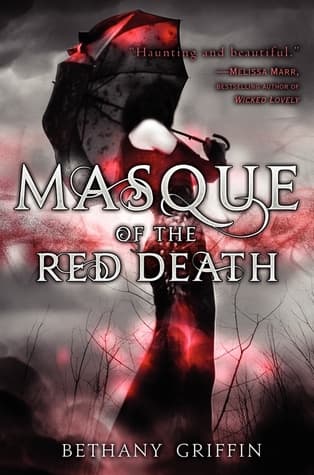
Bethany Griffin (2012)
Genre
Fantasy / Historical Fiction / Science Fiction / Young Adult / Romance
Reading Time
6-7 hours
Key Themes
See below
Sign in to track this book
In a plague-ridden city crumbling into ruin, a young woman seeking oblivion in a decadent club finds herself entangled with two mysterious men and a fight for survival far more exhilarating than any masked ball.
Araby Worth lives in a decaying, walled-off city, destroyed by the Red Death plague. Her family, once rich, struggles now, and her younger brother, April, has a mysterious illness. To deal with the harsh reality, Araby spends her nights at the Debauchery Club, run by Will. Here, she escapes by dancing, drinking, and the brief excitement of being anonymous behind a mask. Her best friend, Lisbeth, often goes with her, seeking the same escape. Araby's father, a scientist, tries to find a cure for the plague, often ignoring his family, while her mother has accepted their situation. Araby feels a strong responsibility for April, whose condition gets worse each day, making her desperate for any distraction.
At the Debauchery Club, Araby often meets Elliott, a charming and smart aristocrat who seems to know more than he says. Their talks always have hidden meanings and veiled comments about the city. Araby finds herself drawn to both Elliott's intelligence and Will's dark appeal, feeling a complicated pull between them. She notices strange things at the club: people disappearing, quiet conversations, and a general feeling of unease beneath the fun. Her suspicions grow because of Elliott's warnings about the city's rulers, the Prosperos, and the club's true purpose, suggesting it is more than just an escape. She starts to think the Red Death is not just a natural disaster.
April's health quickly worsens, showing symptoms like the Red Death, but with unsettling differences. Araby's father is consumed by his research, unable to find a solution. Desperate, Araby asks Will, the owner of the Debauchery Club, for help. She senses that Will has knowledge or resources beyond what he shows. Will, surprisingly, agrees to help April, but his help comes with a cost, suggesting a deeper involvement in the city's hidden workings. This interaction confirms Araby's belief that powerful forces are at play, controlling the city and its people, and that Will is important in this game. She will do anything to save her brother.
Elliott trusts Araby with the truth about the Prosperos, the city's ruling elite. He explains that the entire city is an experiment, a 'masque' designed to study human behavior under extreme conditions of plague and despair. The Red Death itself is not a natural disease but a manufactured virus, carefully managed and released by the Prosperos to keep their power and do their research. The Debauchery Club, Elliott explains, is a controlled place for observing and even 'removing' people. Araby is shocked by this, realizing her whole life has been a lie, and that her family, including April, are just pieces in a bigger, cruel game by the Prosperos.
Will admits who he really is and his deep involvement with the Prosperos. He reveals that he is one of them, though he has become unhappy with their methods, and that he helped create the Debauchery Club as part of their experiment. However, he has come to hate their ways and wants to secretly work against them. He offers Araby a dangerous proposal: join him in his efforts to expose and overthrow the Prosperos. He needs her perspective and her father's scientific knowledge to succeed. Araby is torn, struggling with the betrayal and the huge risk, but her love for April and her growing sense of justice make her consider Will's offer, despite her deep mistrust.
Araby decides to join Will and Elliott in their dangerous mission. Their plan is to gather strong evidence of the Prosperos' manipulation, focusing on how the Red Death was engineered and the city's role as a human laboratory. Araby's father, though he didn't know at first, has important research notes and samples that could reveal the truth. Elliott, with his connections, can help navigate the Prosperos' inner circles, while Will, using his position at the Debauchery Club, can help with communication and movement. The risks are very high, as failure means not only their deaths but the continued suffering of the entire city and no chance for April's survival.
As Araby gets more involved in the resistance, she discovers that Lisbeth, her best friend, has been secretly working for the Prosperos as an informant. Lisbeth, driven by fear and wanting to be safe in the collapsing city, betrays Araby and their plans to the rulers. This betrayal leads to a tense fight, forcing Araby, Will, and Elliott to run from Prospero agents. The escape is dangerous, showing the constant threat and the enemies' efficiency. Araby is heartbroken by Lisbeth's actions, but the urgency of their mission makes her personal pain less important, strengthening her resolve to fight for the truth.
Using their combined skills and knowledge, Araby, Will, and Elliott manage to get into the heavily guarded central compound of the Prosperos. They want to access the main laboratory and communication systems to broadcast their findings to the outside world, if one still exists. Getting in is full of danger, requiring them to get past complex security and confront Prospero guards. Araby's father, now fully aware of the deception, helps by understanding scientific data and bypassing security related to the plague's origins. The tension is high as they get closer to the center of the Prosperos' operation, knowing that one mistake could end everything.
In a big confrontation, Araby and her allies succeed in broadcasting the truth about the Red Death and the Prosperos' experiments to the outside world. The broadcast reveals their cruelty, showing the city as a large, dark stage. However, this win comes at a great cost. Elliott makes a sacrifice, drawing attention away from Araby and Will, making sure they escape. The city falls into chaos as the people learn of the deception, leading to a widespread rebellion against the Prosperos. Araby is left with the consequences of their choices and the uncertain future without the Prosperos' control, but also a small hope for a real cure for April and a new beginning.
With the Prosperos' power broken, the city begins a slow, hard process of healing and rebuilding. Araby, Will, and her father work to develop a real cure for the Red Death and April's specific illness, using the Prosperos' stolen research. April slowly starts to get better, a sign of hope for Araby. The outside world, having received the broadcast, starts to send aid and support. Araby and Will, having formed a strong, complex bond through their shared experience, look towards an uncertain future. While the past's scars remain, there is a feeling of freedom and the promise of a world where truth and kindness can finally grow, free from the manipulative 'masque' of the Red Death.
The Protagonist
Araby transforms from a passive participant in a decadent society into an active agent of change, finding her voice and purpose in challenging systemic oppression.
The Supporting/Love Interest
Will moves from being a seemingly complicit figure in the Prosperos' system to an active rebel, finding redemption through his fight against injustice alongside Araby.
The Supporting/Love Interest
Elliott sacrifices his personal safety and position to expose the truth, solidifying his role as a selfless hero.
The Supporting
April's arc is primarily one of suffering and eventual recovery, symbolizing the city's fate and the possibility of overcoming the plague.
The Supporting
Lisbeth's arc demonstrates the corrupting influence of fear, leading her to betray her friendship for perceived safety.
The Supporting
Mr. Worth shifts from scientific naivety to a crucial ally, using his knowledge to dismantle the system he unknowingly supported.
The Mentioned
Her arc is static, representing the passive victims of the Prosperos' rule.
The Antagonist
The Prosperos' arc is one of sustained control leading to their eventual exposure and downfall, highlighting the fragility of even the most absolute power.
Araby's journey is about finding out who she is amid chaos and lies. At first, she tries to lose herself in the Debauchery Club, but through her relationships with Will and Elliott, and what she learns about her city, she finds a deeper purpose. She changes from just watching to actively participating, finding her strength and voice in the fight for truth. The masks at the club represent hidden selves and the appearances people put on, which Araby eventually removes to show her true, brave self.
“Perhaps that was what the masks did. They allowed you to be yourself. Or they allowed you to be what you thought you should be.”
A main theme is the sharp difference between the reality the Prosperos created and the terrible truth. The whole city is a 'masque' – a big lie meant to control its people. Araby's goal is to uncover this truth, challenging the lies that have guided her life. The discoveries about the engineered plague and the city's purpose make characters face uncomfortable realities, showing the dangers of not knowing and the power of knowledge. The 'masque' itself emphasizes this theme.
“Everything was a lie. The sickness, the deaths, the fear. It was all a carefully orchestrated performance.”
The book looks at the conflict between individual freedom and systemic control. The Prosperos have complete control over the city, deciding life, death, and even information. The Debauchery Club, ironically, offers a false sense of freedom through pleasure, which is itself controlled by Will and, through him, the Prosperos. Araby's rebellion represents the fight for true freedom – intellectual, physical, and emotional – from the oppressive forces that try to control every part of human life. The walled city clearly shows this controlled environment.
“We are all just puppets, Araby. Dancing to their tune, thinking we're free.”
Love, in its different forms, drives many of the characters' actions and often requires sacrifice. Araby's strong love for her brother April is her main reason for seeking a cure and later for joining the rebellion. The growing romantic relationships between Araby, Will, and Elliott also involve sacrifice, as characters risk their lives for each other and for the common good. Elliott's final act of self-sacrifice is an example of this theme, showing that true love can be deep selflessness when facing overwhelming odds.
“Some things are worth dying for, Araby. And some things are worth living for, even when the world tells you there's no hope.”
The city itself shows decay and the possibility for new beginnings. Physically falling apart because of the plague, it reflects the moral decay of its rulers and the despair of its people. The Debauchery Club, with its shiny exterior over rot, is a small example of this. However, Araby's fight and the eventual exposure of the Prosperos offer a promise of renewal. The city, and its people, must first break down the old, corrupt structures to build something new and healthier, symbolizing hope for a rebirth after the apocalypse.
“The city was dying, but even in death, there was a terrible, beautiful dance.”
The literal and metaphorical mask of the city's deception.
The 'masque' functions on multiple levels. Literally, it refers to the masked balls at the Debauchery Club, allowing characters to hide their identities and indulge in escapism. Metaphorically, it represents the entire city's existence – a grand, orchestrated deception by the Prosperos, who have masked the true nature of the plague and their experimental control. The title itself points to this central device, underscoring the theme of truth versus deception and the performative nature of their dystopian reality.
A weaponized plague used for social control and experimentation.
The Red Death is not merely a natural disaster but a plot device that serves as the primary catalyst for the story's conflict and atmosphere. It is revealed to be an engineered virus, deliberately controlled and released by the Prosperos to maintain power and conduct their social experiments. This revelation transforms the plague from a force of nature into a tool of oppression, deepening the antagonist's cruelty and raising the stakes for Araby's quest to find a genuine cure and expose the truth. April's specific variant of the disease is also crucial evidence.
A controlled environment for observation and escapism.
The Debauchery Club acts as a central setting and a key plot device. It is presented as a place of hedonistic escape from the grim reality of the plague, but it is actually a carefully monitored environment established by the Prosperos (through Will) to observe and control the population. It serves as a meeting point for key characters, a place for revelations, and a symbol of false freedom. The masks worn there embody the hidden truths and identities of its patrons, including Araby herself.
A physical manifestation of isolation and controlled experimentation.
The walled city serves as a powerful symbol and plot device, physically isolating the inhabitants and reinforcing the idea of a controlled experiment. The walls not only keep the plague 'contained' but also prevent outside interference and keep the truth from escaping. It creates a claustrophobic atmosphere, intensifying the sense of entrapment and desperation. Breaking through these walls, both literally and figuratively, becomes a goal for Araby and her allies, representing the desire for freedom and connection with a wider, unmanipulated world.
“The Red Death had long devastated the country. No pestilence had ever been so fatal, or so hideous.”
— Opening lines describing the plague's impact.
“But the Prince Prospero was happy and dauntless and sagacious.”
— Introducing the prince's character amidst the crisis.
“He summoned to his presence a thousand hale and light-hearted friends from among the knights and dames of his court.”
— The prince gathers nobles to isolate in his abbey.
“The external world could take care of itself.”
— The prince's dismissive attitude toward the suffering outside.
“There were buffoons, there were improvisatori, there were ballet-dancers, there were musicians, there was Beauty, there was wine.”
— Describing the lavish entertainment in the abbey.
“All these and security were within. Without was the 'Red Death.'”
— Contrasting the safety inside with the plague outside.
“The mask which concealed the visage was made so nearly to resemble the countenance of a stiffened corpse.”
— Describing the ominous appearance of the masked figure.
“And now was acknowledged the presence of the Red Death.”
— The moment the plague is recognized within the abbey.
“He had come like a thief in the night.”
— Describing the plague's stealthy intrusion.
“And one by one dropped the revellers in the blood-bedewed halls of their revel.”
— The nobles succumb to the plague during their party.
“And Darkness and Decay and the Red Death held illimitable dominion over all.”
— The story's conclusion, emphasizing death's ultimate power.
“The prince had provided all the appliances of pleasure.”
— Highlighting the extravagance of the abbey's amenities.
“There were seven—an imperial suite.”
— Describing the seven colored rooms in the abbey.
“And the life of the ebony clock went out with that of the last of the gay.”
— The clock stops as the last reveller dies.
Ready to see how well you understood this book? Take our interactive quiz with 10 questions.







