“In every job that must be done, there is an element of fun. You find the fun, and snap! The job's a game.”
— Mary Poppins teaches the children about chores.

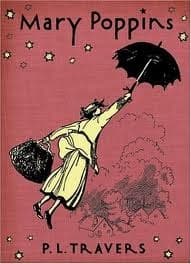
P.L. Travers (1934)
Genre
Fantasy / Children's / Young Adult
Reading Time
210 min
Key Themes
See below
Sign in to track this book
A mysterious nanny arrives on Cherry Tree Lane, making chores magical and showing the Banks children that wonder exists everywhere.
The Banks family, living at Number Seventeen Cherry-Tree Lane, needs a new nanny for their four children: Jane, Michael, and the young twins, John and Barbara. Their previous nanny, Katie Nanna, has just left. A strong East Wind brings a peculiar figure to their doorstep: Mary Poppins. She is stern, precise, and carries a carpetbag and an umbrella with a parrot's head handle. Despite her unusual arrival and interview, Mrs. Banks hires her. Mary Poppins immediately takes charge, telling the children to clean up and sliding up the banister, surprising Jane and Michael.
One day, Mary Poppins takes Jane and Michael for a walk. They meet Bert, a cheerful Match-Man and pavement artist, whom Mary Poppins seems to know. Bert draws pictures on the pavement, and Mary Poppins suggests they step into one of his chalk drawings. They find themselves in a park within the drawing, where they have tea, gingerbread, and ride a carousel. Mary Poppins and Bert dance while the children watch. As the drawing begins to fade, they step back onto the pavement, leaving the magical world behind, though Mary Poppins denies anything unusual happened.
Mary Poppins takes Jane and Michael to visit her Uncle Albert Wigg. Uncle Albert has a condition: on his birthday, if he laughs, he floats to the ceiling and cannot come down until he stops. When they arrive, Uncle Albert is stuck to the ceiling, laughing from a joke. Soon, Mary Poppins and the children laugh with him, and they also float to the ceiling. They share tea and cakes while suspended, enjoying the situation until Mary Poppins tells them to stop laughing, allowing them to descend back to the floor.
During another outing, Mary Poppins points out a cow in a field that, she says, once learned to dance and jumped over the moon. She tells the story of the cow's meeting with the Man in the Moon. Later, on a cold night, Mary Poppins takes the children to look at the stars. She points out a star and speaks to it. The star winks back and seems to talk to Mary Poppins, suggesting her connection to the celestial and natural world, a world beyond the children's ordinary understanding.
Mary Poppins leads Jane and Michael to an old gingerbread shop run by Mrs. Corry and her two large daughters, Fannie and Annie. Mrs. Corry is so old that her fingers are made of barley sugar, and she can peel off pieces of her own body and give them to children. The gingerbread sold here is special; it is made from golden stars. Mrs. Corry breaks off pieces of the gingerbread, and Mary Poppins and the children eat them. Mrs. Corry's daughters, Fannie and Annie, break off pieces of the gingerbread and stick them onto the sky, creating new stars, though Mary Poppins calls this 'nonsense' afterwards.
While walking in the park, Mary Poppins and the children meet a kind old Bird Woman who sits on the steps of St. Paul's Cathedral, selling bags of breadcrumbs for people to feed the pigeons. Mary Poppins gives the children money to buy crumbs. Later, they meet a talking dog named Andrew, who used to belong to a wealthy lady but ran away because he was tired of being pampered. Mary Poppins seems to understand Andrew and speaks to him in his own language. Andrew shares his thoughts on freedom and life, before returning to his independent life.
On Mary Poppins' birthday, a full moon shines. She takes Jane and Michael to the London Zoo, but this is not an ordinary visit. On this night, the animals are out of their cages and speaking in human voices. They gather to celebrate Mary Poppins' birthday, as all creatures understand and love her. A large python gives her a snakeskin as a present, and a bear recites a poem. Jane and Michael see Mary Poppins talking with all the animals, who treat her with respect and affection, showing her connection to the natural and wild world.
John and Barbara, the Banks twins, are babies and communicate in a language only they and animals understand. One day, a Starling lands on the window sill and talks with the twins in their language, showing their connection to nature and the universe. The Starling shares news from the animal kingdom, and the twins respond with babbling that Mary Poppins, Jane, and Michael do not understand. This episode shows the innocence and wisdom of young children, who are still connected to the magical world that adults, and even older children, have begun to forget.
As Christmas nears, Mary Poppins takes Jane and Michael shopping. The shops are busy, and the air is festive. During their outing, they meet what seem to be ordinary women shopping, but Mary Poppins reveals them to be the seven daughters of the Pleiades, a constellation of stars. The Pleiades are buying gifts for their celestial family members, and Mary Poppins talks with them as old friends. This meeting shows Mary Poppins's identity as someone who connects the ordinary and the cosmic, and her ability to see the extraordinary in daily life.
As suddenly as she arrived, Mary Poppins prepares to leave. The children notice a change in the wind; the West Wind begins to blow strongly. Mary Poppins, without much ceremony, says goodbye. She opens her umbrella, and the West Wind lifts her into the sky, carrying her away from Cherry-Tree Lane. Jane and Michael are sad but also understand that she belongs to a larger, more mysterious world. She leaves a note saying 'Au Revoir' (until we meet again), suggesting her return is possible, leaving the Banks children changed by her influence.
The Protagonist
Mary Poppins remains largely unchanged, serving as a catalyst for the children's growth and understanding of the world's magic before departing as mysteriously as she arrived.
The Supporting
Jane learns to embrace wonder and accept the inexplicable, expanding her imagination beyond conventional limits.
The Supporting
Michael's innate sense of wonder is nurtured and expanded, reinforcing his belief in the magical possibilities of life.
The Supporting
Mr. Banks remains largely unchanged in his conventional outlook, serving as a foil to the magical elements.
The Supporting
Mrs. Banks's life is made easier by Mary Poppins's presence, though she never fully grasps the magical reasons behind it.
The Supporting
Bert consistently offers a perspective of wonder and acceptance, serving as a stable, magical presence.
The Supporting
Uncle Albert's role is episodic, providing a specific magical encounter that highlights the whimsical nature of Mary Poppins's family.
The Supporting
The twins' magical understanding of animals is revealed, showcasing the innate wonder of infancy before it fades.
The Supporting
Mrs. Corry's role is episodic, providing a glimpse into a very old and powerful form of magic.
A main theme of 'Mary Poppins' is that magic is not separate from daily life, but hidden within it. Mary Poppins shows this, never admitting her powers, making the extraordinary seem ordinary. From stepping into pavement drawings with Bert to having tea on the ceiling with Uncle Albert, the book shows how common activities can become wondrous with a change in perspective. The children learn to see beyond the usual, realizing that a walk in the park or a visit to a shop can hold enchantment if one is open to it.
“'Anything can happen if you let it.'”
The book contrasts children's imagination with adults' rigid perspectives. Jane and Michael accept and join in the magical adventures, even if they question them, while Mr. and Mrs. Banks remain largely unaware, seeing strange events as coincidence or childish ideas. Mary Poppins, though an adult, helps the children keep their sense of wonder and subtly criticizes the adult world's loss of imagination. The twins, John and Barbara, represent the purest form of childhood perception, understanding animal languages before societal norms set in.
“''I've seen it, I've seen it!' cried Michael, 'We went right into the picture!' 'Nonsense,' said Mary Poppins, taking her arm out of the drawing and giving it a shake. 'How could you?'”
Mary Poppins brings a unique kind of order that often looks like disorder to others. She brings structure to the chaotic Banks household, yet her methods involve magical chaos, like tidying a nursery with a snap of her fingers or pulling furniture from a carpetbag. This theme explores the idea that true order is not always about strict rules and conventional neatness, but about a deeper, perhaps magical harmony. Her stern demeanor often hides her ability to restore balance and wonder, leaving the children more organized in their understanding of the world, even if their rooms were tidied by magic.
“'Spit-spot, into bed,' she said, and snapped her fingers. Immediately, a wave of unseen force seemed to sweep through the room, tidying everything into its proper place.”
'Mary Poppins' blurs the lines between reality and fantasy, making the reader (and the characters) question what is real. Mary Poppins never acknowledges the magic, making it seem like the children are just experiencing things differently. This raises questions about perception: is the magic real, or is it from a strong imagination? The book suggests that reality is subjective and that there are layers of existence beyond what is immediately apparent, especially for those open to seeing them. The magical events are presented as natural occurrences in Mary Poppins's world, making the 'real' world seem duller by comparison.
“'I don't believe you!' cried Jane. 'Very well, then, don't,' said Mary Poppins, and took a large piece of gingerbread.”
Mary Poppins has a connection to the natural world and the cosmos. She talks with animals, knows the secrets of the stars (like the Pleiades), and is carried by the wind. The zoo animals celebrate her birthday, and the infant twins understand birds. This theme shows an ancient understanding of the universe that modern society has lost. It suggests that humans are connected to the natural world and that there is a universal language and intelligence beyond human understanding, which Mary Poppins accesses.
“'For Mary Poppins, you must understand, had a way of knowing things that other people didn't, and of understanding things that other people couldn't.'”
Supernatural elements are presented as ordinary occurrences within a realistic setting.
The primary plot device in 'Mary Poppins' is magical realism. Extraordinary, fantastical events—such as sliding up banisters, stepping into chalk drawings, or having tea on the ceiling—are woven seamlessly into the mundane, everyday life of the Banks family in London. Crucially, Mary Poppins herself never acknowledges these magical feats, treating them as entirely normal, which further blurs the line between reality and fantasy for the children and the reader. This device encourages a suspension of disbelief and allows for profound themes to be explored through whimsical means, making the impossible seem simply a part of the world.
A seemingly ordinary object that defies the laws of physics, symbolizing hidden depths and infinite possibilities.
Mary Poppins's carpetbag is a recurring symbol and a key plot device. Initially appearing as a small, empty bag, it impossibly contains a multitude of large items, including a folding bed, a hat stand, and even an armchair. It functions as a visual representation of Mary Poppins's magic and the idea that things are not always what they seem. The carpetbag symbolizes the hidden depths and endless possibilities that lie beneath a seemingly ordinary exterior, reflecting Mary Poppins's own enigmatic character and her ability to bring unexpected wonder into the children's lives.
A supernatural force that dictates Mary Poppins's arrivals and departures, symbolizing change and the transient nature of magic.
The East Wind and the West Wind serve as significant plot devices, acting as supernatural catalysts for Mary Poppins's arrival and departure. The East Wind blows her to Cherry-Tree Lane, signifying the beginning of her magical influence, while the West Wind carries her away, marking the end of her stay. The wind symbolizes forces beyond human control and understanding, representing the transient nature of magic and change. It underscores that Mary Poppins is not bound by human conventions and arrives when needed and leaves when her work is done, emphasizing her mysterious and elemental connection to the world.
Giving human characteristics and speech to animals and inanimate objects.
Anthropomorphism is frequently used to deepen the magical world. Animals, such as the Starling, the zoo creatures, and the dog Andrew, speak and interact with Mary Poppins and the twins as equals, sharing their thoughts and perspectives. Even objects, like the carousel animals that come to life in the chalk drawing, exhibit human-like qualities. This device highlights Mary Poppins's unique connection to all living things and suggests a deeper, universal language and consciousness that exists beyond human perception, enriching the children's understanding of the world around them.
A series of distinct, self-contained adventures rather than a single overarching plot.
The book employs an episodic narrative structure, where each chapter presents a new, largely self-contained magical adventure. While there is a clear beginning (Mary Poppins's arrival) and end (her departure), the intervening chapters don't build a single continuous plot arc with rising action and climax in a traditional sense. Instead, each episode introduces a different facet of Mary Poppins's magic and its impact on the children. This structure allows for a wide variety of whimsical scenarios and reinforces the idea that magic can happen at any time, in any place, without needing a grand narrative justification.
“In every job that must be done, there is an element of fun. You find the fun, and snap! The job's a game.”
— Mary Poppins teaches the children about chores.
“A spoonful of sugar helps the medicine go down.”
— Mary Poppins sings to make chores enjoyable.
“I never explain anything.”
— Mary Poppins responds to questions about her magic.
“First of all, I would like to make one thing clear: I never give references.”
— Mary Poppins asserts her independence upon arrival.
“Don't you know that everybody's got a Fairyland of their own?”
— Mary Poppins explains imagination to the children.
“It is a curious thing, but when you are dreading something, and would give anything to slow down time, it has a disobliging habit of speeding up.”
— Reflecting on anxious moments before adventures.
“You think, you dream, you plan. But it's always the unexpected that happens.”
— Mary Poppins comments on life's surprises.
“A thing of beauty is a joy forever.”
— Quoted by Mary Poppins during a magical outing.
“The world is a wheel, and it will all come round right.”
— Mary Poppins reassures the children during uncertainty.
“I am practically perfect in every way.”
— Mary Poppins describes herself with confidence.
“The more you know, the more you see.”
— Mary Poppins teaches about observation and learning.
“Wind's in the east, there's a mist coming in. Like something is brewing, about to begin.”
— Mary Poppins senses change in the weather.
“Everything is possible, even the impossible.”
— Mary Poppins encourages belief in magic.
“Close your mouth, please, Michael. We are not a codfish.”
— Mary Poppins corrects Michael's manners humorously.
Ready to see how well you understood this book? Take our interactive quiz with 10 questions.

Biography coming soon.







