“Ah dinnae ken whit tae dae. Ah’m jist a wee boy, and ah’m trapped in here wi’ aw these monsters.”
— Roy Strachan's internal monologue while institutionalized, reflecting his fear and perceived helplessness.

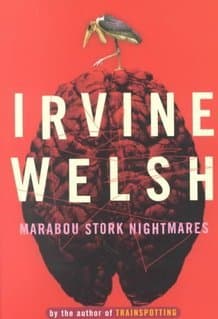
Irvine Welsh (1995)
Genre
Thriller
Reading Time
360 min
Key Themes
See below
Sign in to track this book
Trapped in a coma, Scottish hooligan Roy Strang goes on a hallucinatory quest to hunt a monstrous marabou stork. His psychedelic pursuit is constantly interrupted by lethal memories of the violence and dysfunction that landed him there.
Roy Strang is in a coma in a hospital bed, his mind fractured between vivid, animalistic dreams and fragmented memories of his past. He imagines himself as a great white hunter, leading an expedition into the African savanna to track down and kill the notorious Marabou Stork, a scavenger and predator that embodies pure evil in his subconscious. This quest is a desperate attempt by his mind to find purpose and escape the crushing weight of his real-world trauma. The African scenes are interspersed with brief, disorienting flashes of his childhood and adolescence, hinting at a troubled upbringing and the events that led to his current comatose state.
Roy's memories drift back to his childhood in Muirhouse, a deprived housing estate in Edinburgh. He recounts growing up in a dysfunctional family, with a domineering father and a seemingly passive mother. His early experiences are characterized by the harsh realities of working-class life, including poverty, boredom, and the allure of petty crime. He recalls forming a gang with other local boys, engaging in shoplifting, vandalism, and fighting, establishing a pattern of aggressive behavior and a sense of belonging through defiance. These early memories are often tinged with both nostalgia and underlying resentment.
As Roy enters adolescence, his life becomes consumed by football hooliganism. He becomes a devoted follower of Hibernian F.C., and his identity becomes intertwined with the casual violence and tribalism of football casual culture. His involvement in street brawls and organized fights with rival supporters becomes a primary outlet for his aggression and a source of status within his peer group. These memories are raw and brutal, showing a young man spiraling deeper into a cycle of violence, fueled by alcohol and a desperate need for acceptance and power.
Within his coma, Roy's African safari continues with increasing intensity. He encounters various animals, each imbued with symbolic meaning: the majestic lion representing strength, the cunning hyena, and the terrifying rhino. His quest for the Marabou Stork becomes more urgent, and he faces numerous physical and mental challenges within this dreamscape, battling both the harsh environment and his own internal demons. These fantastical sequences serve as a metaphor for his struggle to confront the deeply buried truths of his past.
A significant shift in Roy's life occurs when his family moves from Muirhouse to a more respectable area of Edinburgh, the New Town. This move is intended to provide a better life, but it only highlights the family's internal strife and Roy's inability to adapt to new social norms. He struggles to fit in with the middle-class kids, feeling like an outsider and often resorting to his ingrained aggressive behaviors. The change of scenery does little to address the fundamental issues within his family or his own violent tendencies, and he continues to gravitate towards trouble.
Seeking an escape and a sense of purpose, Roy enlists in the army. Initially, he thrives on the discipline and camaraderie, believing he has found his calling. However, his inherent aggression and inability to conform to strict rules eventually lead to his downfall. He gets into numerous fights and clashes with authority, culminating in a violent incident that results in his dishonorable discharge. This failure further reinforces his sense of alienation and his inability to escape his destructive patterns, pushing him deeper into despair and resentment.
After his discharge, Roy drifts into the burgeoning rave scene, finding temporary solace and oblivion in drugs, particularly ecstasy. He describes the hedonistic lifestyle, the communal feeling of the raves, and the temporary escape from his inner turmoil. However, this period is also marked by increased drug dependency, reckless behavior, and a further detachment from reality. The fleeting highs are always followed by crushing lows, and the drugs ultimately exacerbate his underlying psychological issues rather than solving them.
In his comatose state, Roy's African hunt reaches a fever pitch. He is convinced he is closing in on the Marabou Stork, the embodiment of evil that he believes he must destroy to find peace. The landscape becomes more treacherous, and the encounters with other animals more intense. The Marabou Stork itself is depicted as a grotesque, menacing figure, constantly just out of reach, taunting him. This intense pursuit mirrors his subconscious struggle to confront the ultimate source of his trauma.
As Roy's mind struggles between the safari and his past, fragmented and disturbing memories begin to surface with increasing clarity. These are not the memories of petty crime or football hooliganism, but much darker, more insidious events. He recalls incidents of sexual abuse by a family friend, a man named Jimmy, and the complicity or inaction of others. These memories are deeply repressed and agonizing, causing immense psychological pain and resistance within his comatose mind, explaining the intensity of his internal struggle.
The truth about Roy's coma is finally revealed. After years of suppressed trauma, Roy confronted his abuser, Jimmy. This confrontation escalated into a violent attack, during which Roy was severely beaten and left for dead, resulting in the brain injury that put him in a coma. This revelation connects all the disparate threads of his life: his aggression, his self-destructive behavior, his inability to form healthy relationships, to the foundational trauma of his childhood abuse and the subsequent violent act.
In a climactic moment within his coma, Roy's hunt for the Marabou Stork culminates in a terrifying realization. The grotesque, scavenging bird he has been pursuing is not just a symbol of evil, but a direct embodiment of Jimmy, his abuser. The physical characteristics and predatory nature of the stork merge with the image of his tormentor, revealing the deeply ingrained psychological connection. This epiphany is both horrifying and liberating, as it allows him to finally identify the true source of his his pain and rage.
With the Marabou Stork now explicitly identified as Jimmy, Roy faces his ultimate foe in the dreamscape. This confrontation is not just a physical battle but a psychological one, as he processes the trauma and betrayal. While the ending remains ambiguous regarding his physical recovery from the coma, the symbolic act of confronting and potentially 'killing' the Marabou Stork represents a crucial step towards psychological healing and reclaiming agency over his own life. The novel concludes with the possibility, however faint, of Roy beginning to process his past and escape the cycle of violence.
The Protagonist
From a violent, unself-aware individual trapped by his past, Roy gradually unearths the repressed trauma of his childhood abuse, leading to a potential path towards psychological healing and self-awareness.
The Antagonist
Jimmy's character doesn't have an arc; instead, his true nature and the extent of his villainy are gradually revealed, forming the central mystery and horror of Roy's past.
The Supporting
His character remains largely static, serving as a representation of a problematic parental figure who contributes to Roy's troubled development.
The Supporting
Like the father, her character remains largely static, serving to illustrate the family's dysfunction and the absence of a protective figure for Roy.
The Supporting
Spud's character is largely static, serving as a foil and companion to Roy during specific periods of his life.
The Symbolic Antagonist
The Marabou Stork's arc is symbolic, transforming from a general representation of evil to the specific embodiment of Roy's abuser, Jimmy.
The novel explores the devastating impact of childhood trauma, particularly sexual abuse, and the psychological mechanisms of repression. Roy's coma is a physical manifestation of his mind's attempt to compartmentalize the unbearable truth. His hallucinatory safari is a subconscious struggle to confront and process these repressed memories. The fragmented narrative structure itself mirrors the fractured nature of his memory, with glimpses of abuse slowly breaking through the more 'acceptable' memories of violence and hedonism. The revelation of Jimmy's actions and the subsequent assault that led to the coma shows how unresolved trauma can dictate an entire life, leading to self-destructive behaviors and an inability to form healthy connections.
“Ah ken deep doon that the stork is me... or part o' me anyway. The black part. The evil part. The part that wis done tae.”
Irvine Welsh dissects the pervasive nature of toxic masculinity and its role in perpetuating cycles of violence. Roy's upbringing in Muirhouse, his involvement in football hooliganism, and his stint in the army all show environments where aggression is valued, emotional expression is suppressed, and vulnerability is seen as weakness. Roy's father embodies this harsh, domineering masculinity, indirectly contributing to Roy's inability to process his trauma in a healthy way. The novel suggests that this societal emphasis on 'toughness' not only leads to physical violence but also prevents men from confronting their emotional wounds, trapping them in a destructive loop. His aggression is a coping mechanism for his unacknowledged pain.
“A man's gotta be a man, son. Nae greetin'. Nae weakness. Just pure strength.”
The novel paints a stark picture of social dysfunction, particularly within the working-class communities of Edinburgh. From the poverty and lack of opportunity in Muirhouse to the escapism of the rave scene, Welsh highlights how societal structures contribute to individual despair and violence. The move to the New Town, intended as an upward social mobility, only exacerbates Roy's sense of alienation, demonstrating that superficial changes cannot mend deep-seated issues. The prevalence of drug abuse, petty crime, and casual violence are depicted as symptoms of a broader societal malaise, where individuals like Roy are often left without adequate support or outlets for their pain, contributing to a cycle of marginalization and self-destruction.
“It's a fuckin' jungle oot there, son. Ye either eat or get eaten.”
Central to the narrative is the relationship between memory and the formation of identity. Roy's fractured memories, constantly shifting between his dream safari and his past, illustrate how selective and unreliable memory can be, especially when dealing with trauma. His identity is initially constructed around the 'acceptable' narratives of a tough, violent man, but as the repressed memories surface, his understanding of himself is fundamentally challenged. The process of recalling the abuse forces him to re-evaluate his entire life and the motivations behind his actions, demonstrating how confronting one's true past is essential, however painful, for authentic self-discovery and the potential for change.
“Sometimes ye huv tae go back tae go forwards. Sometimes ye huv tae dig deep tae find oot who ye really are.”
A physical state that allows for a psychological journey into the protagonist's subconscious.
Roy's coma is the primary plot device, serving as the literal and metaphorical setting for his internal struggle. It allows for the non-linear narrative, blending his fantastical African safari with fragmented memories of his past. The coma provides a safe space, detached from external reality, for Roy's mind to confront the deeply buried trauma that led to his current state. It represents a state of psychological purgatory, where he must battle his inner demons to potentially awaken and heal, making the 'hunt' for the Marabou Stork an entirely internal and symbolic quest for truth.
A symbolic animal representing pure evil, which evolves into the manifestation of Roy's abuser.
The Marabou Stork functions as a powerful, evolving symbol throughout the novel. Initially, it represents a generalized, primal evil that Roy, the 'great white hunter,' must conquer. Its grotesque appearance and scavenging nature make it an ideal metaphor for the insidious nature of trauma and the 'filth' of his past. As Roy's memories become clearer, the stork morphs into the direct embodiment of Jimmy, his abuser. This transformation is crucial, as it allows Roy to externalize and confront the source of his trauma within his dreamscape, making the 'hunt' a direct battle against his personal demons.
The story jumps between Roy's comatose safari and fragmented memories of his past.
The novel employs a non-linear narrative structure, constantly shifting between Roy's vivid, hallucinatory African safari and fragmented flashbacks to different periods of his life. This device effectively mirrors the chaotic and fractured state of Roy's mind as he struggles with repressed memories. The disorienting jumps in time and setting gradually piece together the puzzle of his past, building suspense and delaying the full revelation of his trauma. It forces the reader to actively engage in constructing Roy's story, reflecting his own arduous journey of self-discovery and remembrance.
The narrative reflects Roy's unfiltered thoughts and perceptions, often in Scottish dialect.
The novel extensively uses a stream-of-consciousness style, particularly within Roy's internal monologues and dream sequences. This allows readers direct access to his raw, unfiltered thoughts, fears, and desires. The use of dense Scottish dialect further immerses the reader in Roy's specific cultural and psychological world, emphasizing his working-class roots and his internal voice. This device blurs the lines between reality and hallucination, making the reader intimately experience Roy's fragmented mental state and the painful process of confronting his repressed memories.
“Ah dinnae ken whit tae dae. Ah’m jist a wee boy, and ah’m trapped in here wi’ aw these monsters.”
— Roy Strachan's internal monologue while institutionalized, reflecting his fear and perceived helplessness.
“He wisnae a cunt. He wis jist a boy that done bad things, and that wisnae the same thing at aw.”
— Roy grappling with his past actions and the nature of evil, trying to differentiate between being inherently bad and doing bad things.
“Every cunt’s got a story. Some are jist mair fucked up than others.”
— A general observation on the human condition and the diverse range of experiences, often dark and traumatic, that people carry.
“The past is a foreign country; they do things differently there.”
— A classic quote, likely referenced or echoed by Roy as he tries to make sense of his fragmented memories and the person he used to be.
“”
— Roy's struggle with his mental demons and the inescapable nature of his own thoughts and memories.
“Sometimes the only way tae get through a nightmare is tae pretend it’s a dream.”
— Roy's coping mechanism for dealing with his traumatic past and the horrors he has experienced.
“Ma life’s a jigsaw, and half the pieces are missing, and the other half dinnae fit.”
— Roy's profound sense of confusion and his struggle to reconstruct his fragmented memories and identity.
“He wisnae looking for forgiveness, jist understanding. Or maybe he wis looking for both.”
— Roy's internal conflict regarding his desire for absolution versus simply wanting to comprehend his own actions and motivations.
“The only thing worse than remembering is forgetting.”
— Roy's agonizing dilemma between confronting his painful past and the terrifying prospect of losing his memories entirely.
“”
— A philosophical reflection on the origins of fear and evil, suggesting that internal demons can manifest or be mirrored in external realities.
“Freedom’s a funny thing. Ye dinnae ken whit ye’ve got till it’s gone, and ye dinnae ken whit tae dae wi’ it when ye get it back.”
— Roy contemplating the nature of freedom, both literal and psychological, after being confined.
“”
— Roy's frustration with the elusive nature of truth and the difficulty in piecing together his fragmented past.
“He wis a broken man, but at least he wis trying tae fix himself.”
— A hopeful, albeit grim, assessment of Roy's ongoing struggle for recovery and self-reconstruction.
Ready to see how well you understood this book? Take our interactive quiz with 10 questions.

Irvine Welsh is a Scottish novelist, playwright and short story writer. His 1993 novel Trainspotting was made into a film of the same name. He has also written plays and screenplays, and directed several short films.







