“I am in my mother's room. It's I who live there now. I don't know how I got there.”
— Opening lines of the novel, establishing Malone's isolated state.


Samuel Beckett (2012)
Genre
Literary Fiction
Reading Time
90 min
Key Themes
See below
Sign in to track this book
On his deathbed, the octogenarian Malone rambles through contradictory, often enraged, and darkly witty tales of his decaying existence, finding fleeting solace in the distant, wild barks of dogs.
Malone, an old man confined to a bed in what might be a hospital or asylum, begins to narrate his condition. He is alone, stripped of most possessions, and unsure of his exact location or the people who occasionally attend to him. His primary companions are a pencil stub and an exercise book, which he uses to record his thoughts and stories to pass the time before his death. He describes his physical decay, his failing senses, and his mental state, which moves between lucidity and confusion. He needs to write, to fill the void with words, even as he doubts the meaning or purpose of his endeavor. He decides to tell stories about himself and others, believing it will help him 'die' more quickly or perhaps understand the process.
Malone begins his first story, introducing a character he initially calls Sapo (later Macmann). Sapo is a young boy living with his parents, Mr. and Mrs. Louis, in a rural setting. Malone describes Sapo's mundane life, his interactions with his family, his schooling, and his early experiences with nature. Sapo is a detached and isolated child, observing the world around him with quiet intensity. Malone intersperses Sapo's narrative with his own reflections on storytelling, his memory, and his physical discomfort. He struggles with the details of Sapo's life, often correcting himself or admitting his lack of knowledge, showing the arbitrary nature of his creation.
As Sapo ages, Malone renames him Macmann, signaling a shift in the character's life and perhaps a deeper connection to Malone himself. Macmann is a solitary adult, living in an institution or asylum, much like Malone's own suspected predicament. He is elderly, infirm, and largely passive. Malone introduces Moll, an equally old and infirm woman, who is assigned to care for Macmann. Their initial interactions have a strange mixture of hostility and dependence. Moll is described with grotesque detail, her physical ailments like Macmann's. Their relationship, though without conventional affection, becomes a central focus of Malone's narrative, exploring companionship in extreme old age and infirmity.
Malone describes the daily lives of Macmann and Moll. Moll, despite her own physical limitations, tends to Macmann's basic needs, feeding and cleaning him. Their communication is minimal, often consisting of grunts, sighs, and the occasional, almost ritualistic exchange of insults. Malone describes their shared room, the mundane objects within it, and the repetitive routines that govern their existence. He speculates on their inner lives, their pasts, and their desires, often projecting his own feelings of isolation and despair onto them. The relationship between Macmann and Moll, though bleak, is an exploration of human connection, however fractured, in the face of decay and death.
Malone broadens his focus to describe the institution where Macmann and Moll reside, and the other inhabitants. He mentions names like Lemuel, the sadistic attendant, and the various groups of inmates, often categorizing them by their perceived madness or infirmity. These descriptions are fragmented and often contradictory, reflecting Malone's own decaying memory and unreliable narration. The institution itself is a bleak, oppressive place, a waiting room for death. Malone's observations of the other inmates emphasize isolation, suffering, and the absurdity of human existence at its end. He notes the sounds and smells, creating a disturbing sensory experience.
Malone recounts an excursion organized by the institution, where Macmann, Moll, and other inmates are taken to an island. This outing is overseen by Lemuel, a cruel and indifferent attendant. Lemuel's interactions with the inmates are marked by casual brutality and a complete lack of empathy. During the excursion, the inmates endure various indignities and discomforts. Malone describes the island, its sparse vegetation, and the general atmosphere of despair that pervades the outing. The events on the island culminate in a violent act by Lemuel, further showing the dehumanizing conditions of the institution and the suffering of its inhabitants.
As Malone continues to write, his own physical and mental deterioration becomes evident in his narrative. His ability to maintain a coherent storyline falters. He frequently loses his train of thought, forgets details, and struggles to distinguish between his own reality and the stories he is inventing. The boundaries between Malone, Sapo/Macmann, and even Moll blur. He describes his failing eyesight, his inability to hold his pencil, and the encroaching darkness of his room and mind. The narrative becomes a stream of consciousness, filled with non-sequiturs, repetitions, and raw expressions of his suffering and impending demise. Writing becomes a struggle against the inevitable silence.
Malone's narrative returns to Macmann and Moll on the island, though his descriptions are now highly fragmented and unreliable. He describes their final moments, or what he imagines them to be, often with a sense of merging their fate with his own. The precise details become obscured by Malone's failing consciousness. There are hints of violence, of Lemuel's continued brutality, and of the inmates' eventual demise. The narrative does not offer a clear resolution for Macmann and Moll, but rather a fading into oblivion, mirroring Malone's own process. Their story, like Malone's life, dissolves into the general chaos of existence, ending not with a bang, but a whimper.
In the very final passages, Malone's narrative breaks down almost entirely. His sentences become shorter, syntax unravels, and words are repeated or left incomplete. He loses control of his pencil, and his descriptions of his surroundings and his characters become indistinguishable from his own failing perceptions. The last words are a series of fragmented phrases, hints of movement, and a final, halting attempt to articulate something, anything, before silence. The story of Malone, and his creations, ends not with a grand conclusion, but with the quiet, inevitable cessation of thought and language, leaving the reader with the raw, unvarnished depiction of a mind succumbing to death.
The Protagonist
Malone's arc is one of physical and mental decay, culminating in the complete dissolution of his consciousness and narrative ability.
The Malone's Fictional Creation
Macmann's arc mirrors Malone's, progressing from a quiet childhood to a passive, suffering old age, ultimately fading into an ambiguous end.
The Malone's Fictional Creation
Moll's arc is static, defined by her role as Macmann's caretaker and her own physical decay, ending ambiguously with Macmann on the island.
The Malone's Fictional Creation
Lemuel's arc is static, serving as an antagonistic force within Malone's fictional world.
The Malone's Fictional Creation (Supporting)
Their arc is limited to Sapo's childhood, fading out as Sapo transitions to Macmann.
The Supporting (Malone's Reality)
Her arc is static, serving as a recurring, fleeting presence in Malone's room.
The Mentioned (Malone's Fictional World)
Their arc is collective and static, serving as background to Macmann and Moll's story.
The book explores the meaninglessness of life and the human condition. Malone's storytelling is a futile attempt to impose order on chaos, a way to 'kill time' before death. His own narratives are fragmented, contradictory, and ultimately dissolve, like the perceived lack of inherent purpose in life. The suffering of Macmann, Moll, and the other inmates, their confined and decaying existence, emphasizes the bleak and absurd nature of human being, where actions and words ultimately lead nowhere.
“I shall be reduced to laying myself bare, which is an experience I have not yet had. For up to now I have merely suffered, for sport, not for truth. I have been a spectator, and I have not seen. I have been seen, and I have not been known.”
Malone struggles with his own identity, questioning who he is and whether his past selves truly belong to him. This theme is explored through the blurring of boundaries between Malone, Sapo, and Macmann. As Malone's mind deteriorates, his sense of self fragments, and his characters begin to merge with his own reality. The constant renaming of characters (Sapo to Macmann) and Malone's inability to maintain a consistent narrative reflect an instability of identity, suggesting that the self is an elusive, unknowable construct that disintegrates with the body and mind.
“I shall be called Malone, then I shall be no more.”
The novel is a metafictional exploration of narration. Malone's primary activity is writing, but he constantly doubts its purpose, validity, and his ability to control it. He struggles with memory, invents details, and frequently interrupts his stories with self-reflexive commentary on the difficulty of writing. The narrative ultimately breaks down, like Malone's own decay. This shows the limitations of language and narrative to capture or make sense of reality, especially in the face of death. Storytelling becomes a desperate, yet futile, gesture against silence.
“I shall be content to rot, like the others, and to know that I am rotting, and to say, for the sake of form, I am rotting, before I go. But I must say something.”
The main theme of the novel is physical and mental decay and the inevitability of death. Malone's own body is failing, his senses dimming, and his mind fragmenting. His characters, Macmann and Moll, are also in states of extreme infirmity and old age. The descriptions of their physical ailments, the squalor of the institution, and the general atmosphere of decline are unflinching. The entire narrative is framed by Malone's wait for death, transforming the book into an extended meditation on mortality and the final dissolution of the human being.
“I shall not go to the end, I shall not go to the end, I shall not go to the end.”
Malone's deteriorating mental state and self-contradictions make his account untrustworthy.
Malone is a profoundly unreliable narrator. His memory is failing, he frequently contradicts himself, admits to inventing details, and struggles to distinguish between his own reality and his fictional creations. This unreliability is not merely a stylistic choice but central to the novel's themes, highlighting the subjective nature of perception, the fragility of memory, and the difficulty of constructing a coherent narrative, especially for a mind in decay. The reader is constantly forced to question the truth of what Malone presents, mirroring the character's own uncertainty.
The narrative constantly draws attention to its own construction and the act of writing.
The novel is highly metafictional, with Malone frequently interrupting his stories to comment on the process of writing, his struggles with language, and the arbitrary nature of his creations. He discusses his choice of words, his inability to remember details, and his desire to finish his narrative before he dies. This self-reflexivity blurs the line between author and character, and between fiction and reality, making the act of storytelling itself a central subject of the novel rather than merely a vehicle for plot.
The narrative mimics the unfiltered flow of Malone's thoughts, often disjointed and associative.
The narrative employs a stream of consciousness technique, particularly as Malone's condition worsens. Thoughts, observations, memories, and fictional inventions flow together without strict logical or chronological order. Sentences become fragmented, syntax breaks down, and associations rather than linear progression dictate the narrative's movement. This style immerses the reader directly into Malone's deteriorating mind, conveying his confusion, despair, and the gradual dissolution of his cognitive faculties.
Malone creates characters (Sapo/Macmann) who mirror aspects of his own existence.
Malone's creation of Sapo, who later becomes Macmann, serves as a literary 'double' or alter ego. Macmann's confined, decaying existence in an institution closely parallels Malone's own suspected situation. Malone projects his own anxieties, physical ailments, and philosophical ponderings onto Macmann, creating a parallel narrative that allows him to explore his own condition from a slight remove, yet also blurs the boundaries between himself and his creation. This device emphasizes the theme of identity's dissolution and the self-referential nature of artistic creation.
“I am in my mother's room. It's I who live there now. I don't know how I got there.”
— Opening lines of the novel, establishing Malone's isolated state.
“I shall soon be quite dead at last in spite of all.”
— Malone's recurring reflection on his impending death.
“Nothing is more real than nothing.”
— Malone's philosophical musing on existence and absence.
“I am calm. I am calm, I am calm, I am calm.”
— Malone's repeated self-assurance, hinting at inner turmoil.
“The sun shone, having no alternative, on the nothing new.”
— Description of the mundane, cyclical nature of existence.
“I am not dead, but I am not alive either.”
— Malone's liminal state between life and death.
“I have nothing to say and I am saying it.”
— Reflection on the paradox of expression in meaninglessness.
“The silence is not so bad once you have succumbed.”
— Malone's acceptance of isolation and lack of communication.
“I am alone, I am always alone, I have always been alone.”
— Malone's stark realization of his perpetual solitude.
“To be is to be perceived, but I perceive nothing.”
— Twist on philosophical idealism, highlighting Malone's detachment.
“I tell myself stories to pass the time, but the time passes anyway.”
— Malone's attempt at narrative creation amidst inevitable decay.
“The end is in the beginning and yet you go on.”
— Comment on the cyclical and futile nature of existence.
“I am not unhappy, I am merely not anything.”
— Malone's expression of a neutral, void-like state of being.
“Words are all I have, and they are not enough.”
— Reflection on the inadequacy of language to convey experience.
Ready to see how well you understood this book? Take our interactive quiz with 10 questions.
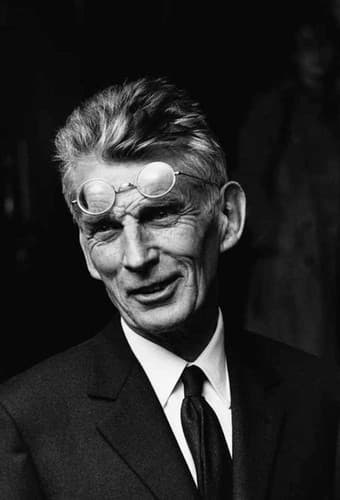
Samuel Barclay Beckett was an Irish novelist, dramatist, short story writer, theatre director, poet, and literary translator. His literary and theatrical work features bleak, impersonal and tragicomic experiences of life, often coupled with black comedy and nonsense. His work became increasingly minimalist as his career progressed, involving more aesthetic and linguistic experimentation, with techniques of repetition and self-reference. He is considered one of the last modernist writers, and one of the key figures in what Martin Esslin called the Theatre of the Absurd.







