“The purpose of life is to live it, to taste experience to the utmost, to reach out eagerly and without fear for newer and richer experience.”
— A philosophical reflection on life's meaning.

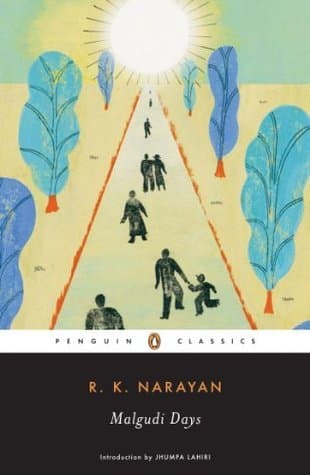
R.K. Narayan (1982)
Genre
Literary Fiction
Reading Time
264 min
Key Themes
See below
Sign in to track this book
Enter the streets of Malgudi, where R.K. Narayan shows universal human comedy and drama through the lives of its inhabitants.
The story begins with an astrologer, who uses his quick mind and knowledge of people to give convincing readings, even though he has no real astrological skills. He sits daily under a tamarind tree in Malgudi, attracting customers with his look and vague statements. One evening, as he is about to pack up, a stranger named Guru Nayak approaches him. The astrologer feels an odd discomfort and tries to send him away, but Nayak insists on a reading. During their talk, the astrologer recognizes Nayak as a man he once tried to murder in his youth, having run from his village believing him dead. He carefully reveals details about Nayak's past, including the attack, advising him never to travel south again to avoid danger, and promising a long life if he stays put. Nayak, convinced by the astrologer's accuracy, pays him well.
Jagan, a strict sweet vendor in Malgudi, lives a life of plainness, carefully counting his income and following traditional values. His son, Mali, returns from America with a Korean-American woman, Grace, whom he introduces as his wife, and suggests a modern business idea: a novel-writing machine. Jagan is at first happy about Mali's return but becomes increasingly confused and upset by his son's Western ways, his casual view of marriage, and his dislike for Jagan's traditional life. Mali and Grace live lavishly, eating meat and drinking alcohol, which Jagan finds wrong. Jagan's attempts to guide Mali are met with indifference or clear rebellion, leading to a growing distance between father and son.
Muni, an old, poor man living in the small village of Kritam, spends his days looking after his two thin goats and remembering his past. His wife often scolds him for being lazy and not providing. One day, while Muni is resting beside a clay statue of a horse and a warrior, a rich American tourist stops his car, having run out of gas. The American, unable to speak Tamil, tries to buy the statue from Muni, thinking it is a valuable antique. Muni, unable to understand English, thinks the American wants to buy his goats. They have a funny, confusing conversation, each understanding the other's actions and words through their own culture. The American eventually pays Muni for the 'horse,' and Muni, confused but happy, returns home with the money, surprising his wife.
Thanappa, a careful and kind postman, is involved in the lives of the people on his route. He is proud to deliver important news, especially marriage proposals. He becomes particularly interested in the coming marriage of Ramanujam's daughter, Kamakshi, to a suitable young man. When a key letter confirming the groom's acceptance goes missing, Thanappa, fearing the marriage will be called off and knowing Ramanujam's sadness, decides to hide the news of the groom's death, which he learns from a later letter. He believes he is protecting Kamakshi's future and Ramanujam's reputation. The marriage happens, and Thanappa carries the secret burden of his lie, showing his complex role as a bringer of both joy and sorrow.
Dr. Raman, a well-known and ethical doctor, prides himself on his honesty and refusal to give false hope to his patients. He believes in telling the truth, no matter how hard. His closest friend, Gopal, becomes very ill. Despite Dr. Raman's efforts, Gopal's condition worsens, and Dr. Raman believes there is no hope. However, Gopal, afraid of death, begs Dr. Raman for comfort. In a moment of deep care, Dr. Raman, against his professional rules, tells Gopal that he will get better. This single lie, spoken out of friendship, has a powerful effect: Gopal's desire to live is renewed, and he makes a surprising recovery, challenging Dr. Raman's strict belief in truth and showing the power of hope and human connection in healing.
The narrator, a new chairman of the Malgudi municipal council, inherits the job of renaming streets to reflect post-independence India. He finds it hard with 'Lawley Road,' named after a British official. The council decides to remove the statue of Sir Frederick Lawley that stands on the road. The narrator struggles to find someone willing to buy or remove the statue because of its size and weight. After many failed attempts and funny talks, he finally sells the statue to an antique dealer for a very small amount. The dealer, however, secretly plans to put it back in a prominent place, leading to a humorous cycle of colonial symbols staying despite official attempts to remove them, showing the lasting presence of the past.
Krishnan is a devoted husband whose wife, sick for a year, is given a bad prognosis by doctors. Desperate, he goes to an astrologer, hoping for a different outcome. The astrologer checks various texts and makes calculations, eventually saying that Krishnan's wife is under a bad planetary influence and needs an expensive ritual to calm it. Krishnan, a man with little money, is torn between his doubts and his love for his wife. He struggles to get the money and perform the rituals, facing many difficulties. The story explores the conflict between modern medicine and old beliefs, and how far love and desperation can push someone, even when facing very hard problems and doubtful solutions.
A young boy, interested in a snake charmer who visits Malgudi, becomes obsessed with the man's cobra. He secretly follows the snake charmer, watching his shows and learning about snakes. One day, the snake charmer gets sick, and the boy, driven by his interest, takes on the job of caring for the cobra. He tries to charm the snake himself, believing he has a special bond with it. However, his lack of experience leads to a dangerous moment where the cobra bites him. The story explores themes of childhood curiosity, the appeal of the exotic, and the fine line between interest and danger, showing the unpredictable nature of both animals and human ambition. The incident teaches the boy a hard lesson, calming his naive excitement.
Ramu, a young schoolboy, is a typical mischievous child, often not studying. One day, he meets Iswaran, a wandering holy man, who captures his attention with his stories, wisdom, and calm manner. Iswaran teaches Ramu about the importance of discipline, self-control, and learning, but in a way that connects with the boy, unlike his strict teachers. Ramu becomes very dedicated to Iswaran, following his teachings and trying to copy his spiritual practices. His grades get better, and his behavior changes, surprising and pleasing his parents and teachers. The story shows how much a mentor can affect a young mind and how unusual education can inspire real change and growth.
A retired Sanskrit scholar, an odd and dedicated academic, becomes obsessed with a small, mysterious clay head he believes is a rare Roman artifact, possibly connecting ancient Rome and India. He spends years of his life studying, researching, and trying to prove this one object, ignoring his personal life and money. He talks with scholars worldwide, writes many papers, and even travels to distant libraries in his search for proof. The story explores the single passion of an academic, the pursuit of knowledge for its own sake, and the thin line between scholarly dedication and obsessive belief. In the end, the true origin of the artifact remains unclear, leaving the scholar's life's work open to different understandings.
The story focuses on a widow and her adult son, who has recently started a promising career. The mother, very protective and attached, continues to treat her son as a child, worrying about his food, clothes, and daily routine. The son, while loving his mother, feels increasingly smothered by her constant attention and wants independence and privacy. He tries subtly to show his autonomy, but his mother sees his attempts as neglect or being ungrateful. The story explores the common tension between parental love and a child's need for personal space and freedom, showing the challenges of letting go and adapting to changing family dynamics, especially in a traditional Indian setting where respect for parents is very important. Their relationship is a delicate balance of affection and unspoken conflict.
Ranga, a man who values his respectable appearance and social standing, faces financial ruin. He desperately needs money to keep his family's honor and avoid public shame. He decides to pawn his wife's valuable gold belt, a treasured family item. He tries to do this quietly, ashamed of his situation. However, the pawnbroker, a smart and cynical man, sees Ranga's desperation and offers him a small amount, taking advantage of his weakness. Ranga, torn between his pride and his urgent need, reluctantly accepts. The story explores themes of dignity, poverty, and the compromises people make to keep their social image, showing the harsh realities of economic struggle and the loss of self-respect that can come with it.
The Protagonist
He confronts his past in the form of Guru Nayak, leading to a moment of reckoning and a resolution to live a more peaceful life.
The Protagonist
He begins the story trying to control Mali's life but ultimately accepts his inability to change his son, finding a new path of detachment.
The Antagonist/Supporting
He challenges his father's way of life but ultimately fails to integrate his modern ideas into the traditional Malgudi society.
The Protagonist
He experiences a brief, bewildering encounter that unexpectedly improves his financial situation, allowing him to momentarily escape his poverty.
The Protagonist
He makes a morally ambiguous decision to protect a family's happiness, leading him to carry the burden of his secret.
The Protagonist
He breaks his lifelong principle of honesty out of compassion for his friend, witnessing the unexpected positive outcome of a lie.
The Protagonist
He sacrifices his skepticism and resources for his wife's well-being, demonstrating the depths of his devotion.
The Protagonist
He is forced to confront his pride and pawn a cherished family heirloom, experiencing the painful reality of financial desperation.
This theme is key to many stories, exploring the conflict between old customs and new ideas, especially from the West. Characters like Jagan in 'The Vendor of Sweets' represent traditional values, struggling to understand his son Mali's Western lifestyle and business plans. Mali's rejection of traditional marriage and his new, though impractical, 'novel-writing machine' show the clash between generations and cultures. Similarly, 'Lawley Road' humorously illustrates how hard it is to remove colonial symbols in post-independence India, suggesting that the past, even if unwanted, often remains. Narayan often shows this conflict with a balanced view, showing both the good and bad sides of tradition, and the appeal and problems of change.
“He looked on the novel-writing machine as a symbol of the new age, and its arrival made him feel that he was being superseded.”
Narayan often explores how fate and human choice interact. Many characters find themselves in situations seemingly controlled by fate, yet their choices and reactions shape their outcomes. In 'An Astrologer's Day,' the astrologer believes he is just reading destiny, but his past actions and present choices (like recognizing Guru Nayak and giving him specific advice) directly affect both their lives. 'Seventh House' shows Krishnan's desperate fight against his wife's perceived astrological fate, highlighting the human wish to challenge destiny through ritual and belief. The stories often suggest that while outside forces may be at work, individual decisions and human connection hold significant power in dealing with life's challenges.
“He had a working analysis of mankind’s troubles: marriage, money, and the entanglements of human ties.”
Narayan is good at showing the universal parts of human experience through ordinary people in Malgudi. His stories capture the humor, sadness, struggles, and simple joys of daily life. 'A Horse and Two Goats' clearly shows miscommunication and cultural barriers through the everyday interaction between Muni and the American tourist. 'The Doctor's Word' explores the ethical problems faced by professionals and the deep effect of understanding and hope on human well-being. The stories often focus on small, seemingly unimportant moments that reveal deeper truths about human nature, relationships, and the search for meaning in routine. The characters, despite their different situations, share common worries, hopes, and flaws.
“The postman, Thanappa, was a familiar figure in the town, and no letter from the outside world ever reached Malgudi without passing through his hands.”
Many characters in Malgudi Days use different kinds of deception, both towards others and themselves. The astrologer in 'An Astrologer's Day' is skilled at deceiving his clients, but also lives a life of self-deception, believing his past crime is hidden. Thanappa in 'The Missing Mail' deceives Ramanujam to ensure a marriage, believing his actions are for the greater good, yet carrying the moral weight. Dr. Raman in 'The Doctor's Word' famously breaks his own rule of honesty to offer false hope, which surprisingly leads to a good outcome. These acts of deception, whether harmful or well-intended, show the complexities of human morality and the sometimes-unpredictable results of bending the truth.
“He knew no more of what was going to happen next than his innocent clients. He was as much a stranger to the stars as were his innocent customers.”
The fictional town serves as a stand-in for universal human experiences.
Malgudi is not just a setting; it functions as a character itself and a powerful plot device. It is a fictional South Indian town that, despite its specific cultural context, becomes a universal stage for human drama. Narayan uses Malgudi to create a sense of familiarity and continuity across disparate stories, allowing readers to recognize common human traits and societal dynamics. The town's unchanging nature often contrasts with the individual struggles and transformations of its inhabitants, highlighting the timelessness of the human condition. It allows Narayan to explore broad themes like tradition vs. modernity, fate, and community, within a contained and relatable environment.
Situational and dramatic irony are used to highlight life's absurdities.
Narayan frequently employs irony and gentle humor to underscore the quirks and contradictions of human nature. This is evident in stories like 'A Horse and Two Goats,' where the mutual misunderstanding between Muni and the American tourist creates comical situations rooted in cultural and linguistic barriers. In 'Lawley Road,' the chairman's futile efforts to remove a colonial statue are laden with situational irony. This device allows Narayan to critique societal norms and human foibles without being overly critical, fostering empathy and amusement in the reader. The humor often arises from the gap between characters' intentions and outcomes, or their perceptions and reality.
Elevating ordinary events to reveal profound insights.
Narayan's writing often takes seemingly mundane events and imbues them with profound significance. A simple transaction ('A Horse and Two Goats'), a doctor's ethical dilemma ('The Doctor's Word'), or a postman's delivery route ('The Missing Mail') become vehicles for exploring deeper philosophical questions about human nature, morality, and destiny. This device allows the reader to connect with the characters on a personal level, recognizing universal truths within their ordinary struggles. By focusing on the 'everyday,' Narayan demonstrates that extraordinary insights can be found in the most common aspects of life, making his stories relatable and impactful.
Objects and characters represent larger ideas or societal forces.
Narayan uses symbolism subtly but effectively. The statue of Sir Frederick Lawley in 'Lawley Road' symbolizes the lingering presence of colonial influence and the challenge of establishing a post-colonial identity. Muni's two goats in 'A Horse and Two Goats' symbolize his meager existence and his connection to the simple, rural life. The gold belt in 'The Gold Belt' represents family honor and the fragility of social standing. These symbols enrich the narratives, providing layers of meaning beyond the literal plot, and helping to convey the broader themes and cultural contexts within the stories.
“The purpose of life is to live it, to taste experience to the utmost, to reach out eagerly and without fear for newer and richer experience.”
— A philosophical reflection on life's meaning.
“When you are young, you are not afraid of anything. You feel immortal. You are not scared of death or failure.”
— Reflecting on the fearlessness of youth.
“It is not the great things that matter, but the small things that make life beautiful.”
— Emphasizing the importance of everyday joys.
“A man's worth is not measured by the clothes he wears or the money he has, but by the character he possesses.”
— A commentary on true value and character.
“The greatest joy in life is to be loved for who you are, not for what you have.”
— Exploring the essence of genuine love.
“Time is a great healer, but a poor barber.”
— A humorous observation about time's effects.
“There are no ordinary moments. Every moment is a gift.”
— A reminder to appreciate every second of life.
“The world is full of magic things, patiently waiting for our senses to grow sharper.”
— Encouraging a deeper perception of the world.
“Change is the only constant in life.”
— A philosophical statement about the nature of existence.
“It is better to light a candle than curse the darkness.”
— A proverb about taking action instead of complaining.
“The true measure of a man is how he treats someone who can do him absolutely no good.”
— Defining genuine character through kindness to all.
“Happiness is not something ready-made. It comes from your own actions.”
— A perspective on the active pursuit of happiness.
“Life is what happens when you're busy making other plans.”
— A common reflection on the unexpected turns of life.
“The mind is its own place, and in itself can make a heaven of hell, a hell of heaven.”
— Exploring the power of perception and mental state.
Ready to see how well you understood this book? Take our interactive quiz with 10 questions.

Biography coming soon.







