“Mr. and Mrs. Mallard were looking for a place to live.”
— Opening line introducing the duck couple's search for a home.

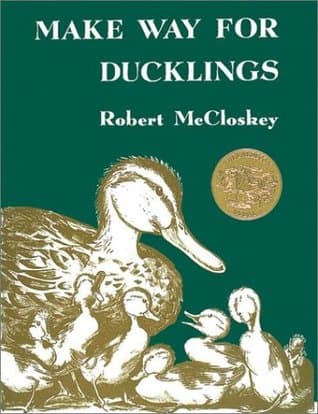
Robert McCloskey (1941)
Genre
Children's
Reading Time
15 min
Key Themes
See below
Sign in to track this book
Follow Mrs. Mallard and her eight ducklings as they find a safe home in Boston's busy streets.
Mr. and Mrs. Mallard fly over New England, looking for a good place to build a nest and raise ducklings. They see different places, including Boston's busy streets, but find them too loud or unsafe. They like the Public Garden, where they get peanuts from a kind man, but decide it has too many bicycles. They choose a small island in the Charles River, which is quiet and private, away from the city noise. This is where they will lay their eggs and raise their family.
After settling on the island in the Charles River, Mrs. Mallard lays her eggs. She sits on them patiently, and soon, eight small ducklings hatch. Their names are Jack, Kack, Lack, Mack, Nack, Ouack, Pack, and Quack. Mr. and Mrs. Mallard teach their ducklings how to swim, dive, and find food. They practice these skills on their island, growing bigger and stronger under their parents' care, getting ready for their trip to the Public Garden.
When the ducklings are old enough and can swim and find food, Mr. Mallard says he will explore the rest of the river. He says goodbye to Mrs. Mallard and their eight ducklings, promising to meet them later at the Public Garden. Mrs. Mallard takes care of the ducklings alone, getting them ready for their move to the Public Garden, which she thinks will be a safer home with more food.
Mrs. Mallard and her eight ducklings decide it is time to move to the Public Garden, as Mr. Mallard suggested. She leads them from their island in the Charles River to the bank. The ducklings, still small, have trouble keeping up with their mother. Their first challenge is climbing the steep bank and then crossing the busy road next to the river. This is their first time facing the dangers of the human world outside their quiet island.
As Mrs. Mallard and her ducklings try to cross a busy street, they meet Michael, a kind policeman. Seeing their problem, Michael immediately stops all the cars, blowing his whistle and waving his arms. He then gently helps Mrs. Mallard and her eight ducklings safely across the busy street. Michael is friendly and understanding. He makes sure the family can continue their trip without harm and says he will watch out for them.
After crossing the first street with Michael's help, Mrs. Mallard and her ducklings keep going toward the Public Garden. They come to several more busy streets. Michael, keeping his word, has called his fellow policemen. At each crossing, a different policeman waits, ready to stop traffic and let the duck family pass safely. This organized effort by the Boston police shows the community's care for the ducklings, making their trip a little easier.
After their long trip through Boston's streets, guided by the helpful policemen, Mrs. Mallard and her eight ducklings finally get to the Public Garden. They are tired but glad to be there. They walk through the gate and go to the quiet pond, where they can finally rest and swim peacefully. The Public Garden, with its calm water and plenty of food, is the perfect new home for the duck family.
As Mrs. Mallard and the ducklings settle into their new home in the Public Garden pond, Mr. Mallard, as he promised, flies down to join them. He lands gently on the water, happy to be with his family again. The whole Mallard family is now together, safe in the beautiful Public Garden. They spend their days swimming, diving, and enjoying the people who visit the park, living happily in their Boston home.
The Protagonist
From a cautious explorer, she becomes a brave and resourceful leader, successfully guiding her family to safety.
The Supporting
He transitions from a co-explorer to a reunion with his family, trusting in their journey.
The Supporting
They grow from helpless hatchlings to slightly more experienced ducklings, capable of navigating their new home.
The Supporting
He acts as a benevolent guardian, ensuring the ducklings' initial safe passage through the city.
The Mentioned
They collectively provide safe passage for the duck family through the urban landscape.
The Mentioned
His actions provide an early positive impression of the Public Garden for the ducks.
The main idea is Mrs. Mallard's strong love and protection of her eight ducklings. Every choice she makes, from picking a nest spot to leading them through the city, comes from her wish to keep her children safe. Her patience in teaching them to swim and dive, and her bravery in facing traffic, show how much a parent will do for their young. Her careful actions and the ducklings' complete trust in her clearly show this theme.
“"Mrs. Mallard had to be careful, for she was all alone with eight ducklings, and she didn't want to lose one."”
The book shows the unexpected kindness and helpfulness in a busy city. The policemen, especially Michael, help the duck family stay safe by stopping traffic and working with others. This shows that even in a big city, people will help others, no matter who they are. The people in the Public Garden who feed the ducks also support this idea of humans and animals living together peacefully.
“"Michael was a big, good-natured policeman, and he loved animals. 'Quack!' said Mrs. Mallard, 'Quack, quack, quack!' 'All right, Mrs. Mallard,' said Michael, 'you just wait right here and I'll stop the traffic for you.'"”
The story looks at how the ducks' wild nature meets the city's man-made world. The Mallards first look for a natural, quiet place but find a good middle ground in the Public Garden, a city park. The journey shows the dangers of city things (cars, bikes) but also how humans can live alongside nature, making places where animals can do well. It's about balancing wild freedom and city life.
“"This is no place for ducklings, with all those bikes and things."”
A main idea is the search for a good home. Mr. and Mrs. Mallard carefully check many places before choosing the island. Then Mrs. Mallard takes a determined trip to reach the Public Garden, which becomes their perfect, lasting home. 'Home' is not just about shelter; it is about safety, community, and a place where the family can grow and feel secure. Their reunion and peaceful life in the Public Garden mean they found what they were looking for.
“"This is a fine place to live, thought Mrs. Mallard, and she led her ducklings into the water."”
Giving human characteristics to animal characters.
The ducks are given human-like thoughts, concerns, and decision-making abilities. Mrs. Mallard 'thinks' about the safety of locations, 'decides' to move, and 'leads' her family with a clear purpose, much like a human mother. This device allows young readers to connect with the characters on an emotional level and understand their motivations, making the story's themes of parental love and perseverance more accessible and relatable despite the animal protagonists.
The plot is structured around a physical journey to a specific destination.
The entire second half of the book is a clear quest narrative, with Mrs. Mallard leading her ducklings on a perilous journey from their nesting island to the Public Garden. The goal is clear, the obstacles (traffic, busy streets) are distinct, and the helpers (policemen) appear at crucial moments. This structure provides a strong sense of progression, suspense, and resolution, making the story engaging as readers follow the family's determined path towards their new home.
The use of rhyming names for the ducklings.
The names of the eight ducklings (Jack, Kack, Lack, Mack, Nack, Ouack, Pack, and Quack) are a memorable and charming example of repetition and simple rhyme. This device makes the many ducklings easy for young children to remember and distinguish, even if only by sound. It adds a playful and musical quality to the text, reinforcing the book's appeal as a read-aloud story and contributing to its gentle, rhythmic flow.
The use of detailed illustrations to convey narrative and emotion.
McCloskey's iconic, sepia-toned illustrations are integral to the storytelling, often conveying as much information and emotion as the text itself. The detailed drawings of Boston landmarks, the expressions on the ducks' faces, and the dynamic scenes of traffic being stopped all contribute significantly to the narrative. The visuals are not merely decorative but actively advance the plot, establish setting, and highlight character emotions, making it a classic example of a picture book where images and text are inseparable.
“Mr. and Mrs. Mallard were looking for a place to live.”
— Opening line introducing the duck couple's search for a home.
“But every time Mr. Mallard saw what looked like a nice place, Mrs. Mallard said it was no good.”
— Mrs. Mallard's cautious nature during their house-hunting.
“There were certain to be foxes in the woods or turtles in the water, and she was not going to raise a family where there might be foxes or turtles.”
— Mrs. Mallard explaining her safety concerns for their future ducklings.
“So they flew on and on.”
— Describing their continued journey to find a suitable home.
“They looked for a place in the country, but they did not like it.”
— Their initial dissatisfaction with rural areas.
“They looked for a place in the town, but they did not like that either.”
— Their dissatisfaction with urban areas as well.
“They looked for a place in the city, and they liked that.”
— Finding their preferred location in Boston.
“So they chose to live in the Public Garden because there was a nice pond with a little island on it.”
— The ducks deciding on their home in Boston's Public Garden.
“The island was just right for ducks because it was away from foxes and turtles and it was away from people.”
— Explaining why the island in the pond is a safe haven.
“So they built a nest and Mrs. Mallard laid eight eggs in it.”
— The beginning of their family with the ducklings.
“Then she sat on the eggs to keep them warm.”
— Mrs. Mallard caring for the eggs before they hatch.
“She sat on the eggs and sat on the eggs.”
— Emphasizing her dedication and patience during incubation.
“At last the eggs hatched.”
— The joyful moment when the ducklings are born.
“One duckling was named Jack, another Kack, another Lack, another Mack, another Nack, another Ouack, another Pack, and another Quack.”
— Introducing the eight ducklings with rhyming names.
“Mr. and Mrs. Mallard were bursting with pride.”
— The parents' pride in their new ducklings.
Ready to see how well you understood this book? Take our interactive quiz with 10 questions.

Biography coming soon.

Dan Gemeinhart
4.5
Kate O'Hearn
4.4

Jeanne Birdsall
4.4

Jen Wang
4.4
Wendelin Van Draanen
4.3

John Marsden
4.3

Chris Van Allsburg
4.3
Jennifer A. Nielsen
4.2