“A good detective story is a puzzle, and the reader should be able to solve it if they're clever enough.”
— Alan Conway discussing his writing philosophy in his novel within the novel.

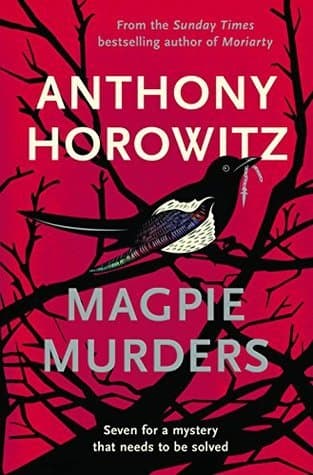
Anthony Horowitz (2016)
Genre
Thriller / Mystery
Reading Time
450 min
Key Themes
See below
Sign in to track this book
An editor reads a beloved author's manuscript and finds a real murder mystery hidden in the fictional tale of a sleepy English village.
Susan Ryeland, a senior editor at Cloverleaf Books, receives the manuscript for Alan Conway's latest Atticus Pünd novel, 'Magpie Murders.' She begins reading it, enjoying the classic whodunit set in the fictional village of Saxby-on-Avon. The story follows the murder of Mary Blakiston, the housekeeper at Pye Hall, and Pünd's investigation into the wealthy Pye family and their associates. Susan becomes absorbed in the plot and the many suspects, from the arrogant Sir Magnus Pye to the handyman, Fraser. However, as she nears the end, she finds the last few chapters are missing, leaving the mystery unsolved. This is unusual for Alan Conway, and Susan is frustrated by the abrupt stop in the narrative.
Shortly after finding the missing chapters, Susan hears shocking news: Alan Conway has died. The police say it was suicide, that he jumped from his attic window at his home in Suffolk. Susan immediately suspects foul play. Despite Alan's difficult personality and recent problems with his publisher, she does not believe he would kill himself, especially not before finishing his anticipated novel. She also remembers a conversation with Alan where he said he wanted to stop writing Pünd novels, hinting at a new, more personal project. This difference makes her question the official verdict and the circumstances of his death.
Believing Alan was murdered and the missing chapters are important, Susan travels to Alan's country home in Suffolk. She meets his sister, Claire, and her husband, Charles Clover, the publisher of Cloverleaf Books. She also meets Alan's former housekeeper, Joy Wilkes, and his gardener, Brent. Susan searches Alan's study, library, and personal items, hoping to find the missing manuscript pages. She believes that if she finds the ending to 'Magpie Murders,' it might reveal something about Alan's real-life death, perhaps a hidden message or clue in the fictional story. Her search, however, is not successful at first.
During her investigation, Susan uncovers details about Alan Conway's life and his strained relationships. She learns he was an unpleasant man, estranged from many, including his sister, Claire, and his former lover, James Fraser. Alan had recently broken up with his partner, Lisa Maxwell, and was known for his sarcastic and often cruel remarks. Susan discovers that Alan based many of the characters in 'Magpie Murders' on people from his own life, often portraying them negatively. This makes her believe that his fictional story might reflect real-life tensions and motives, providing a possible reason for murder among those he had offended or portrayed maliciously.
As Susan rereads the available chapters of 'Magpie Murders,' she starts to notice similarities between the fictional world Alan created and his own life. The character of Sir Magnus Pye, the murder victim's employer, seems to be a caricature of Charles Clover, her boss. Other characters in the book also resemble people Alan knew. More unsettling, the method of death in one of the fictional murders, a fall from a height, is like Alan's supposed suicide. Susan suspects that Alan was not just writing a book, but perhaps leaving clues, or even directly accusing someone, through his fiction, leading her to examine every detail for a double meaning.
After more searching and a stroke of luck, Susan finds the complete manuscript of 'Magpie Murders,' including the missing final chapters. They were hidden in plain sight, disguised as part of an earlier draft. With the full text, Susan can now read the complete solution to Atticus Pünd's investigation into the murder of Mary Blakiston and the later death of Sir Magnus Pye. She reads the ending carefully, absorbing every detail of Pünd's deductions and the killer's reveal. This helps her understand the fictional murderer's motive and method, which she hopes will provide a framework for understanding Alan Conway's actual death.
In the completed 'Magpie Murders' manuscript, Atticus Pünd reveals that Mary Blakiston's killer was her own son, Robert Blakiston. Robert had been hiding an affair with Lady Pye and was blackmailing Sir Magnus. When Mary found out and threatened to expose him, Robert murdered her to silence her. He later also killed Sir Magnus Pye to prevent him from revealing his part in the blackmail plot. Pünd's investigation pieces together the clues, exposing Robert's alibis and motives. The fictional solution is a satisfying whodunit, but Susan's mind is still focused on the real-life mystery of Alan Conway.
With the full 'Magpie Murders' manuscript, Susan re-examines Alan Conway's life and death. She realizes that Alan had crafted his novel not just as a story, but as a confession and a coded message about his real-life murder. The key is that the killer in 'Magpie Murders' is Robert Blakiston, a character Alan based on his editor, Susan Ryeland, but with a twist: Robert is the son of the victim, Mary Blakiston. This means that if the book is a mirror, the real-life killer must be the 'son' of the 'victim' (Alan Conway), meaning someone who felt like a child to Alan, or was a beneficiary, and whose name could be subtly linked to Robert. Susan pieces together the clues, understanding Alan's clever deception.
Susan finally deduces that Alan Conway's killer is Charles Clover, her boss and Alan's publisher. Alan had discovered that Charles was embezzling money from Cloverleaf Books and planned to expose him, using 'Magpie Murders' as his final, damning statement. The 'Robert Blakiston' character in the book, the son of the victim, was a coded reference to Charles. Charles, desperate to prevent his exposure and financial ruin, murdered Alan by staging his suicide. He then removed the crucial final chapters of the manuscript, knowing they would incriminate him by revealing the true killer's identity and motive, disguised in the fiction. Susan confronts Charles, who confesses to the murder.
Following Susan's confrontation and the police investigation, Charles Clover is arrested for Alan Conway's murder. The evidence, gathered by Susan and supported by the coded clues in 'Magpie Murders,' proves his guilt. With the mystery solved and justice served, Susan thinks about her experiences. The intense journey of solving the real-life murder, intertwined with the fictional one, makes her re-evaluate her career. She realizes her true passion is writing, not editing. Susan decides to leave Cloverleaf Books and pursue her ambition of becoming a full-time writer, having found her own voice and purpose through the ordeal.
The Protagonist
Susan transforms from a cynical editor to a confident amateur detective and ultimately decides to pursue her own writing career, finding her true calling.
The Victim/Antagonist (in a meta-sense)
His character arc is presented posthumously, revealing his bitterness and his final, ingenious act of revenge and truth-telling through his novel.
The Fictional Protagonist
Pünd's arc is confined to the fictional narrative, where he solves his final case with his usual brilliance despite his declining health.
The Antagonist
His arc reveals his descent from a respected publisher to a desperate murderer, ultimately being exposed by Susan.
The Supporting
She remains largely static, a victim of her brother's nature and her husband's deception.
The Supporting
His arc involves coming to terms with his past relationship with Alan and assisting Susan's investigation.
The Supporting
She remains steadfast in her loyalty to Alan, eventually coming to terms with the truth of his murder.
The Supporting
Her arc is brief, serving to provide information about Alan's final days and motives.
The Fictional Victim
Her arc is confined to being the initial victim and the catalyst for the fictional mystery.
The Fictional Victim
His arc is confined to being a prominent suspect and then a second victim in the fictional mystery.
The novel is a metafictional construct, a story within a story. Susan Ryeland reads Alan Conway's manuscript, 'Magpie Murders,' which becomes a key to solving Conway's real-life murder. Horowitz blurs the lines between fiction and reality, using Conway's novel as a coded confession and a commentary on the crime genre. The structure shows how stories can hide and reveal truth, and how authors often weave parts of their own lives and resentments into their creations, as seen with Conway basing characters on real people.
““Reading a book is a conversation between you and the author. He tells you his story and you, in return, provide the imagination.””
Susan Ryeland's journey is one of self-discovery. Initially, she is an editor, somewhat unfulfilled. Her investigation into Alan Conway's death forces her to use her analytical skills and detective instincts, revealing a hidden talent and passion. By the end, she realizes her true calling is not to edit others' stories but to write her own. This theme also appears in Alan Conway's resentment of his Atticus Pünd persona, suggesting he felt trapped by a fictional identity he created.
““I'd spent my entire working life helping other people tell their stories. Maybe it was time to start telling my own.””
Deception is central to both the fictional 'Magpie Murders' and the real-life murder of Alan Conway. In Conway's novel, characters hide secrets, commit adultery, and engage in blackmail, leading to murder. In the real world, Charles Clover deceives everyone, including his wife and colleagues, through embezzlement and then by staging Alan's suicide. Alan Conway himself uses deception, crafting his novel as a clever, coded accusation. The entire narrative is built on layers of hidden truths and betrayals, both personal and professional.
““Everyone has secrets. Everyone tells lies. Even to themselves.””
The book explores good and evil, particularly through Alan Conway. Despite being the victim, Conway is portrayed as an unpleasant, vindictive man who used his writing to cause pain. This challenges the reader's sympathy for him and shows that victims are not always morally pure. Conversely, the killer, Charles Clover, initially seems respectable. The novel suggests that evil can be found in unexpected places and that motives for violence often stem from greed and self-preservation.
““There is no such thing as a perfect crime. There is no such thing as a perfect victim either.””
Horowitz pays tribute to classic British Golden Age mysteries, like Agatha Christie, through the Atticus Pünd narrative. 'Magpie Murders' within the book features a secluded village, a country house, multiple suspects with secrets, and a detective. However, the novel also changes these tropes by having the 'real' mystery unfold outside the fictional one, using the classic framework for a modern, meta-narrative. It celebrates and deconstructs the genre, showing how its conventions can be used in new ways.
““It was all there: the victim, the suspects, the clues, the red herrings, the secrets hidden behind the lace curtains of an English village.””
The primary structural device, embedding a fictional mystery within a real-world one.
The novel's most prominent plot device is its nested narrative structure. The main story follows Susan Ryeland investigating the death of author Alan Conway. Within this, the reader is presented with Conway's complete manuscript, 'Magpie Murders,' a classic whodunit featuring detective Atticus Pünd. The fictional narrative is not merely a subplot; it is integral to solving the real-life murder, as Conway deliberately encoded clues and accusations within his final work. This structure allows Horowitz to comment on the genre while simultaneously constructing a complex, multi-layered mystery.
Misleading clues and suspects designed to divert the reader and Susan's attention.
Horowitz masterfully employs red herrings in both layers of the narrative. In 'Magpie Murders,' Pünd encounters numerous suspects with plausible motives and secrets, leading the reader down several false paths before the true killer is revealed. Similarly, in the real-world investigation, Susan initially suspects various individuals connected to Alan Conway, such as James Fraser or Lisa Maxwell, due to their grievances or proximity. These diversions serve to heighten suspense and challenge the reader's deductive abilities, mirroring the classic mystery tradition while also complicating Susan's own investigation.
Alan Conway's manuscript as a deliberately misleading yet truthful source.
Alan Conway, as the author of 'Magpie Murders,' functions as a posthumous unreliable narrator. While his fictional story provides the literal solution to the fictional crime, it also contains coded, misleading, yet ultimately truthful clues about his own murder. Conway's difficult personality and his tendency to base characters on real people, often in unflattering ways, make his 'testament' complex. Susan must discern which elements are literal, which are metaphorical, and which are deliberate misdirections designed to expose his killer, making the author himself a puzzle.
The deliberate echoing of plot points, characters, and themes between the two narratives.
Mirroring is a crucial device, as events and characters in Alan Conway's 'Magpie Murders' directly parallel or comment upon the real-life circumstances surrounding his death. For instance, a fall from a height in the fictional story reflects Alan's 'suicide.' Fictional characters like Sir Magnus Pye are thinly veiled versions of real-life individuals like Charles Clover. This parallelism forces Susan (and the reader) to constantly compare and contrast the two narratives, searching for the symbolic connections that unlock the truth about Conway's murder and the identity of his killer, who is disguised within the fictional solution.
A physical plot device that drives Susan's initial investigation.
The initial absence of the final chapters of 'Magpie Murders' serves as a critical plot device. It not only creates immediate suspense and frustration for Susan but also acts as the primary catalyst for her investigation into Alan Conway's death. The missing pages strongly suggest foul play, as a meticulous author like Conway would not leave his work unfinished, particularly if he intended it as a final statement. The search for these pages propels Susan's journey, leading her to Alan's home and into the heart of the real-life mystery, making their eventual discovery a pivotal moment.
“A good detective story is a puzzle, and the reader should be able to solve it if they're clever enough.”
— Alan Conway discussing his writing philosophy in his novel within the novel.
“The truth is like a magpie. It collects shiny things, but you have to look past the glitter to see what's really there.”
— Susan Ryeland reflecting on the nature of truth in the investigation.
“In a village, everyone knows everyone else's business, but nobody knows the truth.”
— Observation about the setting of Saxby-on-Avon in Conway's manuscript.
“A murder is not just a crime. It's a story, and every story has a beginning, a middle, and an end.”
— Atticus Pünd's thoughts on the structure of a murder investigation.
“The past is never dead. It's not even past.”
— A line from Conway's manuscript, echoing Faulkner, about unresolved history.
“You can't judge a book by its cover, but you can certainly judge a person by the books they read.”
— Susan musing on clues from a character's library.
“Sometimes the most obvious suspect is the right one, but it's the journey that makes it interesting.”
— Atticus Pünd explaining his investigative approach.
“A secret is only a secret if no one knows it exists.”
— Reflection on hidden motives in the village community.
“The pen is mightier than the sword, but in a murder mystery, it can be just as deadly.”
— Comment on the power of writing and authorship in the plot.
“Every character has a motive, but not every motive leads to murder.”
— Atticus Pünd analyzing suspects in the case.
“In the end, it's not about who did it, but why they did it.”
— Susan summarizing the deeper themes of the mystery.
“A missing chapter is like a missing piece of a jigsaw puzzle. Without it, the picture is incomplete.”
— Susan discovering the importance of the lost manuscript pages.
“The village is a character in itself, with its own secrets and lies.”
— Description of Saxby-on-Avon's role in the story.
“Truth is often stranger than fiction, but in a detective story, they have to be one and the same.”
— Reflection on the blending of reality and narrative in the book.
Ready to see how well you understood this book? Take our interactive quiz with 10 questions.

Anthony Horowitz is a prolific British author known for his engaging mystery and thriller novels. He is the creator of the bestselling Sherlock Holmes novels, including 'The House of Silk' and 'Moriarty,' as well as the acclaimed 'Hawthorne and Horowitz' series, featuring 'The Word is Murder' and 'The Sentence is Death.' Horowitz also penned the Alex Rider series for young adults, which has sold over 19 million copies worldwide.







