“I was a child who was always waiting for something to happen. I was waiting for my life to begin.”
— Baby reflects on her sense of anticipation and longing for change.

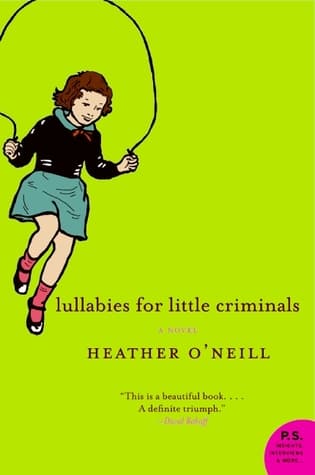
Heather O'Neill (2006)
Genre
Literary Fiction / Young Adult
Reading Time
360 min
Key Themes
See below
Sign in to track this book
Thirteen-year-old Baby navigates the perilous, drug-addled streets of Montreal, clinging to doll-filled suitcases and her own vivid imagination, as she fends off a charismatic pimp and her neglectful father in a desperate search for belonging and self-preservation.
Baby, a thirteen-year-old girl, lives with her father, Jules, in a series of rundown hotels and rooming houses across Montreal. Jules is a heroin addict who often prioritizes his next fix over his daughter's well-being, though he possesses a certain charm and a knack for storytelling. Baby is motherless and has little stability, frequently missing school and learning to fend for herself in the city's grittier neighborhoods. She carries a suitcase with her dolls and treasures, a symbol of her clinging to childhood amidst a prematurely adult existence. Their life is a cycle of Jules getting money, using it on drugs, and then moving to a new, equally squalid place, always just on the edge of homelessness and danger.
While Jules is away on one of his drug-related errands, Baby meets Alphonse, a charismatic but dangerous pimp who operates in their neighborhood. Alphonse is initially kind and attentive to Baby, offering her food and a place to stay when Jules is absent. She is drawn into his orbit and meets the other 'girls' who live under his control, including the hardened but protective Wendy and the younger, more innocent Rosie. These girls, despite their difficult circumstances, provide Baby with a semblance of a social group and a sense of belonging she rarely experiences with her father. She begins to spend more time with them, slowly becoming desensitized to their lifestyle.
Due to Jules's continued neglect and the intervention of social services, Baby is eventually placed in a children's lodge. This period marks a significant shift in her life, as she experiences regular meals, a stable bed, and attends school consistently for the first time in a long while. She forms friendships with other children at the lodge and, for a brief time, enjoys a semblance of a normal childhood. However, Baby struggles to adapt fully to the structured environment, still longing for the unpredictable freedom, and complicated affection, of her father. She also carries the secrets of her life on the streets, making it difficult to fully connect with her new peers.
Despite the stability offered by the lodge, Baby eventually leaves to return to Jules, who makes a fleeting attempt to be a better father. However, Jules quickly reverts to his old habits, and Baby finds herself back in the familiar, dangerous environment of the streets. Alphonse's influence grows stronger. He continues to shower her with attention and gifts, slowly grooming her and subtly pushing her towards prostitution. Baby, craving affection and a sense of family, becomes increasingly entangled in his web, seeing him as a protector and provider, even as the true nature of his intentions becomes clearer to the reader.
As Baby spends more time with Alphonse and his girls, she witnesses the darker aspects of their lives: the violence, the drug use, and the constant fear. She sees how the girls are exploited and abused, and the innocence she still possesses begins to erode. Alphonse's manipulation intensifies, as he isolates her from Jules and others, making her increasingly dependent on him. He pressures her to dress more provocatively and to participate in his illicit activities, blurring the lines between childhood and the harsh adult world he inhabits. Jules, in his drug-addled state, is largely oblivious or unable to protect her from the escalating danger.
Wendy, one of Alphonse's older girls, attempts to run away, seeking to escape his control. Her escape is short-lived, as Alphonse brutally punishes her, making an example of her to the other girls. This event deeply traumatizes Baby, showing her the severe consequences of defiance and solidifying her fear of Alphonse. She feels more trapped than ever, realizing the grim reality of her situation and the limited options available to her. The incident crushes any lingering hope she had of a simple escape and highlights the pervasive power Alphonse holds over their lives, forcing Baby to confront the bleakness of her future.
In a desperate, drug-fueled attempt to protect Baby from Alphonse's clutches, Jules takes her away from Montreal to a secluded cabin in the countryside. This brief period offers Baby a temporary respite from the dangers of the city and Alphonse's influence. It's a rare moment of paternal care from Jules, where he tries to reconnect with her and shield her from harm. However, the isolation and lack of drugs soon take their toll on Jules, and his resolve weakens. Baby, despite the peace, feels a lingering unease, knowing this escape is likely temporary and that the city's dangers still loom.
Jules's heroin addiction proves too strong to overcome in the isolation of the countryside. He becomes restless and desperate for a fix, ultimately forcing them to return to Montreal. Upon their return, Baby is immediately drawn back into Alphonse's orbit, who has been patiently waiting. Her brief taste of freedom and Jules's protection is shattered, and she feels the full weight of her vulnerability. Alphonse's grip on her tightens further, as he exploits her dependence and her father's inability to provide a safe haven, pushing her closer to a life she fears but sees no escape from.
The manipulation and pressure from Alphonse culminate in Baby being forced into prostitution. This event is a pivotal and devastating moment in the novel, signifying the complete loss of her childhood innocence and her entry into the harsh realities of street life. Baby experiences deep trauma and despair, feeling utterly betrayed and abandoned. This act cements her status as one of Alphonse's 'girls' and leaves her with a profound sense of hopelessness. Despite the horror, Baby's inner resilience, though bruised, begins to stir, hinting at a future struggle for survival and self-preservation.
Despite the overwhelming despair, Baby begins to find small ways to assert her agency. She clings to her storytelling, her vivid imagination, and the crumbs of affection she receives from unexpected sources. She observes the world around her with a keen, if often disillusioned, eye. In a final, desperate act of self-preservation, Baby makes a choice that allows her to break free from Alphonse's control. This act is not without its own moral complexities, but it demonstrates her inner strength and her refusal to be completely consumed by the predatory world she inhabates. It is a testament to her will to survive and reclaim some semblance of her own life, however fractured.
The Protagonist
Baby transforms from a naive, dependent child into a hardened survivor who, despite profound trauma, finds the strength to reclaim her agency.
The Supporting
Jules remains largely static, unable to escape the cycle of addiction, ultimately failing to protect his daughter.
The Antagonist
Alphonse's character remains consistently predatory, serving as the relentless force of evil Baby must overcome.
The Supporting
Wendy's arc is tragic, as her attempts at rebellion are brutally suppressed, solidifying her role as a victim.
The Supporting
Rosie's arc is one of slow, silent erosion of innocence, serving as a poignant reflection of Baby's potential future.
The Mentioned
Mr. Bernard's arc is limited to his role as an external force attempting to provide care, ultimately failing to fully protect Baby.
The Supporting
The landlady remains a consistent, if minor, figure of authority and care during Baby's time at the lodge.
The Supporting
The doll's significance evolves, initially a comfort, later a poignant symbol of lost innocence as Baby faces harsher realities.
The novel charts Baby's brutal journey from a vulnerable child to a prematurely hardened young woman. Her experiences with Jules's addiction, the predatory Alphonse, and the harsh realities of street life systematically strip away her childhood. This theme is evident in her exposure to prostitution, drug use, and violence, forcing her to confront adult cruelties far too young. The image of Baby carrying her dolls while navigating dangerous streets poignantly captures this central theme, highlighting the conflict between her internal desire for childhood and the external pressures demanding her maturity.
“I was thirteen, but I understood the world as if I were a hundred. I had seen everything. I had seen too much.”
Despite the relentless adversity, Baby demonstrates remarkable resilience and an innate will to survive. She adapts to her transient lifestyle, learns to read people, and develops coping mechanisms like storytelling and imagination to endure her trauma. Her ability to find 'crumbs of happiness' and her eventual act of self-preservation underscore her strength. This theme is not about escaping unscathed, but about finding the internal fortitude to persist and reclaim agency in the face of overwhelming odds, even when deeply scarred. Her survival is a testament to the human spirit's capacity for endurance.
“I was like a little weed that would grow anywhere, no matter how much you tried to stomp it down.”
The novel explores the complex and often twisted forms of love and family in Baby's life. Her relationship with Jules is characterized by a deep, albeit dysfunctional, love mixed with profound neglect. She craves his affection but suffers from his addiction. Alphonse offers a manipulative 'love' that preys on her need for belonging, creating a perverse sense of family among his exploited girls. This theme questions what constitutes love and care when basic needs are unmet and boundaries are blurred, showing how vulnerable individuals can mistake exploitation for affection when genuine love is scarce.
“He loved me like a drowning man loves air, desperately and without any thought of how he would get it.”
Jules's heroin addiction is a central driving force in the narrative, directly shaping Baby's transient and dangerous life. The theme explores not only the addict's struggle but, more importantly, the devastating ripple effect on those around them, particularly children. Jules's addiction dictates their living conditions, his ability to protect Baby, and his overall reliability as a parent. It illustrates how addiction can warp a parent's priorities, rendering them incapable of providing the stability and care their child desperately needs, thus perpetuating a cycle of instability and vulnerability for Baby.
“Jules was like a cloud that moved through the city, always changing shape, always drifting, never quite settling.”
Baby uses her vivid imagination and gift for storytelling as a crucial coping mechanism and a means of escape from her harsh reality. She creates elaborate fantasies and narratives, both for herself and for Jules, to make sense of her world or to simply survive it. These stories allow her to process trauma, maintain a sense of self, and inject beauty or meaning into an otherwise bleak existence. This theme highlights the power of the human mind to find refuge and preserve its integrity through creativity, even when external circumstances are unbearable.
“I made up stories in my head, stories where I was a princess or a queen, or a girl who lived in a house with a garden and a dog.”
Allows intimate access to Baby's thoughts and experiences, filtered through her innocent yet knowing eyes.
The novel is told entirely from Baby's perspective, providing an intimate and often heartbreaking view of her world. This device allows the reader to experience events through her unique lens – a blend of childlike innocence, vivid imagination, and premature understanding of adult cruelties. The language reflects her age and limited vocabulary, yet conveys profound emotional depth. This perspective creates empathy, making the reader a direct witness to her trauma and resilience, while also highlighting the unreliable nature of a child's understanding of complex adult situations.
Represents Baby's clinging to childhood and lost innocence.
Baby's vinyl suitcase, containing her dolls and cherished trinkets, serves as a powerful symbol throughout the novel. The dolls represent her lingering childhood innocence, her desire for comfort, and her attempts to maintain a semblance of normalcy amidst chaos. The suitcase itself symbolizes her transient life, always packed and ready to move, yet also holding the precious fragments of her identity. As her innocence is eroded, the doll becomes a poignant reminder of what she is losing, a silent witness to her trauma.
Hints at impending danger and the gradual erosion of Baby's innocence.
The novel employs subtle foreshadowing to build tension and indicate the escalating dangers Baby faces, particularly from Alphonse. Early descriptions of Alphonse's charm, the 'girls' living with him, and Baby's growing fascination with their world, all hint at her impending exploitation. These hints are often filtered through Baby's innocent perspective, where she misinterprets the danger or sees it as a form of care. This technique creates a sense of dread for the reader, who can often see the peril before Baby fully grasps its implications, making her eventual trauma all the more devastating.
The city's gritty streets and hotels reflect Baby's chaotic and dangerous inner world.
The city of Montreal, particularly its rundown hotels, seedy streets, and neglected neighborhoods, functions almost as a character in itself. It is a harsh, unforgiving landscape that mirrors Baby's internal state and external circumstances. The transient nature of their living situations, the constant movement between squalid rooms, and the ever-present threat of the streets contribute to Baby's instability and vulnerability. The setting is not merely a backdrop but an active force shaping her experiences and limiting her options, becoming synonymous with her struggle for survival.
“I was a child who was always waiting for something to happen. I was waiting for my life to begin.”
— Baby reflects on her sense of anticipation and longing for change.
“My father was a junkie, and that meant that he was the king of the world and I was his princess.”
— Baby describes her complex relationship with her heroin-addicted father, Jules.
“I was like a little animal that had been raised in a cage and then let out into the world.”
— Baby feels unprepared and vulnerable navigating life on her own.
“The world is a terrible place, and the only way to survive is to be terrible too.”
— Baby learns harsh lessons from her experiences in Montreal's underbelly.
“I wanted to be a good girl, but I didn't know how.”
— Baby struggles with her moral compass amid difficult circumstances.
“Love is a strange thing. It makes you do things you never thought you would.”
— Baby reflects on how love influences her actions and decisions.
“Sometimes I felt like I was made of glass and everyone could see right through me.”
— Baby expresses her feelings of transparency and vulnerability.
“I had a map of the world in my head, but all the roads led to nowhere.”
— Baby feels lost and directionless in her life.
“The sky was the color of a dirty dishrag, and I felt like I was the dirt on it.”
— Baby uses vivid imagery to describe her bleak outlook and self-perception.
“I was a criminal because I was born into a world that didn't want me.”
— Baby rationalizes her circumstances and sense of alienation.
“My heart was a little bird that kept trying to fly away, but it didn't know where to go.”
— Baby metaphorically describes her restless and searching nature.
“I learned that the only thing worse than being alone is being with someone who makes you feel alone.”
— Baby reflects on her experiences with relationships and loneliness.
“I was a story that nobody wanted to read, but I kept writing myself anyway.”
— Baby asserts her resilience and determination to define her own narrative.
“The city was a monster that ate little girls like me for breakfast.”
— Baby personifies Montreal as a threatening force in her life.
Ready to see how well you understood this book? Take our interactive quiz with 10 questions.

Biography coming soon.







