“To conquer fear, you must become fear.”
— Spoken by the bear, Bear, to Luka early in his journey.

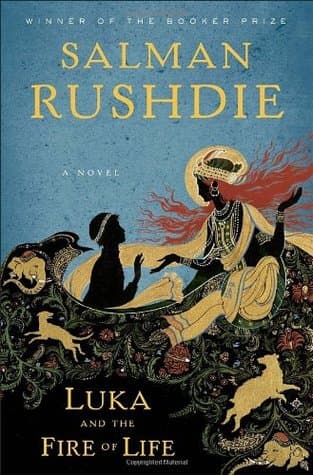
Salman Rushdie (2010)
Genre
Fantasy / Children's / Young Adult
Reading Time
240 min
Key Themes
See below
Sign in to track this book
To save his legendary storyteller father from an unending sleep, young Luka embarks on a perilous quest through a whimsical, wordplay-filled Magic World to steal the ever-burning Fire of Life from the mischievous Badly Behaved Gods.
Ten-year-old Luka, the younger son of the storyteller Rashid Khalifa, lives a seemingly ordinary life in the city of Kahani. His father, known as the Shah of Blah, is renowned for his captivating tales. One day, however, Rashid suddenly falls into an unnatural sleep, from which no doctor or cure can rouse him. The family is devastated, and the doctors declare that Rashid is rapidly losing his 'life-force' and will soon fade away completely. Luka, heartbroken and desperate, overhears a mysterious voice emanating from his father's room, hinting at a solution in the 'Magic World' – a place of stories and myths.
The mysterious voice, revealed to be a talking bear named Bear and a dog named Dog, explains to Luka the true nature of his father's predicament. Rashid, in his storytelling journeys, had visited the Magic World and, in a moment of hubris, stolen the 'Fire of Life' – a vital energy source for storytellers. Now, the Fire is depleting, causing Rashid's life-force to ebb away. To save his father, Luka must embark on a perilous quest into the Magic World, a realm where stories become reality, and steal back the Fire of Life before it's too late. He is warned that he only has a limited number of 'Lives' for his journey.
Luka, armed with his father's old, dusty game console and the guidance of Bear and Dog, enters the Magic World through a portal. This world is a fantastical land where the rules of reality are fluid. His first encounter is with a magical flying carpet named 'The Flying Carpet of Averroes,' which becomes his primary mode of transport. Bear and Dog, revealed to be projections of his father's storytelling companions, provide counsel and comic relief. They encounter the first of many strange creatures and challenges, establishing the adventurous tone of Luka's quest and the unique physics of the Magic World.
Luka, Bear, Dog, and the Flying Carpet arrive in the labyrinthine City of If, a place where possibilities and hypotheticals take physical form. The city is full of 'Ifs' and 'Buts' that can lead to endless diversions. Here, they seek the guidance of the Old Man of the Sea, a powerful and ancient figure known for his wisdom. The Old Man, after testing Luka's resolve and understanding of the Magic World, provides crucial information about the path to the Fire of Life, warning him of the dangers ahead, particularly the land of the Badly Behaved Gods.
The journey leads Luka and his companions into the Land of the Badly Behaved Gods, a chaotic and unpredictable realm ruled by deities who are powerful, but also childish, vain, and prone to mischief. They encounter various gods, each with their own peculiar demands and challenges. Luka must use his wit and courage to outsmart them, often by appealing to their vanity or exploiting their squabbles. This section highlights the arbitrary nature of power and the importance of cleverness over brute force in the Magic World, as Luka gradually loses some of his precious 'Lives' in these encounters.
To reach the ultimate destination, Luka must cross the River of Time, a flowing body of water where past, present, and future mingle. The river is treacherous, filled with currents that can sweep one into different eras or possibilities. They also encounter the Bridge of Sighs, a place of melancholy where lost opportunities and regrets reside. Luka must confront his own fears and the potential for loss, understanding the gravity of his quest and the preciousness of time, before continuing his journey towards the Fire of Life, now with fewer 'Lives' remaining.
After many trials, Luka and his dwindling 'Lives' finally arrive at the grand Palace of the Fire of Life. The palace is heavily guarded by powerful entities, including a fearsome dragon and other mythical creatures, all designed to protect the Fire from being stolen. Luka realizes that brute force is not the answer and must rely on his intelligence, the unique abilities of his companions, and the lessons learned throughout his journey to bypass these guardians and reach the heart of the palace where the Fire of Life burns.
Inside the Palace, Luka confronts the ultimate guardian of the Fire of Life, a powerful and ancient being. This guardian reveals the true nature of the Fire: it is not merely an energy source, but the very essence of storytelling, imagination, and the spark of creation. The guardian challenges Luka to prove his worthiness, not through battle, but through understanding and demonstrating his own capacity for imagination and love. Luka, now down to his last few 'Lives', must articulate why he deserves to take the Fire, not for himself, but for his father.
In a climactic moment, Luka realizes that merely stealing the Fire is not enough. To truly save his father, he must make a sacrifice. He understands that his father's life-force is intertwined with the Fire, and he must become a part of it. Using his last 'Life,' Luka merges with the Fire of Life, not taking it, but becoming its conduit. This act of selfless love and imagination allows the Fire to flow back to Rashid, slowly restoring his life-force and consciousness. Luka's journey culminates in a spiritual victory, where he transcends the simple act of theft.
Luka, transformed by his experience, returns to Kahani. He finds his father, Rashid Khalifa, slowly beginning to stir from his deep sleep. As Rashid awakens, he is not only restored but also imbued with a renewed sense of wonder and storytelling. The experience has changed both father and son. Luka, having faced mortality and the power of creation, is no longer just a boy but a hero in his own right, forever connected to the Magic World and the Fire of Life. The family is reunited, and Rashid's storytelling takes on a new depth.
The Protagonist
Luka transforms from an ordinary boy into a courageous hero, learning about the power of stories, sacrifice, and the true meaning of life and death.
The Supporting
Starts in a death-like sleep, is slowly restored by Luka's efforts, and awakens with a renewed appreciation for life and storytelling.
The Supporting
Remains a steadfast guide, reinforcing Luka's courage and providing necessary information and support throughout the journey.
The Supporting
Serves as a consistent source of loyalty and humor, his character remaining largely stable while supporting Luka's growth.
The Supporting
Remains a reliable and supportive companion, demonstrating its loyalty and utility throughout the adventure.
The Supporting
Serves as a pivotal mentor figure, providing exposition and guidance at a critical juncture in Luka's quest.
The Antagonists/Supporting
Serve as a series of episodic challenges that test Luka's cleverness and resilience, collectively representing a significant hurdle.
The Antagonist/Supporting
Serves as the ultimate philosophical and emotional challenge, forcing Luka to understand the true meaning of his quest.
The Mentioned
Not present in the story, but his past adventures provide a backdrop for Luka's own journey.
The entire narrative is steeped in the idea that stories create and sustain worlds. The Magic World itself is a manifestation of stories, and the Fire of Life is explicitly linked to the spark of imagination. Rashid's storytelling is his life-force, and Luka's ability to navigate the Magic World often depends on his own imaginative problem-solving and understanding of narrative logic. The book suggests that imagination is not merely escapism but a vital force that shapes reality and sustains life. For example, Bear and Dog are literally brought to life from Rashid's tales.
““The greatest gift we have is the ability to imagine things as they are not.””
Luka's entire quest is driven by his love for his father, Rashid. He willingly faces dangers and makes personal sacrifices, including risking his own 'Lives,' to save his father from fading away. This theme explores the depth of the parent-child bond and the selfless acts it can inspire. Luka's ultimate act of merging with the Fire of Life to become its conduit for his father is the pinnacle of this theme, demonstrating that true love involves giving of oneself.
““Love, like a story, is a thing that must be made, and remade, every day.””
The central conflict revolves around Rashid's fading life-force, directly addressing themes of death and the fragility of life. Luka's journey through the Magic World, particularly his encounters with the River of Time and the concept of 'Lives,' forces him to confront mortality. The Fire of Life itself is a symbol of life's preciousness and its connection to creativity. The story ultimately offers a hopeful perspective, suggesting that while individual lives may end, the essence of life, creativity, and love can be sustained and renewed through connection and sacrifice.
““To live is to lose Lives, but to live well is to gain meaning.””
Luka embarks on a classic hero's journey, leaving his ordinary world to enter a magical one, facing trials, gaining allies, and undergoing a transformation. Initially feeling ordinary, Luka discovers his own courage, resourcefulness, and strengths throughout his quest. His journey is not just about saving his father, but also about understanding his place in the world and realizing his own potential. He grows from a boy into a hero, not by becoming someone else, but by embracing who he truly is.
““Every story is also the story of the one who tells it, and the one who hears it.””
A fantastical realm where stories and imagination manifest as reality.
The Magic World serves as the primary setting for Luka's quest. It is a highly imaginative and surreal landscape where the laws of physics are fluid, and mythical creatures, talking animals, and personified concepts (like 'Ifs' and 'Buts') exist. This device allows for endless creative possibilities and provides the challenging, unpredictable environment necessary for Luka's growth. It is where the abstract power of storytelling becomes tangible, making the stakes of Rashid's fading life-force all the more real.
A mystical energy source representing life, creativity, and storytelling.
The Fire of Life is the MacGuffin of the story, the object Luka must retrieve to save his father. However, it is more than just a plot driver; it is a symbolic representation of the essence of life itself, intertwined with imagination and the creative spark of storytelling. Its depletion directly causes Rashid's illness, and its ultimate restoration through Luka's sacrifice signifies the renewal of life and the enduring power of narrative. It gives the quest a profound, metaphorical layer beyond simple recovery.
A finite number of chances Luka has in the Magic World, represented by a video game mechanic.
Luka is granted a limited number of 'Lives' for his journey, much like in a video game. This device serves multiple functions: it creates immediate tension and stakes for every challenge Luka faces, forcing him to be careful and strategic. It also metaphorically represents the fragility of life and the consequences of actions, grounding the fantastical journey with a tangible sense of risk and loss. Losing a 'Life' is a real setback, emphasizing the gravity of his quest and the preciousness of his own existence.
Giving human characteristics and sentience to inanimate objects and abstract concepts.
This device is pervasive throughout the Magic World. From talking animals (Bear, Dog) and a sentient flying carpet (Averroes) to the personified 'Ifs' and 'Buts' in the City of If, and even the 'Badly Behaved Gods' who act with very human flaws, personification brings the abstract to life. It enriches the fantastical setting, provides comedic elements, and allows for deeper thematic exploration by giving voice to elements that might otherwise be passive backdrop. It makes the Magic World feel truly alive and interactive.
“To conquer fear, you must become fear.”
— Spoken by the bear, Bear, to Luka early in his journey.
“The world is full of stories, and some of them are true.”
— A recurring theme about the nature of stories and reality.
“Every journey begins with a single step, but sometimes that step is into a void.”
— Luka's realization as he embarks on his quest.
“Even the smallest light can banish the greatest darkness, if it shines with enough conviction.”
— A lesson Luka learns about hope and determination.
“Time is not a river, it's a sea. And we are all just tiny boats upon it.”
— A philosophical musing on the nature of time.
“Sometimes the only way to save someone is to leave them.”
— A difficult choice Luka faces during his adventure.
“Magic is just science we don't understand yet.”
— A practical view on the wonders encountered in the world.
“The greatest treasure is not what you find, but who you become in the finding.”
— Luka's ultimate realization about the purpose of his quest.
“Words are powerful. They can build worlds, or burn them down.”
— A reflection on the impact of language.
“Never underestimate the power of a good story to change things.”
— A testament to the transformative power of narrative.
“Laughter is the shortest distance between two people.”
— A simple observation about connection and joy.
“To be truly alive, you must embrace the possibility of dying.”
— A lesson about living fully and accepting mortality.
“The world doesn't owe you anything, but you owe the world your best.”
— A challenging but inspiring piece of advice.
“Even heroes get scared. The trick is to do it anyway.”
— A realistic view on bravery and heroism.
Ready to see how well you understood this book? Take our interactive quiz with 10 questions.

Sir Ahmed Salman Rushdie is an Indian-born British-American novelist. His work often combines magic realism with historical fiction and primarily deals with connections, disruptions, and migrations between Eastern and Western civilizations, typically set on the Indian subcontinent. Rushdie's second novel, Midnight's Children (1981), won the Booker Prize in 1981 and was deemed to be "the best novel of all winners" on two occasions, marking the 25th and the 40th anniversary of the prize.







